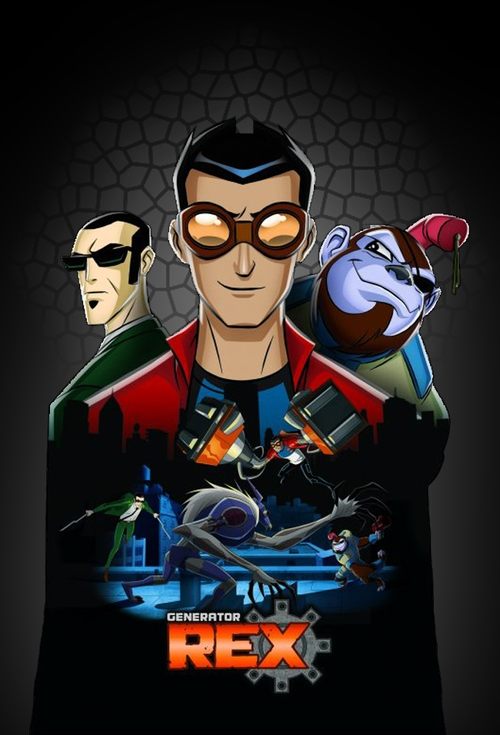
Generator Rex
A high-octane sci-fi symphony of teenage angst and bio-mechanical fury, painting a world where humanity's cure becomes its own monstrous cage.
Generator Rex

Generator Rex

23 April 2010 — 27 December 2012 United States of America 3 season 59 episode Ended ⭐ 8.5 (394)
Cast: Daryl Sabara, Troy Baker, Grey DeLisle, Fred Savage, Wally Kurth
Animation Action & Adventure Family Kids
Identity and Amnesia Man vs. Machine / Transhumanism Control vs. Freedom Found Family

Overview

"Generator Rex" is set in a world radically altered by a global catastrophe known as the "Nanite Event." Five years prior, a massive explosion unleashed microscopic machines called nanites into the atmosphere, infecting every living being on Earth. These nanites can randomly activate, transforming their hosts into monstrous creatures called E.V.O.s (Exponentially Variegated Organisms). To combat this threat, a global organization named Providence was formed to contain and, if possible, cure the E.V.O.s.

The series centers on Rex Salazar, a fifteen-year-old amnesiac with a unique and powerful connection to the nanites. Unlike other E.V.O.s, Rex can control his nanites, allowing him to grow incredible bio-mechanical weapons and vehicles from his own body. More importantly, he possesses the rare ability to communicate with and deactivate the nanites in other E.V.O.s, effectively curing them. Working as Providence's secret weapon, Rex battles dangerous E.V.O.s alongside his partners: the stoic, sword-wielding Agent Six, the brilliant Dr. Rebecca Holiday, and his wisecracking E.V.O. chimpanzee sidekick, Bobo Haha. Throughout the series, Rex not only confronts weekly monster threats but also delves into the mystery of his own past, the truth behind the Nanite Event, and his connection to the enigmatic and dangerous E.V.O. scientist, Van Kleiss.

Core Meaning

At its core, "Generator Rex" explores the themes of identity, control, and what it means to be human in a world saturated with technology. The series posits that the very thing that can destroy humanity—the nanites—is also the key to its salvation, embodied in Rex himself. It delves into the struggle of a young man trying to forge his own identity while being treated as both a weapon and a cure. Rex's journey is a powerful allegory for adolescence: grappling with a body that feels alien and uncontrollable, searching for a past to define his future, and learning to accept the monstrous parts of himself to become a hero. The show ultimately argues for a symbiotic relationship with technology, suggesting that true progress lies not in eradicating what we fear, but in understanding and controlling it with empathy and responsibility.

Thematic DNA

Identity and Amnesia 35%
Man vs. Machine / Transhumanism 30%
Control vs. Freedom 20%
Found Family 15%

Identity and Amnesia

Rex's amnesia is the central mystery of the series. He has no memory of his life before Providence, which fuels his personal journey across all three seasons. This theme is explored as he encounters figures from his past, like his old gang of E.V.O.s, who reveal a version of himself he doesn't recognize—a more selfish and reckless person. His arc is not about simply regaining memories, but about deciding who he wants to be now, independent of his past actions. The show cleverly treats amnesia not as a plot device to be solved, but as the foundation of his character, forcing him to build his identity from scratch based on his actions in the present.

Man vs. Machine / Transhumanism

The series is a deep dive into transhumanism, where every living thing is infected with nanites, blurring the line between organic and machine. The central conflict is humanity's relationship with this new reality. Villains like Van Kleiss seek to accelerate the process, believing E.V.O.s are the next stage of evolution, while organizations like Providence initially seek to control or destroy it. Rex represents the balance: a perfect synthesis of man and machine. He doesn't just fight monsters; he is a living embodiment of the potential for technology to be controlled and used for good, a direct counterpoint to the Luddite fear of scientific advancement.

Control vs. Freedom

From the very first episode, Rex chafes under the strict control of Providence and its leader, White Knight. He is their greatest asset, but he is also a teenager who craves a normal life, friends, and freedom. This theme evolves throughout the series. Initially, it's about his personal freedom, but it expands to question Providence's authoritarian methods and the ethics of controlling E.V.O.s. When the sinister Black Knight takes over, Providence's goal shifts from containment to weaponizing E.V.O.s, making the theme of control a central, darker conflict. Rex's ultimate victory is not just defeating the villains, but also establishing a new, more humane world order.

Found Family

Lacking memories of his biological family, Rex forges a new one within Providence. Agent Six evolves from a stoic handler into a protective father figure. Dr. Holiday becomes a caring, maternal presence, and even the cynical Bobo Haha acts as a loyal, if troublesome, brother. His friendship with Noah provides Rex with a crucial link to normalcy and teenage life. This found family becomes his anchor and moral compass, giving him something personal and profound to fight for beyond just "saving the world." Their interactions provide the show's emotional core, highlighting that family is defined by loyalty and love, not just blood.

Character Analysis

Rex Salazar

Daryl Sabara

Archetype: The Reluctant Hero
Key Trait: Empathetic

Motivation

Initially, Rex is motivated by a desire for personal freedom and the truth about his forgotten past. As the series progresses, his motivation shifts. He develops a deep-seated need to protect his found family (Six, Holiday, Bobo, and Noah) and a genuine, empathetic drive to cure every E.V.O. he can, seeing them not as monsters but as victims like himself. His ultimate motivation becomes creating a world where no one has to suffer from the nanite infection.

Character Arc

Rex begins the series as a cocky, impulsive teenager who, despite his immense power, feels like a prisoner of Providence. His primary goal is to uncover his past and achieve a semblance of a normal life. Across the series, he matures significantly. He learns the truth about his involvement in the Nanite Event, not as a villain, but as a tragic victim and key component. This knowledge forces him to accept responsibility on a global scale. He transitions from a reluctant weapon into a true leader, culminating in him gaining full control over all nanites on Earth to perform a worldwide cure, a decision that shows his growth from a self-interested teen to a selfless savior.

Agent Six

Wally Kurth

Archetype: The Mentor / The Stoic Guardian
Key Trait: Loyal

Motivation

Six's primary motivation is his unwavering loyalty and a deeply ingrained sense of duty. Initially, this duty is to Providence. Over time, his loyalty transfers directly to Rex and Dr. Holiday. He is driven by a past failure (revealed in the episode "Promises, Promises") to protect those he cares about, making his mission to keep Rex safe intensely personal.

Character Arc

Six starts as Rex's handler, a mysterious and seemingly emotionless agent defined by his lethal efficiency and adherence to Providence protocol. His relationship with Rex is purely professional. However, as the series unfolds, he thaws considerably, revealing a deeply protective and caring nature. He becomes a father figure to Rex, often defying his superiors, like White Knight, to protect him. His arc is about rediscovering his own humanity through his bond with Rex, moving from a simple agent to a core member of Rex's family.

Dr. Rebecca Holiday

Grey DeLisle

Archetype: The Scientist / The Nurturer
Key Trait: Compassionate

Motivation

Holiday is driven by a dual motivation: a scientific imperative to solve the nanite problem and a deeply personal need to cure her sister. This combination makes her both a compassionate caregiver and a relentless researcher. Her primary focus is always on the ethical treatment of E.V.O.s and ensuring that Rex is treated as a person, not just a weapon.

Character Arc

Dr. Holiday is introduced as the lead scientist studying Rex and the nanite phenomenon. She is professional, brilliant, and serves as Rex's primary medical overseer. Her arc is one of balancing scientific objectivity with growing emotional attachment. She becomes a maternal figure for Rex, fiercely advocating for his well-being against the more ruthless elements of Providence. Her personal stake in finding a cure is revealed through her incurable E.V.O. sister, giving her a powerful and emotional backstory that drives her scientific pursuits. She evolves from a doctor treating a patient to a mother protecting her son.

Van Kleiss

Troy Baker

Archetype: The Mad Scientist / The Twisted Prophet
Key Trait: Ambitious

Motivation

Van Kleiss is motivated by a lust for absolute power and a god complex. He was one of the original scientists on the Nanite Project and feels he is the rightful master of their power. He needs to periodically absorb nanites from the ground of Abysus or from other E.V.O.s to survive, creating a constant, parasitic hunger that drives his actions. His ultimate goal is to unlock the secrets of the Meta-Nanites and reshape the world in his own image.

Character Arc

Van Kleiss is the primary antagonist for much of the series. He is intrinsically linked to Rex's past and the Nanite Event. His arc is a descent into obsession. Initially, he presents himself as a revolutionary leader, creating a supposed utopia for E.V.O.s in Abysus. He believes E.V.O.s are the future. However, his true goal is revealed to be achieving godhood by controlling the nanites. He constantly tries to manipulate Rex, believing him to be the key. His arc is not one of change, but of escalating ambition, becoming more monstrous and desperate as his plans are repeatedly foiled, cementing him as a tragic figure who squandered his genius for power.

Symbols & Motifs

Rex's Goggles

Meaning:

Rex's signature goggles symbolize his unique vision and perspective. They represent his ability to see the world differently, not just in terms of E.V.O.s and nanites, but also in his capacity for empathy. While others see monsters, Rex sees people who need to be cured. They are a classic visual shorthand for a youthful, adventurous hero, grounding his incredible powers in a relatable, slightly quirky accessory.

Context:

Rex wears his goggles in nearly every episode, especially during combat or while riding his motorcycle build. They are a constant part of his visual identity, linking his casual teenage persona with his superhero duties. They are often the last thing he puts on before heading into a fight, signifying his shift into his role as Providence's weapon.

The Nanites

Meaning:

The nanites are the central symbol of the series, representing technology's dual-edged nature. They are simultaneously a plague and a source of miracles. For most, they bring monstrous transformation and chaos, symbolizing uncontrolled scientific ambition. For Rex, they represent potential, power, and the ability to heal. Ultimately, they symbolize humanity's evolving relationship with technology, and the choice between using it for destruction or for the betterment of society.

Context:

Nanites are omnipresent throughout the entire series. They are the cause of every E.V.O. threat, the source of Rex's powers, and the subject of all scientific and military endeavors by both Providence and the villains. Their visual representation, often as glowing, microscopic machines, appears whenever Rex uses his powers or cures an E.V.O.

Abysus

Meaning:

Van Kleiss's kingdom of Abysus symbolizes a twisted utopia and the seductive danger of unchecked ambition. It is presented as a haven for E.V.O.s, a place where they can be free from Providence's persecution. However, it is built on the will of a single, tyrannical ruler, symbolizing how a search for freedom can lead to a different kind of imprisonment. It represents a corrupted path for E.V.O.s, one that embraces the monster rather than seeking to reclaim humanity.

Context:

Abysus is a recurring location, particularly in the first season. It is the site of several key confrontations between Rex and Van Kleiss. The kingdom itself is biomechanical, directly connected to Van Kleiss, visually representing how his will and the environment are one and the same.

Memorable Quotes

I'm not a machine. I'm a person. And you can't control me.

— Rex Salazar

Context:

This sentiment is a recurring theme, but it is a cornerstone of his arguments with authority figures like White Knight throughout the first season as he rebels against the strict confines of his life at Providence.

Meaning:

This quote encapsulates Rex's central conflict. It's a declaration of his humanity and his constant struggle against those who see him as merely a tool or a weapon to be controlled, whether it's Providence or villains like Van Kleiss. It affirms his core identity and his fight for self-determination.

There's always going to be something, isn't there?

— Rex Salazar

Context:

This line is often said to Agent Six at the end of an episode after defeating a major threat, only to be alerted to another one, highlighting the never-ending nature of his responsibilities.

Meaning:

Spoken with a mix of weariness and resolve, this line reflects Rex's acceptance of his role as a hero. It shows his maturation from a teenager who resents his duties to a young man who understands that his life will always be filled with challenges and that he must face them head-on.

Rule number one: Don't get attached. I break that one a lot.

— Agent Six

Context:

This is an internal thought or quiet admission that reflects his character development throughout the series, especially during moments when he prioritizes Rex's safety over Providence's orders.

Meaning:

This quote reveals the internal conflict within the normally stoic Agent Six. It acknowledges his professional, detached facade while admitting that his bond with Rex has caused him to break his own rules. It's a moment of vulnerability that defines his transformation into a father figure.

Episode Highlights

Promises, Promises

S1E19

On the anniversary of him joining Providence, Rex experiences flashbacks to his past with a group of E.V.O.s in Hong Kong. The episode delves into Agent Six's past and reveals how he first met Rex. It shows a younger, more ruthless Six and explains why he is so fiercely protective of Rex in the present. It's a character-defining episode for Six and adds significant depth to his and Rex's relationship.

Significance:

This episode is crucial for understanding the foundational relationship between Rex and Agent Six. It provides the emotional backstory for Six's transformation from a cold-hearted assassin to a paternal guardian, making their bond one of the most compelling aspects of the series.

Divide by Six

S2E6

Agent Six loses his memories and reverts to his old, more dangerous personality, becoming an enemy to Rex and Providence. The original creator of the Six, a man known as 'One,' appears, revealing the dark origins of the agent program. Rex must find a way to restore Six's memory before he is decommissioned or causes irreparable harm.

Significance:

This episode deeply explores Six's identity and past, solidifying Rex's commitment to him not as a handler, but as family. It reverses their typical dynamic, with Rex having to save and protect a vulnerable Six, marking a significant point of growth for Rex as a hero.

Ben 10/Generator Rex: Heroes United

S3E3

A crossover special where Ben Tennyson from "Ben 10: Ultimate Alien" is accidentally transported to Rex's dimension. After an initial misunderstanding and fight, the two heroes team up to battle a powerful nanite entity called Alpha, which was created by Rex's brother, Caesar.

Significance:

This special was a major event for Cartoon Network, uniting two of its flagship action heroes. It successfully blended the lore of both universes and was highly praised by fans. It explored the differences and similarities between the two heroes and expanded the multiverse concept for both shows.

A Brief History of Time

S3E13

Rex is thrown back in time and gets to experience a world before the Nanite Event. He meets his parents and the other scientists, including a younger Van Kleiss, and witnesses the moments leading up to the catastrophic explosion. He uncovers the truth about how the event happened and his own central role in it.

Significance:

This episode is a massive lore-dump, answering many of the series' central questions about the Nanite Event and Rex's origins. It provides crucial context for the final arc of the series and gives Rex a poignant, tragic understanding of his own past and his family.

Endgame, Part 1 & 2

S3E19

In the two-part series finale, Rex must confront the Consortium and the god-like Black Knight, who has gained control of the Meta-Nanites. To save the world, Rex must unlock his full potential, gaining the ability to control every nanite on the planet. He makes the ultimate sacrifice by using his powers for a worldwide cure, even if it means losing his own unique abilities forever.

Significance:

This finale provides a definitive and satisfying conclusion to the series. It brings Rex's character arc full circle, from a boy wanting to be normal to a hero who embraces his extraordinary nature to give normalcy back to the rest of the world. It resolves the global nanite crisis and establishes Rex's legacy as the world's savior.

Philosophical Questions

What defines humanity in a post-human world?

The series constantly explores this question through the existence of E.V.O.s. Are they still human? If a person's body is monstrous and their mind is gone, what remains of their identity? Rex's ability to cure them suggests that their humanity is dormant, not destroyed. The show challenges viewers to consider whether humanity is defined by physical form, memory, or the capacity for reason and emotion. Rex himself, a synthesis of human and machine, is the ultimate exploration of this, proving that humanity is not about biological purity but about one's actions and choices.

Is absolute security worth the price of individual freedom?

This question is central to the conflict between Rex and Providence, particularly under the leadership of White Knight. White Knight believes in control and security at any cost, keeping Rex under lockdown and advocating for extreme measures against the E.V.O. threat. Rex, on the other hand, constantly fights for his own freedom and believes in a more compassionate approach. The series uses this dynamic to explore the classic philosophical debate between security and liberty, ultimately siding with the idea that a life without freedom isn't worth living, and that true strength comes from trust and empathy, not just control.

Alternative Interpretations

One significant alternative interpretation revolves around the nature of Providence. While the series presents the organization, particularly under White Knight, as a flawed but ultimately necessary force for good, some viewers interpret it as a more sinister entity. This reading suggests that Providence's methods—imprisoning Rex, their willingness to use lethal force, and their initial desire to kill all E.V.O.s—are fundamentally villainous. From this perspective, Rex isn't a hero working for a noble cause, but a child soldier being exploited by a manipulative military-industrial complex. The arrival of the overtly evil Black Knight in Season 3 is seen not as a corruption of Providence, but as the logical conclusion of its inherent authoritarian principles.

Cultural Impact

"Generator Rex" premiered in 2010 as part of a wave of story-driven action cartoons on Cartoon Network, alongside shows like "Ben 10: Ultimate Alien" and "Sym-Bionic Titan." Created by Man of Action, it shared a similar art style and narrative DNA with the "Ben 10" franchise, which both helped and hindered its reception; it was often compared to its more famous sibling. Despite this, the series carved out its own identity with a more mature, serialized plot and deeper character writing. The show was praised for its compelling protagonist, complex villains like Van Kleiss, and high-quality action sequences.

The series was notable for featuring one of the first mainstream Latino animated heroes in a leading role with Rex Salazar, a significant step for representation in children's media. Its themes of transhumanism, identity, and the ethics of technology were more complex than typical for its target demographic, leading to a dedicated fanbase that appreciated its depth. While its initial run was somewhat overshadowed and its final episodes were burned off by the network, "Generator Rex" has since become a cult favorite. Its legacy lives on through fan communities and its influence is seen in subsequent action cartoons that blend episodic adventures with a strong overarching narrative and character development.

Audience Reception

Audience reception for "Generator Rex" has been largely positive, with many fans considering it an underrated gem from Cartoon Network's action-animation era. The show is frequently praised for its compelling, serialized storyline, well-developed characters, and mature themes that set it apart from other cartoons at the time. Rex's character arc, the father-son dynamic with Agent Six, and the quality of the animation and action sequences are consistently highlighted as strengths. The crossover special, "Heroes United," was almost universally acclaimed by fans of both "Generator Rex" and "Ben 10."

Criticism of the show is often directed at its pacing, with some feeling that the overarching plot was occasionally slowed by standalone "filler" episodes. The third and final season is a point of contention; while many enjoyed the ambitious storyline involving the Consortium and Meta-Nanites, some felt the ending was rushed. This is often blamed on Cartoon Network's handling of the show's final run, where episodes were aired erratically or released online first, diminishing its broadcast impact. Overall, despite a somewhat troubled broadcast history, the series maintains a loyal cult following and is remembered fondly as one of Man of Action's best works.

Interesting Facts

  • The series was created by "Man of Action", the same creative team behind the popular "Ben 10" franchise.
  • The show is based on the 1999 comic book "M. Rex", created by Aaron Sowd, Joe Kelly, and Duncan Rouleau.
  • The title had to be changed from "M. Rex" to "Generator Rex" because the original name was already trademarked.
  • There were two major crossovers with the Ben 10 franchise: "Ben 10/Generator Rex: Heroes United" in 2011 and a reboot crossover special titled "Ben Gen 10" in 2021.
  • The creators of the show, Man of Action, made a cameo appearance in the first episode, "The Day That Everything Changed," as teenagers who interact with Rex.
  • The series won an Emmy award in 2010 for Outstanding Individual Achievement in Animation.
  • Several episodes of the final season were released on iTunes for purchase before they officially aired on Cartoon Network.

Easter Eggs

In the crossover episode "Ben 10/Generator Rex: Heroes United," when Ben Tennyson first appears, he is in his Humungousaur form. This specific alien choice is a nod to the fact that both shows often feature teenage boys transforming into giant, powerful beings to fight.

This serves as an immediate visual connection between the two series, highlighting their shared genre and themes. It was a moment created specifically for the fans of both shows, who had long debated which hero was stronger.

In the same crossover, a mysterious new alien form for Ben named "Shocksquatch" makes a brief, accidental appearance. This was the character's debut before he was officially introduced later in "Ben 10: Omniverse."

This was a deliberate easter egg and a sneak peek for Ben 10 fans, generating excitement and discussion for the next installment of that franchise, and further cementing the connection between the two Man of Action properties.

Rex makes a brief, non-speaking cameo appearance in the "OK K.O.! Let's Be Heroes" special episode "Crossover Nexus."

This cameo places "Generator Rex" within the larger multiverse of Cartoon Network shows, paying homage to its legacy as one of the network's significant action cartoons from the early 2010s.

⚠️ Spoiler Analysis

Click to reveal detailed analysis with spoilers

Frequently Asked Questions

Explore More About This Movie

Dive deeper into specific aspects of the movie with our detailed analysis pages

Comments (0)

Leave a comment

No comments yet. Be the first to share your thoughts!