Skip to content
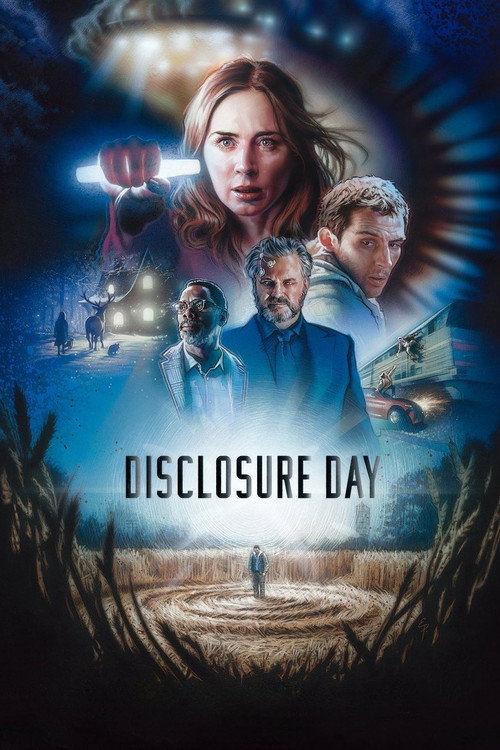
Disclosure Day
A suspenseful sci-fi thriller that evokes awe and contemplation, showcasing a global broadcast of truth that shatters the static of institutional fear and unites humanity through the ultimate close encounter.
Disclosure Day

Disclosure Day

"We deserve to know."

10 June 2026 United States of America 146 min 6.7 (841)

Director: Steven Spielberg

Cast: Emily Blunt, Josh O'Connor, Colin Firth, Colman Domingo, Eve Hewson

Thriller Science Fiction The Unifying Power of Truth Communication and Empathy Institutional Control vs. Public Right Faith and Awe in the Modern Age
Budget: $115,000,000
Box Office: $216,600,000

Overview

Disclosure Day follows two seemingly disparate individuals thrust into the center of an 80-year-old global cover-up. Daniel Kellner, a rogue codebreaker, goes on the run from WARDEX—a shadowy government contractor headed by the ruthless Noah Scanlon—after stealing irrefutable proof of extraterrestrial contact. Meanwhile, Kansas City meteorologist Margaret Fairchild experiences a bizarre encounter with a bird that leaves her with sudden, overwhelming telepathic and multilingual abilities.

As Noah's operatives hunt Daniel and hold his girlfriend, Jane, hostage, Daniel and Margaret are drawn together by forces they cannot fully comprehend. Aided by Hugo Wakefield, a defector from WARDEX, they race against time to execute a massive, coordinated broadcast. Their goal is not just to survive, but to trigger 'Disclosure Day'—the moment humanity finally learns it is not alone in the universe.

Core Meaning

Spielberg uses the framework of a UFO thriller to explore the necessity of radical empathy and the unifying power of truth in a divided world. The film posits that discovering extraterrestrial life shouldn't be a source of terror, but rather a catalyst to shock humanity out of its cynical, disconnected rut. By focusing on communication—whether decoding complex mathematics or instantly understanding all human languages—Spielberg suggests that our salvation lies in breaking down the barriers we build between ourselves and the unknown.

Thematic DNA

The Unifying Power of Truth 30%
Communication and Empathy 30%
Institutional Control vs. Public Right 20%
Faith and Awe in the Modern Age 20%

The Unifying Power of Truth

Daniel and Hugo's mission to release the WARDEX files is driven by the belief that keeping humanity in the dark breeds division, while universal truth—no matter how shocking—can heal society.

Communication and Empathy

Margaret's sudden ability to speak every language and read memories symbolizes the ultimate breakdown of human borders, emphasizing that empathy is our most vital survival tool.

Institutional Control vs. Public Right

Noah Scanlon and the WARDEX corporation represent the cynical hoarding of knowledge. Their 80-year cover-up highlights the arrogance of governments believing citizens cannot handle reality.

Faith and Awe in the Modern Age

Spielberg frames the impending disclosure not as a scientific anomaly, but as a deeply spiritual awakening, echoing the awe of his earlier sci-fi classics.

Character Analysis

Margaret Fairchild

Emily Blunt

Archetype: The Empath Key Trait: Deeply empathetic and intuitively perceptive

Motivation

To understand the source of her sudden abilities and fulfill a higher purpose of connecting humanity.

Character Arc

Starting as a grounded local TV meteorologist, Margaret is thrust into the extraordinary when she suddenly gains the ability to understand all languages and access people's memories. Her journey shifts from confusion to embracing her role as the ultimate telepathic transmitter for the alien intelligence.

Dr. Daniel Kellner

Josh O'Connor

Archetype: The Whistleblower Key Trait: Intelligent, paranoid, and fiercely determined

Motivation

To rescue Jane and expose the 80-year extraterrestrial cover-up to the public.

Character Arc

A brilliant codebreaker who transitions from a compliant WARDEX employee to a desperate fugitive. His arc is defined by his relentless drive to decode the truth and his frantic effort to rescue his kidnapped girlfriend, ultimately leading him to risk everything to inform the world.

Noah Scanlon

Colin Firth

Archetype: The Gatekeeper Key Trait: Arrogant, calculating, and unapologetically cynical

Motivation

To maintain global stability by keeping the existence of aliens a tightly guarded secret at any cost.

Character Arc

The smarmy and ruthless director of WARDEX, Noah remains steadfast in his cynical belief that humanity cannot handle the truth. He never wavers from his role as the antagonist, enforcing absolute institutional lockouts to maintain the status quo.

Hugo Wakefield

Colman Domingo

Archetype: The Catalyst Key Trait: Righteous, strategic, and brave

Motivation

To dismantle the shadowy organization he once served and initiate full global disclosure.

Character Arc

As a former WARDEX employee turned defector, Hugo guides the whistleblowing operation. He serves as the bridge between the stolen files and the public broadcast, culminating in his shocking live television presentation.

Symbols & Motifs

The WARDEX Archives

Meaning:

Symbolizes the historical weight of human secrecy and the corruption of institutions that hide the truth to maintain control.

Context:

Seen through shifting media formats (1940s film to modern digital) as Daniel uncovers decades of suppressed interrogations and encounters.

The Morning Cardinal

Meaning:

A symbol of sudden awakening, spiritual messaging, and the intrusion of the extraordinary into the mundane.

Context:

The bird appears at Margaret's breakfast table, serving as the catalyst that inexplicably triggers her multilingual and telepathic abilities.

The Freight Train

Meaning:

Symbolizes the unstoppable momentum of the approaching truth and the relentless nature of the pursuit.

Context:

Featured in a massive, tension-filled chase sequence where Daniel evades WARDEX operatives, captured in a sweeping crane shot.

Memorable Quotes

The truth doesn't set you free, Dr. Kellner. It burns the house down.
— Noah Scanlon

Context

Delivered during an intense interrogation sequence, serving as both a threat to Daniel and a philosophical defense of WARDEX's mission.

Meaning

Encapsulates WARDEX's paternalistic and cynical worldview regarding humanity's fragility.

Listen.
— Margaret Fairchild

Context

The film's final shot: Margaret looks directly into the camera lens, delivering the word just before the screen cuts to black on a massive cliffhanger.

Meaning

This ambiguous final command serves as both a literal instruction regarding the alien broadcast and a philosophical plea for humanity to practice empathy and open-mindedness.

Philosophical Questions

Is humanity truly ready for absolute truth?

The film contrasts WARDEX's belief that truth causes societal collapse with Daniel and Hugo's belief that it is essential for human evolution and unity.

Does advanced communication breed empathy or vulnerability?

Through Margaret's spontaneous multilingual and telepathic abilities, the film asks if breaking down all barriers of language and privacy would unite us in understanding, or expose us to overwhelming psychological burdens.

Alternative Interpretations

The film's dramatic cliffhanger ending has led to wildly divergent interpretations. The most common reading is optimistic: Margaret's command to 'Listen' is a plea for global empathy, suggesting that the aliens bring a message of peace that can only be understood if humanity stops fighting itself. However, a more cynical interpretation posits that the broadcast itself is a form of pacification or mind control. Because WARDEX successfully hid the aliens for 80 years, some viewers theorize that the sudden disclosure, aided by Margaret's telepathy, is an orchestrated 'global pause' meant to subjugate the population without firing a shot. A third interpretation focuses on Margaret and Daniel's powers; some argue they aren't just communicating with the aliens, but have actively been 'harvested' or altered by them since childhood, making them unwitting sleeper agents for their arrival.

Cultural Impact

Releasing in the summer of 2026, Disclosure Day arrived at a time of deep global anxiety and political division. Critics noted that Spielberg utilized the science fiction blockbuster format not just for spectacle, but as a deliberate commentary on the modern epidemic of misinformation and societal disconnect. By framing the discovery of extraterrestrial life as a unifying, healing event rather than an apocalyptic threat, the film struck a chord with audiences craving optimism. Though it sparked debate—with some critics finding the optimism overly sappy or criticizing the narrative decision to keep Blunt and O'Connor separated for much of the film—it dominated the box office, grossing $222.9 million. The film's ambiguous final line, 'Listen,' immediately became a viral cultural touchstone, generating countless reaction videos and online theories about whether it was a warning or a message of hope.

Audience Reception

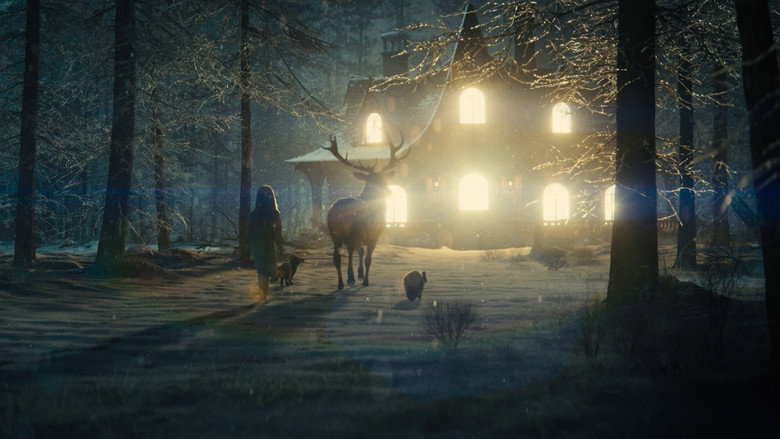
Audiences enthusiastically propelled Disclosure Day to the top of the box office, praising Spielberg's return to the wondrous, awe-inspiring sci-fi of his early career. Viewers highlighted the breathtaking cinematography by Janusz Kamiński—especially a stunning continuous shot at a farmhouse and a massive freight train sequence—as well as the powerhouse performances of Emily Blunt and Colman Domingo. However, reception was not universally glowing. A vocal segment of the audience and critics felt the narrative spun its wheels in the middle act, expressing frustration that Blunt and O'Connor were kept physically separated for the majority of the runtime. Additionally, while many found the hopeful tone refreshing, others considered the film's unyielding optimism bordering on naïve, describing the final product as a collection of Spielberg's leftover ideas rather than a cohesive new masterpiece. Despite this, the ending left a massive, indelible mark on pop culture.

Interesting Facts

  • Steven Spielberg considered the film a spiritual successor to Close Encounters of the Third Kind.
  • Cinematographer Janusz Kamiński shot roughly two-thirds of the film on KODAK 35mm film using Panavision Millennium XL2 cameras, switching to the digital Sony Venice 2 only for specific low-light sequences.
  • To accurately replicate the WARDEX archives, Kamiński and Spielberg manipulated exposure and lighting to natively mimic media formats spanning from the 1940s to the modern day.
  • The film's release date was originally scheduled for May 15, 2026, but Universal pushed it back to June 12, 2026.
  • The film was banned in several countries, including Kuwait and Qatar, due to its controversial themes regarding government secrecy and religious polemics.

Easter Eggs

The Devils Tower Model

In Noah Scanlon's office, a small, subtle sculpture of Devils Tower can be seen on a bookshelf, a direct visual homage to Spielberg's own Close Encounters of the Third Kind.

Ancient Egyptian Hieroglyphs

During Daniel's decoding sequences, the WARDEX files briefly reveal archival footage linking the alien visitation to ancient Egyptian hieroglyphs, suggesting an 80-year cover-up is only the tip of a millennia-old iceberg.

⚠️ Spoiler Analysis

Click to reveal detailed analysis with spoilers

Frequently Asked Questions

Explore More About This Movie

Dive deeper into specific aspects of the movie with our detailed analysis pages

Comments (0)

Leave a comment

No comments yet. Be the first to share your thoughts!

Similar Movies