Skip to content
Dream
A sunlit blend of sports comedy and heartfelt social drama, Dream mirrors a scarred soccer ball rebounding against pavement—capturing the tender, defiant warmth of broken individuals learning to stand tall together.
Dream

Dream

드림

"You are hopeless, helpless and homeless? No, you are NOT!"

26 April 2023 South Korea 127 min 6.9 (130)

Director: Lee Byeong-heon

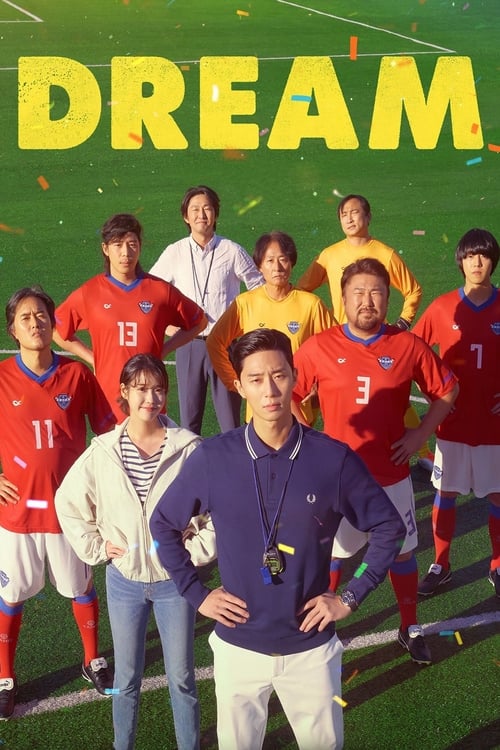
Cast: Park Seo-jun, IU, Kim Jong-soo, Ko Chang-seok, Jung Seung-kil

Drama Comedy Human Dignity, Resilience, and Marginalization Redemption and Reclaiming Personal Purpose Performative Media vs. Authentic Empathy Community and Found Family Sport as a Universal Equalizer
Box Office: $3,890,008

Overview

Dream is an uplifting South Korean sports comedy-drama centered on Yoon Hong-dae, a professional soccer player whose short temper leads to public disgrace after he assaults an invasive reporter. Facing suspension and an impending career slump worsened by his mother's involvement in financial fraud, Hong-dae's agency enrolls him in a community service public relations stunt: coaching South Korea's first-ever national team for the Homeless World Cup.

Hong-dae is paired with Lee So-min, an unapologetically pragmatic and career-fatigued documentary producer tasked with filming a human-interest documentary about the squad. So-min openly orchestrates melodramatic narratives to maximize television ratings and secure corporate sponsorships, working with a ragtag group of marginalized homeless men who lack conventional athletic ability.

Initial training sessions devolve into comedic chaos marked by Hong-dae's reluctant frustration and So-min's staging. However, as the eccentric squad members open up about the systemic misfortunes and personal tragedies that left them unhoused, Hong-dae and So-min gradually drop their cynical facades, transforming an insincere publicity campaign into a shared quest to restore human dignity on an international stage.


Core Meaning

The central premise of the film is that victory is measured not by scoreboard dominance, but by the reclamation of self-worth and human dignity. The narrative uses the framework of the Homeless World Cup to deconstruct societal prejudices against unhoused people.

Rather than presenting a conventional underdog fantasy where novices magically defeat world champions, the film argues that true triumph lies in simply stepping onto the pitch, refusing to quit, and demanding recognition as human beings. Simultaneously, it critiques media voyeurism and performative empathy, showing that genuine solidarity requires looking beyond manufactured sob stories to acknowledge individual agency.

Thematic DNA

Human Dignity, Resilience, and Marginalization 30%
Redemption and Reclaiming Personal Purpose 25%
Performative Media vs. Authentic Empathy 20%
Community and Found Family 15%
Sport as a Universal Equalizer 10%

Human Dignity, Resilience, and Marginalization

The film humanizes homeless individuals, showcasing how systemic debt, family abandonment, and psychological trauma push ordinary people to societal fringes. Their participation in soccer asserts their existence and right to respect rather than offering an instant escape from poverty.

Redemption and Reclaiming Personal Purpose

Both Hong-dae and his players have been written off by society. Through coaching, Hong-dae confronts his athletic inadequacy and filial shame, shifting from self-absorbed cynicism to genuine leadership.

Performative Media vs. Authentic Empathy

Through So-min's documentary production, the film exposes how mainstream culture consumes poverty as entertainment, critiquing the commodification of suffering while revealing the transformative potential of honest storytelling.

Community and Found Family

Estranged from biological families, the team members form a protective, interdependent brotherhood, demonstrating that mutual support softens the harsh realities of social isolation.

Sport as a Universal Equalizer

On the pitch, societal titles, wealth, and past failures are stripped away, creating a level playing field where shared sweat and physical effort unite people across cultural and socioeconomic divides.

Character Analysis

Yoon Hong-dae

Park Seo-jun

Archetype: Disgraced Hero / Reluctant Mentor Key Trait: Hot-tempered exterior masking deep-seated vulnerability and athletic insecurity.

Motivation

To clear his tarnished public image, pay off family debts, and resolve his conflicted identity as an athlete.

Character Arc

Begins as an irritable, insecure soccer player who views the homeless squad as a PR stepping stone to an entertainment career. Through witnessing their genuine struggles, he sheds his cynicism, embraces sportsmanship, and reclaims his passion for soccer.

Lee So-min

IU (Lee Ji-eun)

Archetype: Pragmatic Observer / Cynical Provocateur Key Trait: Fast-talking, razor-sharp wit paired with a pragmatic work ethic.

Motivation

To produce a successful documentary that will revive her career and provide financial security.

Character Arc

Starts as an overtly business-minded, burnt-out documentarian crafting artificial narratives for paychecks. As she spends time with the team, she discards manipulative scripts to document their authentic, unvarnished journey with genuine respect.

All 5 characters and cast

Symbols & Motifs

Tattered Shoes and Cleats

Meaning:

Symbolize the precarious physical footing of the homeless players and their tangible step toward rebuilding stability and social presence.

Context:

Seen when the players transition from worn sneakers and slides to proper soccer cleats for training.

The Documentary Camera / Viewfinder

Meaning:

Represents the gaze of society, evolving from an instrument of cynical staging and commercial exploitation into an empathetic witness to raw courage.

Context:

Operated by So-min throughout training and matches to record the team's progress.

The Big Issue Magazine

Meaning:

Represents legitimate reintegration into society, honest labor, and the public visibility of the unhoused population.

Context:

Appears as a recurring real-world motif sold and carried by the unhoused characters.

The Soccer Ball

Meaning:

Serves as the ultimate equalizer and a bridge connecting Hong-dae to a marginalized world he previously ignored.

Context:

Used throughout training drills and competitive matches as a tool requiring no social pedigree to kick.

The Single Goal

Meaning:

Serves as a symbol of collective validation, perseverance, and moral victory rather than an implausible tournament championship.

Context:

Scored in the dying moments of the intense match against powerhouse Germany.

Memorable Quotes

열정 페이만 주면 열정은 페이만큼만 나오는 거지.
— Lee So-min

Context

Delivered when explaining her cynical approach to producing reality documentaries.

Meaning

Captures So-min's dry, exhausted realism while critiquing modern exploitative labor culture in the media industry.

이기라고 안 해. 끝까지 뛰라고!
— Yoon Hong-dae

Context

Shouted from the sidelines during the brutal match against Germany.

Meaning

Encapsulates the core philosophy of the film: valorizing unyielding effort, perseverance, and self-respect over mere scoreline victory.

All 4 quotes

Philosophical Questions

What constitutes meaningful achievement in life when winning is out of reach?

The film explores how human value is defined by integrity, perseverance, and participation rather than hierarchical success or scoreboard dominance.

Where does ethical documentation end and voyeuristic exploitation begin?

Through So-min's filming practices, the narrative probes the moral boundaries of publicizing personal trauma for commercial awareness and entertainment.

Is social marginalization an individual failure or a systemic breakdown?

By detailing each player's descent into homelessness, the story challenges meritocratic assumptions that poverty results purely from lack of character or personal effort.

Alternative Interpretations

Anti-Trophy Sports Movie: One prominent reading views Dream as a subversion of Hollywood underdog tropes, emphasizing that for marginalized individuals, surviving the match and refusing to quit is a triumph in itself rather than an unrealistic championship victory.

Full ending explanation

Cultural Impact

The film is loosely based on South Korea's real-life first entry into the 2010 Homeless World Cup in Rio de Janeiro, Brazil, where the team finished 43rd out of 43 teams but was awarded the 'Best Newcomer' trophy for perseverance and sportsmanship.

In South Korea, where public perception of homelessness has historically leaned toward severe social stigma, the film directly supports awareness for organizations like The Big Issue Korea (founded in 2010) to foster empathy and dismantle biases against the unhoused.

Released domestically in April 2023, the film drew over 1.12 million admissions in South Korea and entered top-ten streaming ranks across multiple international markets upon its global Netflix release in July 2023.

Audience Reception

Audience and critical reception highlighted several key strengths and criticisms:

  • Praised Strengths: Fast-paced, rhythmic dialogue; lively comedic chemistry between Park Seo-jun and IU; touching performances by veteran character actors; and an emotionally stirring climactic match avoiding unearned sports miracles.
  • Points of Criticism: Clashing tonal shifts between director Lee's slapstick comedic banter and heavy melodramatic backstories; a predictable underdog narrative structure; and underutilization of IU's dramatic acting range.
  • Overall Verdict: A warm, crowd-pleasing sports comedy that successfully balances humor with social advocacy.

Interesting Facts

  • Director Lee Byeong-heon conceived the idea after watching a 2010 TV documentary covering South Korea's inaugural appearance at the Homeless World Cup.
  • It took nearly ten years to secure financing, which became possible only after the runaway box-office success of director Lee's 2019 comedy Extreme Job.
  • Principal photography began in South Korea in May 2020, but international shoots were delayed for almost two years due to COVID-19 travel restrictions before wrapping in Budapest in April 2022.
  • Park Seo-jun underwent rigorous physical conditioning and soccer training to match the body language and kicking techniques of a professional athlete.
  • The film features several recurring actors from director Lee Byeong-heon's past works, known as the 'Lee Byeong-heon division,' including Kim Jong-soo, Yang Hyun-min, and Heo Joon-seok.
  • Dream made its North American premiere as the Centerpiece Presentation at the 22nd New York Asian Film Festival (NYAFF) in July 2023.

Easter Eggs

Kang Ha-neul's cameo as Hong-dae's rival soccer peer Sung-chan.

Serves as a multi-layered reunion: Kang previously starred alongside Park Seo-jun in Midnight Runners (2017), alongside IU in Moon Lovers: Scarlet Heart Ryeo (2016), and in director Lee Byeong-heon's film Twenty (2015).

Park Myung-hoon's cameo as the invasive reporter poked in the eye.

Features the actor famous for playing the basement man in Parasite in a comedic instigating role.

Real sports broadcasters appearing as tournament commentators.

Features real-life South Korean football commentator Park Moon-sung and TV caster Cho Woo-jong to provide authentic broadcast delivery during the Homeless World Cup matches.

Frequently Asked Questions

Explore More About This Movie

Dive deeper into specific aspects of the movie with our detailed analysis pages

Comments (0)

Leave a comment

No comments yet. Be the first to share your thoughts!

Similar Movies