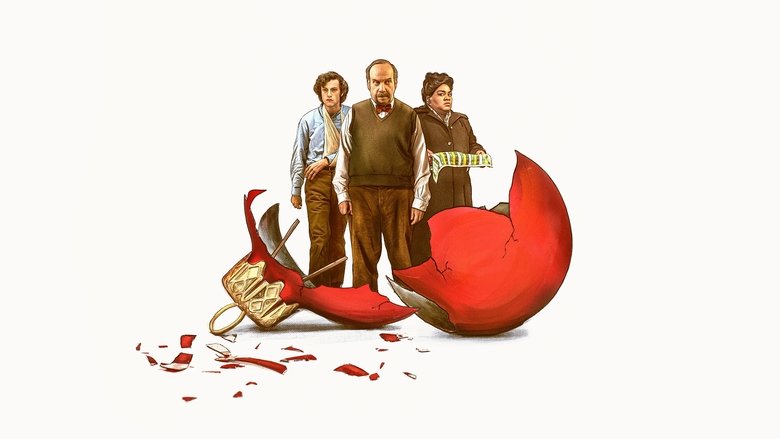
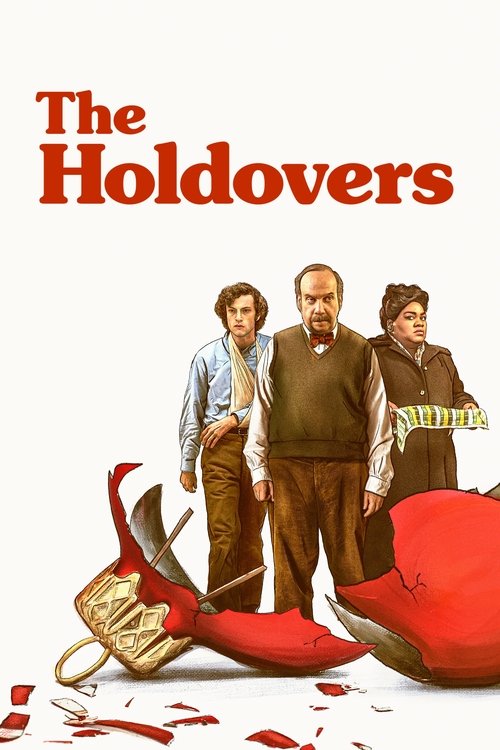
The Holdovers
A melancholic yet heartwarming holiday dramedy that balances bitter loneliness with the profound warmth of found family, developing its characters like a vintage photograph slowly revealing true colors in the harsh New England snow.
The Holdovers

The Holdovers

"Discomfort and joy."

27 October 2023 United States of America 133 min ⭐ 7.6 (2,393)
Director: Alexander Payne
Cast: Paul Giamatti, Dominic Sessa, Da'Vine Joy Randolph, Carrie Preston, Brady Hepner
Drama Comedy
Found Family and Human Connection Grief and Loss Class Inequality and Privilege The Burden of the Past
Budget: $13,000,000
Box Office: $42,513,270

Overview

Set in December 1970 at the prestigious Barton Academy in New England, The Holdovers follows Paul Hunham, a curmudgeonly and universally disliked classics teacher. When the winter break arrives, Paul is forced to remain on campus to chaperone the "holdovers"—students who have nowhere to go for the holidays. Through a series of events, the group is eventually whittled down to just three people: Paul, a grieving cafeteria manager named Mary Lamb, and Angus Tully, a highly intelligent but troubled teenager whose mother has abandoned him for a honeymoon with her new husband.

As the empty school becomes a snowy, isolating echo chamber, this unlikely trio of wounded souls is forced to navigate their shared loneliness. Angus acts out against Paul's strict, punitive regime, while Mary quietly observes, processing the recent death of her son Curtis in the Vietnam War. Despite their initial friction and vast generational and class differences, the three begin to drop their defenses.

Breaking the academy's strict rules, they embark on an unauthorized field trip to Boston. During this journey, deeply buried secrets are revealed, and the characters are forced to confront the painful realities of their pasts. Ultimately, the film transforms into a tender exploration of surrogate family, demonstrating how unexpected connections can provide the courage needed to face an uncertain future.
Core Meaning

The core message of The Holdovers is rooted in the Roman philosopher Cicero's quote that Paul recites early in the film: "Non nobis solum nati sumus" (Not for ourselves alone are we born). Director Alexander Payne and writer David Hemingson suggest that while life can be profoundly unfair and isolating, human connection is our primary salvation. The film argues that our history does not have to dictate our destiny, and that true teaching and healing occur not through strict discipline or isolation, but through radical empathy, vulnerability, and self-sacrifice.

Thematic DNA

Found Family and Human Connection 35%
Grief and Loss 25%
Class Inequality and Privilege 20%
The Burden of the Past 20%

Found Family and Human Connection

The film deeply explores how broken, isolated individuals can form a makeshift family unit. Paul, Mary, and Angus are all outcasts dealing with abandonment and profound loneliness. Over the Christmas holiday, they discover that connection can be found in the most unexpected places, bridging gaps of age, race, and class.

Grief and Loss

Grief permeates the narrative, manifesting differently in each character. Mary actively mourns her son Curtis, who died in Vietnam. Angus grieves the loss of his family unit and his father's mental decline. Paul mourns his stolen potential and lost career trajectory after being expelled from Harvard. The film shows how unaddressed grief paralyzes, while shared grief can heal.

Class Inequality and Privilege

Set against the backdrop of the Vietnam War, the film sharply contrasts the immense privilege of the Barton Academy boys with the working-class reality of Mary Lamb. Her son Curtis was drafted because they couldn't afford college tuition. Paul's backstory also highlights this inequality, as his life was derailed by a wealthy legacy student at Harvard.

The Burden of the Past

All three protagonists are anchored to their pasts. Paul hides behind ancient history to avoid the present; Mary is trapped in the memories of her deceased son; and Angus is terrified that he will genetically inherit his father's mental illness. The narrative arc forces them to process their histories so they can step into the future.

Character Analysis

Paul Hunham

Paul Giamatti

Archetype: Antihero / Mentor
Key Trait: Cynical and pedantic

Motivation

Initially, to uphold the rigorous academic traditions of Barton as a shield for his own insecurities. Later, his motivation shifts to protecting Angus and ensuring the boy doesn't repeat Paul's tragic trajectory.

Character Arc

Paul evolves from a bitter, rigid disciplinarian who uses his intellect to punish students into a compassionate surrogate father. Ultimately, he sacrifices his only source of safety—his job at Barton—to save Angus from a bleak future.

Angus Tully

Dominic Sessa

Archetype: Troubled Hero
Key Trait: Sharp-witted and vulnerable

Motivation

Desperately seeking connection and validation while simultaneously terrified of his own genetic legacy and the prospect of being sent to military school.

Character Arc

Angus transitions from a defiant, abandoned teenager hiding his pain behind sarcasm, to a vulnerable young man who learns to accept love and realizes that his father's mental illness does not dictate his own destiny.

Mary Lamb

Da'Vine Joy Randolph

Archetype: The Caregiver
Key Trait: Pragmatic and deeply empathetic

Motivation

To survive the crushing weight of her grief and honor the memory of her son, Curtis, who attended Barton but could not afford college.

Character Arc

Numbed by the devastating loss of her son in Vietnam, Mary moves from a state of paralyzing grief to a place of quiet acceptance, finding renewed purpose in supporting her pregnant sister's upcoming child.

Symbols & Motifs

Paul's Lazy Eye

Meaning:

It physically symbolizes Paul's skewed perspective on the world, as well as how the world misperceives and judges him based on his awkward exterior.

Context:

It is a constant source of mockery from the students. The visual gag of people not knowing which eye to look at represents how people fail to truly "see" Paul until Angus and Mary take the time to look deeper.

The Duffle Coat

Meaning:

The coat makes Paul look somewhat childlike and emotionally stunted, representing how he has never truly left his own schoolboy days behind.

Context:

Paul wears this heavy, oversized coat throughout the harsh winter, using it as a physical shield against the coldness of his environment and his own internal isolation.

The Snow Globe

Meaning:

It represents a frozen, idealized, and artificial moment of familial happiness that Angus desperately wishes he could preserve.

Context:

Angus buys it in Boston and gives it to his father in the psychiatric hospital. Tragically, the father weaponizes it during an outburst, shattering Angus's illusion of a happy family reunion.

Meditations by Marcus Aurelius

Meaning:

The book symbolizes Paul's reliance on ancient stoicism to intellectualize his pain rather than actually feeling it.

Context:

Paul gives this book as a standard Christmas gift to his students, hiding behind the philosophical text to avoid offering genuine emotional warmth.

The Monograph Notebook

Meaning:

It symbolizes a blank slate, a new beginning, and the permission to dream beyond the confining walls of Barton Academy.

Context:

Mary gifts this beautiful blank notebook to Paul at the end of the film, encouraging him to finally write the book he has always talked about and to embrace his life after being fired.

Memorable Quotes

I find the world a bitter and complicated place, and it seems to feel the same way about me.

— Paul Hunham

Context:

Paul says this to Angus when they are bonding, acknowledging their shared status as outcasts who struggle to fit into normal society.

Meaning:

This perfectly encapsulates Paul's worldview and his deep-seated sense of victimhood and loneliness.

For most people, Mr. Kountze, life is like a henhouse ladder -- shitty and short. You were born lucky.

— Paul Hunham

Context:

Paul delivers this classic insult while scolding a wealthy, entitled student who is complaining about his temporary hardships.

Meaning:

A stinging rebuke of the immense, unearned privilege the Barton boys enjoy, contrasting with the harsh realities faced by people like Mary.

You can't even dream a whole dream, can you?

— Mary Lamb

Context:

Mary says this to Paul after he admits he only wants to write a "monograph" (a short book) rather than an entire book, because he doubts he has a whole book in him.

Meaning:

A profound observation on Paul's stunted ambitions and his fear of failure, challenging him to want more out of his life.

Non nobis solum nati sumus.

— Paul Hunham

Context:

Paul quotes Cicero to the headmaster early in the film as a pedantic shield, but he only truly embodies the quote's meaning at the climax when he sacrifices his career for Angus.

Meaning:

Translates to "Not for ourselves alone are we born." It represents the film's core theme of altruism and mutual responsibility.

In real life, your history does not have to dictate your destiny.

— Paul Hunham

Context:

Paul tells this to Angus after visiting Angus's institutionalized father, addressing the boy's terrifying fear that he will inevitably inherit his father's mental illness.

Meaning:

A moment of profound mentorship and healing, assuring Angus that he is his own man.

Philosophical Questions

Does our history dictate our destiny?

The film explores biological and social determinism through Angus, who is terrified of inheriting his father's severe mental illness, and Paul, who feels forever branded by his past failure at Harvard. The narrative challenges this by suggesting that self-awareness, human connection, and active choices can break the chains of our past.

What are our moral obligations to those outside our immediate family?

Through the Cicero quote Non nobis solum nati sumus (Not for ourselves alone are we born), the film asks what we owe to strangers. Paul initially uses this philosophy as an empty academic weapon, but ultimately realizes true morality requires painful, personal sacrifice to protect the vulnerable.

How does systemic privilege insulate people from the realities of human suffering?

The film contrasts the insulated, wealthy boys of Barton Academy with Mary Lamb, whose son was killed in Vietnam because they lacked the money to keep him in school. It asks the audience to consider how societal structures distribute suffering unevenly based on wealth and class.

Alternative Interpretations

While The Holdovers is widely viewed as a heartwarming tale of found family, some critics offer a more cynical, psychoanalytic interpretation of Paul Hunham's final sacrifice. One alternative reading suggests that Paul's decision to take the fall for Angus was not entirely altruistic, but rather a subconscious act of self-liberation. Paul was too cowardly to quit his miserable job at Barton, so he manufactured a scenario where he would be fired, thus forcing himself to finally leave his comfort zone and write his monograph.

Another interpretation views the film's 1970s setting not merely as nostalgic window-dressing, but as a deliberate mirror to contemporary America. From this perspective, the film is a critique of modern wealth inequality, institutional apathy, and the over-medication of emotional distress. Angus and his father are treated as embarrassments to be institutionalized and hidden away. The film argues that society still demands marginalized and troubled individuals to suffer in silence, making the protagonists' ultimate rebellion an act of radical, modern-day defiance disguised as a period piece.

Cultural Impact

The Holdovers made a significant cultural impact upon its release, immediately being hailed as a "New Christmas Classic." Critics and audiences alike praised how director Alexander Payne resurrected the aesthetic and emotional resonance of 1970s New Hollywood cinema—reminiscent of filmmakers like Hal Ashby. Instead of relying on modern blockbuster pacing, the film proved there is still a massive, hungry audience for quiet, character-driven, mid-budget dramas for adults.

Culturally, the film sparked vital conversations about the intersection of class, privilege, and grief. By placing the narrative against the backdrop of the Vietnam War, it highlighted the disparity between wealthy prep school boys who avoid the draft and working-class men like Mary's son, Curtis, who became "cannon fodder" because they lacked the funds for college. Da'Vine Joy Randolph's universally acclaimed, Oscar-winning performance anchored the film's emotional weight, ensuring its legacy as a profound exploration of maternal loss and marginalized voices within elite spaces.

Audience Reception

Audience reception for The Holdovers was overwhelmingly positive, earning high ratings across aggregators like Rotten Tomatoes and Letterboxd. Viewers heavily praised the film's cozy, melancholic atmosphere and its authentic 1970s aesthetic. The central trio of performances was universally lauded; Paul Giamatti was celebrated for bringing deep humanity to a prickly character, Da'Vine Joy Randolph was singled out for her devastatingly understated portrayal of grief, and newcomer Dominic Sessa was praised for going toe-to-toe with seasoned veterans.

If there was any criticism, it was that the film adheres to a rather traditional, predictable "found family" narrative structure. Some audiences felt they knew exactly where the story was heading from the first act. However, the vast majority of viewers agreed that the execution was so flawless, the dialogue so sharp, and the emotional core so earned, that the familiarity of the tropes became a comforting strength rather than a weakness.

Interesting Facts

  • Dominic Sessa had never acted on camera before this film. He was actually a senior student at Deerfield Academy, one of the real-life boarding schools used as a filming location, when the casting director discovered him.
  • To achieve Paul Hunham's lazy eye, Paul Giamatti wore a large, soft contact lens that practically blinded him in that eye during filming. The eye's orientation also subtly shifts from left to right throughout the movie.
  • Director Alexander Payne and cinematographer Eigil Bryld designed the production as a 'thought experiment,' deliberately filming and editing it as if they were physically making the movie in 1970. This included using a 1.85:1 aspect ratio, vintage studio logos, and mono-style audio mixing.
  • Da'Vine Joy Randolph chose to smoke real cigarettes during filming because she felt the fake herbal ones looked unrealistic and lacked the proper weight and aesthetic for the era.
  • Paul Giamatti actually grew up in a similarly privileged academic environment as his character; his father, A. Bartlett Giamatti, was a former president of Yale University.
  • The crew pushed the digital film stock in post-production to create a custom grain structure, specifically designed to match the look of 50-year-old celluloid film.

Easter Eggs

Lydia Crane's Heart Necklace

Carrie Preston's character, Miss Crane, wears a distinctive heart-shaped necklace. Costume designer Wendy Chuck revealed this is the exact same necklace worn by Reese Witherspoon's character (Tracy Flick) in Alexander Payne's 1999 film Election.

Hertzels Pharmacy Sign

The pharmacy that the characters visit features a sign for "Hertzels Pharmacy." This is a subtle visual callback and Easter egg referencing another one of Alexander Payne's acclaimed films, About Schmidt.

⚠️ Spoiler Analysis

Click to reveal detailed analysis with spoilers

Frequently Asked Questions

Explore More About This Movie

Dive deeper into specific aspects of the movie with our detailed analysis pages

Comments (0)

Leave a comment

No comments yet. Be the first to share your thoughts!