Skip to content
Dust Bunny
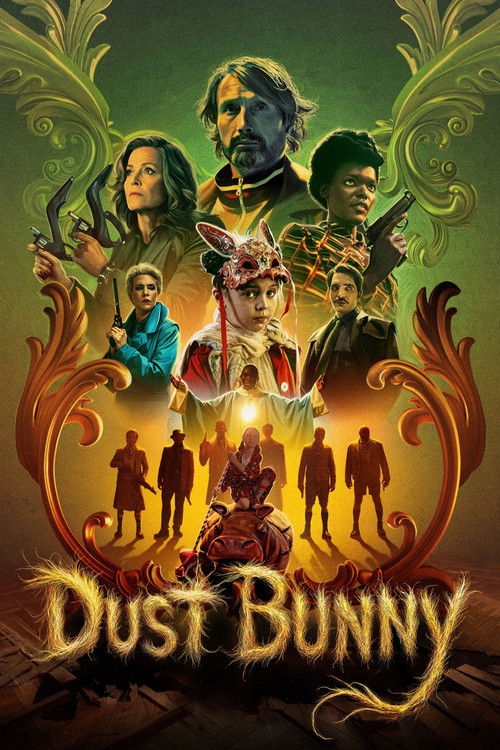
A darkly whimsical fairy-tale noir drenched in pastel dread, Dust Bunny captures the ache of unprocessed grief through the haunting silhouette of a child seeking salvation in the shadow of a lethal guardian.
Dust Bunny
Dust Bunny

"Sometimes there really are monsters under your bed."

11 December 2025 United States of America 106 min 6.7 (394)

Director: Bryan Fuller

Cast: Mads Mikkelsen, Sophie Sloan, Sheila Atim, David Dastmalchian, Rebecca Henderson

Fantasy Action Horror Childhood Trauma and Externalized Fear Redemption and Unlikely Kinship The Duality of Men vs. Monsters Mythmaking and Storytelling as Coping Innocence Lost to Violence
Box Office: $928,164

Dust Bunny — Ending Explained

⚠️ Spoiler Analysis

As the hunt progresses, the narrative reveals that Aurora’s biological family was not devoured by a random phantom, but caught in the violent orbit of a contract hit orchestrated by the crime syndicate overseen by the Handler (Sigourney Weaver). Resident 5B realizes that his own shadowy past directly contributed to Aurora’s orphaned status.

However, the film subverts a purely rationalist twist: when the climax unfolds beneath the apartment building, a real, monstrous manifestation of the Dust Bunny does exist, spawned from the accumulated grief, darkness, and violent history of the residence. 5B and Aurora face both the human assassins—including David Dastmalchian's enforcer—and the creature itself. By combining 5B's lethal combat skills and Aurora's courage, they defeat the beast and neutralize the syndicate threats. The ending solidifies their bond: having conquered her literal and psychological demons, Aurora leaves her solitary life behind, forging a surrogate family with 5B as they step into an uncertain future together.

Alternative Interpretations

Different analytical perspectives include:

  • The Literal Fairy Tale: The entity under the floorboards is a genuine supernatural creature that preys on urban decay, and the underworld syndicate is an obstacle in a dark modern fable.
  • The Psychological/Trauma Allegory: The creature is a psychological manifestation of Aurora’s PTSD. In this reading, the violence that claimed her family was human and syndicate-related, and her mind constructed the beast as a shield to process unbearable reality.
  • The Dual Reality Interpretation: The film intentionally inhabits a liminal dream logic where both the underworld hitmen and the grotesque monster are equally real within Fuller's heightened, hyper-stylized universe.

Explore More About This Movie

Dive deeper into specific aspects of the movie with our detailed analysis pages

Similar Movies