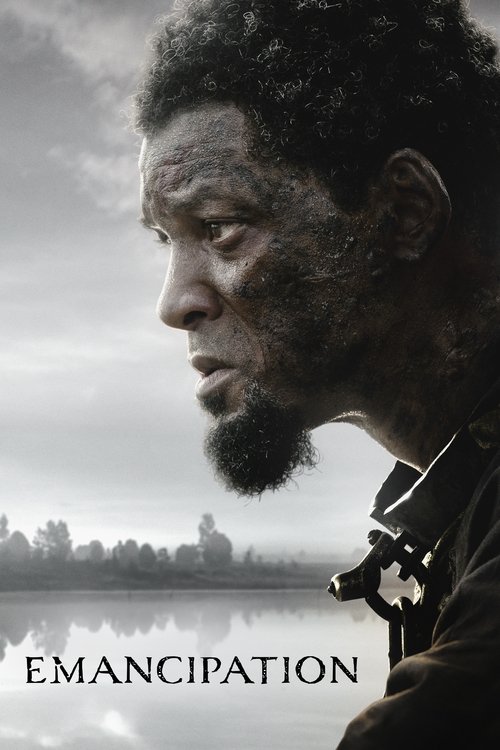
Emancipation
Overview
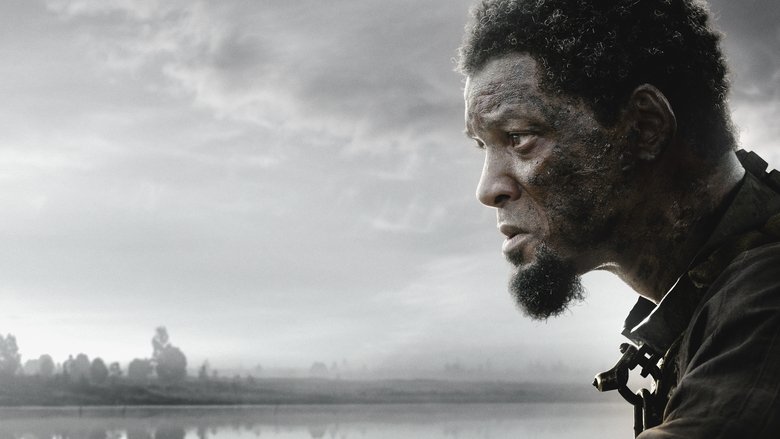
In the midst of the American Civil War, Peter, an enslaved man in Louisiana, is forcibly separated from his family and sold to a Confederate labor camp to build a railroad. Enduring horrific abuse and near-starvation, he clings to his deep Christian faith and the promise of reuniting with his wife and children. When he overhears that Abraham Lincoln has issued the Emancipation Proclamation and that the Union Army has taken Baton Rouge, Peter seizes a moment of chaos to escape, beginning a perilous journey through the treacherous swamps.
Hunted by the ruthless slave catcher Jim Fassel and his pack of dogs, Peter must survive not only his pursuers but also the deadly natural environment, battling alligators, hunger, and infection. His journey is a test of physical and spiritual endurance as he navigates a landscape that seems intent on destroying him. The film relentlessly tracks his desperate flight toward the sound of Lincoln's cannons, transforming a historical struggle into an action-heavy survival thriller.
Upon reaching Union lines, Peter's ordeal is far from over. He finds that his freedom comes with a new condition: he must join the fight. Enlisting in the Louisiana Native Guard, he endures the horrors of war on the battlefield, culminating in the siege of Port Hudson. Throughout it all, his singular motivation remains his promise to return to his family, a promise that drives him through every bullet, lash, and swamp.

Core Meaning
At its heart, Emancipation is a testament to the indestructible nature of the human spirit and the power of faith in the face of absolute dehumanization. Director Antoine Fuqua uses the historical figure of "Whipped Peter" not just to document the atrocities of slavery, but to explore the concept of self-emancipation. The film argues that true freedom is not merely granted by a proclamation or a government, but is seized through personal will, resilience, and action. It posits that love and faith are not passive comforts, but radical acts of defiance against a system designed to crush the soul.
Thematic DNA
The Indomitable Human Spirit
Peter's journey is defined by his refusal to be broken, physically or mentally. Despite being treated like an animal, he constantly asserts his humanity through prayer, intelligence, and survival instincts. The film showcases how an individual's will can withstand systemic brutality.
Faith as Resistance
Religion is central to Peter's character. Unlike the distorted version of Christianity used by slave owners to justify oppression, Peter's faith is his armor and compass. His constant recitation of Psalms serves as a psychological shield, allowing him to maintain hope and sanity in a hopeless environment.
Family as Motivation
The drive to reunite with his wife Dodienne and their children is the engine of the plot. This theme underscores that for the enslaved characters, freedom is not an abstract political concept but the tangible reality of being with their loved ones without fear of separation.
Dehumanization vs. Identity
The antagonist Fassel explicitly tries to reduce Peter to the status of a dog or beast. The film constantly juxtaposes this external dehumanization with Peter's internal affirmation of his identity as a man and a child of God.
Character Analysis
Peter
Will Smith
Motivation
To return to his wife and children and fulfill his promise that he would come back for them.
Character Arc
Peter transforms from a captive enduring abuse to a fugitive fighting for his life, and finally to a soldier fighting for his people. His internal strength remains constant, but his agency expands from passive resistance to active combat.
Jim Fassel
Ben Foster
Motivation
A twisted sense of duty and racial superiority; he believes he is 'god' to the enslaved people.
Character Arc
Fassel remains static in his obsession. He views himself as a divinely appointed predator whose purpose is to crush rebellion. He tracks Peter with a single-minded focus until his own violent demise.
Dodienne
Charmaine Bingwa
Motivation
To protect her children and survive until Peter returns.
Character Arc
While Peter runs, Dodienne endures on the plantation. She makes a horrific sacrifice to keep her family together, proving her own immense strength and resilience parallel to Peter's.
Symbols & Motifs
The Scourged Back
It represents the undeniable, graphic proof of slavery's cruelty. It transforms Peter from a man into a living symbol that galvanizes the abolitionist movement.
Recreated from the famous historical photo, this image is revealed during a medical examination in the Union camp, shocking the soldiers and photographers.
The Swamp
A liminal space of death and rebirth. It represents the chaotic, dangerous transition from bondage to freedom, where the rules of society fall away and only survival of the fittest remains.
Peter spends the majority of the film traversing this landscape, fighting nature (alligators, snakes) as much as his human pursuers.
Onions
A tool of survival and ingenuity. They symbolize the practical knowledge enslaved people used to outwit their oppressors.
Peter rubs raw onions over his body to mask his scent from the tracking dogs, a painful but necessary act to evade capture.
Chains and Bells
The physical manifestation of control and the auditory signal of captivity. They are designed to strip away stealth and autonomy.
Runners are often fitted with bells on their collars so they cannot hide; removing them is a key step in Peter's liberation.
Memorable Quotes
I am not a slave. I am a man!
— Peter
Context:
Peter screams this defiance at his captors, refusing to accept the label they force upon him.
Meaning:
A declaration of personhood that rejects the legal and social definition of his existence. It is the core assertion of the film.
You walk the earth because I let you. You are my dog now.
— Jim Fassel
Context:
Spoken to Peter during a moment of capture/intimidation to assert dominance.
Meaning:
Encapsulates Fassel's god complex and the total dehumanization he inflicts on the people he hunts.
The Lord is with me. I will not be afraid. What can a mere man do to me?
— Peter
Context:
Recited throughout his journey, especially in moments of extreme fear or pain.
Meaning:
A biblical recitation (Psalm 118:6) that Peter uses to center himself. It frames his struggle as spiritual warfare where his soul is untouchable by his physical tormentors.
We fight for freedom... We will take freedom.
— Peter
Context:
Spoken to fellow black soldiers before charging into battle.
Meaning:
Marks the shift from running to fighting. Peter realizes that freedom is not a gift to be waited for, but a right to be seized.
Philosophical Questions
Is freedom given or taken?
The film challenges the narrative that Lincoln 'freed the slaves.' Through Peter's character, it argues that the Proclamation was just words until individuals physically seized their freedom through dangerous action and combat.
Where is God in the face of absolute evil?
Peter's constant prayer in a world of torture raises the question of theodicy. The film suggests that God is not found in the absence of suffering, but in the strength to endure it; Fassel represents the godless arrogance of men who try to play God.
Does the end justify the violent means?
Peter, initially a man of peace, must become a killer to survive and eventually a soldier. The film explores the morality of violence when it is the only tool available to secure basic human rights.
Alternative Interpretations
While ostensibly a historical drama, some critics interpret the film as an action-thriller disguised in prestige clothing. The superhuman feats Peter performs—fighting alligators, outsmarting hunters, surviving impossible wounds—reframe the narrative from a 'witness to history' story into a mythic 'hero's journey.' Another interpretation focuses on the color grading: the desaturated, near-monochrome palette with selective bursts of red (blood) and green (nature) can be seen as representing a world drained of life and hope by slavery, where life only breaks through in moments of violence or natural indifference.
Cultural Impact
Emancipation faced a complicated release, heavily overshadowed by Will Smith's assault on Chris Rock at the Oscars earlier that year. The 'slap' dominated the discourse, with many questioning if audiences were ready to welcome Smith back. Culturally, the film reignited the debate around 'slave trauma porn' in cinema. Critics and audiences argued whether graphic depictions of black suffering are necessary historical education or exploitative spectacles. Despite its historical significance, the film failed to make a major splash during awards season, largely due to the controversy surrounding its star. However, it remains a significant cinematic recreation of one of the most important photographs in American history.
Audience Reception
Audience reception was mixed to positive, generally higher than critical reception. Viewers praised Will Smith's committed and emotional performance, calling it one of his best. The cinematography and the unflinching look at history were also highlighted as strengths. However, criticism focused on the relentless brutality, which some found difficult to watch. The 'alligator scene' was frequently cited as a moment where the film jumped the shark into unrealistic action territory. Many reviews were unavoidably colored by opinions on Will Smith's personal life, creating a polarized response unrelated to the film's actual quality.
Interesting Facts
- The film is based on the true story of 'Gordon' (named Peter in the film), whose scarred back was photographed in 1863 and published in Harper's Weekly.
- This was Will Smith's first film released after the controversial 'slap' incident at the 2022 Academy Awards.
- Production was moved from Georgia to Louisiana in protest of Georgia's restrictive new voting laws.
- The famous 'Scourged Back' photo was recreated in the film with meticulous detail during the medical exam scene.
- Will Smith stayed in character with method acting techniques, refusing to speak to some cast members outside of scenes.
- The alligator fight scene is fictional; there is no historical record of Gordon fighting an alligator.
- Filming in the Louisiana swamps was physically grueling, with the cast and crew dealing with extreme heat, mud, and insects.
- Ben Foster deliberately kept his distance from Will Smith on set to maintain the tension between their characters.
Easter Eggs
Dodienne's Hand Injury
Dodienne (Charmaine Bingwa) asks her daughter to crush her hand in a cotton gin. This is a subtle but horrific detail explaining how she avoided being sold—by making herself 'damaged goods' to the slave owners, she ensured she could stay with her children.
The Burning House and Cross
Peter encounters a burning plantation house and a dying girl who gives him a cross. This scene is not in the historical record but serves as a symbolic 'descent into hell' and a reinforcement of the religious motif, contrasting the destruction of the slave owner's world with the endurance of faith.
Blaxploitation Homage
Some critics noted the film's stylistic pivots, comparing Peter's action-hero capabilities to characters in 1970s Blaxploitation films like The Legend of Nigger Charley, suggesting a deliberate genre-bending by Fuqua.
⚠️ Spoiler Analysis
Click to reveal detailed analysis with spoilers
Frequently Asked Questions
Explore More About This Movie
Dive deeper into specific aspects of the movie with our detailed analysis pages
Comments (0)
No comments yet. Be the first to share your thoughts!