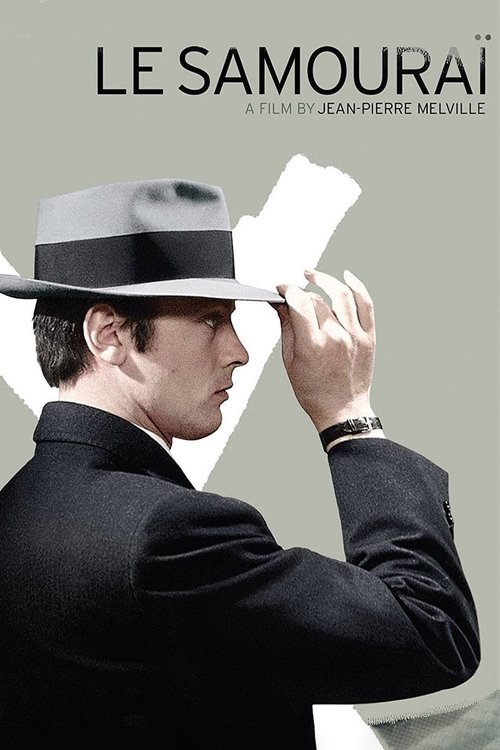
Le Samouraï
"His only friend was his gun!"
Overview
Jef Costello is a methodical contract killer living in a spartan Parisian apartment, his only companion a caged bullfinch. He operates with a strict personal code of conduct, executing his hits with ritualistic precision. After assassinating a nightclub owner, Jef is seen by several witnesses, including the club's pianist, Valérie. despite being identified in a lineup, his carefully constructed alibis—provided by his lover Jane—and Valérie's surprising refusal to identify him allow him to walk free, though the police Superintendent remains convinced of his guilt.
As the police launch a massive manhunt and surveillance operation to trap him, Jef discovers that his own employers have betrayed him, viewing him as a liability. Wounded and cornered, he must navigate a treacherous path between the relentless law enforcement and the criminal underworld. The film culminates in a mesmerizing cat-and-mouse game through the Paris Metro and a final return to the nightclub, where Jef's adherence to his samurai-like code leads to a tragic and deliberate conclusion.
Core Meaning
Jean-Pierre Melville's Le Samouraï is a meditation on the existential solitude of the modern individual. The film posits that true perfection and adherence to a code lead inevitably to isolation and death. Melville strips the crime genre of its moralizing and sensationalism to reveal a tragic hero who is a prisoner of his own professionalism. The 'Samurai' title refers not to a literal warrior, but to a state of mind—a 'Ronin' without a master, operating in a world where honor is obsolete. The film explores the idea that fate is a cage we build for ourselves through our choices and rituals.
Thematic DNA
Solitude and Isolation
Jef is the ultimate solitary figure, disconnected from society. His apartment is a gray cell, his interactions are minimal, and his only friend is a caged bird. The opening quote (attributed to the Book of Bushido) explicitly frames this solitude as the film's central condition.
Ritual and Process
The film fetishizes the process: putting on the fedora, the white gloves, the theft of the car with a ring of keys. These rituals are Jef's religion; they give his life structure and meaning in an otherwise chaotic and amoral universe.
Fatalism and Destiny
From the first shot, Jef appears doomed. His movements are precise but circular, leading him back to the scene of the crime. The narrative suggests an inescapable fate where the protagonist knowingly walks toward his own demise to preserve his integrity.
Silence and Minimalism
Dialogue is scarce; communication happens through glances, gestures, and actions. This theme reflects the characters' emotional detachment and the director's belief that words are often deceptive or unnecessary.
Character Analysis
Jef Costello
Alain Delon
Motivation
To survive, to maintain his professional standards, and ultimately, to choose the manner of his own death rather than be captured or killed like a common criminal.
Character Arc
Jef starts as a flawless machine, an untouchable killer. As the net tightens and he is betrayed, he moves from predator to prey. His arc concludes with a reclaiming of agency through a sacrificial act, maintaining his code to the bitter end.
The Superintendent
François Périer
Motivation
To find the truth and uphold the law, believing that 'everyone is guilty' until proven innocent.
Character Arc
He is the intellectual foil to Jef. He begins with a hunch and methodically dismantles Jef's alibis using psychological pressure and modern technology. He respects Jef's skill but is determined to break him.
Valérie
Cathy Rosier
Motivation
Her motivations remain ambiguous—perhaps fear, perhaps attraction to Jef, or perhaps she is also part of the criminal web.
Character Arc
She witnesses the murder but protects Jef for mysterious reasons. She becomes the key to his undoing and his final destination. She represents the beauty and danger that Jef cannot eliminate.
Symbols & Motifs
The Caged Bullfinch
The bird represents Jef's own soul and situation: a solitary creature trapped in a cage (the apartment/his life/fate). It also serves a practical function as an alarm system, warning him of intruders.
Placed centrally in Jef's gray apartment, the bird is the only living thing he interacts with tenderly. When the police bug his room, the bird's agitated feathers alert Jef to the intrusion.
The Trench Coat and Fedora
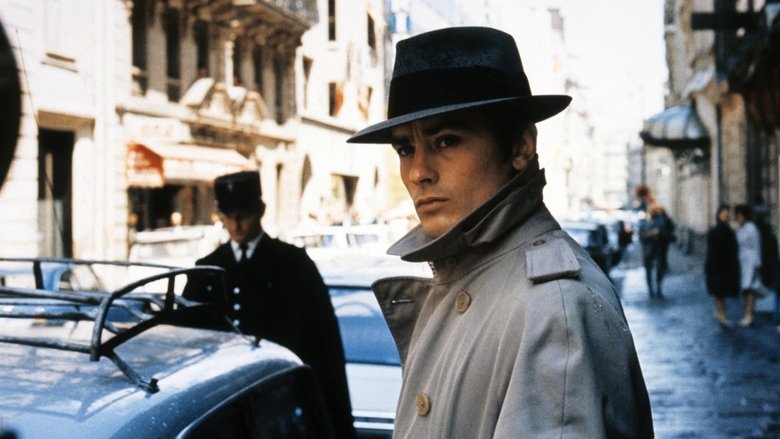
These are Jef's armor and uniform. They strip him of individual personality and transform him into the archetype of the 'noir' figure. Putting them on is part of his ritual of preparing for the world.
Jef is rarely seen without them. Before leaving his apartment, he meticulously adjusts the brim of his hat in the mirror, a gesture of self-composure and armoring.
The Ring of Keys
Symbolizes Jef's methodical nature and his ability to access forbidden spaces, yet also underscores the mechanical, repetitive nature of his existence.
Used in the scene where Jef patiently tries key after key to steal a Citroën DS, demonstrating his patience and professionalism.
White Gloves
They represent the ritual of death and Jef's desire to leave no trace, both physically (fingerprints) and morally (keeping his hands 'clean' in a spiritual sense).
Jef deliberately puts on white gloves before entering the nightclub to kill the owner, and again in the final scene, signaling his intent.
Memorable Quotes
Il n'y a pas de plus profonde solitude que celle du samouraï si ce n'est celle d'un tigre dans la jungle... peut-être.
— Opening Title Card
Context:
The very first text seen on screen before the opening shot of Jef lying in bed.
Meaning:
Sets the tone of the film. It establishes the protagonist as a tragic, mythical figure defined by his isolation. It elevates a crime story to a philosophical study.
I never lose. Never really.
— Jef Costello
Context:
Spoken to his poker partners when they ask if he lost the game (which serves as his alibi).
Meaning:
Reveals Jef's worldview. Even in death or capture, he believes he retains control if he adheres to his code. It foreshadows his orchestrated end.
I was paid to.
— Jef Costello
Context:
The final scene in the nightclub, just before he raises the gun and is shot by the police.
Meaning:
Jef's final words to Valérie. A simple, brutal statement of fact that hides his true intent (suicide). It emphasizes his role as a professional until the last second.
Philosophical Questions
Does strict adherence to a personal code grant freedom or imprison the individual?
The film explores this paradox through Jef. His code makes him superior to the chaotic world and grants him a form of dignity, yet it also turns him into a machine, traps him in a cage of routine, and ultimately demands his life. Is he a master of his fate or a slave to his own rules?
Can honor exist in a world devoid of morality?
Melville places a character with 'old world' values (bushido, loyalty, silence) into a modern, transactional, and treacherous environment. The film asks whether such virtues are noble or simply absurd and suicidal in a modern context.
Alternative Interpretations
The Romantic Suicide: Some critics interpret Jef's death not just as adherence to a code, but as an act of love or protection for Valérie, the only person who showed him mercy.
Schizophrenic Projection: A psychological reading suggests the entire film is a projection of a mentally disturbed loner (the 'tiger in the jungle'), with the police and gangsters representing his internal demons closing in.
The Ghost Theory: Given the opening shot where Jef looks like a corpse and the gray, purgatorial atmosphere, some interpret Jef as a ghost or spirit who is already dead, simply acting out a final ritual before fading away.
Cultural Impact
Le Samouraï is widely considered one of the most influential crime films ever made. It established the archetype of the 'cool,' silent, professional hitman that has been copied endlessly in cinema. Its influence is directly seen in the works of John Woo (The Killer is a homage), Walter Hill (The Driver), Luc Besson (Léon: The Professional), and Nicolas Winding Refn (Drive). Jim Jarmusch's Ghost Dog: The Way of the Samurai is a direct spiritual successor, remixing Melville's themes with hip-hop culture. The film's minimalist style and Alain Delon's stoic performance created a blueprint for the modern anti-hero.
Audience Reception
Upon release, the film was a commercial success in France and received critical praise for its atmosphere and Delon's performance. Over the decades, its reputation has grown to that of a masterpiece. Audiences and critics universally praise the cinematography, the tension, and the minimalist direction. It holds a rare 100% rating on Rotten Tomatoes. Some contemporary viewers may find the pacing slow or the lack of dialogue challenging, but it is widely revered by cinephiles as the epitome of cinematic 'cool'.
Interesting Facts
- The famous opening quote attributed to 'The Book of Bushido' was entirely invented by director Jean-Pierre Melville.
- During the filming, Jean-Pierre Melville's private studio (Studios Jenner) burned down, destroying the set of Jef's room and killing the actual bullfinch used in the movie.
- Alain Delon and his wife Nathalie Delon (who plays Jane) were in the process of separating during the production, adding real tension to their scenes.
- Melville reportedly filmed an alternate ending where Jef dies with a smile on his face, but he cut it because Delon had already smiled in a death scene in another film.
- Alain Delon took the role after Melville read him the script for 10 minutes; when Delon realized there was no dialogue yet, he said 'I'll do it.'
- The bird's chirping was used as a deliberate plot device to indicate when police had intruded into the apartment.
- This was Melville's first film in color, though he meticulously desaturated the palette to make it look like a black-and-white film shot in color.
Easter Eggs
The Bushido Quote
The opening text claims to be from the 'Book of Bushido', but it is a fabrication by Melville. This reflects the director's tendency to mythologize his characters and create his own cinematic reality rather than adhere to historical fact.
Jef's Gun
The emptiness of the gun in the final scene is a hidden detail that recontextualizes the entire climax. It is not revealed until after Jef is dead, turning an attempted murder into a ritual suicide.
⚠️ Spoiler Analysis
Click to reveal detailed analysis with spoilers
Frequently Asked Questions
Explore More About This Movie
Dive deeper into specific aspects of the movie with our detailed analysis pages
Comments (0)
No comments yet. Be the first to share your thoughts!