Skip to content
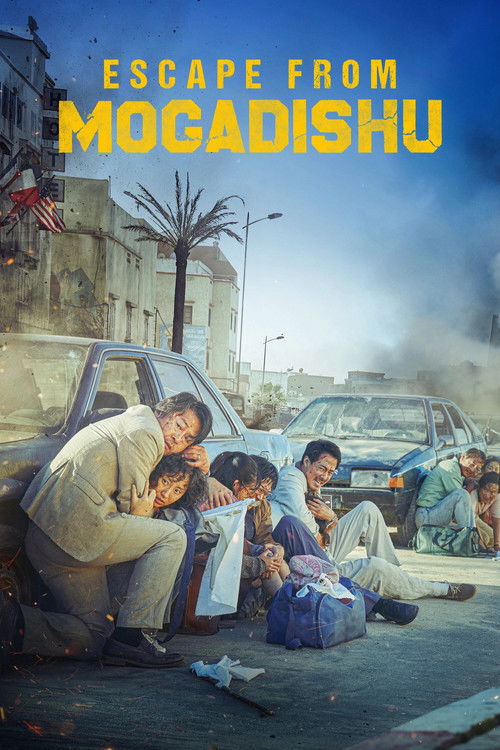
Escape from Mogadishu
A sun-scorched, pulse-pounding survival drama wrapped in devastating geopolitical irony, where sworn Cold War enemies forge an unspoken sanctuary behind sandbags and makeshift armor while the world outside collapses into flames.
Escape from Mogadishu

Escape from Mogadishu

모가디슈

"A city in revolt, we must escape."

28 July 2021 South Korea 121 min 7.1 (213)

Director: Ryoo Seung-wan

Cast: Kim Yun-seok, Zo In-sung, Huh Joon-ho, Kim So-jin, Jeong Man-sik

Drama War History Action Thriller Survival Over Ideology The Tragedy of National Division The Absurdity of Diplomatic Posturing Human Vulnerability in the Midst of Civil Collapse
Box Office: $29,855,981

Overview

Set in late 1990 and early 1991, Escape from Mogadishu reconstructs the real-world diplomatic conflict between South Korea (ROK) and North Korea (DPRK) in Mogadishu, Somalia. At the time, neither Korean state held full membership in the United Nations, leading both delegations to engage in fierce behind-the-scenes lobbying and mutual sabotage to secure Somalia’s crucial diplomatic vote at the UN General Assembly.

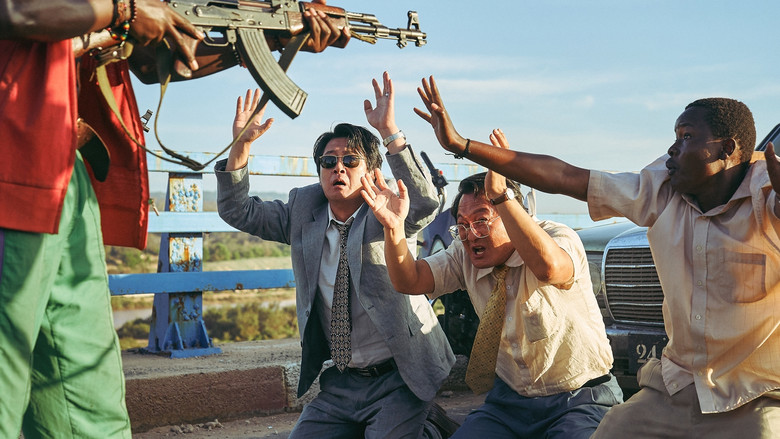
The petty diplomatic warfare abruptly ceases when the Somali Civil War engulfs the capital. Rebel forces advance against dictator Mohamed Siad Barre’s regime, plunging Mogadishu into anarchy. With electrical grids failing, telephone lines severed, and foreign embassies besieged by looters and militias, both diplomatic contingents find themselves trapped without rescue from Seoul or Pyongyang.

Faced with mortal danger, the stranded diplomats must confront their deep-seated indoctrination and mutual hostility. The film tracks their improbable, perilous coalition as they navigate urban crossfire and desperate logistical hurdles in a collective bid to flee the collapsing state alive.
Core Meaning

Director Ryoo Seung-wan uses a harrowing, real-life historical incident to interrogate the tragic absurdity of national division. The film posits that when stripped of ideological rhetoric and state apparatus, shared humanity and cultural kinship naturally supersede artificial geopolitical boundaries.

Crucially, Ryoo avoids saccharine melodrama; the film shows that survival requires pragmatic trust, yet the tragedy of the Korean Peninsula dictates that genuine solidarity must ultimately be suppressed to protect one another from their respective authoritarian security regimes upon returning to civilization.

Thematic DNA

Survival Over Ideology 35%
The Tragedy of National Division 30%
The Absurdity of Diplomatic Posturing 20%
Human Vulnerability in the Midst of Civil Collapse 15%

Survival Over Ideology

When social order collapses, nationalistic dogmas become useless. The diplomats on both sides are trained to view each other as existential threats, yet basic instincts for survival and the protection of children compel them to shelter under one roof and share food.

The Tragedy of National Division

The film illustrates how two groups of people who share the exact same language, history, culinary traditions, and cultural humor are forced by global Cold War politics to act as mortal enemies. Even after saving one another’s lives, they must return to a state of manufactured estrangement.

The Absurdity of Diplomatic Posturing

The early acts showcase the comic pettiness of diplomatic rivalry—bribing local officials, planting false media stories, and sabotaging car rides—contrasted sharply against the profound human catastrophe unfolding around them in Somalia.

Human Vulnerability in the Midst of Civil Collapse

The film presents war not as a glorious ideological crusade, but as an overwhelming force of chaos that indiscriminately threatens diplomats, citizens, and child soldiers alike.

Character Analysis

Han Shin-sung

Kim Yun-seok

Archetype: The Reluctant Statesman / Pragmatic Leader Key Trait: Measured empathy under acute pressure

Motivation

Ensuring the physical survival of all embassy staff and their dependents.

Character Arc

Begins as a mild-mannered, career-focused bureaucrat fixated on landing diplomatic points with Barre. When chaos strikes, he evolves into a courageous leader willing to risk his career and safety to shelter North Korean families.

Kang Dae-jin

Zo In-sung

Archetype: The Rogue Pragmatist / Intelligence Operative Key Trait: Sharp-witted adaptability

Motivation

Outmaneuvering adversaries and getting everyone out alive.

Character Arc

Arrives with a cynical Cold War mindset, orchestrating underhanded tricks. Under fire, his combative drive transforms into tactical ingenuity as he coordinates physical defense and vehicle modifications.

All 5 characters and cast

Symbols & Motifs

The Shared Dinner Table (Perilla Leaves)

Meaning:

Symbolizes breaking ideological bread and realizing shared cultural kinship that transcends political indoctrination.

Context:

When North and South Koreans sit together at the South Korean residence, the North Koreans fear poison. When Ambassador Han visibly eats the dishes and Counselor Kang helps untangle a perilla leaf, the shared domestic ritual breaks the psychological barrier.

Books and Sandbags as Armored Plating

Meaning:

Represents transforming intellectual, educational, and bureaucratic tools into physical armor against brute violence.

Context:

The diplomats wrap their sedans with hardcover books, taped telephone directories, and sandbags to protect themselves during the escape run across Mogadishu.

The White Surrender Flag

Meaning:

Symbolizes pure non-partisan survival and universal surrender, emphasizing shared human vulnerability.

Context:

Waved desperately out of vehicle windows during the drive to signal to both government troops and rebel insurgents that nationality is irrelevant.

Child Soldiers Imitating Gunshots

Meaning:

Reflects the tragic corruption of youth and the loss of innocence in systemic societal collapse.

Context:

Young boys holding assault rifles wander the streets, mimicking violent shooting gestures at the trapped diplomats with fingers and automatic weapons.

Separate Disembarkation Buses

Meaning:

Represents the inevitable return to geopolitical division and Cold War estrangement reclaiming human beings after a moment of unity.

Context:

Upon landing at the airport in Kenya, South and North Korean contingents are boarded onto two separate transport buses under the watchful eyes of state intelligence.

Memorable Quotes

우리의 투쟁 목표는 오직 생존입니다.
— Han Shin-sung

Context

Ambassador Han addresses both South and North Korean contingents gathered together in the South Korean residence.

Meaning

Establishes that survival supersedes all Cold War political disputes and ideological dogmas inside the besieged compound.

여기서 죽으면 공산주의고 자본주의고 다 무슨 소용입니까?
— Kang Dae-jin

Context

Kang urges Tae Joon-ki and the North Koreans to stop suspecting foul play and pool their physical resources.

Meaning

Highlights the ultimate absurdity of ideological division when facing imminent physical death.

All 4 quotes

Philosophical Questions

Is ideology an innate human structure or a fragile artificial construct?

Explored through the speed with which both South and North Korean delegations discard lifelong political dogma once basic physical survival and the protection of children are on the line.

What defines kinship when national identity is divided?

Investigated through shared cultural traditions, language, and everyday domestic rituals (like sharing food) that instantly bridge the gap created by geopolitical hostility.

Can moral goodness survive under institutional surveillance?

Examined in the final moments where diplomats must outwardly perform hatred and cold indifference to ensure the real-world safety of those they just saved.

Alternative Interpretations

Interpretations of the film's silent conclusion generally fall into three perspectives:

Full ending explanation

Cultural Impact

In the late 1980s and early 1990s, the ROK and DPRK engaged in aggressive diplomatic lobbying across Africa to gain votes for UN admission. Both nations were simultaneously admitted to the United Nations in September 1991, just months after the events shown in the film.

Within South Korean cinema, Escape from Mogadishu marks an evolution away from hyper-nationalistic sentimentality (Shinpa) toward grounded political realism. By navigating South Korea's National Security Act through a focus on shared human survival rather than political overtures, the film resonated deeply with contemporary audiences while breaking box office records during the pandemic era.

Audience Reception

Critical and audience reception was overwhelmingly positive, praising the film's relentless pacing, Choi Young-hwan’s kinetic cinematography, and the nuanced performances of Kim Yun-seok and Huh Joon-ho. The DIY armored vehicle escape sequence in the third act was widely acclaimed as a masterclass in tension and practical stunt choreography.

Minor criticism from international reviewers noted that local Somali characters were largely framed as background threats and armed militia rather than being granted individualized character arcs or complex agency.

Interesting Facts

  • The entire production was shot 100% on location in Essaouira and Marrakech, Morocco, over four months from late 2019 to early 2020 just prior to COVID-19 border closures.
  • It marked the first South Korean feature film shot entirely on location in Morocco, involving close coordination with Moroccan military and international stunt teams.
  • The narrative is adapted from the true memoirs of former South Korean Ambassador Kang Shin-sung, who sheltered North Korean Ambassador Han Chang-seop and his staff in January 1991.
  • Director Ryoo Seung-wan insisted on practical car stunts using real 1980s-era sedans reinforced with books and sandbags, using minimal CGI.
  • Actor Huh Joon-ho sustained a real back injury during the filming of high-impact vehicle collisions in the climactic escape sequence.
  • The production employed Somali students residing in South Korea during pre-production to ensure script authenticity, verify dialects, and check period props.
  • Despite being released under Level 4 social distancing restrictions in South Korea, it became the highest-grossing Korean film of 2021 with over 3.6 million admissions.
  • The film was chosen as South Korea's official submission for Best International Feature Film at the 94th Academy Awards and won Best Film and Best Director at the 42nd Blue Dragon Film Awards.

Easter Eggs

Nod to Black Hawk Down and Argo

The visual staging of the embassy siege and evacuation pays homage to Ridley Scott’s Black Hawk Down and Ben Affleck’s Argo, while inverting Hollywood savior tropes by focusing on two divided Asian delegations fending for themselves.

Director Ryoo's Division Thematic Echoes

Serves as a thematic counterpart to Ryoo Seung-wan’s 2013 spy thriller The Berlin File, continuing his exploration of North and South Korean operatives finding fleeting empathy within rigid ideological frameworks.

1988 Seoul Olympics Archival VHS Tapes

The South Korean embassy gifts VHS tapes of the 1988 Seoul Olympics opening ceremony to Somali officials, illustrating Seoul's real-life diplomatic modernization and lobbying efforts at the close of the Cold War.

Authentic 1980s European and Japanese Sedans

The production sourced period-accurate vehicles across North Africa (such as the Mercedes-Benz W123, Peugeot, and Fiat) to faithfully depict Mogadishu street traffic in 1991.

Frequently Asked Questions

Explore More About This Movie

Dive deeper into specific aspects of the movie with our detailed analysis pages

Comments (0)

Leave a comment

No comments yet. Be the first to share your thoughts!

Similar Movies