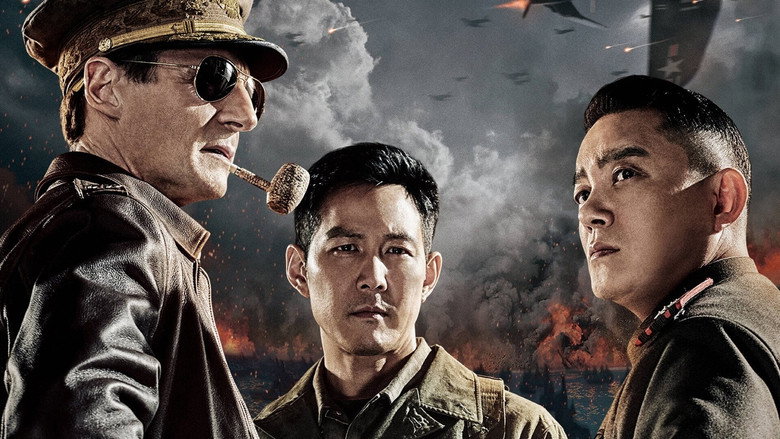
Operation Chromite
인천상륙작전
"The Odds Were 5000 to 1 … One was all They Needed."
Director: John H. Lee
Cast: Lee Jung-jae, Liam Neeson, Lee Beom-soo, Jin Se-yeon, Jung Jun-ho
Overview
Core Meaning
Thematic DNA
Sacrifice of the unnamed
The film's engine is the gap between a famous victory and the invisible people who made it possible. The eight men of Operation X-Ray are given families, debts, jokes and fears precisely so that their erasure registers; by the end the operation succeeds and the team does not survive it, and the film lingers on the loved ones who will never learn what happened.
Brothers on opposite sides of an ideology
Jang Hak-soo and Colonel Lim Gye-jin are constructed as reflections: same tongue, same stubbornness, opposite oaths. Their cat-and-mouse scenes turn interrogation into a debate about which loyalty is real, and the final confrontation plays less like conquest than like a civil war reduced to two men in one room.
The gamble against expert consensus
MacArthur's Incheon plan is introduced as the option every professional rejects — bad tides, sea walls, a single channel. The film dramatises command as the willingness to stake thousands of lives on an intuition, and quietly notes that the same logic sends eight men into the harbour with no way out.
Identity under disguise
The team survives by wearing the enemy's uniform and speaking the enemy's slogans. The longer the masquerade lasts, the more the film worries at the question of what is left of a man who must perform his opposite convincingly — and how thin the line between the two sides really was.
Patriotism as spectacle and as mourning
Openly and deliberately, the film speaks the language of national tribute — flags, anthemic scoring, martyrdom. Critics read this as chest-thumping; the film itself seems to want both registers at once, using the volume of heroism to carry an undertone of loss for a generation consumed in three months of 1950.
Character Analysis
Jang Hak-soo
Lee Jung-jae
Motivation
To complete Operation X-Ray and light the lighthouse so the fleet can enter — and, increasingly, to make his comrades' deaths mean something rather than merely precede his own.
Character Arc
Introduced as a disciplined ROK Navy lieutenant of the Korean Liaison Office, he leads seven men into Incheon in enemy uniform and spends the film holding a disintegrating deception together. As the mission narrows, his role shifts from spy to sacrifice: he loses his team one by one, and in the finale kills Colonel Lim Gye-jin before dying himself, having made the landing possible.
Colonel Lim Gye-jin
Lee Beom-soo
Motivation
To protect Incheon and prove his ideological loyalty absolute, rooting out the infiltrators he can sense but not yet name.
Character Arc
The scrupulous senior North Korean officer commanding Incheon's defences. He suspects the visiting 'inspection unit' almost from the start, and the film builds him as an equal rather than a caricature — a man whose certainty is as complete as Jang's. His hunt tightens across the film until the two commanders meet in a final, fatal confrontation.
Symbols & Motifs
The Palmido lighthouse
The film's central emblem: light as permission. It stands for the tiny human act on which enormous historical machinery depends, and for knowledge itself — the fleet cannot move until someone illuminates the way.
Lighting the lighthouse is one of X-Ray's mission directives, the agreed signal for the invasion; MacArthur commits the fleet to the channel only once the beam appears. The lamp is therefore also the team's death sentence, since a light in a blacked-out harbour tells the enemy exactly where to aim.
The North Korean uniform
A second skin that symbolises both the interchangeability of the two Koreas and the moral cost of deception — protection that can be mistaken for betrayal.
The team infiltrates Incheon disguised as a North Korean inspection unit, and much of the tension comes from small failures of costume and vocabulary under Colonel Lim's scrutiny.
The tides and sea walls of Incheon
Nature as the true adversary, and as a metaphor for a narrow window of opportunity: a few hours a month in which history can be reversed.
The hostile tidal range is the argument used against the landing in the planning scenes, and it converts MacArthur's decision from tactics into faith.
Maps and charts of the harbour
Information as the real ammunition of modern war; the fetish object of the whole plot is a drawing, not a weapon.
The mission exists to locate mines and coastal batteries, so the film's most valuable prize is intelligence carried in a notebook or a memorised diagram rather than territory taken.
MacArthur's pipe, glasses and posture
The iconography of the legend — a man already performing his own monument, which is why he functions in the film as myth rather than psychology.
Liam Neeson plays MacArthur largely in briefing rooms and aboard ship; reviewers noted how much the performance leans on the familiar silhouette, and how stiff the character's pronouncements sound as a result.
Philosophical Questions
Can a commander ethically spend a few lives to save many?
MacArthur sends eight men on a mission with no realistic extraction, and argues for a landing his own staff calls suicidal. The film never lets him articulate the arithmetic honestly; instead it shows the answer — the operation works, everyone sent dies — and leaves the viewer to decide whether success settles the moral question or merely closes it.
What is left of a man who must perfectly impersonate his enemy?
Jang's team survives by wearing North Korean uniforms and reciting North Korean convictions. The longer the masquerade lasts, the more the film implies that the performance is frighteningly easy, because the two sides were one people weeks earlier — identity here is a costume the war handed out.
Who owns a victory?
History records Incheon as MacArthur's masterstroke; the film relocates the decisive act to eight anonymous Koreans and a lighthouse switch. By splitting its screen time between the legend and the expendables, it asks whether credit belongs to the mind that conceives a plan or the bodies that make it physically possible.
Is a death meaningful if no one will ever know about it?
The X-Ray operatives die deniable, their families left without answers. The film's answer is deliberately double: the mission's success gives the deaths objective weight, while the closing emphasis on those who will never learn the truth insists that meaning without witness is a kind of second loss.
Alternative Interpretations
<p><strong>As patriotic monument.</strong> The most straightforward reading, and the one the film's own rhetoric invites: a tribute to real, largely forgotten intelligence operatives, with the annihilation of the X-Ray team functioning as sanctified martyrdom. Domestic box office suggests this is how millions of viewers took it.</p> <p><strong>As propaganda, rea...
Cultural Impact
Audience Reception
Interesting Facts
- The film is a fictionalisation built on two real intelligence operations that preceded the Incheon Landing: Operation X-Ray, run by the ROK Navy intelligence unit, and the American Operation Trudy Jackson, which involved the Korean Liaison Office and the CIA.
- Principal photography began on 4 December 2015 and wrapped on 10 March 2016.
- The production was made for a budget of about US$12.7 million and grossed roughly US$50.9 million worldwide — close to four times its cost.
- Liam Neeson's casting as General Douglas MacArthur was credited with helping the film open strongly in South Korea; it took about US$13.5 million, or 1.79 million admissions, over its first weekend (29–31 July 2016).
- Director John H. Lee co-wrote the screenplay as well as directing.
- An 'Extended Edition' of the film was subsequently released, running longer than the theatrical cut.
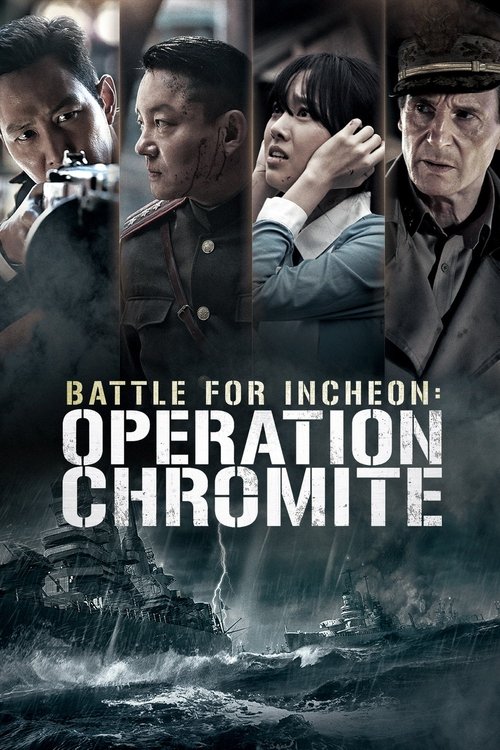
- For international markets the film circulated under the title 'Battle for Incheon: Operation Chromite'.
- North Korean state media weighed in before the film had even finished its domestic run: the outlet Uriminzokkiri dismissed it as the product of 'ridiculous bravado from ignorant lunatics'.
- Reviews were sharply split from the reception at home: overseas critics called the film variously 'creaky and clunky' and 'so bad it's almost spellbinding', while praising individual set-pieces, shoot-outs and chases.
Frequently Asked Questions
Explore More About This Movie
Dive deeper into specific aspects of the movie with our detailed analysis pages

Comments (0)
No comments yet. Be the first to share your thoughts!