Skip to content
Prisoner of War
A savage World War II martial arts epic where a downed British flyer becomes a gladiator in the mud — sweat, monsoon rain and blood-caked fists standing in for the last scrap of a man's dignity.
Prisoner of War

Prisoner of War

"Fight to survive."

19 September 2025 Philippines 113 min 7.1 (208)

Director: Louis Mandylor

Cast: Scott Adkins, Peter Shinkoda, Michael Copon, Gabbi Garcia, Michael Rene Walton

War History Action Thriller Dignity under dehumanisation Brotherhood forged in captivity Violence as entertainment and as control Historical atrocity and remembrance Honour codes in collision
Budget: $2,000,000
Box Office: $94,700,000

Overview

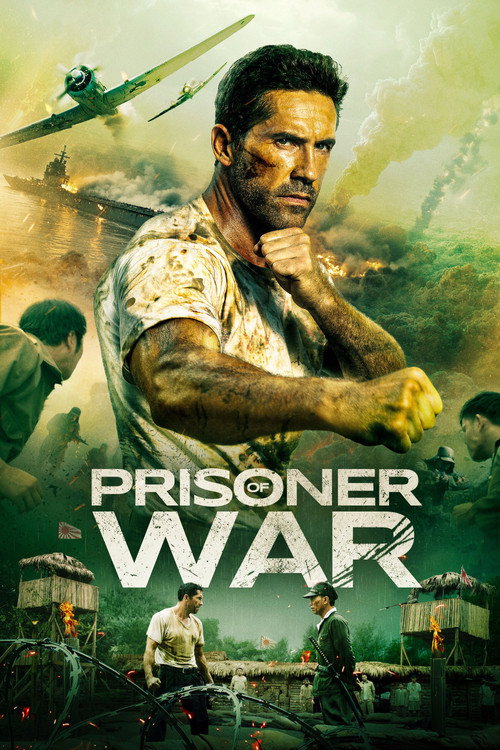
Prisoner of War (2025) is a martial arts war film directed by Louis Mandylor, written by Marc Clebanoff from a story by star Scott Adkins. Adkins plays Wing Commander James Wright, a Royal Air Force officer shot down over the Philippines and taken by Japanese forces into a brutal prisoner-of-war camp during the earliest, darkest months of the Pacific war.

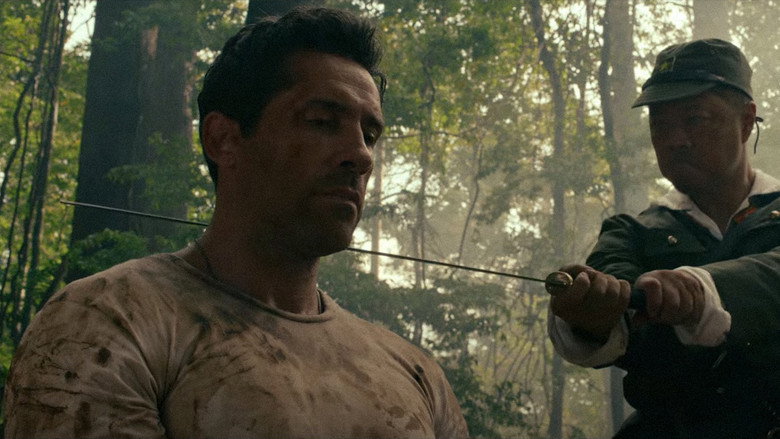
Inside the wire, survival is not simply a matter of enduring starvation and forced labour. The camp is overseen by Lieutenant Colonel Benjiro Ito (Peter Shinkoda), who stages bare-knuckle death matches between prisoners for the entertainment of his officers. Wright, a trained fighter, quickly becomes the camp's prize attraction — and discovers that every victory in the ring buys food, medicine and time for the men around him, at a cost to his own soul.

As Wright forms bonds with fellow captives — among them Captain Collins (Donald Cerrone), the Filipino soldier Villanueva (Michael Copon), Jonesy (Gary Cairns) and the man known only as The Beard (Michael Rene Walton) — talk turns from surviving the next bout to escaping altogether, with the looming spectre of the Bataan Death March pressing down on everyone in the compound. The film premiered at the Beverly Hills Film Festival on 3 April 2025 and was released in US cinemas and on VOD by Well Go USA on 19 September 2025.
Core Meaning

At its heart, Prisoner of War argues that dignity is the last territory a man defends. Adkins conceived the story after being inspired by David Lean's The Bridge on the River Kwai (1957), and the film inherits that classic's central preoccupation: what a soldier holds onto when rank, weapons, nation and even the war itself have been stripped away from him.

Mandylor stages the death matches not as spectacle for its own sake but as a moral trap. Every fight Wright wins keeps his comrades fed; every fight he wins also makes him a more valuable instrument of his captors' amusement. The film's message is that resistance is rarely heroic in the clean sense — it is compromised, humiliating, negotiated in inches, and its true measure is not whether you beat the man in front of you but whether you can still see him as a man.

By anchoring an action premise to the real history of the Bataan Death March, the film also insists on remembrance as a moral act: that the Filipino and Allied soldiers who died in that atrocity are owed something more than being a footnote, and that the genre muscle of a fight film can carry historical grief without cheapening it.

Thematic DNA

Dignity under dehumanisation 30%
Brotherhood forged in captivity 25%
Violence as entertainment and as control 20%
Historical atrocity and remembrance 15%
Honour codes in collision 10%

Dignity under dehumanisation

The camp system is designed to reduce men to livestock — numbered, starved, wagered upon. Wright's arc turns on whether performing for his captors is capitulation or the only available form of defiance. His refusal to break eye contact, to beg, or to kill an opponent on command becomes the film's true combat.

Brotherhood forged in captivity

The bonds between Wright, Collins, Villanueva, Jonesy and The Beard form the film's emotional spine. Rations shared, wounds bound, a name spoken aloud — these small acts of solidarity are shown as more strategically important than any punch, and it is the group, not the lone hero, that makes escape conceivable.

Violence as entertainment and as control

Ito's staged bouts weaponise spectacle: the ring keeps the prisoners divided against each other rather than against the guards. The film is self-aware about its own genre, implicating the audience in the same appetite that the Japanese officers indulge — we came to watch Scott Adkins fight, and the film asks what that appetite costs.

Historical atrocity and remembrance

The looming Bataan Death March gives the fight-film premise a documentary weight. The Filipino characters, especially Villanueva, ground the story in a national trauma rather than a purely Anglo-American one, insisting that the camp is not an arena but a real place where thousands died.

Honour codes in collision

Ito is not written as a cartoon sadist but as a man operating inside a rigid warrior code that permits cruelty in the name of honour. Wright's Western military ethic and Ito's bushido-inflected one recognise each other even as they destroy each other — the film's most interesting friction is between two disciplines, not two nations.

Character Analysis

Wing Commander James Wright

Scott Adkins

Archetype: Reluctant gladiator / stoic hero Key Trait: Understated, contained ferocity

Motivation

Initially to stay alive and keep his men fed; ultimately to get his fellow prisoners out and to deny his captors the pleasure of watching him break.

Character Arc

Begins as a disciplined RAF officer confident in the structures of rank and duty; his plane is shot down and those structures evaporate. He becomes the camp's prize fighter, then slowly recognises that his real command responsibility is to the men in the barracks rather than to his own survival, moving from isolated endurance to leading an escape.

Lieutenant Colonel Benjiro Ito

Peter Shinkoda

Archetype: Antagonist / mirror figure Key Trait: Icy formality masking cruelty

Motivation

To assert dominance and honour through his prisoners' submission, and to find in Wright an adversary equal to his own self-image.

Character Arc

The camp commandant who devises the death matches. He is drawn as a man of code and control rather than a raving sadist, and his fascination with Wright as a worthy opponent gradually corrodes the detachment on which his authority depends.

All 5 characters and cast

Symbols & Motifs

The fighting pit

Meaning:

A microcosm of the war itself: an enclosed patch of earth where men who have no quarrel with each other are made to destroy one another for the profit and pleasure of those who watch from above.

Context:

The camp's death matches, staged for the Japanese officers, are the film's structural spine; every escalation of the plot is measured by another descent into the pit.

Monsoon rain and mud

Meaning:

Erasure and levelling. Rain dissolves uniforms, insignia and skin colour into the same brown sludge, visually arguing that captivity has flattened every man to the same raw material.

Context:

Shot on location in the Philippines during the rainy season — conditions so severe the set washed away more than once — the weather is less a backdrop than an antagonist woven through the whole film.

The RAF uniform

Meaning:

Identity and rank as vanishing property. Wright's status as a wing commander is meaningless inside the wire, and what remains of the uniform tracks how much of the officer is left inside the fighter.

Context:

Established at the moment of his shoot-down and capture, then progressively stripped, torn and soiled across the camp sequences.

Food and the ration bowl

Meaning:

The currency of the moral economy. Calories are the prize for winning, so every mouthful Wright earns is implicitly taken from someone else's body.

Context:

Recurs in the barracks scenes, where sharing or hoarding food defines who the prisoners really are to each other.

The road out of the camp

Meaning:

False deliverance. The prisoners fixate on getting beyond the wire, but history has already decided that the road leads to the Bataan Death March — freedom of movement is not freedom.

Context:

Threaded through the escape planning and the film's final movement, when the camp is emptied for the march.

Hands

Meaning:

The last weapon and the last instrument of tenderness. The same fists that are made to kill are the ones that tend a comrade's wounds.

Context:

Emphasised in the film's bare-knuckle choreography, where the absence of weapons is the whole point of the combat design.

Philosophical Questions

Is participating in your oppressor's spectacle a form of resistance or a form of collaboration?

Wright's victories in the pit buy food and survival for his fellow prisoners, yet they also entertain the men who imprison him and reinforce the camp's power structure. The film refuses a clean answer, letting each fight accumulate both moral credit and moral debt.

What remains of a person once rank, nation and uniform are taken away?

Stripped of his RAF authority, Wright must discover whether his identity was ever really located in the insignia. The camp becomes a laboratory in which the film tests what is essential and what was only institutional.

Can an honour code justify atrocity?

Ito acts within a rigid warrior ethic that he genuinely believes elevates him, while presiding over systematic cruelty. The film uses him to ask whether a coherent code of honour is any protection against becoming monstrous, or whether it is precisely what enables it.

Is courage meaningful when the outcome is already lost?

The shadow of the Bataan Death March means the prisoners' defiance cannot save most of them. The film suggests that the value of an act of resistance may lie entirely in the act itself rather than in what it achieves.

What do the living owe the anonymous dead?

A character known only as The Beard, and the mass of unnamed Filipino and Allied prisoners around him, embody the historical reality that most victims of the march are remembered only as a number. The film's own existence functions as an argument that dramatising them is a form of debt payment.

Alternative Interpretations

The film as straightforward war heroism. Read at face value, it is a tale of Allied endurance and eventual defiance — a man who refuses to be broken, and comrades who choose each other over self-preservation. On this reading the death matches are simply the obstacle course of an escape thriller.

Full ending explanation

Cultural Impact

Prisoner of War arrives as part of a broader push by Scott Adkins to move beyond pure fight vehicles into films with dramatic and historical weight. Coming from a story Adkins developed himself, the project is openly positioned as a descendant of the classic POW picture — The Bridge on the River Kwai above all — reimagined through the grammar of the martial arts tournament film. That hybrid is its main contribution: it fuses the prestige war-drama setting with the underground death-match subgenre, a combination the action press singled out as unusually effective.

Historically, the film's decision to build on the Bataan Death March gives it a stake in a memory that remains central to Filipino and American commemoration of the Pacific war. The presence of Filipino performers including Gabbi Garcia and Michael Copon, and shooting on location in the Philippines, tie the production to the ground the story depicts rather than to a generic backlot jungle.

Critically, the reception among genre outlets was strongly positive: reviewers described it as a savage, stripped-down and visceral martial arts war epic and repeatedly highlighted that Adkins reveals an emotional range beyond what audiences expect of him, playing Wright with a contained ferocity that erupts only when earned. Its festival route through the Beverly Hills Film Festival and Big Bad Film Fest before a Well Go USA theatrical-and-VOD release is characteristic of how contemporary action cinema builds word of mouth outside the studio system.

Audience Reception

Praised: Genre critics responded warmly, describing the film as a savage, stripped-down and visceral martial arts war epic. The action design drew particular admiration for taking the underground death-match premise and wringing full value from it with fights that blend multiple styles. Reviewers also credited Mandylor's location work in the Philippines with giving the film a grimy authenticity that most DTV-budget war pictures never reach.

Adkins' performance: The most consistent point of praise was that this is a different Scott Adkins than audiences expect — playing Wright with understated intensity that erupts only at the right moments, and showing an emotional range that reviewers read as evidence of a serious dramatic actor behind the martial artist. That his own story concept underpins the film added to the sense of a passion project.

Points of debate: The chief tension viewers weigh is tonal — whether a fight-tournament framework can carry the historical weight of the Bataan Death March without trivialising it, and whether the film's most crowd-pleasing sequences sit comfortably alongside its atrocity setting. The R rating for strong violence signals just how unsparing the film is willing to be.

Verdict: Received as one of the standout action films of 2025 within the martial arts community, and as a genuine step up in ambition for the Adkins–Mandylor partnership.

Interesting Facts

  • The story originated with star Scott Adkins, who was inspired by David Lean's 1957 classic The Bridge on the River Kwai and conceived a World War II tale of a British officer forced to fight for his life; the screenplay was then written by Marc Clebanoff.
  • Director Louis Mandylor brought in his Odyssey Motion Pictures partner Marc Clebanoff to write and produce the film.
  • The film reunites Adkins with Louis Mandylor, who co-starred with him in The Debt Collector — this time with Mandylor behind the camera rather than in front of it.
  • Shooting took place on location in the Philippines during the rainy season; the production endured typhoon conditions and the set washed away more than once, though the filmmakers felt the punishing weather was giving them exceptional footage.
  • Adkins injured himself on the very first day of shooting, and the physical toll of the on-location shoot became a story in itself among the cast and crew.
  • The premise is anchored to the real history of the Bataan Death March, in which thousands of Filipino and American soldiers died — the camp story unfolds before the prisoners are forced onto the march.
  • Former UFC fighter Donald Cerrone appears as Captain Collins, one of Wright's fellow prisoners, bringing genuine combat-sports credibility to the death-match sequences.
  • The MPA rated the film R for strong violence and some language, a classification reported in late August 2025 ahead of release.
  • The film world premiered at the Beverly Hills Film Festival on 3 April 2025 and also screened at the Big Bad Film Fest before its wide release.
  • Well Go USA picked up the film for distribution, releasing it in US cinemas and on VOD on 19 September 2025.

Easter Eggs

The Bridge on the River Kwai DNA

Adkins has said outright that the 1957 David Lean film inspired his story. Viewers familiar with it will recognise the architecture — the British officer whose sense of discipline collides with a Japanese commandant's code inside a Pacific-theatre labour camp — repurposed here for a martial arts framework.

Casting Donald Cerrone, a real UFC veteran, as a POW fighter

A wink to combat-sports fans: the death-match conceit is populated by an actual professional cage fighter, blurring the line between staged movie violence and the real thing in a film that is explicitly about violence staged for an audience.

The Adkins–Mandylor reunion

The pair previously appeared together on screen in The Debt Collector; here Mandylor directs. For followers of the modern DTV action scene, the collaboration itself functions as a recurring signature across their filmographies.

Frequently Asked Questions

Explore More About This Movie

Dive deeper into specific aspects of the movie with our detailed analysis pages

Comments (0)

Leave a comment

No comments yet. Be the first to share your thoughts!

Similar Movies