Skip to content
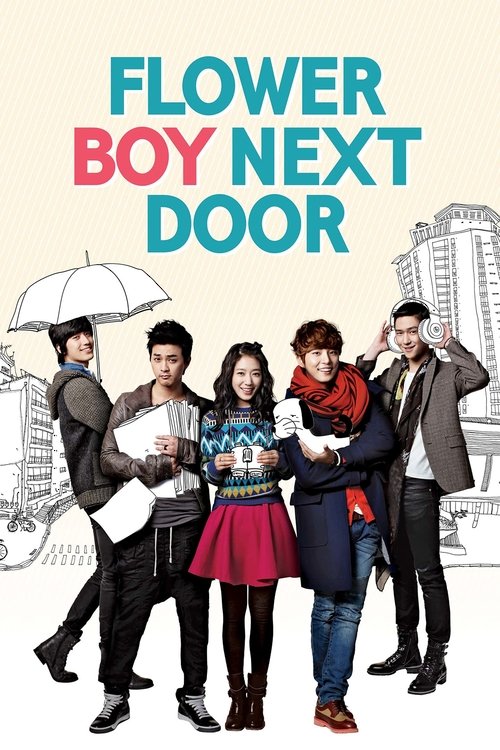
Flower Boy Next Door
A tender, sunlit romantic comedy about a woman who lives behind drawn curtains — where loneliness is a locked apartment door and love arrives as a stranger too loud to ignore.
Flower Boy Next Door

Flower Boy Next Door

이웃집 꽃미남

07 January 2013 — 26 February 2013 South Korea 1 season 16 episode Ended 8.1 (127)

Cast: Park Shin-hye, Yoon Shi-yoon, Kim Ji-hoon, Park Soo-jin, Kim Yoon-hye

Drama Comedy Loneliness and self-imposed isolation Watching versus being seen Trauma, scars and the ethics of healing Masks, pen names and the art we hide behind Found community in a small building

Overview

Flower Boy Next Door (이웃집 꽃미남) is a sixteen-episode South Korean romantic comedy that aired on tvN from January 7 to February 26, 2013, on Monday and Tuesday nights at 23:00 KST. It was the third installment of the cable channel's "Oh! Boy" flower boy franchise, following Flower Boy Ramyun Shop and Shut Up Flower Boy Band, and it adapts the webtoon I Steal Glances At You Every Day.

The story belongs to Go Dok-mi (Park Shin-hye), whose name literally means something close to "lonely beauty" — a young woman who almost never leaves her apartment and whose one daily ritual is watching, from behind her curtain, the man who lives across the way. Her private world cracks open when a different neighbor, the relentlessly bright game designer Enrique Geum (Yoon Shi-yoon), catches her in the act. What follows is less a chase than a slow excavation: Enrique keeps inventing reasons to appear, the quiet webtoon artist Oh Jin-rak (Kim Ji-hoon) keeps loving her from a careful distance, and the shared corridors and rooftops of one small residential building turn into a net that keeps catching her.

Rather than manufacturing dramatic catastrophe, the series builds its arc out of small acts of approach and retreat. Over its run it widens from one woman's agoraphobic hermitage to an ensemble of neighbors who are all, in their own ways, hiding — behind pen names, behind cheerfulness, behind a foreign language, behind old cruelties. The unfolding question is not simply who Dok-mi will choose, but whether she can bear to be seen at all, and what the people around her must risk to be seen in return.

Core Meaning

The series argues that the opposite of loneliness is not romance but recognition — the experience of being looked at closely and not flinched away from. Its heroine has organized an entire life around avoiding that gaze, and the drama's patient thesis is that healing does not come from being rescued by a prince but from the slow, unglamorous work of unlocking one's own door.

Its second and quieter claim is about empathy as a discipline. As Enrique puts it, love is understanding the other person; the show keeps insisting that once people have actually shared time in the same room, they can feel the simple fact that the other person is another human being just like me, who can get hurt like me. Cruelty in this story is almost always a failure of imagination — the onlooker who never measured the depth of someone's scar and so cannot understand why they don't simply climb out of the water.

Finally, it is a defense of the small life. The building, the corridor, the shared meals, the handwritten note — the series treats an ordinary neighborhood as sufficient territory for a whole emotional epic, and treats the decision to stay, speak, and be known as the bravest thing a person can do.

Thematic DNA

Loneliness and self-imposed isolation 28%
Watching versus being seen 24%
Trauma, scars and the ethics of healing 20%
Masks, pen names and the art we hide behind 16%
Found community in a small building 12%

Loneliness and self-imposed isolation

The show opens with a heroine who has made a fortress of a one-room apartment, and it treats her withdrawal seriously rather than comically. Her curtain, her headphones and her refusal to answer the door are not quirks but symptoms.

Across the sixteen episodes the isolation is progressively dismantled from the outside in: first the building's neighbors force proximity, then proximity forces conversation, then conversation forces confession. By the closing stretch the drama has redefined solitude — not as something to be cured by another person, but as something Dok-mi chooses to step out of on her own terms.

Watching versus being seen

Every relationship in the series begins as surveillance. Dok-mi watches the man across the way; Jin-rak watches Dok-mi; Enrique watches everyone and narrates what he sees. Looking is the show's native language of desire, and also its native cowardice.

The arc bends from voyeurism toward mutuality: the safe, one-directional gaze is steadily replaced by the terrifying reciprocal one. The final movement of the story literally reverses the premise — the woman who spent her life peering out from behind a curtain ends up as the author of a story that others will read.

Trauma, scars and the ethics of healing

Dok-mi's withdrawal has a cause, and the series unspools it gradually rather than deploying it as a single twist. Her most pointed line indicts bystanders who don't know the depth of another's scars and still demand to know why they can't just pull themselves out of the water.

The drama refuses easy repair. Some wounds are addressed and some — notably a ruined friendship — are simply left ruined, which is precisely the show's point: recovery is not the same as restoration, and moving forward does not require everyone to be forgiven.

Masks, pen names and the art we hide behind

Nearly every character produces something under a false front: a webtoon drawn in another's name, a game built by a man who won't sit still, a cheerfulness worn like armor, a diary written in the third person.

The series treats creative work as both hiding place and confession booth. The long-run development is that each character's art migrates from disguise to signature — the culminating gesture of the finale is someone finally opening a new file and beginning to write, at last, in a voice that is her own.

Found community in a small building

The apartment block functions as the show's real protagonist: a vertical village of misfits — artists, a foreign lodger, an ex-friend, a boy who cooks — whose lives intersect through corridors, deliveries and shared walls.

What begins as irritating intrusion is gradually revealed as the mechanism of rescue. By the end the neighborhood has become a chosen family, and the series' warmth comes less from the central romance than from the accumulated evidence that other people, however inconvenient, are the cure.

Character Analysis

Go Dok-mi

Park Shin-hye

Archetype: Wounded recluse / reluctant hero Key Trait: Guarded interiority — enormous feeling kept behind an unmoving face

Motivation

Initially, pure self-protection: to avoid being seen, judged, or hurt again. This mutates into a wish to be understood without having to explain, and finally into an active desire to speak for herself and be known on her own terms.

Character Arc

She begins as a shut-in whose entire emotional life is conducted through a curtain, and whose name itself marks her as a 'lonely beauty'. The early episodes reveal an apparently closed-off woman; the middle stretch exposes how much strength and pain lie underneath, as an old betrayal surfaces and forces her to confront the person who caused it.

Her long arc is a steady widening of territory — from apartment to corridor to street to the world — and a shift from being written about to writing. Even in the finale she is still catching herself narrating her own life in the third person, a beautifully unfinished detail: the show lets her be healed enough rather than cured.

Enrique Geum

Yoon Shi-yoon

Archetype: Trickster catalyst / sunshine disruptor Key Trait: Aggressive, unembarrassed warmth

Motivation

At first, curiosity and the compulsion to fix and cheer; his stated creed is that you have to love people to make games. That instinct deepens into a specific, adult commitment to one person, and to loving her without shrinking either of their lives.

Character Arc

He arrives as an irrepressible game designer based in Spain, all noise and motion, functioning as the crowbar that pries Dok-mi's door open. The comedy of his early episodes conceals a man using relentless brightness to avoid his own losses.

Over the run his energy is slowly converted from performance into presence: he stops entertaining people and starts understanding them. His closing position — knowing exactly what matters to him and that it is the person standing beside him — is the payoff of a character who spent sixteen episodes learning to be still.

All 4 characters and cast

Symbols & Motifs

The curtain and the window

Meaning:

The single most loaded object in the series: a membrane between watching and being watched, safety and exposure. To draw it is to choose the world; to close it is to choose the wound.

Context:

Introduced in the premiere as the frame for Dok-mi's daily glances at her neighbor, and returned to at every emotional threshold. The show's visual grammar repeatedly shoots her through glass, so that even her freedom is initially framed by a pane.

The door and the doorbell

Meaning:

Consent, and the violence of intrusion. Who is allowed to knock, and who is allowed in, is the show's running measure of intimacy.

Context:

Enrique's comic refusal to respect the door — appearing uninvited, inventing pretexts, as the series' own episode title has it, making up a hundred reasons to meet by chance — is the engine of the plot's first half.

The Rapunzel / fairy-tale princess motif

Meaning:

The story's ironic frame. The tower romance promises rescue by a prince; the drama withholds it, insisting the tower must be left from the inside.

Context:

Dok-mi is explicitly written as a modern Rapunzel shut in her apartment, and she dismantles the fantasy herself with the line telling Jin-rak that he had it wrong all along — she is not the princess.

The webtoon and the manuscript

Meaning:

Authorship as identity. Drawing or writing under someone else's name is the show's shorthand for a life lived by proxy.

Context:

Jin-rak's comic and Dok-mi's writing run in parallel throughout; the finale's image of her opening a new file titled That Woman's World converts a life of watching into an act of making.

Food and shared meals

Meaning:

The least verbal form of care in the series — nourishment offered where words would be refused.

Context:

Deliveries, cooked dishes and rooftop meals recur as the neighbors' way of breaching Dok-mi's isolation without demanding she explain herself.

Spain and the animation project

Meaning:

The wider world, and the possibility that love need not mean confinement. Distance becomes a test of whether two people can stay chosen.

Context:

Enrique's life abroad frames the story at both ends, and the epilogue set a year later — with his animation being made in Spain — resolves the question of whether staying and going are truly opposites.

Memorable Quotes

Love is understanding the other person.
— Enrique Geum

Context

Spoken by Enrique in connection with his creative philosophy that you have to love people in order to make games; it recurs as the principle guiding his approach to Dok-mi. (Quoted here in English translation, as circulated in international subtitles.)

Meaning

The show's thesis compressed into one line. It reframes romance as an act of cognition rather than passion, and sets the standard against which every relationship in the series is measured.

You have to love people to make games.
— Enrique Geum

Context

Delivered as an offhand explanation of his work as a game designer, it doubles as a self-portrait of a man who cannot stop reaching toward others.

Meaning

Links art to empathy: the maker must first care about who is on the other side. It also quietly explains Enrique's obsessive interest in his neighbors — for him, curiosity about people is a vocation.

All 6 quotes

Episode Highlights

Episode 1

S1E1

Establishes the premise with unusual economy: a young woman who almost never leaves her apartment is caught mid-glance at the neighbor she watches every day — not by him, but by a stranger across the way. The intrusion that will define the series happens in its first hour.

Significance:

The premiere sets the show's central mechanism — surveillance interrupted by unwanted contact — and its tone of comedy layered over genuine agoraphobic distress. Viewers widely praised these opening episodes as the most charming stretch of the run.

Episode 16 (Final)

S1E16

The finale is built around the difference between what each character thought love was and how that idea changes once they have actually lived it. Dok-mi is still narrating herself in the third person, and the closing image is of her opening a new file titled That Woman's World. An epilogue jumps forward a year to Enrique in Spain, working on his animation, clear at last that the thing that matters most is the person standing beside him.

Significance:

It resolves the romance without dissolving the characters' separateness: two very different people who met by chance choose each other with maturity and honesty, valuing the road they took even though the future can't be predicted. Notably, it withholds the conventional tidy pairings — the second leads are not matched off, and the broken friendship is not repaired — a restraint that many reviewers considered the ending's greatest strength.

Philosophical Questions

Can another person pull you out of isolation, or must you leave it yourself?

The series stages the question through its fairy-tale frame and then dismantles it. Dok-mi is explicitly written as a Rapunzel in a tower, and both male leads audition for the role of rescuer — one by battering at her door, one by standing guard outside it. Her own line, that the man who loved her had it wrong the whole time and she is not the princess, is the show's verdict: intervention can create the conditions for change, but the door opens only from the inside.

What do we owe to pain we cannot see?

Dok-mi's most cutting passage attacks the onlookers who don't know the depth of another's scars and still ask why she can't simply pull herself out of the water. The drama builds a whole ensemble of people who misjudge each other on the basis of surfaces — a cheerful man assumed to be shallow, a silent one assumed to be cold, a charming woman assumed to be kind — and quietly proposes that the minimum ethical requirement is to assume a depth you cannot yet measure.

Is love a feeling or a form of knowledge?

Enrique's formulation — that love is understanding the other person, and that you have to love people to make games — makes empathy the precondition of both art and romance. The finale then tests it directly by contrasting what each character believed love to be with what they discover once they've actually lived it, coming down firmly on the side of love as attention: the willingness to keep learning someone rather than to keep wanting them.

Does watching someone from a distance count as knowing them?

Every character in the building has been observing another for a long time, and the series systematically demonstrates that this yields almost no real information. Jin-rak has watched Dok-mi for years and still misreads her; Dok-mi's daily glances across the way are a fantasy, not a relationship. Only reciprocal exposure produces knowledge, which is why the show's turning points are all moments when someone is caught looking.

Must a wound be reconciled to be survived?

By refusing to restore the broken friendship at the center of Dok-mi's trauma, the drama separates healing from forgiveness. Its position is that a person can be made whole enough to live fully without the original harm ever being resolved — and that insisting on reconciliation is often another demand made by people who never measured the damage.

How It Ends

Alternative Interpretations

Romance or recovery narrative? The most common split among viewers concerns what the show is actually about. One reading takes it as a love triangle in which the choice between the extrovert and the guardian is the point. The other — supported by the finale's own emphasis on how each character's idea of love changed once they experienced it firsthand — treats the romance as scaffolding for a study of one woman's return to the world, in which the men are catalysts rather than prizes.

Full ending explanation

Cultural Impact

Flower Boy Next Door arrived at a moment when tvN was aggressively differentiating itself from terrestrial broadcasters by building youth-targeted, franchise-branded cable dramas. As the third installment of the channel's "Oh! Boy" flower boy line — after Flower Boy Ramyun Shop and Shut Up Flower Band — it helped consolidate a template that mattered a great deal to the subsequent decade of Korean television: shorter, cheaper, tonally specific cable romances aimed at a young demographic, built on a distinctive visual signature rather than star-driven spectacle.

Its most durable contribution is thematic. In a genre landscape then dominated by chaebol heirs, amnesia and terminal illness, this series made an agoraphobic shut-in its heroine and treated her withdrawal as a legitimate psychological condition rather than a quirk to be cured by a kiss. English-language critics singled out exactly this: a show unafraid of emotion, whose best episodes spend more time on characters talking about their feelings than on plot mechanics. That willingness to slow down anticipated the later wave of "healing dramas" that would become a defining Korean export.

It also sits at a hinge point in Park Shin-hye's career, immediately preceding her breakout run of hit romantic leads, and it drew unusual attention among international viewers for its design — a blue/grey/orange palette and meticulously chosen props that reviewers described as beautiful and striking. Its adaptation from the webtoon I Steal Glances At You Every Day is likewise part of a broader shift, as webtoons moved from niche source material to the primary feedstock of Korean screen drama.

Commercially it was never a phenomenon — it was a late-night cable show with modest ratings — but it has aged into a persistent cult favorite, regularly cited in English-language retrospectives as one of the genre's better-written romances and as comfort viewing for people who recognize themselves in its heroine.

Audience Reception

Overall verdict: warmly regarded but divisive in its back half. The series holds a 7.1 on IMDb, and English-language critics have called it a very well written and acted work and one of the top romances in the K-drama genre. Its reputation has proved durable, and it is frequently recommended in retrospectives as a quieter, more emotionally literate alternative to mainstream network romance.

What was praised: reviewers consistently highlighted the show's emotional courage — it is not afraid of emotion, and its best episodes spend more time on characters talking about their feelings than on narrative or plot development. The characterization of Dok-mi drew particular admiration: a heroine who appears completely closed off but is gradually revealed to carry enormous strength and pain, and who visibly grows by the end. The production design was another common point of praise, with the blue/grey/orange palette and the carefully chosen props singled out as beautiful and striking. Critics also credited the writing for building an intelligent love triangle around an introvert rather than the usual extroverted heroine, and for making viewers genuinely feel for characters who behave like real people.

The main criticism: pacing in the final stretch. A recurring complaint is that the show drags in its last few episodes, and one widely shared framing calls it a big tease — audiences absolutely loved the first few episodes but were disappointed by where the story went and how it got there. The gap between the sparkling early premise and the more diffuse middle-to-late run is the single most consistent grievance.

Contested points: the finale's decision to withhold conventional resolutions split viewers. Its refusal to pair the second leads or to repair the destroyed friendship frustrated those who wanted closure, while others considered it the ending's integrity — a satisfying and meaningful conclusion to the journey precisely because it declined to throw in the kitchen sink of resolutions. Opinion has trended favorably over time: the show was a modest late-night cable performer that has been steadily re-evaluated upward by international audiences who value its treatment of loneliness.

Interesting Facts

  • The series aired on tvN from January 7 to February 26, 2013, in the Monday–Tuesday 23:00 KST slot, running 16 episodes.
  • It was the third installment of tvN's "Oh! Boy" flower boy drama franchise, following Flower Boy Ramyun Shop and Shut Up Flower Boy Band.
  • The story is adapted from the webtoon I Steal Glances At You Every Day.
  • It was created by Choi Jin-hee and Park Ji-young, written by film screenwriter Kim Eun-jung, and directed by Jung Jung-hwa.
  • Director Jung Jung-hwa had previously helmed the franchise's earlier entry Flower Boy Ramyun Shop (released internationally as Cool Guys, Hot Ramen).
  • The residential buildings that anchor the story are actually only two stories tall; computer graphics were used to turn them into five-story buildings on screen.
  • Rather than using 3D fonts, the production switched to hand-written on-screen titles starting from episode 3, specifically to give the show a warmer feel.
  • A separate behind-the-scenes special was produced alongside the main series, collecting on-set moments from the shoot.
  • Heroine Go Dok-mi's name is a pun: it reads roughly as "lonely beauty," and Park Shin-hye's role was pitched as a modern Rapunzel who never leaves her tower.
  • The series holds a 7.1 rating on IMDb, and reviewers repeatedly singled out its blue/grey/orange color palette and its carefully chosen props as standout production elements.

Easter Eggs

The hand-written on-screen titles introduced from episode 3

A deliberate craft choice rather than a stylistic accident — the production abandoned 3D fonts precisely so the typography would read as warm and handmade, matching a story about small analog gestures of care.

The CG-extended apartment buildings

The intimate five-story world the characters inhabit is a digital illusion built on two-story locations. A show about facades and constructed appearances is itself shot against a constructed facade.

Go Dok-mi's name as a built-in joke

The heroine's name translates to something close to "lonely beauty," so the character's entire predicament is encoded in her name before a single scene plays.

The episode title "I Make Up 100 Reasons to Meet You by Chance"

The show's episode titles function as first-person confessions rather than plot labels, and this one names Enrique's entire courtship strategy — manufactured coincidence as an act of love.

Its place in the "flower boy" trilogy

As the third "Oh! Boy" entry, it inherits a house style — ensemble of young men, cable-scale intimacy, a female outsider at the center — and viewers familiar with Flower Boy Ramyun Shop will recognize the same director's fingerprints.

Frequently Asked Questions

Explore More About This Movie

Dive deeper into specific aspects of the movie with our detailed analysis pages

Comments (0)

Leave a comment

No comments yet. Be the first to share your thoughts!

Similar Movies