The Wolf of Wall Street
"Earn. Spend. Party."
Overview
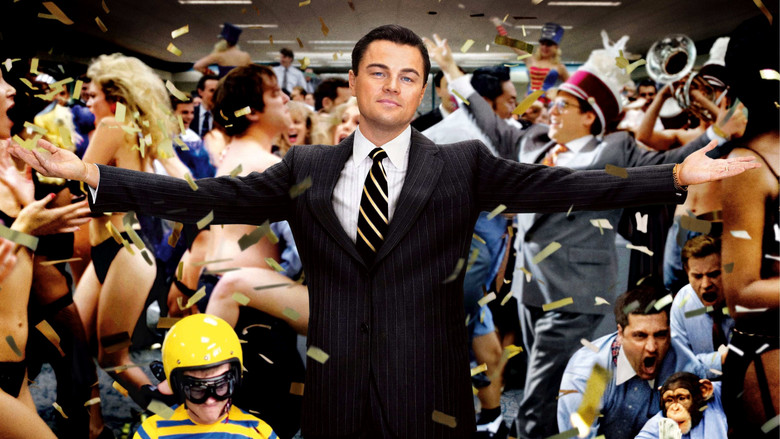
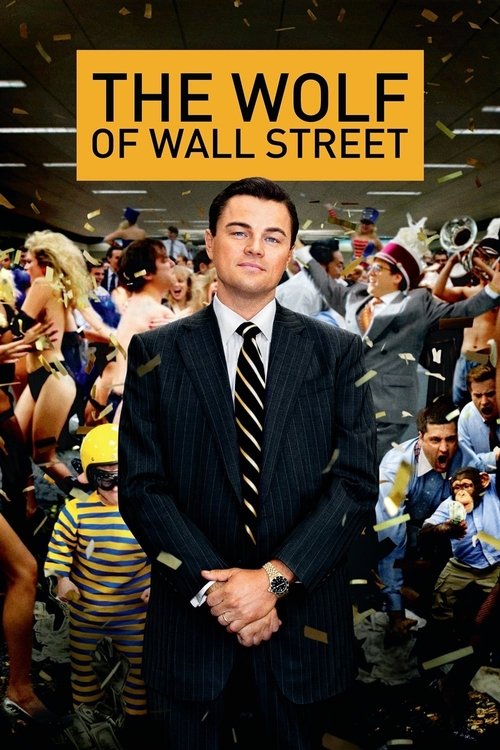
"The Wolf of Wall Street," directed by Martin Scorsese, is a biographical film based on the memoir of Jordan Belfort. The story follows Belfort's (Leonardo DiCaprio) explosive rise from a rookie stockbroker to the head of his own firm, Stratton Oakmont, in the late 1980s and 1990s. Belfort, along with his partner Donnie Azoff (Jonah Hill) and a loyal group of friends, perfects the "pump and dump" scheme, artificially inflating the price of penny stocks before selling them off to unsuspecting investors.
This illegal activity catapults them into a world of unimaginable wealth, leading to a lifestyle of extreme excess and debauchery, filled with lavish parties, drugs, and prostitutes. As their empire grows, they attract the attention of FBI agent Patrick Denham (Kyle Chandler), who is determined to bring their corrupt operation down. The film is a wild, often comedic, and unflinching look at the seductive power of greed and the moral decay that accompanies a life of unchecked ambition and hedonism, ultimately leading to Belfort's inevitable downfall.

Core Meaning
At its core, "The Wolf of Wall Street" is a satirical critique of the unbridled greed and corruption inherent in the American financial system and a perversion of the American Dream. Martin Scorsese presents a cautionary tale, not by moralizing, but by immersing the audience in the exhilarating and seductive nature of Jordan Belfort's world. The film intentionally avoids explicitly condemning its characters, forcing viewers to confront their own feelings about wealth, success, and morality. It explores how the relentless pursuit of money can become a destructive addiction, leading to a complete erosion of ethics and humanity. Ultimately, the film suggests that the systems that allow such figures to rise are still in place, questioning whether any real lessons have been learned.
Thematic DNA
Greed and Excess
The central theme is the corrupting nature of absolute greed. Jordan Belfort and his colleagues are driven by an insatiable desire for wealth and pleasure, which manifests in their obscene spending, constant parties, and rampant drug use. The film vividly portrays how this endless pursuit of "more" becomes the core of their existence, leading to their moral and eventual legal downfall.
The Corruption of the American Dream
The film presents a twisted version of the American Dream, where immense wealth is achieved not through honest hard work, but through fraud and manipulation. Belfort embodies the idea of self-made success, but his story serves as a critique of a capitalist culture that can prioritize wealth accumulation above all else, blurring the line between ambition and destructive greed.
Addiction
While substance abuse is a constant presence, the primary addiction explored is the addiction to money and power. The thrill of the scam, the lavish lifestyle, and the feeling of invincibility are as intoxicating to the characters as any drug. The film draws direct parallels between Belfort's dependency on Quaaludes and his addiction to the adrenaline rush of his illicit financial activities.
Moral Decay and Lawlessness
The world of Stratton Oakmont operates in a moral vacuum where laws are seen as obstacles to be circumvented. The characters display a complete disregard for the consequences of their actions on their victims, who remain faceless throughout the film. This theme explores how quickly ethical boundaries can dissolve in an environment of immense, unchecked power and wealth.
Character Analysis
Jordan Belfort
Leonardo DiCaprio
Motivation
His primary motivation is an insatiable desire for wealth, power, and every form of excess. He is driven not just by the money itself, but by the god-like status and limitless lifestyle it affords him.
Character Arc
Jordan begins as an ambitious but relatively grounded young man eager to succeed on Wall Street. He is quickly corrupted by the hedonistic culture and, after losing his job, channels his charisma and sales skills into building a fraudulent empire. His arc is a classic rise-and-fall narrative, where he transforms into a person consumed by greed and addiction, ultimately losing everything but never fully grappling with the morality of his actions.
Donnie Azoff
Jonah Hill
Motivation
Donnie is motivated by a pure, unadulterated lust for money and the hedonistic lifestyle it enables. He sees Jordan as his ticket to this world and fully commits to the Stratton Oakmont ethos without question.
Character Arc
Donnie's arc is less of a transformation and more of an immediate embrace of corruption. He is instantly captivated by Jordan's wealth and eagerly becomes his partner in crime. He serves as an amplifier of Jordan's worst impulses, often pushing the debauchery to new extremes. His character remains largely static in his amorality, culminating in his eventual betrayal of Jordan.
Naomi Lapaglia
Margot Robbie
Motivation
Her initial motivation is the allure of a luxurious and exciting life. This later shifts to a primal need to protect herself and her children from Jordan's self-destruction, leading her to eventually leave him.
Character Arc
Initially drawn to Jordan's power and wealth, Naomi willingly participates in the lavish lifestyle. Her arc shows her gradual disillusionment as Jordan's addictions and criminal activities spiral out of control, threatening her and their children. She transforms from a partner in excess to a woman desperate to escape the destructive chaos of her husband's life.
Patrick Denham
Kyle Chandler
Motivation
Denham is driven by a strong sense of duty and justice. He is motivated to bring down Belfort not for personal gain, but because he believes what Belfort is doing is fundamentally wrong and harmful to society.
Character Arc
Agent Denham serves as the film's moral compass and primary antagonist to Belfort's operation. He is an incorruptible and persistent FBI agent who is disgusted by the excess and fraud he witnesses. His arc is one of steady determination, representing the slow, methodical process of justice in the face of rampant, high-flying crime.
Symbols & Motifs
The Pen
The pen symbolizes the power of salesmanship and the ability to manufacture desire. It's not about the object itself, but about creating a need in the consumer. This concept is the foundation of Jordan's entire fraudulent empire—selling the illusion of value.
The recurring scene where Jordan challenges his associates to "Sell me this pen" serves as a test of their sales prowess. It highlights his core philosophy that a master salesman can sell anything, regardless of its intrinsic worth.
The Yacht (The Naomi)
The yacht represents the pinnacle of Jordan's material success and the excesses of his lifestyle. Its sinking symbolizes the chaotic and destructive end of his empire, a direct consequence of his hubris and recklessness.
Named after his wife, the yacht is the setting for some of the film's most debauched moments. Its destruction during a storm while Jordan attempts to reach his Swiss bank account serves as a powerful metaphor for his life spiraling out of control.
Quaaludes
The frequent and heavy use of Quaaludes, specifically Lemmon 714s, symbolizes the characters' detachment from reality and morality. The drug-induced stupor reflects their willful ignorance of the consequences of their actions and their ultimate loss of control.
The infamous scene where Jordan suffers a delayed overdose and is reduced to crawling to his car is a moment of dark physical comedy that perfectly illustrates his complete physical and moral incapacitation.
Memorable Quotes
Sell me this pen.
— Jordan Belfort
Context:
Jordan poses this challenge to his friends and employees to test their sales abilities. It's a recurring motif that demonstrates his core belief that everything is about the sell, not the substance.
Meaning:
This quote encapsulates Jordan's entire sales philosophy: the product is irrelevant; the skill lies in creating a need. It's a powerful statement on the nature of salesmanship and manufactured desire, which is the bedrock of his fraudulent business.
The only thing standing between you and your goal is the bullshit story you keep telling yourself as to why you can't achieve it.
— Jordan Belfort
Context:
Jordan delivers this line during one of his fiery, cult-like speeches to his Stratton Oakmont employees, and later in his career as a motivational speaker.
Meaning:
This is a powerful motivational line that, in any other context, would be inspiring. Within the film, it's darkly ironic, as Jordan uses this empowering rhetoric to convince his employees to engage in unethical and illegal activities. It highlights his skill as a charismatic and manipulative leader.
I'm not gonna die sober!
— Donnie Azoff
Context:
Donnie screams this while on Jordan's yacht as it is sinking in a violent storm, just before they are about to take more drugs, showcasing their complete detachment from reality.
Meaning:
Shouted in a moment of mortal peril, this line perfectly captures the hedonistic, self-destructive, and absurdly defiant ethos of the characters. Their commitment to excess is so absolute that even in the face of death, their primary concern is to remain intoxicated.
Philosophical Questions
Does immense wealth inevitably lead to moral corruption?
The film explores this by charting Jordan Belfort's transformation from an ambitious young man into a morally bankrupt criminal consumed by greed. It suggests that the environment of Wall Street, combined with the intoxicating power of limitless money, creates a perfect storm for ethical decay. The narrative serves as a powerful case study, questioning whether integrity can survive in a system that so handsomely rewards amoral behavior.
What is the modern definition of the American Dream?
"The Wolf of Wall Street" presents a grotesque and distorted version of the American Dream. Belfort achieves the traditional markers of success—wealth, power, family—but through fraudulent and destructive means. The film interrogates whether the dream has shifted from an ideal of success through hard work to a 'get-rich-quick' mentality where the ends justify any means. The final scene, with an audience eager to learn from Belfort, suggests this corrupted dream is still powerfully alluring.
Alternative Interpretations
The central interpretive debate surrounding "The Wolf of Wall Street" is whether it functions as a celebration or a critique of its subject matter. The primary interpretation sees the film as a sharp, dark satire of capitalism's excesses. In this view, Scorsese deliberately seduces the audience with the glamour and thrill of Belfort's lifestyle to demonstrate how easily one can be corrupted by greed, forcing a self-examination rather than providing a simple moral lesson.
An alternative reading argues that the film, regardless of its intent, ends up glorifying its protagonist. By focusing so intensely on the fun and excitement of the debauchery and giving minimal screen time to Belfort's victims, this perspective holds that the film makes a life of crime appear aspirational. The ending, which shows Belfort successfully rebranding himself, is seen by some as a cynical but accurate critique of society's willingness to forgive and even reward such figures, while others view it as a failure to provide a satisfying sense of justice.
Cultural Impact
Upon its release, "The Wolf of Wall Street" was a major topic of cultural conversation, praised for its masterful filmmaking and powerhouse performances while also generating significant controversy. Critics were divided; some lauded it as a brilliant satire of financial excess and a modern masterpiece, while others accused it of glorifying a criminal lifestyle without sufficient condemnation. The debate centered on whether the film's immersive, non-judgmental approach was a powerful satirical tool or an irresponsible glamorization of greed. The film was a box office success and Scorsese's highest-grossing film. It earned five Academy Award nominations, including Best Picture, Best Director, Best Actor for DiCaprio, and Best Supporting Actor for Hill. The movie has had a lasting impact on pop culture, with scenes, quotes (like "Sell me this pen"), and the overall depiction of corporate debauchery being widely referenced and parodied. It also served as a breakout role for Margot Robbie, launching her into international stardom.
Audience Reception
Audience reception for "The Wolf of Wall Street" was highly polarized. Many viewers praised the film for its high-energy entertainment value, dark humor, and Leonardo DiCaprio's commanding performance. However, it received a surprisingly low "C" grade from CinemaScore polls on its opening week, indicating that a significant portion of the audience was put off by its content. Common points of criticism included the excessive profanity, graphic drug use, and nudity, with some viewers finding the three-hour runtime to be repetitive and indulgent. The central controversy among audiences mirrored the critical debate: many felt the film glorified a toxic and criminal lifestyle without showing the devastating impact on Belfort's victims, while others appreciated it as a sharp, satirical commentary on greed.
Interesting Facts
- The chest-thumping and humming chant performed by Matthew McConaughey's character was an improvisation and is part of the actor's personal pre-scene warm-up ritual.
- The actors snorted crushed B vitamins to simulate cocaine in the numerous drug scenes. Jonah Hill reportedly developed bronchitis from inhaling so much of the powder.
- The word "fuck" is used over 500 times, which at the time of its release, set a record for a mainstream feature film.
- Jonah Hill took the SAG minimum salary of $60,000 for the role of Donnie Azoff because he was so eager to work with Martin Scorsese.
- Margot Robbie improvised a slap on Leonardo DiCaprio during her audition, which helped her land the role of Naomi.
- The real Jordan Belfort makes a cameo appearance in the final scene of the film, introducing the cinematic Jordan Belfort at a sales seminar.
Easter Eggs
Martin Scorsese has a voice cameo.
In an early scene, when Jordan is selling penny stocks for the first time over the phone, the voice of the client he is speaking to, John, belongs to director Martin Scorsese himself.
The wedding guest list includes crew members' names.
When Jordan hands FBI Agent Denham a list of his wedding guests on his yacht, the names on the list are actually those of various crew members who worked on the film.
The real Jordan Belfort introduces the film's Jordan Belfort.
In the final scene of the movie, the person who introduces Leonardo DiCaprio's character at the sales seminar is the actual Jordan Belfort, in a meta-cameo appearance.
⚠️ Spoiler Analysis
Click to reveal detailed analysis with spoilers
Frequently Asked Questions
Explore More About This Movie
Dive deeper into specific aspects of the movie with our detailed analysis pages
Comments (0)
No comments yet. Be the first to share your thoughts!