Friends
"I'll be there for you."
Overview
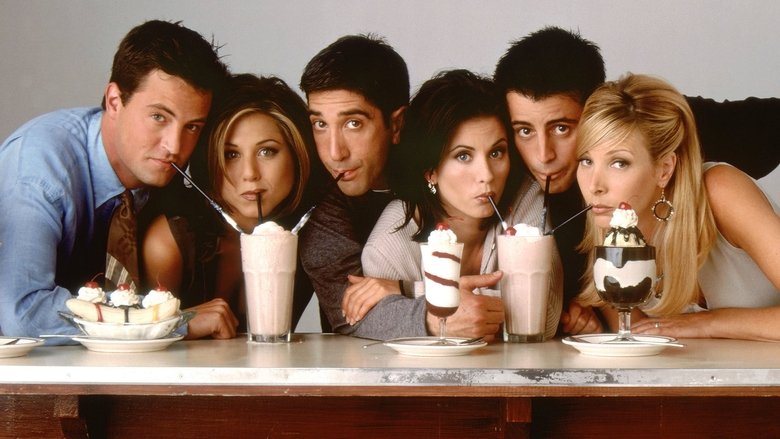
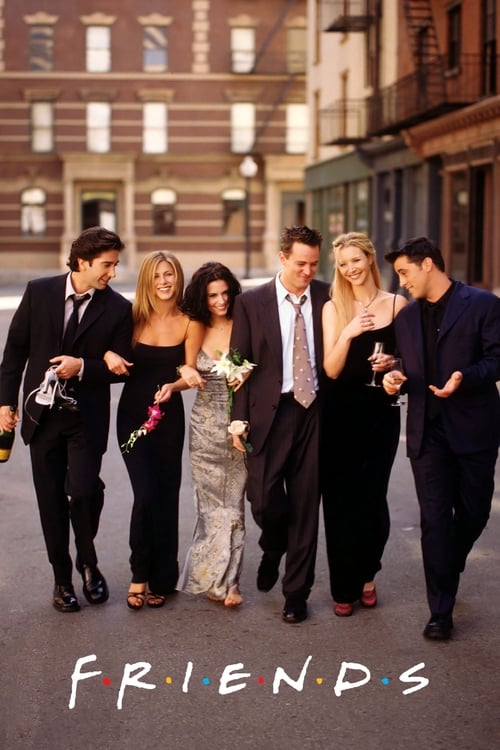
Friends is a seminal American sitcom that follows the lives of six young adults—Rachel, Monica, Phoebe, Joey, Chandler, and Ross—navigating the complexities of career, romance, and identity in 1990s and early 2000s New York City. The series begins with the arrival of Rachel Green, a runaway bride who moves in with her high school friend Monica Geller, effectively completing the ensemble. Over the course of ten seasons, the group serves as a surrogate family for one another, spending their time at the Central Perk coffee shop or Monica’s iconic purple apartment.
The narrative arc follows their transition from the uncertainty of their early twenties to the established responsibilities of their thirties. Major milestones include evolving career paths—from waitressing and acting to fashion and paleontology—and the intricate web of romantic entanglements within and outside the group. The show maintains a balance between lighthearted situational comedy and poignant emotional beats, culminating in a series finale that sees the characters finally outgrowing their shared living spaces to embark on individual futures.

Core Meaning
The core philosophy of Friends is articulated in its original pitch: "It's about that time in your life when your friends are your family." The series suggests that during the volatile transition between biological family dependence and the creation of one's own domestic unit, deep platonic bonds provide the necessary stability to survive the "real world." It celebrates the concept of the chosen family, arguing that loyalty, shared history, and unconditional support are the true foundations of adulthood.
Thematic DNA
The Chosen Family
The show emphasizes that friendship can be as binding and significant as biological ties. Throughout the series, characters support each other through parental divorces, career failures, and personal heartbreaks, often prioritizing the group dynamic over external relationships. This theme culminates in the finale, where the physical space of the apartment is emptied, but the emotional bond remains the characters' defining legacy.
The Search for Identity and Independence
Beginning with Rachel cutting up her credit cards in the pilot, the series tracks the slow, often painful process of self-actualization. Each character must define themselves outside of their parents' expectations—whether it's Chandler finding a career he actually enjoys or Monica overcoming her childhood insecurities to become a mother.
Romantic Timing and Fate
Centralized in the Ross and Rachel "will-they-won't-they" dynamic, the series explores how love is often a matter of timing and personal growth. It contrasts the chaotic, destiny-driven love of Ross and Rachel with the steady, evolving partnership of Monica and Chandler, suggesting that love manifests in multiple forms.
Professional Perseverance
The series realistically depicts the struggle of the 1990s workforce. Joey’s constant struggle as an actor and Rachel’s climb from waitress to executive highlight the theme that professional success requires resilience and the willingness to start at the bottom.
Character Analysis
Rachel Green
Jennifer Aniston
Motivation
Initially motivated by a fear of a stagnant life, she evolves to be driven by professional pride and the desire for a meaningful partnership with Ross.
Character Arc
Starts as a sheltered, dependent daughter of wealth and transforms into a high-powered fashion executive and capable single mother. Her arc is defined by the gain of self-reliance and the reconciliation of her career ambitions with her personal heart.
Monica Geller
Courteney Cox
Motivation
Driven by an intense need for order and the desire to be a mother and wife, often to compensate for a lack of maternal approval.
Character Arc
Moves from an insecure, competitive chef living in her brother's shadow to the foundational matriarch of the group. She finds fulfillment not just in professional success but in the domestic stability she creates with Chandler.
Ross Geller
David Schwimmer
Motivation
Motivated by a deep-seated belief in 'the one' and scientific order, which often clashes with the messy reality of his relationships.
Character Arc
The series begins and ends with his obsession with Rachel. His path involves navigating multiple failed marriages and personal breakdowns before learning to prioritize his emotional needs over his rigid intellectualism.
Chandler Bing
Matthew Perry
Motivation
Driven by a fear of loneliness and a desperate need for acceptance, which he initially masks with deflective sarcasm.
Character Arc
Transitions from a commitment-phobic, sarcastic man using humor as a shield against childhood trauma to a vulnerable, devoted husband. His transformation is perhaps the most profound, as he learns to embrace intimacy.
Phoebe Buffay
Lisa Kudrow
Motivation
Motivated by loyalty and a desire to bring light to the world through her art and unique worldview.
Character Arc
Despite a traumatic, unhoused past, she maintains an optimistic eccentricity. Her arc concludes with her finally finding the traditional stability she lacked as a child when she marries Mike.
Joey Tribbiani
Matt LeBlanc
Motivation
Driven by simple pleasures—food, romance, and his career—and an unwavering devotion to his friends.
Character Arc
Stays the most consistent in personality, though he grows from a struggling actor into a soap opera star. He remains the emotional glue of the group, demonstrating that loyalty is more important than intellectual prowess.
Symbols & Motifs
The Orange Couch
Symbolizes the group's stability and their shared emotional center.
Located in Central Perk, it is the one constant location where the characters gather to process their daily lives, representing a communal living room for Manhattan's lonely youth.
The Yellow Picture Frame
Symbolizes the perspective of the group and the 'frame' through which they view their shared life.
Hung over the peephole on Monica's apartment door, it serves as a visual icon of the show's domestic heart, framing every entrance and exit of the ensemble.
The Fountain
Symbolizes the joy and playfulness that persists despite life's 'rain'.
Featured in the opening credits, the characters frolic in the water while carrying umbrellas, mirroring the show's theme of finding happiness through companionship during difficult times.
The Magna Doodle
Symbolizes the silent communication and evolving history between Joey and Chandler.
Located on the back of Joey and Chandler's door, the drawings and messages changed in almost every episode, often reflecting off-screen jokes or plot points.
Memorable Quotes
Welcome to the real world. It sucks. You're gonna love it.
— Monica Geller
Context:
Said to Rachel in the pilot episode after she cuts up her credit cards to begin her independent life.
Meaning:
Encapsulates the cynical yet optimistic spirit of the show regarding the challenges of adulthood.
We were on a break!
— Ross Geller
Context:
First argued in Season 3 after Ross sleeps with someone else hours after he and Rachel 'take a break'.
Meaning:
A recurring catchphrase that represents the central conflict of communication and interpretation in relationships.
Pivot!
— Ross Geller
Context:
Shouted repeatedly while Ross, Rachel, and Chandler try to move a couch up a narrow stairwell in Season 5.
Meaning:
Symbolizes the comedic absurdity of the characters' shared physical and life struggles.
I got off the plane.
— Rachel Green
Context:
Spoken in the series finale after Ross realizes his love for her, and she returns to his apartment instead of moving to Paris.
Meaning:
The emotional climax of the series, representing the final choice of love over career ambition.
Episode Highlights
The Pilot (The One Where Monica Gets a Roommate)
Rachel enters the group's lives in a wedding dress, setting the entire decade-long story in motion. It establishes the central coffee shop location and the core dynamics of the ensemble.
Introduces the concept of 'friends as family' and the catalyst for Rachel's independence.
The One with the Prom Video
An old home movie reveals Ross's long-standing devotion to Rachel, leading to their first real romantic unification.
Confirmed the 'Ross and Rachel' arc as the show's primary romantic engine.
The One with the Embryos
A high-stakes trivia contest results in the girls losing their apartment to the boys, while Phoebe undergoes the procedure to become a surrogate for her brother.
Widely cited as the series' best episode for its balance of high-stakes comedy and emotional resonance.
The One Where Everyone Finds Out
Phoebe and Rachel discover Monica and Chandler's secret relationship, leading to a hilarious game of psychological 'chicken'.
Solidified Monica and Chandler as a legitimate, fan-favorite couple equal to Ross and Rachel.
The Last One
Monica and Chandler welcome twins, Ross and Rachel reunite for good, and the group leaves their keys on the counter of the empty apartment.
The emotional farewell to an era, marking the end of the 'youthful' stage of the characters' lives.
Philosophical Questions
Can platonic friendship truly serve as a permanent replacement for biological family?
The series suggests yes, but ultimately shows that as characters mature, they tend to move toward traditional family structures (marriage, children), implying that the 'friendship' era is a beautiful but temporary transitional phase.
Does fate dictate romantic compatibility, or is it a product of proximity and persistence?
The show balances the 'destiny' of Ross and Rachel with the 'choice' of Monica and Chandler, ultimately suggesting that while chemistry might be fated, the success of a relationship requires work and shared values.
Alternative Interpretations
One popular fan theory suggests that the entire series is a meth-addled hallucination of Phoebe, who remains homeless and is staring through the window of Central Perk at five strangers she wishes were her friends. Another interpretation posits that the characters are all patients in a psychiatric hospital, with the apartments and coffee shop representing different wards of the facility. A more literary reading suggests the characters represent the Seven Deadly Sins, with Phoebe as Lust, Monica as Pride (or Wrath), and Joey as Gluttony.
Cultural Impact
Friends is a global phenomenon that fundamentally altered the landscape of television. It popularized the 'ensemble sitcom' format, where no single lead dominates the narrative. Culturally, it defined the aesthetic of the 1990s, from the 'Rachel' haircut to the rise of coffee house culture as a social hub. Its influence is seen in successor shows like How I Met Your Mother and The Big Bang Theory. Despite criticisms regarding its lack of racial diversity, the show's legacy remains strong through syndication, influencing how millions of people worldwide perceive friendship, adulthood, and the American 'dream'.
Audience Reception
During its initial run, Friends was a ratings juggernaut, consistently ranking in the top ten of the Nielsens. Critics initially dismissed it as a Seinfeld clone, but soon praised its sharp writing and the genuine chemistry of the cast. While the later seasons (especially Season 9) faced criticism for repetitive plotlines and the controversial Joey/Rachel romance, the series finale was widely celebrated as a satisfying and emotional conclusion. Modern audiences on streaming platforms have praised its comfort-watch quality while debating its dated social politics and lack of diversity.
Interesting Facts
- The show was originally titled 'Insomnia Cafe' during early development.
- The main cast famously negotiated as a group, ensuring they were all paid the same salary ($1 million per episode by the final season).
- The iconic fountain featured in the opening credits is located on the Warner Bros. ranch in Burbank, not in New York City.
- The role of Ross Geller was written specifically with David Schwimmer in mind; he was the first actor cast.
- Courteney Cox was originally asked to play Rachel, but she requested the role of Monica because she liked the character's 'strong' personality.
- Gunther, the barista, was played by James Michael Tyler, who was originally cast as an extra because he was the only one who knew how to operate an espresso machine.
- The frame around the peephole on Monica's door was originally a mirror that a crew member accidentally broke, and the creators liked the look of just the frame.
Easter Eggs
The apartment numbers changed early in the series.
In the first few episodes, Monica’s apartment was #5 and Joey’s was #4. Producers realized these numbers didn't reflect a high floor in a Manhattan building, so they were changed to #20 and #19.
The 'Arquette' credits.
In the Season 6 premiere, every cast member's name in the opening credits was followed by 'Arquette' to celebrate Courteney Cox's marriage to David Arquette.
The Potato in the fruit bowl.
In one episode, a potato can be seen sitting in a fruit bowl in Monica's kitchen, a deliberate visual gag by the set designers.
⚠️ Spoiler Analysis
Click to reveal detailed analysis with spoilers
Frequently Asked Questions
Explore More About This Movie
Dive deeper into specific aspects of the movie with our detailed analysis pages
Comments (0)
No comments yet. Be the first to share your thoughts!