BEASTARS
Overview
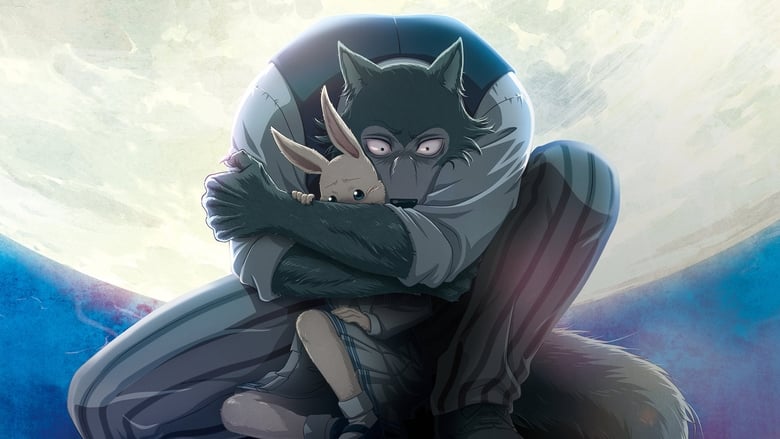
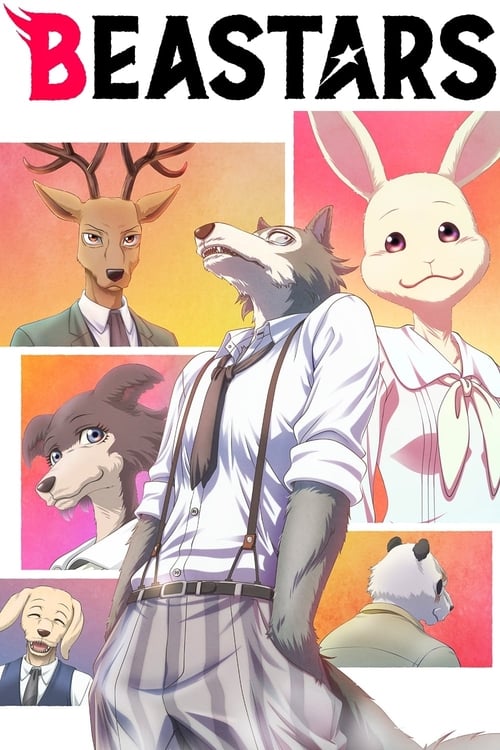
BEASTARS is set in a modern, civilized world populated by anthropomorphic animals where a fragile peace exists between carnivores and herbivores. This social contract is shattered at Cherryton Academy when an alpaca named Tem is brutally murdered and devoured. In the shadow of this tragedy, Legoshi, a timid and self-loathing gray wolf, struggles to navigate his own predatory instincts while falling for Haru, a dwarf rabbit who challenges his perception of strength and vulnerability. The series follows Legoshi's transformation from a passive outsider into a principled protector of the societal balance.
As the narrative progresses beyond the school walls, it delves into the darker underbelly of their society, including the Black Market—a place where the literal and metaphorical consumption of others is a lucrative trade. The story shifts from a high-school mystery into a sprawling crime drama, following the intersecting paths of Legoshi, the ambitious red deer Louis, and the rising tensions between those who seek to maintain the status quo and those who wish to tear it down. The third and final season expands this scope further, introducing the half-breed villain Melon and forcing the protagonists to confront the fundamental contradictions of their existence.

Core Meaning
The core of BEASTARS is an exploration of the eternal conflict between biological nature and social morality. It posits that true character is defined not by the instincts one is born with, but by the conscious choices made to resist or channel those impulses. Through the lens of predator-prey dynamics, the creators examine the burden of strength, the resilience of the marginalized, and the hypocrisy of a 'perfect' society that survives by repressing its most basic truths. Ultimately, it suggests that coexistence requires the difficult, active work of understanding the 'other' without erasing the inherent differences that define them.
Thematic DNA
Nature vs. Nurture
The series constantly asks if an individual can ever truly escape their biological programming. Legoshi represents the struggle to suppress innate aggression for the sake of empathy, while characters like Riz and the Shishigumi represent the danger of fully surrendering to one's predatory side. This theme evolves from a personal struggle in Season 1 to a societal debate about legal and illegal consumption by Season 3.
Societal Hypocrisy and Facades
Nearly every character wears a mask. Louis wears the mask of a perfect, stoic leader to hide his past as livestock; Legoshi slouches to appear smaller and less threatening. The series reveals that the 'peaceful' society is built on the hidden exploitation of the Black Market, suggesting that civility is often a thin veneer over a chaotic reality.
Identity and Self-Loathing
Characters struggle with how the world perceives them versus how they feel. Legoshi loathes being a wolf because he is gentle, while Haru engages in promiscuous behavior as a way to reclaim agency in a world that only sees her as a fragile victim. The series charts their journey toward self-acceptance and redefining their roles.
Power Dynamics and Privilege
The divide between carnivores (privileged in strength but socially restricted) and herbivores (socially protected but biologically vulnerable) serves as a complex allegory for race, class, and gender. The title 'Beastar' represents the pinnacle of this power, a symbol of unity that is often more political than altruistic.
Character Analysis
Legoshi
Chikahiro Kobayashi
Motivation
Initially driven by guilt over his attack on Haru, his motivation evolves into a desire to create a world where a wolf and a rabbit can live together as equals.
Character Arc
Starts as a shy, self-deprecating wolf who hides his strength out of guilt. Over three seasons, he moves from suppressing his nature to mastering it. He drops out of school to live in the 'real world,' undergoes rigorous training to fight without eating meat, and eventually becomes a bridge between the two worlds.
Louis
Yuki Ono
Motivation
The pursuit of power to ensure he is never viewed as weak or as 'meat' ever again.
Character Arc
Begins as a prideful stag seeking the status of 'Beastar' to overcome his traumatic past as 'illegal livestock.' In Season 2, he becomes the leader of the Shishigumi (a lion gang), experiencing the world from the predator's perspective. By Season 3, he reconciles his past to become a realist leader who understands the necessity of both strength and mercy.
Haru
Sayaka Senbongi
Motivation
To be treated as an individual with agency rather than a species-defined victim.
Character Arc
Haru rejects the 'fragile herbivore' stereotype by being sexually assertive and fiercely independent. While her screen time fluctuates, her influence remains central as she navigates her relationship with Legoshi, refusing to be his 'prey' or a mere object of his protection.
Melon
Koji Okino
Motivation
To expose the ugliness of the world and destroy the systems that produced him as a 'mistake.'
Character Arc
Introduced in Season 3, Melon is a half-leopard, half-gazelle hybrid who represents the total failure of the societal ideal. He is a sociopath who cannot taste food or feel empathy, viewing his existence as a curse and the world as a playground for his cruelty.
Symbols & Motifs
The Moon
The moon symbolizes the awakening of carnivorous instincts and the loss of control.
It is most prominent when Legoshi first attacks Haru and during his final training phases, representing the raw, unavoidable truth of his predator nature that cannot be hidden by school uniforms.
The Stage / Drama Club
A metaphor for social performance and the roles animals are forced to play in society.
Much of the first season takes place within the club, where the literal acting on stage mirrors the figurative acting required of them to maintain the peace between species.
Eggs / Egg Sandwiches
Symbolizes restraint, routine, and the mundane side of carnivorous life.
Legoshi’s ritual of eating egg sandwiches every Friday represents his attempt to find a 'safe' and controlled way to satisfy his need for protein without causing harm to others.
The Black Market
Represents the repressed desires and the 'id' of the animal society.
It is the physical space where the society’s contradictions are laid bare—a place where herbivores are sold for meat while carnivores satisfy their forbidden urges in secret.
Memorable Quotes
I'm a wolf, but I'm not a monster.
— Legoshi
Context:
Season 1, Episode 1. It is a recurring internal mantra as he faces suspicion from his peers.
Meaning:
This quote encapsulates Legoshi's fundamental struggle to separate his identity from his biology.
Look at me. I'm a herbivore, and I'm the one who's in control here.
— Louis
Context:
Season 1, Episode 2. Said while asserting his dominance over Legoshi in the drama club.
Meaning:
Reflects Louis's rejection of the natural order and his assertion that willpower can override physical strength.
In this world, being eaten is the ultimate form of friendship.
— Riz
Context:
Season 2, Episode 11. Riz explains why he devoured Tem to a horrified Legoshi.
Meaning:
A chilling justification for predation, showing how a twisted philosophy can be used to cope with guilt.
Episode Highlights
The Moon and the Beast
The murder of Tem sets the tone for the series, and Legoshi’s first encounter with Haru under the full moon establishes the central conflict of hunger versus love.
It establishes the world-building and the core premise of the series' 'speciesism.'
A Wolf is Born
Legoshi must perform on stage for the first time, acting as a substitute. The scene blends the drama of the play with the internal drama of his instincts.
Highlights the theme of 'acting' and the performance of social roles.
A Wolf in Sheep's Clothing
Legoshi breaks into the Shishigumi hideout to save Haru, fully embracing his predatory power for the first time but using it for a protective purpose.
The turning point where Legoshi decides to use his strength as a tool for justice rather than a source of shame.
The Chef's Secret
The final confrontation between Legoshi and Riz. Louis sacrifices his leg for Legoshi to eat, giving him the strength to win the fight through a shared bond.
A controversial and pivotal moment that redefines the relationship between carnivores and herbivores as one of mutual sacrifice.
Interspecies Relations
Legoshi starts his life as a 'dropout' and moves into the Hidden Condo, meeting diverse neighbors and beginning his investigation into the criminal hybrid, Melon.
Signals a shift from school drama to adult societal exploration and the introduction of hybrid psychology.
Philosophical Questions
Is true freedom the ability to follow your instincts or the ability to resist them?
The series explores this through Legoshi’s ascetic lifestyle versus Riz’s 'honesty' about his hunger, ultimately siding with the idea that restraint is the highest form of freedom.
Can a society be truly just if it requires the suppression of individual identity?
This is explored through the role of the 'Beastar,' a figurehead who must represent a perfect ideal that often ignores the messy reality of animal life.
Alternative Interpretations
Critics and fans have proposed several readings of the series: 1. A Gender Allegory: Some see the carnivore/herbivore divide as a metaphor for toxic masculinity and the fear women (herbivores) feel in a world where men (carnivores) possess innate physical power. 2. Queer Subtext: The intense bond between Legoshi and Louis is often interpreted as a 'star-crossed' romantic connection that transcends their species' biological enmity. 3. Class Struggle: The Black Market and the Shishigumi are read as commentaries on the underground economies that thrive when mainstream society fails to provide for all its members.
Cultural Impact
BEASTARS significantly challenged the stigma against 3D CGI in anime, with Studio Orange proving that the medium could deliver high-quality, expressive acting that 2D animation sometimes struggles with. It has been widely discussed as a sophisticated 'adult' counterpart to Disney's Zootopia, engaging with themes of sexuality, drug abuse (represented by the meat trade), and structural inequality. The series gained a massive following within and outside the 'furry' fandom, often praised for its ability to use animal traits to highlight universal human insecurities. It remains a landmark series for its intersection of noir, coming-of-age, and political allegory.
Audience Reception
The series received widespread critical acclaim, currently holding a 94% on Rotten Tomatoes. Fans initially approached the show with skepticism due to its CGI and anthropomorphic premise but were quickly won over by the depth of its character writing. Season 1 was lauded for its atmosphere and mystery. Season 2 received praise for its psychological depth and the complex character of Riz, though some found the 'duel' ending bizarre. Season 3 has been noted for its more frantic pacing and the introduction of Melon, who is seen as one of the most compelling villains in recent anime, though some manga readers have noted the condensed nature of the adaptation.
Interesting Facts
- The opening for Season 1 was created using stop-motion animation, a rare and labor-intensive technique in modern anime.
- Studio Orange used a custom plugin called 'Hair Farm' to render the realistic, reactive fur on the characters.
- The creator, Paru Itagaki, is the daughter of Keisuke Itagaki, the creator of the famous martial arts manga Baki the Grappler.
- The voice actors recorded their lines 'theater style' using shotgun mics, allowing them to move and interact naturally to capture more authentic emotional performances.
- Director Shinichi Matsumi was inspired to use 3D CGI for the series after seeing Disney's Zootopia.
- Paru Itagaki frequently appears in public wearing a large chicken mask to maintain her anonymity.
Easter Eggs
Beast Complex References
Characters and background details often reference Beast Complex, Paru Itagaki's short story collection set in the same universe. Some background characters in the anime are protagonists from those stories.
Legoshi's Name Origin
His name is inspired by the legendary actor Bela Lugosi, famous for playing Count Dracula, nodding to Legoshi's 'monstrous' but gentlemanly nature.
⚠️ Spoiler Analysis
Click to reveal detailed analysis with spoilers
Frequently Asked Questions
Explore More About This Movie
Dive deeper into specific aspects of the movie with our detailed analysis pages
Comments (0)
No comments yet. Be the first to share your thoughts!