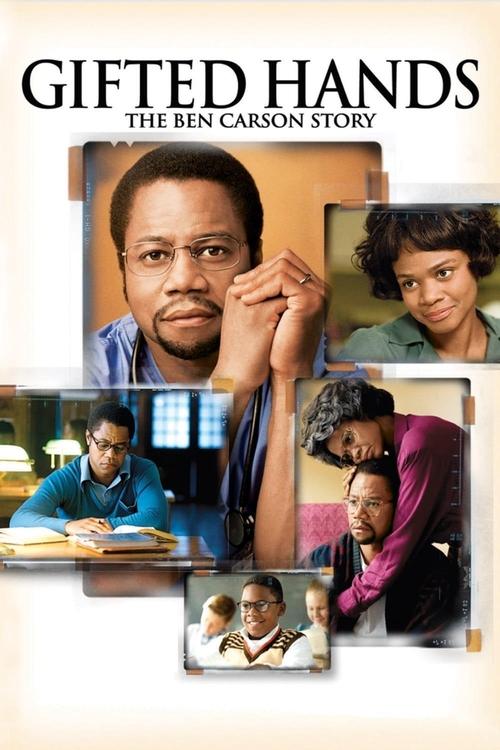
Gifted Hands: The Ben Carson Story
A cinematic tapestry of resilience, tracing a surgeon's ascent from the shadows of poverty to the brilliance of the operating room through a mother's unwavering light and a steady hand guided by faith.
Gifted Hands: The Ben Carson Story

Gifted Hands: The Ben Carson Story

07 February 2009 United States of America 86 min ⭐ 7.8 (759)
Director: Thomas Carter
Cast: Cuba Gooding Jr., Kimberly Elise, Aunjanue Ellis-Taylor, Harron Atkins, Ele Bardha
Drama
The Power of Education and Literacy Maternal Influence and Sacrifice Faith and Divine Providence Perseverance against Racial Prejudice Risk and Innovation

Overview

Gifted Hands: The Ben Carson Story is a 2009 biographical drama that chronicles the life of Benjamin Carson, who rose from a struggling student in a single-parent household to become a world-renowned pediatric neurosurgeon at Johns Hopkins. The film utilizes a non-linear narrative, opening with the 1987 challenge of separating the Rausch twins—conjoined at the head—before flashing back to 1961 Detroit to explore the foundational moments of Carson's childhood.

Directed by Thomas Carter, the story highlights the pivotal role of Ben's mother, Sonya Carson, who, despite her own struggles with illiteracy and depression, pushed her sons to prioritize education and self-discipline. The plot follows Ben's academic transformation, his battle with a violent temper during adolescence, and his eventually groundbreaking medical career, where he must navigate high-stakes surgeries and the weight of professional risk.


Core Meaning

The core message of the film is that human potential is limitless when fostered by discipline, education, and faith. Director Thomas Carter emphasizes that one's circumstances do not define their destination; rather, the "gift" in the title refers not just to natural talent, but to the developed skill and moral character formed through perseverance. The film carries a heavy theme of empowerment through literacy and the spiritual conviction that every individual has a unique purpose that can be realized through hard work and divine guidance.

Thematic DNA

The Power of Education and Literacy 30%
Maternal Influence and Sacrifice 25%
Faith and Divine Providence 20%
Perseverance against Racial Prejudice 15%
Risk and Innovation 10%

The Power of Education and Literacy

The film illustrates how books served as a portal to a different life for Ben and his brother. Sonya's requirement for her sons to read and write reports—despite her own inability to read them—symbolizes education as a tool for social mobility and intellectual liberation.

Maternal Influence and Sacrifice

Sonya Carson is the emotional anchor of the film. Her belief in her children, "You can do anything anyone else can do, only you can do it better," acts as a mantra that counteracts the low expectations of a prejudiced society.

Faith and Divine Providence

Religious faith is portrayed as a stabilizing force, particularly when Ben prays to overcome his violent temper. His medical successes are often depicted as a partnership between his surgical skill and God's intervention.

Perseverance against Racial Prejudice

The film addresses the systemic and personal racism Ben faced, from a teacher's public beratement of his white classmates for being out-performed by a "colored boy" to colleagues at Johns Hopkins initially mistaking him for an orderly.

Risk and Innovation

The medical narrative arc focuses on the courage required to attempt the impossible. Ben’s decision to operate on the conjoined twins despite the failure of previous similar attempts underscores the theme of calculated risk-taking in the pursuit of saving lives.

Character Analysis

Benjamin Carson

Cuba Gooding Jr.

Archetype: The Determined Hero
Key Trait: Methodical Perseverance

Motivation

Driven by a desire to prove his worth and a deeply held belief (instilled by his mother) that he is capable of greatness through God's help.

Character Arc

Transitions from a labeled "dummy" in elementary school to a rebellious teenager with a dangerous temper, and finally to a humble, world-renowned neurosurgeon who breaks medical boundaries.

Sonya Carson

Kimberly Elise

Archetype: The Mentor/Sacrificial Mother
Key Trait: Unflinching Resilience

Motivation

Determined to ensure her sons have the opportunities she lacked, focusing entirely on their academic and moral development.

Character Arc

Maintains a steadfast front of strength for her children while privately battling clinical depression and the shame of her illiteracy.

Candy Carson

Aunjanue Ellis-Taylor

Archetype: The Supportive Partner
Key Trait: Empathetic Grace

Motivation

Unconditional love and shared faith, acting as a collaborator in Ben's personal and professional life.

Character Arc

Provides a steady emotional foundation for Ben during his residency and personal tragedies, such as the loss of their first children.

Symbols & Motifs

Gifted Hands

Meaning:

Represents the dual nature of human ability. Early in the film, hands are tools of potential violence (the knife incident), but they are transformed into instruments of healing and precision through education and self-control.

Context:

Title of the film and a recurring motif in medical scenes where the camera focuses on Ben's steady, gloved hands during surgery.

Books/Library Cards

Meaning:

Symbolizes the keys to a kingdom of knowledge that is accessible regardless of economic status. They represent the internal world Ben builds to escape the limitations of his environment.

Context:

Ben's first trip to the library to research rocks and his mother's insistence on the library-based curriculum for her sons.

The Pool Table

Meaning:

Symbolizes the intersection of intuition and scientific calculation. The movement of the balls provides the mechanical epiphany Ben needs to solve the blood-drainage problem in the separation surgery.

Context:

Ben plays billiards alone while wrestling with the surgical plan for the conjoined twins.

The Knife

Meaning:

A symbol of the destructive path Ben nearly took. Its breaking represents a "divine intervention" or a second chance to redirect his life's energy.

Context:

A teenage Ben attempts to stab his friend over a radio dispute, only for the blade to break against the friend's belt buckle.

Memorable Quotes

You got all the world in here. You just got to see beyond what you can see.

— Sonya Carson

Context:

Sonya encouraging Ben when he feels "dumb" and unable to imagine a future for himself.

Meaning:

Encapsulates the philosophy of visualization and internal strength over external circumstance.

Success is determined not by whether or not you face obstacles, but by your reaction to them.

— Ben Carson

Context:

Reflecting on his journey from the inner city to the surgical suite.

Meaning:

Highlights the central theme of individual agency and the importance of resilience.

If you look at these obstacles as a containing fence, they become your excuse for failure. If you look at them as a hurdle, each one strengthens you for the next.

— Ben Carson

Context:

Discussing the challenges of his career and upbringing.

Meaning:

A metaphorical explanation of how to reframe adversity as training for success.

Philosophical Questions

Does genius reside in natural talent or cultivated discipline?

The film explores this by showing Ben starting at the bottom of his class and only becoming "gifted" after his mother forces him to adopt rigorous study habits, suggesting that "giftedness" is a byproduct of effort.

Can a person truly escape their past, or are they always defined by it?

Through the motif of Ben's temper, the film suggests that while the past can be overcome, it requires constant vigilance and spiritual grounding to keep destructive impulses at bay.

Alternative Interpretations

While generally viewed as a straightforward inspirational biopic, some critics have discussed the film through the lens of individualism vs. systemic change. One interpretation suggests the film places the entire burden of success on individual character and family support, potentially downplaying the structural barriers that require more than just personal grit to overcome. Another reading focuses on the spiritual vs. scientific dichotomy, where Ben's medical breakthroughs are interpreted not just as scientific progress but as a form of modern-day ministry.

Cultural Impact

The film had a significant impact as an inspirational tool in educational and religious communities, particularly within the African American community in Detroit and beyond. It reinforced the "American Dream" narrative of social mobility through education and was frequently shown in schools to motivate underprivileged youth. Critically, it was praised for its earnestness and the performances of Gooding and Elise, though some critics found it overly sentimental. Its legacy was further cemented when Ben Carson transitioned into politics, as the film served as a primary cultural introduction to his life story for many voters.

Audience Reception

Audience reception was overwhelmingly positive, particularly among families and faith-based groups. Viewers praised the film's emotional heart and its ability to present a complex medical career in an accessible way. Critical reception was more mixed; while many lauded Kimberly Elise’s powerful performance, some reviewers criticized the film for being "syrupy" and having "plodding" transitions. However, it remains a beloved staple of the biographical genre with high ratings on platforms like IMDb and Rotten Tomatoes.

Interesting Facts

  • The real Dr. Ben Carson and his wife Candy make a brief cameo as individuals walking by and looking at a chart in a hospital hallway.
  • Cuba Gooding Jr. inadvertently held the stethoscope backward in the scene where Ben listens to the babies' hearts after the miscarriage.
  • The movie was filmed primarily in Michigan, including scenes at the real Detroit locations mentioned in the book.
  • Actual medical professionals—doctors and nurses from local medical centers—were used as background extras in the operating room scenes to ensure authenticity.
  • Director Thomas Carter was nominated for a Directors Guild of America Award for his work on this film.

Easter Eggs

The Hitchcock Moment

The real-life Ben Carson and his wife Candy appear as background extras in a hallway scene. This cameo serves as a "seal of approval" from the subject of the biopic and a treat for viewers familiar with the real figure.

⚠️ Spoiler Analysis

Click to reveal detailed analysis with spoilers

Frequently Asked Questions

Explore More About This Movie

Dive deeper into specific aspects of the movie with our detailed analysis pages

Comments (0)

Leave a comment

No comments yet. Be the first to share your thoughts!