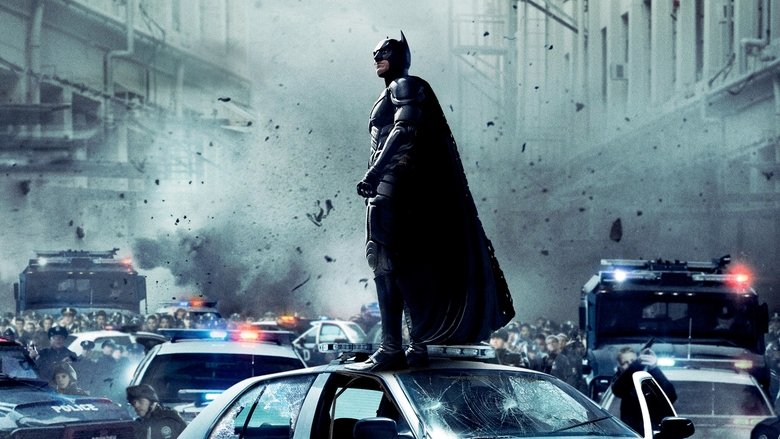
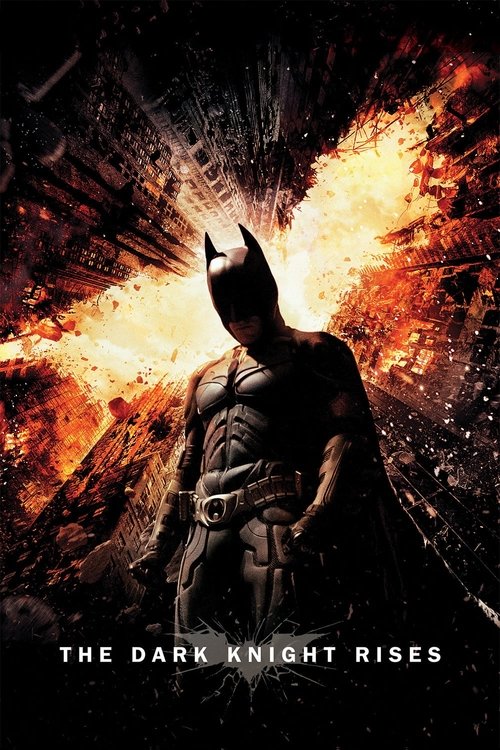
The Dark Knight Rises
"The legend ends."
Overview
Set eight years after the events of The Dark Knight, Gotham City enjoys a fragile peace under the weight of the Dent Act, a law that has virtually eradicated organized crime. Bruce Wayne has become a reclusive shell of his former self, mourning his lost love and nursing physical scars from years of vigilantism. However, the emergence of a formidable and brutal terrorist leader named Bane forces Bruce to confront the reality that his city still needs a protector.
As Bane initiates a systematic dismantling of Gotham's social and economic structures, Batman is drawn back into a conflict that tests his physical and psychological limits. The struggle expands beyond a simple battle between good and evil, involving a cunning cat burglar with her own agenda and a young, idealistic police officer who still believes in the symbol of the Batman. The film culminates in an epic siege of Gotham, where the fate of millions hangs on a single man's ability to overcome his fear of death and find a reason to live.
Core Meaning
The core meaning of the film centers on the transition from man to myth. Christopher Nolan explores how a single individual is finite and destructible, but an idea or a symbol can become incorruptible and everlasting. The film posits that true heroism often requires the sacrifice of one's identity and life for the sake of a greater good, ultimately suggesting that anyone can be a hero through acts of courage and compassion.
Furthermore, it examines the nature of hope and despair. Bane's philosophy is that hope is the ultimate torture when combined with certain doom, but the film refutes this by showing that hope is the necessary catalyst for the 'rise'—the spiritual and physical rebirth required to overcome impossible odds.
Thematic DNA
Resurrection and Ascendance
The central motif of 'rising' is explored through Bruce Wayne's journey from a broken, suicidal recluse to a man who chooses life. His literal climb out of 'The Pit' serves as a metaphor for overcoming deep-seated trauma and reclaiming his purpose not out of a desire for death, but a commitment to life.
The Power of Symbols
The film concludes the trilogy's meditation on symbolism. It argues that Gotham doesn't need Bruce Wayne, but it does need the Batman—an icon that stands for justice regardless of the person behind the mask. This is reinforced by the handoff of the legacy to John Blake.
Social and Class Warfare
Through Bane's occupation of Gotham, the film mirrors real-world anxieties about economic inequality and populist uprisings. Bane exploits the '1%' rhetoric to sow chaos, revealing a cynical view of how easily social order can collapse when the rule of law is replaced by mob rule.
Lies as a Foundation for Peace
The story deconstructs the 'White Knight' legacy of Harvey Dent. It questions whether a peace built on a lie (the cover-up of Dent's crimes) is sustainable, eventually proving that true stability requires the truth, even if that truth is painful.
Fear as a Motivator
Unlike Batman Begins, where Bruce learns to master fear, here he must learn to embrace it. The film suggests that the fear of death makes one fight harder and live more fully, whereas the apathy of a man with nothing to lose leads to stagnation.
Character Analysis
Bruce Wayne / Batman
Christian Bale
Motivation
Initially motivated by a sense of obligation, he eventually finds motivation in the preservation of Gotham's soul and the desire for a life beyond the mask.
Character Arc
Bruce begins as a broken recluse seeking an end to his suffering. He must lose his wealth, his body, and his allies to rediscover the will to live rather than just the will to fight.
Bane
Tom Hardy
Motivation
To fulfill the mission of the League of Shadows by destroying Gotham, fueled by his devotion to Talia al Ghul.
Character Arc
A physical and intellectual powerhouse who successfully 'breaks' Batman. However, his arc reveals him as a tragic figure—a protector turned destroyer driven by a misplaced sense of loyalty.
Selina Kyle / Catwoman
Anne Hathaway
Motivation
Survival and the acquisition of the 'Clean Slate' software to start a new life.
Character Arc
Starts as a self-interested survivor looking for a 'Clean Slate' to erase her criminal past. She eventually learns that she cannot outrun her conscience and joins the fight for Gotham.
John Blake
Joseph Gordon-Levitt
Motivation
Justice in its purest form, unburdened by the compromise of bureaucracy.
Character Arc
An idealistic cop who grows disillusioned with the red tape of the police force. He recognizes the necessity of the Batman and is ultimately chosen to inherit the mission.
Alfred Pennyworth
Michael Caine
Motivation
The survival and happiness of Bruce Wayne, even at the cost of their relationship.
Character Arc
The emotional anchor who finally decides to stop enabling Bruce's self-destruction. His 'betrayal' is his ultimate act of love to save Bruce from the Batman.
Symbols & Motifs
The Pit (The Lazarus Pit)
Symbolizes rebirth and the underworld. It is a place of total despair where one must find the 'will to rise' without the safety net of a rope.
Bruce is imprisoned here by Bane after his defeat. His successful climb out of the pit marks his transition back into the hero Gotham needs.
Bane's Mask
Represents constant pain and the rejection of humanity. It serves as a literal barrier between Bane and the world, fueling his brutality.
Bane wears the mask to inhale analgesic gas that manages the chronic pain from an old injury. In the final fight, Batman targets the mask to weaken him.
The Bat-Signal
A symbol of hope and continuity. Even when destroyed, its memory lingers, and its eventual repair signals that the hero is never truly gone.
John Blake finds a restored Bat-Signal at the end of the film, indicating that Bruce Wayne survived and passed the mantle.
The Pearl Necklace
Symbolizes legacy and the past. For Bruce, it's a tie to his mother; for Selina, it's a prize that links her to the world of the elite she resentfully navigates.
Selina Kyle steals the necklace from Bruce's safe, which acts as the initial catalyst for their interaction and Bruce's return to the world.
The Ice
Represents the fragility of order. Walking on thin ice serves as a metaphor for the precarious state of Gotham under Bane's rule.
Exile across the frozen river is the punishment for those 'convicted' in Crane's kangaroo courts.
Memorable Quotes
Why do we fall? So we can learn to pick ourselves up.
— Thomas Wayne / Alfred Pennyworth
Context:
First spoken by Bruce's father in Batman Begins, it is echoed by Alfred when Bruce is at his lowest point in this film.
Meaning:
The thematic thesis of the entire trilogy. It emphasizes that failure is not final but a necessary step toward growth and resilience.
The shadows betray you, because they belong to me!
— Bane
Context:
Said during the first brutal fight in the sewers where Bane dominates Batman physically and psychologically.
Meaning:
Highlights Bane's superior mastery of the environment and his deep connection to the darkness that Batman merely 'adopted' as a tool.
A hero can be anyone. Even a man doing something as simple and reassuring as putting a coat around a young boy's shoulders...
— Batman
Context:
Spoken to Commissioner Gordon just before Batman flies the bomb away from the city.
Meaning:
The final confirmation of Batman's identity as a symbol. It reveals that the man under the mask is the boy who was once comforted by Gordon.
I see a beautiful city and a brilliant people rising from this abyss.
— Commissioner Gordon (reading Charles Dickens)
Context:
Read during Bruce Wayne's funeral, taken from the closing lines of A Tale of Two Cities.
Meaning:
A literary parallel to the film's ending, suggesting that out of the destruction and 'abyss' of the current order, a better society can emerge.
Philosophical Questions
Is a lie more effective than the truth for maintaining social order?
The film explores the utility of the 'Noble Lie' regarding Harvey Dent. It shows that while the lie brought peace, its revelation by Bane destroyed society's faith in the system, suggesting that peace built on falsehood is inherently fragile.
Can an individual ever truly separate their identity from a symbol they've created?
Bruce Wayne struggles with the fact that 'Batman' has consumed his life. The film explores whether Bruce can exist without Batman, or if the creator must eventually be sacrificed to preserve the creation.
Does hope empower or paralyze the human spirit?
Bane uses hope as a weapon to prolong suffering. Bruce, however, proves that hope is the only thing that allows for transcendence, especially when the fear of failure is finally accepted as a motivator.
Alternative Interpretations
The most discussed alternative interpretation involves the ending at the cafe in Florence. Some fans and critics suggest that Alfred seeing Bruce is merely a dying dream or a hallucination born of Alfred's guilt, noting the 'too perfect' nature of the scene. However, Christian Bale himself has clarified that he believes the scene is real and that Bruce survived.
Another reading views the film as a religious allegory, specifically a Christ-like narrative where Batman 'dies' for the sins of Gotham (the lie about Harvey Dent) and is 'resurrected' from a tomb-like pit to save his people. Additionally, political readings often interpret Bane as a false populist—a warning against radicalism that destroys the very people it claims to empower, suggesting the film is a defense of the status quo and the importance of institutions.
Cultural Impact
The Dark Knight Rises left a significant mark on popular culture, serving as the definitive end to one of the most respected trilogies in cinema history. It solidified the 'grounded' superhero aesthetic that would influence films for the next decade. The film's imagery of social uprising and class conflict led to widespread comparisons with the Occupy Wall Street movement, sparking intellectual debates about Nolan's own political leanings—with some seeing it as conservative pro-authority and others as a critique of systemic corruption.
Critically, while it was praised for its ambition and scale, it sparked debate for its dense plot and the intelligibility of Bane's voice, which became an internet meme. Despite these critiques, the film was a massive commercial success, grossing over $1 billion worldwide and proving that mature, philosophically complex blockbusters could dominate the box office. It remains a benchmark for how to conclude a character's journey with finality and emotional weight.
Audience Reception
The audience reception was overwhelmingly positive but notably more divisive than its predecessor. Fans praised the epic scale, the emotional closure for Alfred and Bruce, and Tom Hardy's physically imposing performance. Anne Hathaway's portrayal of Selina Kyle was also a highlight, overcoming initial skepticism about her casting.
Criticism typically centered on plot logic—such as Bruce's miraculous travel back to Gotham—and the complex, sometimes muffled audio of Bane's dialogue. Despite these gripes, the 'Batman Rises' sequence and the final five minutes are frequently cited as some of the most emotionally resonant moments in the superhero genre. On aggregators like Rotten Tomatoes and IMDb, it holds high scores, reflecting a consensus that it is a flawed but magnificent finale.
Interesting Facts
- Tom Hardy based Bane's distinctive voice on Bartley Gorman, a legendary bare-knuckle boxer known as the 'King of the Gypsies'.
- Christopher Nolan filmed the final scene of the movie in Florence, Italy, and only a handful of people knew the real ending to prevent leaks.
- The football stadium scene utilized over 11,000 extras at Heinz Field in Pittsburgh, many of whom were actual fans of the Pittsburgh Steelers.
- Anne Hathaway performed her own stunts and trained extensively in martial arts, specifically the Keysi Fighting Method.
- The film features over an hour of footage shot using IMAX cameras, which was a record for a major narrative feature at the time.
- Christian Bale stated that this would be his final time playing Batman, a promise he kept despite the later expansion of DC films.
- The 'Clean Slate' software in the film is a nod to the concept of digital privacy and the desire to erase one's past in the information age.
- The character of John Blake's legal first name is revealed at the end to be 'Robin', a clever tribute to Batman's famous sidekick.
- A scene showing Bane's backstory in the League of Shadows was filmed but cut to keep the pacing and maintain the mystery of the character.
- The production built a full-sized, functional vehicle called 'The Bat' (the aerial tumbler) that was piloted by a stunt driver from a hidden cockpit.
Easter Eggs
Killer Croc Mention
In the sewers, a cop sarcastically asks if Gordon saw 'giant alligators'. This is a direct reference to the Batman villain Killer Croc, who famously resides in Gotham's sewers.
DC Comics Logo on Radios
The Gotham City Police Department radios feature a logo that is a stylized version of the classic DC Comics 'bullet' logo used in the 1970s and 80s.
Batman '66 References
In Wayne Manor, eagle-eyed fans can spot a red phone and a bronze bust of Shakespeare, which are nods to the 1960s Batman TV series equipment used to access the Batcave.
Holly Robinson Cameo
Juno Temple plays Jen, Selina's roommate. In the comics, this character is Holly Robinson, Catwoman's protégé and a key figure in Frank Miller's Year One.
The Joker's Smile
During the unveiling of the Batman statue at the end, the placement of the crowd is rumored to be a subtle tribute to the Joker's smile, honoring Heath Ledger.
⚠️ Spoiler Analysis
Click to reveal detailed analysis with spoilers
Frequently Asked Questions
Explore More About This Movie
Dive deeper into specific aspects of the movie with our detailed analysis pages
Comments (0)
No comments yet. Be the first to share your thoughts!