Skip to content
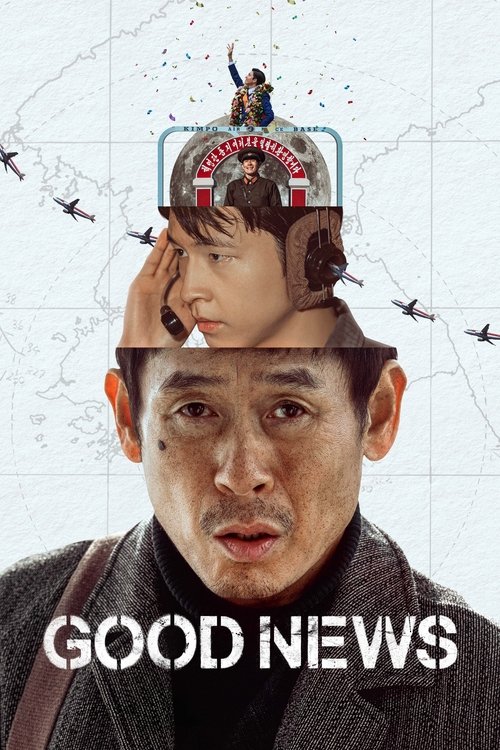
Good News
A Cold War farce with a bleeding clock at its center: an airliner full of hostages becomes a stage set, and an entire nation paints a fake sky over its own runway to keep the truth from landing.
Good News

Good News

굿뉴스

"The greatest lie (n)ever landed."

05 September 2025 South Korea 136 min 7.0 (101)

Director: Byun Sung-hyun

Cast: Sul Kyung-gu, Hong Kyung, Ryoo Seung-bum, Takayuki Yamada, Kippei Shiina

History Thriller Comedy The Fabrication of Reality by Power Bureaucratic Cowardice and Institutional Farce Ideology as Performance Anonymity, Credit and the Disposable Individual Comedy as a Way of Surviving Terror

Overview

Set in 1970, Good News opens aboard a Japanese domestic flight from Tokyo that is seized in midair by a cell of young radicals who demand to be flown to Pyongyang. What begins as a hijacking quickly becomes a diplomatic emergency spanning three governments, none of which is prepared to look weak, tell the truth, or take responsibility for whatever happens next.

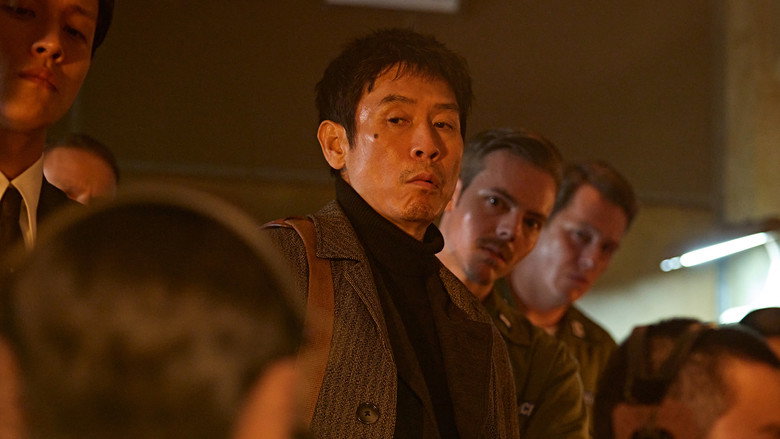
On the ground, a mysterious operative known only as "Nobody" (Sul Kyung-gu) is pulled back into service by Park Sang-hyeon (Ryoo Seung-bum), the head of the Korean Central Intelligence Agency, to attempt something audacious: rather than storming the aircraft, they will steal it from the air — talking the hijackers down onto a runway that is not where the hijackers think it is. Drafted into the scheme is Seo Go-myung (Hong Kyung), a straight-arrow Air Force lieutenant whose voice on the radio must sell the deception minute by minute.

Byun Sung-hyun stages the ensuing 136 minutes as a black comedy of institutional panic, in which officials in Seoul and Tokyo sprint between committee rooms, blame each other in advance, and improvise an enormous piece of theater. Inspired by a real and genuinely bizarre Cold War episode, the film keeps its laughs and its dread on the same runway, and never lets you forget that real people are strapped into seats above it.

Core Meaning

Byun Sung-hyun's subject is not the hijacking but the machinery that converts crisis into narrative. The film argues that modern states rarely solve emergencies; they stage them, dressing a runway, a press conference, and a set of uniforms until the story becomes more governable than the facts.

Its cruelest joke is that the deception works — and that the men who invented it will be the ones to decide who gets remembered for it. The title is the thesis: "good news" is a manufactured product, assembled by people whose primary fear is not death but embarrassment. Around that satire the film sets a quieter, sadder question about the individuals — the lieutenant on the radio, the nameless fixer, the idealists in the cabin — who are all, in different ways, expendable to the story their superiors intend to tell.

Thematic DNA

The Fabrication of Reality by Power 30%
Bureaucratic Cowardice and Institutional Farce 25%
Ideology as Performance 20%
Anonymity, Credit and the Disposable Individual 15%
Comedy as a Way of Surviving Terror 10%

The Fabrication of Reality by Power

The film's central operation is a lie built to full scale: an airport dressed to impersonate another country. Around it, officials draft communiqués about events that have not happened yet and decide in advance what the public will be told. Critics read the film as an argument that the victors write the incident, not merely the history of it — the truth is whatever survives the press release.

Bureaucratic Cowardice and Institutional Farce

Reviewers have described the film as a biting satire of bureaucratic spinelessness, and its comic engine is exactly that: multinational officials in Seoul and Tokyo sparring, deferring, and protecting their own careers while a bomb sits on a runway. Park Sang-hyeon's KCIA moves fastest not toward a solution but toward whoever will be blamed. Nobody wants to own the outcome; everybody wants to own the announcement.

Ideology as Performance

The hijackers believe they are flying toward a socialist paradise; the state that catches them believes it is defending a free one. The film lets both convictions be exposed as scripts — the radicals recite slogans to an audience of hostages, the government recites patriotism to an audience of reporters. The Cold War here is less a clash of beliefs than a competition between two propaganda departments.

Anonymity, Credit and the Disposable Individual

Sul Kyung-gu's operative has no name at all, and Lieutenant Seo — the man whose voice actually carries the operation — is the one with the least power over how his own actions will be recorded. The film keeps asking who is permitted to exist in the official version, and answers that usefulness and recognition are inversely related in this system.

Comedy as a Way of Surviving Terror

The tonal daring of the film is that its absurdity never cancels its stakes; the closer the deadline comes, the funnier and more frightening the officials become. Laughter functions as both the audience's release valve and the film's indictment — we are amused by exactly the incompetence that could kill everyone aboard.

Character Analysis

Nobody

Sul Kyung-gu

Archetype: Trickster / amoral mentor-fixer Key Trait: Unreadable, theatrical detachment

Motivation

To make the impossible resolution happen, and to remain outside the record while doing it. His loyalty is to the successful outcome and to his own untraceability, not to any flag.

Character Arc

Summoned out of the shadows to solve an unsolvable problem, he architects the entire deception with unnerving calm, treating a life-or-death crisis as a piece of stagecraft. Rather than a conventional transformation, his arc is a slow revelation of what such a man costs the people around him — the operation succeeds, and someone else pays for it. Sul has said the character was written as deliberately abstract and non-realistic, which is why he occasionally turns and addresses the camera.

Seo Go-myung

Hong Kyung

Archetype: Reluctant hero / innocent conscript Key Trait: Earnest, and increasingly disillusioned

Motivation

Duty, and then something more stubborn — the wish that the hostages survive and that what actually happened be acknowledged.

Character Arc

An elite Air Force lieutenant with a clean conscience is pulled into a scheme he did not design and cannot refuse, becoming the human voice of an institutional lie. As the operation succeeds he discovers that competence buys him no protection, and that the version of events being written has no room for him in it. His journey is from belief in the system to comprehension of it.

All 3 characters and cast

Symbols & Motifs

The false Pyongyang airport

Meaning:

The purest image of state-manufactured reality: a nation's capacity to build a convincing world rather than face an inconvenient one. It stands for every official set dressing — the podium, the flag, the staged welcome — behind which a government hides its improvisation.

Context:

The centerpiece of the operation, drawn from the real 1970 episode in which South Korean authorities disguised Gimpo Airport as a North Korean arrival, complete with borrowed uniforms and a staged welcome party, to fool hijackers into disembarking.

The name "Nobody"

Meaning:

Namelessness as both privilege and erasure. To have no identity is to be untouchable by consequence — and also to be someone the record can simply omit. He is the state's deniability given a body.

Context:

Sul Kyung-gu's fixer is referred to only as Nobody throughout; the actor has described the role as deliberately abstract and detached, at times speaking directly to the camera as a commentator on the events.

The radio voice

Meaning:

Truth reduced to a signal that can be forged. The disembodied voice symbolizes how authority operates at a distance — persuasive, unverifiable, and only as good as the listener's willingness to believe.

Context:

Lieutenant Seo's job is to talk the aircraft down while impersonating the ground he is not standing on; the film's tensest passages are conversations between people who cannot see each other.

The countdown to noon

Meaning:

Time as the one variable no committee can negotiate with. Against endless deliberation, the deadline is the film's memento mori: bureaucracy talks, the clock does not.

Context:

In the final act the hijackers set an ultimatum tied to both a clock and a wounded man's bleeding, forcing the endlessly deferring officials into a single irreversible decision.

The grounded aircraft

Meaning:

A sealed capsule of ordinary people suspended between ideologies — the civilian population itself, held hostage by other people's convictions and unable to influence any of them.

Context:

Once the plane is on the runway it becomes a stage everyone negotiates around and nobody enters, watched by cameras, officials and soldiers alike.

The press briefing

Meaning:

The moment the event stops being real and becomes 'good news'. It symbolizes the final, most efficient stage of the operation: the manufacture of public memory.

Context:

Threaded throughout the film as officials rehearse language, manage journalists, and shape what the citizens of two countries will believe happened.

Philosophical Questions

If a lie saves lives, does it become the truth?

The entire rescue depends on an elaborate deception, and it works. The film refuses to let the audience enjoy that outcome cleanly, because the same apparatus that built the saving lie immediately builds a self-serving one about who saved whom. It suggests that a state which becomes skilled at useful lies will not stop at useful ones.

Who owns the official version of an event?

Through the press management running under the plot, the film shows history being drafted in real time by the people with the most to lose. The final reckoning over credit and recognition makes the question concrete: the men who did the work and the men who record it are not the same men.

Is cowardice more dangerous than malice?

The officials are not villains plotting harm; they are careerists avoiding responsibility. The film's comedy accumulates into an argument that ordinary institutional self-protection can be more lethal than deliberate evil, because it is universal, respectable, and never has to be defended.

What is a person worth to the state that uses them?

A nameless operative and a young lieutenant both perform the operation's essential work, and neither owns the result. The film measures the distance between usefulness and value, and finds the state comfortable letting one substitute for the other.

Can conviction excuse what is done in its name?

The hijackers are true believers who have taken civilians hostage in pursuit of a paradise that does not exist. The film neither caricatures them entirely nor absolves them, using their sincerity to ask whether belief is a justification or simply another mechanism by which people are made into instruments.

Alternative Interpretations

Reading 1 — a systemic satire. The dominant critical view treats the film as an attack on institutions rather than individuals: no one in it is truly evil, merely afraid of blame, and the tragedy emerges from the aggregate cowardice of a bureaucracy. Under this reading, the ending is neither victory nor defeat but the system doing exactly what systems do — surviving, and rewriting the event to suit itself.

Full ending explanation

Cultural Impact

Good News arrived as one of 2025's most warmly received Korean films, premiering at the Toronto and Busan festivals before a worldwide Netflix launch on October 17, 2025. It holds a 92% Tomatometer score on Rotten Tomatoes (from 24 reviews at the time of writing), with Variety calling it a sharp political farce and Screen Daily's Robert Daniels describing it as "a biting satire about bureaucratic spinelessness" with "fantastic, multi-layered performances" from its ensemble.

Its cultural charge comes from the material itself. The Yodogo hijacking is a genuinely strange node of Cold War history binding Japan, South Korea and North Korea, and by retelling it as farce Byun implicates all three states at once — the incompetence of officials on both sides of the Korea Strait, and the propaganda apparatus that converted the episode into a triumph. Reviewers noted how directly the film's portrait of governments managing perception rather than reality speaks to the present political moment, a reading Byun endorsed when he told Variety the Cold War story "still resonates today."

Within Byun's filmography the film marks a pivot: after the stylized noir of his earlier work, this is his first full turn into satire, and it extends the recent wave of Korean cinema — from The Attorney to Netflix's own political thrillers — that reexamines the authoritarian 1970s through genre. It also continues a lineage of global Cold War black comedies stretching back to Dr. Strangelove, the reference point critics most often invoked.

Audience Reception

Praised: Reviews converged on the ensemble performances and the screenplay. Critics singled out Sul Kyung-gu's enigmatic, deliberately stylized Nobody and his chemistry with Hong Kyung, whose back-and-forth exchanges were described as bringing the script to life, along with Ryoo Seung-bum's slippery KCIA chief. The satirical writing drew the strongest praise — the film's skewering of officials in both Japan and Korea, its handling of propaganda and public manipulation, and its ability to hold comedy and dread in the same frame. Its 92% Tomatometer (24 reviews) reflects a broadly enthusiastic critical consensus, with some reviewers calling it one of the year's best.

Criticised: The most common reservation concerned length and excess: at 136 minutes the film was felt by some to be "a little too much of a good thing," with a busy structure and a tonal range that not every viewer found consistently controlled. Some found the mixture of broad farce with a genuine hostage tragedy uneasy, and the abstract, non-naturalistic conception of Nobody divided viewers — the very quality Sul Kyung-gu said he wrestled with during shooting.

Contested: The final act, which shifts decisively from comedy toward bleakness and settles the question of recognition and credit, generated the most discussion, as did the film's willingness to make farce out of an incident in which real people were terrorized.

Verdict: A confident, sharply written political black comedy — occasionally overstuffed, but one of the most acclaimed Korean films of 2025 and a significant tonal departure for its director.

Interesting Facts

  • The film is a fictionalized black comedy inspired by the real 1970 Yodogo hijacking, in which members of a Japanese Red Army Faction cell seized a domestic Japan Airlines flight and demanded to be flown to North Korea.
  • In the real incident, South Korean authorities disguised Gimpo International Airport as a North Korean arrival point — using North Korean-style uniforms, greeters and dressed runway signage — in an attempt to make the hijackers believe they had landed in Pyongyang.
  • It is Sul Kyung-gu's fourth collaboration with director Byun Sung-hyun; the actor said he trusted the director through a role he found difficult to grasp.
  • Sul Kyung-gu described 'Nobody' as the first genuinely abstract character of his career, saying he shot scenes while doubting whether his approach was right.
  • The character of Nobody was designed to be detached and exaggerated, at times acting as a commentator who looks directly into the camera.
  • Hong Kyung plays Air Force lieutenant Seo Go-myung, tasked with 'double hijacking' the plane from the ground, while Ryoo Seung-bum plays KCIA director Park Sang-hyeon.
  • The film runs 136 minutes and was co-written by Byun Sung-hyun.
  • It premiered on the festival circuit with screenings at the Toronto International Film Festival and the Busan International Film Festival before its Netflix release.
  • Netflix released it worldwide on October 17, 2025, and later published a 'Making Of' behind-the-scenes featurette in which Byun discussed his directorial intentions.
  • Byun told Variety that the Cold War story 'still resonates today', and that the project let him explore a different aspect of star Sul Kyung-gu.

Easter Eggs

The staged Pyongyang welcome is a near-recreation of documented history

The most outlandish sequence in the film — soldiers in enemy uniforms, a fake welcoming party, a runway pretending to be another country — is the part that actually happened in 1970. The film's biggest 'invention' is its most factual element, which is precisely Byun's satirical point about how absurd real statecraft can be.

Nobody's direct-to-camera asides

Sul Kyung-gu has confirmed that the role was built to occasionally address the audience as a commentator. The device places the film in the tradition of political farces that break the frame to remind viewers they are watching a performance — fitting for a story in which the characters themselves are staging one.

The Dr. Strangelove register

Critics repeatedly reached for Kubrick's Dr. Strangelove to describe the film's tone: men in rooms cheerfully mismanaging an apocalypse. Whether or not it is a deliberate homage, the film joins a lineage of Cold War comedies that treat institutional stupidity as the true weapon of mass destruction.

Frequently Asked Questions

Explore More About This Movie

Dive deeper into specific aspects of the movie with our detailed analysis pages

Comments (0)

Leave a comment

No comments yet. Be the first to share your thoughts!

Similar Movies