Skip to content
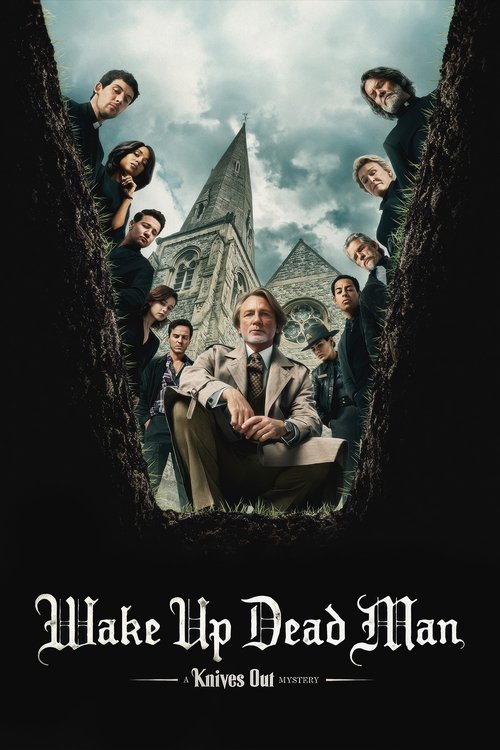
Wake Up Dead Man: A Knives Out Mystery
A brooding Gothic chamber piece bathed in candlelight and autumn mist, Wake Up Dead Man pierces institutional sanctimony, transforming a locked-room murder into a soul-searching meditation on faith, guilt, and divine reckoning.
Wake Up Dead Man: A Knives Out Mystery

Wake Up Dead Man: A Knives Out Mystery

"He works in mysterious ways."

26 November 2025 United States of America 145 min 7.2 (2,750)

Director: Rian Johnson

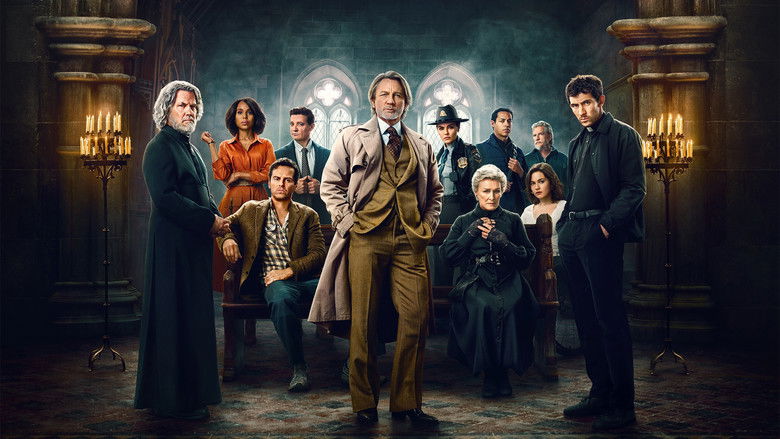
Cast: Daniel Craig, Josh O'Connor, Glenn Close, Josh Brolin, Mila Kunis

Thriller Comedy Mystery Authentic Grace vs. Performative Dogma The Idolatry of Greed & Material Inheritance Rational Truth vs. Spiritual Faith Guilt, Confession, and Penance Tribalism and the Weaponization of Fear
Budget: $210,000,000
Box Office: $4,000,000

Overview

Following the flamboyant, sun-drenched satire of Glass Onion, writer-director Rian Johnson steers the Knives Out franchise into colder, moodier, and more contemplative territory. Set in the quiet upstate New York community of Chimney Rock, the story centers around the church of Our Lady of Perpetual Fortitude. The parish is ruled under the tyrannical, fire-and-brimstone dominion of Monsignor Jefferson Wicks, a polarizing demagogue whose sermons weaponize shame and fear against an increasingly insular, bitter congregation.

The fragile dynamic collapses when Father Jud Duplenticy—a young priest and former boxer reassigned to the parish following a violent outburst—clashes fundamentally with Wicks's reactionary philosophy. When Monsignor Wicks is found stabbed to death in a sealed room immediately following a fiery Good Friday service, the locked-room circumstances and circumstantial evidence point directly at Jud.

Confronted with an "impossible crime" charged with supernatural and miraculous overtones, local Police Chief Geraldine Scott calls upon the renowned gentleman sleuth Benoit Blanc. As Blanc arrives, he partners with the troubled young priest to sift through an eccentric ensemble of bitter devotees, uncovering buried secrets, hidden avarice, and a decades-old town mystery where secular deduction meets spiritual crisis.
Core Meaning

Rian Johnson utilizes the traditional Agatha Christie-style locked-room whodunit and Edgar Allan Poe-inspired Gothic melodrama to examine the modern crisis of American tribalism, ideological radicalization, and the distortion of spiritual communities. The film argues that when faith becomes an instrument of power, vengeance, and exclusion, it ceases to be divine and curdles into toxic idolatry.

Through the juxtaposition of Benoit Blanc's rigorous empirical rationality and Father Jud's bruised, compassionate spirituality, Wake Up Dead Man asserts that true grace and truth are not found in dogma, self-righteous crusades, or material wealth, but in vulnerable human empathy, genuine contrition, and the courage to welcome the outcast.

Thematic DNA

Authentic Grace vs. Performative Dogma 30%
The Idolatry of Greed & Material Inheritance 25%
Rational Truth vs. Spiritual Faith 20%
Guilt, Confession, and Penance 15%
Tribalism and the Weaponization of Fear 10%

Authentic Grace vs. Performative Dogma

Explored through the direct philosophical contrast between Father Jud's belief in love and second chances versus Monsignor Wicks's punitive, fear-driven fundamentalism.

The Idolatry of Greed & Material Inheritance

Explores how spiritual piety is often a masquerade for ruthless financial avarice, centered around the elusive "Eve's Apple" legacy of the church founder.

Rational Truth vs. Spiritual Faith

Benoit Blanc's empirical materialism dialogues with Jud's theological worldview, exploring the complementary nature of seeking truth in logic and seeking healing in faith.

Guilt, Confession, and Penance

The Catholic sacrament of Reconciliation is woven directly into the investigative structure; secrets whispered in the dark carry far greater consequences than physical forensic evidence.

Tribalism and the Weaponization of Fear

Examines how insular communities construct paranoid "us versus them" narratives to justify moral rot and shield themselves from accountability.

Character Analysis

Benoit Blanc

Daniel Craig

Archetype: The Master Sleuth / Rationalist Inquirer Key Trait: Razor-sharp deduction cloaked in warm Southern charm.

Motivation

Uncover empirical truth and dismantle fraudulent myths.

Character Arc

Evolves from treating the case as an intellectual puzzle to stepping back and honoring a higher, moral resolution.

Father Jud Duplenticy

Josh O'Connor

Archetype: The Reluctant Anchor / Bruised Penitent Key Trait: Radical sincerity, masked beneath a defensive boxer's posture.

Motivation

Seek redemption and bring genuine empathy to a broken community.

Character Arc

Overcomes the guilt of his violent past in the ring to become the true spiritual shepherd and Blanc's investigative guide.

All 5 characters and cast

Symbols & Motifs

The Devil's-Head Pommel Dagger

Meaning:

A motif of weaponized sin, symbolizing how the perpetrators projected their own malevolence onto "the demonic" to craft an artificial myth of holy martyrdom.

Context:

Crafted from a red devil-head finial stolen from a bar and utilized as the primary murder weapon in the staged locked-room crime.

"Eve's Apple" (The Swallowed Diamond)

Meaning:

Represents original sin, spiritual corruption consumed from within, and the lethal weight of hidden wealth.

Context:

The mythical diamond into which the parish founder converted his fortune before swallowing it whole to hide it.

The Sealed Confessional Booth

Meaning:

A space where narrative truth and metaphysical absolution collide, contrasting judicial punishment with spiritual reckoning.

Context:

Used both literally for confessions and symbolically during key revelations and the film's climax between Martha and Father Jud.

The Broken Crucifix / Blood Moon

Meaning:

Signifies broken covenants, desecration from within the flock, and the ominous weight of judgment looming over the community.

Context:

Recurrent visual motifs appearing during dramatic parish moments and atmospheric exterior sequences over Chimney Rock.

Memorable Quotes

To understand this case, I had to look at the myth that was being constructed. Not to solve whether it was real or not, but to feel in my soul the essence of that which it strove to convey... A holy priest. Struck down by no man, but by the hand of Satan himself... His justice for the holy. His vengeance for the wicked.
— Benoit Blanc

Context

Blanc delivers his climactic deconstruction of the staged locked-room crime, revealing how the scene was crafted as a liturgical spectacle.

Meaning

Highlights Blanc's analytical breakthrough regarding the theatrical and liturgical staging of the crime.

These things I did with… hatred in my heart. 'Vengeance is mine,' said the Lord. And that is the story the crime scene will tell the world, but… inside my heart, I know… vengeance is mine.
— Martha Delacroix

Context

Spoken during her final confession in the darkened booth to Father Jud.

Meaning

Represents Martha's tragic acknowledgment of her descent into sin and her prideful usurpation of God's role.

All 3 quotes

Philosophical Questions

Does true justice belong to the rule of law or the realm of divine conscience?

The film questions whether legal punishment holds any weight compared to internal moral accountability and genuine spiritual penance.

Can sacred institutions survive the worldly corruption of their leaders?

The narrative investigates whether faith can be detached from the flawed humans who claim to represent and administer it.

Is myth-making an act of deceit or a psychological necessity?

Blanc's deductions highlight how humans construct miraculous and demonic narratives to cope with mundane malice and grief.

Alternative Interpretations

Different analytical perspectives include:

Full ending explanation

Cultural Impact

Released in late 2025, Wake Up Dead Man caught the cultural zeitgeist by directly addressing the factionalization and moral polarization within American religious institutions. Critics and cultural commentators lauded Rian Johnson for avoiding cheap, surface-level mockery, offering instead a nuanced exploration that contrasted the genuine comfort of spiritual faith with the authoritarian corruption of religious nationalism.

Critics praised the film as the most emotionally mature entry in the trilogy, frequently singling out Josh O'Connor's soulful co-lead performance alongside Daniel Craig. It earned widespread critical acclaim and comparisons to vintage classic detective cinema for its mastery of locked-room mechanics.

Audience Reception

Audiences and critics celebrated the film as a triumphant reinvention of the series that successfully pivoted away from farcical comedy toward rich, atmospheric mystery.

Key praise was directed at Josh O'Connor's performance, Daniel Craig's grounded evolution as Benoit Blanc, the darker, richly textured Gothic cinematography, and the sophisticated locked-room mechanics. Minor criticisms noted slightly extended pacing during the second-act exposition and limited screen time for certain ensemble members compared to suspects in earlier installments.

Interesting Facts

  • Continuing Rian Johnson's tradition of titling Benoit Blanc mysteries after famous rock songs, the title is named after the closing track on U2's 1997 album Pop.
  • Unlike the opulent, sunny Aegean backdrop of Glass Onion, Johnson intentionally shot in gloomy locations in the United Kingdom to capture the chilly, overcast, Gothic tone of upstate New York autumn.
  • Johnson structured the mystery as a homage to John Dickson Carr's classic locked-room mystery The Hollow Man and Edgar Allan Poe's macabre tales of sealed crypts and guilt.
  • Longtime DP Steve Yedlin utilized custom digital-emulation algorithms to replicate the tactile texture, gate weave, and halation of vintage film stock inside candlelit stone chapels.
  • Jeremy Renner, who previously appeared only as a running gag on a bottle of hot sauce in Glass Onion, joined the active cast in person as Dr. Nat Sharp.
  • Nathan Johnson returned to compose the score, utilizing scratchy solo cellos, mournful horns, and sudden organ bursts to evoke Gothic religious terror.
  • The film had its world premiere at the Toronto International Film Festival (TIFF) on September 6, 2025, prior to its limited theatrical run and Netflix debut in December 2025.

Easter Eggs

Cameos by Noah Segan and Joseph Gordon-Levitt

Regular Rian Johnson mainstays make traditional appearances; Segan appears as tavern owner Nikolai, while Gordon-Levitt cameos as the voice of a baseball announcer.

Phish Message Board Reference

In a comedic pop-culture reference, Dr. Nat Sharp's broken marriage is attributed to his wife leaving him for a devotee she met on an online Phish forum.

Bram Stoker's Dracula Homage

The dramatic flashback sequence where Grace bursts through the church doors under a stylized blood moon directly pays homage to Francis Ford Coppola's 1992 film Bram Stoker's Dracula.

U2 Lyric Paraphrasing

The script subtly incorporates thematic echoes and lyrical motifs of Bono's spiritual pleading ("Jesus, help me") without using the literal track on the score.

Frequently Asked Questions

Explore More About This Movie

Dive deeper into specific aspects of the movie with our detailed analysis pages

Comments (0)

Leave a comment

No comments yet. Be the first to share your thoughts!

Similar Movies