Full spoilers for all three seasons follow.
Season one. The premise is a trap sprung in the first episode: Iori Kitahara arrives in Izu to live above his uncle's dive shop expecting a glittering college life, and is stripped and drugged into the Peek a Boo diving club at the welcoming party, where Tokita and Kotobuki serve him 'oolong tea' that is vodka mixed with whisky and 'water' that is a vodka named Water of Life. The reveal the season withholds and then delivers is that the club is not a hazing gauntlet to escape but the family Iori will spend three seasons refusing to admit he wants. Chisa Kotegawa, established as an accomplished diver whose family runs a diving shop, is set up as the object of Iori's aspirations and as the person most disgusted by him — a contempt the series gradually exposes as cover for feelings she will not name. The tennis-doubles arc, engineered by the seniors as revenge on the tennis club for its prize money, is the season's structural key: it shows that every apparently random episode of chaos is in fact a scheme with a petty, human motive underneath.
Season two. Returning in July 2025 after seven years, the second season's real turn is tonal rather than plot-driven. The gag machinery is intact — the drinking, the stripping, the schemes — but the season steadily foregrounds the club's older cohort and the fact that university ends. The graduating-seniors material is the season's emotional payload, and the widely reported viewer reaction is that it landed with a force the comedy had not prepared anyone for. Retroactively it recodes season one: the seniors' relentless tormenting of Iori reads, in hindsight, as people compressing everything they have into the time they had left. Iori's own arc completes its inversion here — he is no longer the victim of the club's nonsense but a fluent participant in it, and his competence as a diver is now taken for granted rather than earned on screen. The season closes on 23 September 2025 at a point viewers described as painful to reach, softened only by the prior announcement of a third season.
Season three. Opening in July 2026 with 'Unfinished Business' and continuing with 'Homecoming', the third season takes the cast overseas to Palau. The relocation is the series' first structural change: removing the club from Izu tests whether the group is a product of its place or of its people, and the answer — that they reconstitute the same chaos in tropical water — is the show's final argument about found family. The titles themselves signal the season's preoccupation with things left undone and returns that are not quite returns.
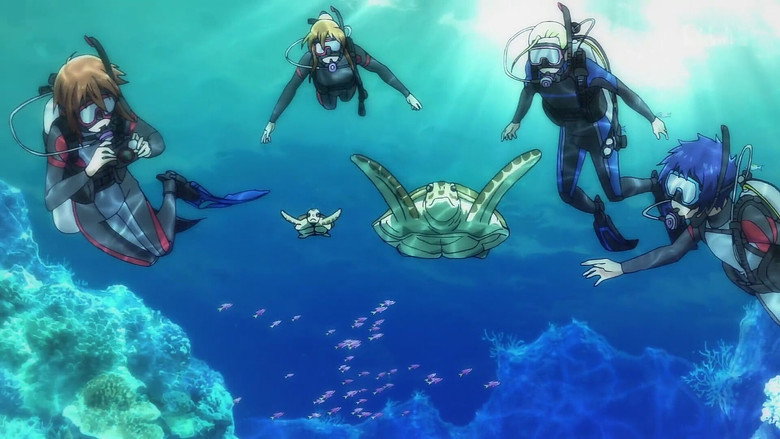
The meaning that only surfaces at the end. Watched whole, the series' bifurcated structure stops looking like a gimmick. Every silent, beautifully animated descent is bought with an episode of degradation on land, and the show's real claim is that this is the actual exchange rate of youth: you do not get the clarity without the idiocy, or the people without the humiliation. With the seniors gone and the diving now reaching the far side of the world, the underwater silence reads less as spectacle than as the only place these characters have ever been able to say anything true.