Skip to content
Grand Blue Dreaming
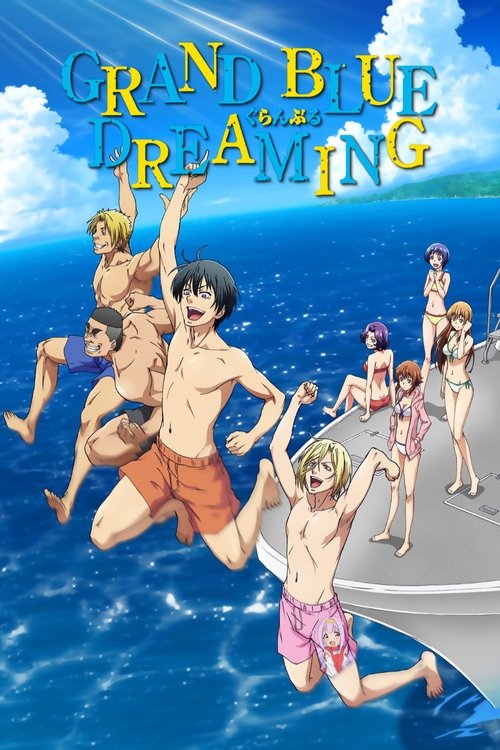
A sun-bleached comedy that drowns dignity in cheap vodka and then surfaces into sudden silence and light: college life as a beach party held above impossibly blue water.
Grand Blue Dreaming

Grand Blue Dreaming

ぐらんぶる

14 July 2018 — 01 September 2026 Japan 3 season 36 episode Returning Series 7.8 (197)

Cast: Yuma Uchida, Ryohei Kimura, Chika Anzai, Kana Asumi, Toa Yukinari

Animation Comedy Found family and the diving club as home The sea as the show's sacred register Coming of age through humiliation Romance, cowardice and emotional honesty Freedom, excess and the temporary licence of university

Overview

Grand Blue Dreaming (ぐらんぶる), adapted from the manga written by Kenji Inoue and illustrated by Kimitake Yoshioka, follows Iori Kitahara as he moves to the coastal town of Izu to begin university, lodging above his uncle's scuba shop. Within hours of arriving he is stripped, poured full of alcohol and absorbed into the diving club "Peek a Boo," and his carefully rehearsed vision of a sparkling campus romance is replaced by something louder, dumber and far more affectionate.

Across its run the series alternates between two registers that should not coexist. On land it is escalating farce: drinking games, cosplay disasters, tennis grudge matches, and elaborate schemes engineered by upperclassmen with no sense of shame. Below the surface it turns quiet and reverent, taking the mechanics and beauty of diving seriously enough that the jokes stop entirely. The first season, animated by Zero-G and directed and written by Shinji Takamatsu, aired in 2018; after a seven-year wait a second season arrived in 2025 from Zero-G and Liber, and a third, produced with Saber Works, followed in 2026 and takes the cast overseas to Palau.

The through-line is not plot so much as accumulation. Iori and his friend Kohei Imamura acquire certifications, part-time jobs, humiliations and, gradually, people they would be genuinely sorry to lose. Chisa Kotegawa, an experienced diver aiming to become an instructor, anchors the show's more grounded emotional register, while the club's seniors provide both the chaos and, eventually, the reminder that university is a place people leave.
Core Meaning

Beneath the nudity gags and the industrial quantities of vodka, Grand Blue Dreaming argues that the version of youth you plan for is worthless compared to the one that ambushes you. Iori arrives with a fantasy of a clean, romantic college life, and every episode dismantles it in favour of something undignified, exhausting and real.

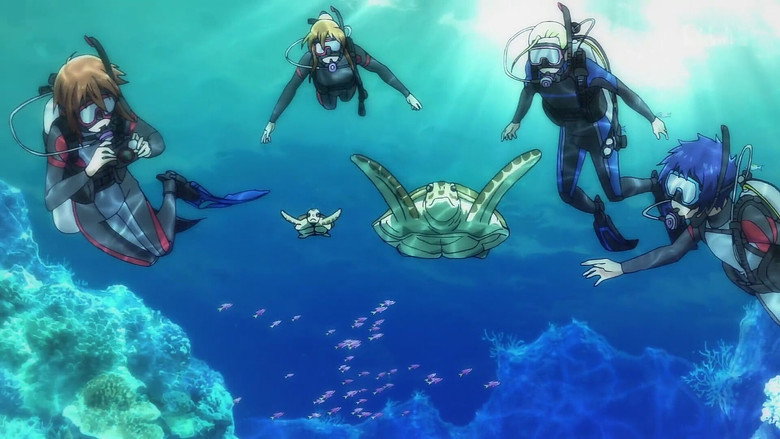
The series' structural joke is also its thesis. It commits absolutely to stupidity on land and then, without warning, goes silent underwater, where the animation turns lucid and the characters become competent, careful and serious. The implication is that the idiocy is not the opposite of the beauty but the price of admission to it: you only get the blue because you were willing to be ridiculous with the people who take you there.

Across three seasons the message hardens into something quietly melancholy. Certifications are earned, seniors graduate, trips end. What the show finally says is that these years are a shared, temporary and unrepeatable dive — and the correct response is not to be careful with them.

Thematic DNA

Found family and the diving club as home 25%
The sea as the show's sacred register 22%
Coming of age through humiliation 20%
Romance, cowardice and emotional honesty 18%
Freedom, excess and the temporary licence of university 15%

Found family and the diving club as home

Iori is conscripted into Peek a Boo before he consents to anything, and the club's rituals — drinking, stripping, mutual humiliation — function as an aggressive form of adoption. Early on the seniors are antagonists to be survived; by mid-series they are the people Iori instinctively calls when something goes wrong.

The theme deepens as the series ages with its cast. Later seasons introduce the pressure of graduation and departure, and the storyline of the graduating seniors was singled out by viewers as landing far harder than an absurd comedy has any right to. The club stops being a joke machine and becomes a thing that can be lost.

The sea as the show's sacred register

Reviewers consistently note that the comedy is relentless but that Grand Blue never mocks anything below sea level. Diving procedure, buoyancy, equipment checks and the discipline of the sport are treated with real respect, and the underwater sequences are staged as genuinely beautiful.

Across the seasons the scope of the water widens — from the pool and local Izu dives, to open-water certification and boat trips, and finally to the tropical waters of Palau in season three. The escalation mirrors the characters' competence: the further they can go, the more the ocean rewards them.

Coming of age through humiliation

The show's engine is a loop of escalating bad decisions, and Iori's dignity is the fuel. But the humiliations are formative: each one strips away another layer of the polished self-image he brought to Izu.

Over three seasons the gag evolves from something done to Iori into something he participates in willingly and eventually orchestrates. Growing up here is measured not by maturity but by how completely a character stops performing.

Romance, cowardice and emotional honesty

Chisa openly disdains Iori's perverted behaviour while privately developing feelings for him, and the series keeps that tension deliberately unresolved for long stretches, using comedy as an avoidance mechanism the characters share with the show itself.

The romantic material accumulates rather than progresses: near-confessions, misread signals, and the recurring spectacle of characters sabotaging their own feelings. Later seasons let more of it surface, so that the moments of sincerity land with disproportionate force precisely because everything around them is a joke.

Freedom, excess and the temporary licence of university

Izu University is depicted as a lawless interval — a place where drinking, nonsense and total absence of supervision are not failures of the institution but the point of it. The show frames this as a finite permit rather than a lifestyle.

As the run continues, the outside world intrudes: part-time work, exams, career intentions, graduation. The excess never stops, but it acquires a deadline, and the later seasons are quietly aware that the party has a last call.

Character Analysis

Iori Kitahara

Yuma Uchida

Archetype: Reluctant everyman hero turned willing fool Key Trait: Doomed dignity — a straight man who is never allowed to stay straight

Motivation

Initially, to have the sparkling romantic university life he pictured. That goal erodes into something less articulate and more honest: to stay with these people, keep diving, and avoid admitting how much either matters.

Character Arc

Arrives in Izu with a meticulously imagined college fantasy and is immediately stripped of it — literally. Season one is his resistance: he is dragged into the club, the drinking and the diving, protesting the entire way.

Across the later seasons the resistance quietly disappears. He becomes a competent diver, a reliable friend and eventually a co-author of the nonsense rather than its victim, while remaining incapable of handling sincerity when it is aimed at him. By the Palau material of season three he is the veteran, not the newcomer.

Kohei Imamura

Ryohei Kimura

Archetype: Foil and fellow victim Key Trait: Fanatical conviction, instantly punctured

Motivation

To preserve his idealised fantasy world intact. Increasingly complicated by loyalty to people who make that impossible.

Character Arc

Introduced as Iori's counterpart in the club's hierarchy of suffering — an otaku with a violently defended two-dimensional taste in women, whose composure collapses on contact with reality.

Over the seasons he shifts from rival to genuine best friend, the person Iori's humiliations are shared with rather than inflicted by. His growth is measured in how far his obsessions bend when actual relationships get in the way.

All 5 characters and cast

Symbols & Motifs

The blue of the open water

Meaning:

The title's colour stands for clarity, silence and everything the characters cannot articulate on land. It is the show's one sincere image, reserved and never undercut by a punchline.

Context:

Deployed as a deliberate tonal break: the animation shifts from distorted gag faces to lucid, carefully lit underwater photography whenever the cast descends, in every season from the Izu dives through to the Palau waters of season three.

Alcohol and the disguised drink

Meaning:

Drink is the club's sacrament and its trap — a symbol of forced intimacy, of the loss of the self you were protecting, and of the comedy of consent inside a group that has already decided you belong.

Context:

Established immediately at the welcoming party, where Tokita and Kotobuki hand Iori 'oolong tea' that is actually vodka mixed with whisky, and later 'water' that turns out to be a vodka called Water of Life. The gag recurs as a structural motif for the rest of the series.

Nudity and the stripped body

Meaning:

Being naked is the club's initiation and its shorthand for honesty: masks removed, pretensions gone, nothing left to defend. It is played entirely for comedy, but it is also the show's most consistent metaphor.

Context:

From Iori's first night in Izu onward, stripping is the club's default response to celebration, crisis and boredom alike, and the joke is escalated in each season rather than retired.

The mask and regulator

Meaning:

Diving gear symbolises competence and trust — equipment you check for your buddy, and the one context in which these characters are unimpeachably careful.

Context:

Used across the certification storylines, where the ritual of pre-dive checks doubles as an image of people quietly taking responsibility for each other after an episode of doing the exact opposite.

The dive shop above which Iori lives

Meaning:

A threshold space between land and sea, family obligation and freedom — the point where Iori's old life is exchanged for the new one.

Context:

Iori's uncle's shop is his lodging, his workplace and the gateway to Peek a Boo; almost every arc begins or ends with someone walking through it.

Memorable Quotes

脱げ! (Nuge! — "Strip!")
— The Peek a Boo diving club

Context

Established from the welcoming-party sequence in the first episode of season one and escalated as a running motif through every subsequent season.

Meaning

The series' signature imperative and its thesis in one word: shed the presentation, join the group. It is the club's answer to celebration, panic and boredom alike.

It's oolong tea.
— Tokita and Kotobuki

Context

Season one, episode one: at the university welcoming party the seniors hand Iori 'oolong tea' that is in fact a mixture of vodka and whisky.

Meaning

The purest expression of the show's comic logic — a lie so flimsy it is barely a lie, offered by people who fully expect you to drink anyway. It sets the terms of Iori's entire university career within minutes.

All 4 quotes

Episode Highlights

The Welcoming Party

S1E1

Iori arrives in Izu to live above his uncle's dive shop and is inside the diving club's grip before the episode ends: stripped, handed 'oolong tea' that is vodka and whisky, and then 'water' that is a vodka called Water of Life.

Significance:

Establishes the entire series contract in twenty minutes — the fantasy of college life demolished, the club as inescapable family, and alcohol as the show's recurring engine.

The Tennis Doubles Match

S1E5

Tokita and Kotobuki manoeuvre the club into a tennis doubles match, the real motive being revenge on the tennis club and the seizure of its prize money. Fans repeatedly single the tennis match out as one of the best stretches of the first season.

Significance:

The first full demonstration of the show's escalation formula: a petty grudge inflated into an operatic set piece, and the template for the elaborate schemes that structure later seasons.

Season One Finale

S1E12

The closing episode of the 2018 run, broadcast 29 September 2018 on the Animeism block, capping Iori's first stretch in Izu.

Significance:

Ended what turned out to be a seven-year interval before continuation, leaving the first season to stand alone as a cult comedy — and making the eventual return an event in its own right.

Season Two Premiere

S2E1

The long-delayed return, produced by Zero-G with Liber and broadcast 8 July 2025. Reviewers called it a solid premiere with plenty of gag humour, and audiences greeted the reappearance of Iori and Chisa warmly.

Significance:

Proved the comedy had not aged out after seven years and reset the series as an ongoing property rather than a one-season curiosity; season two went on to score higher than season one with viewers.

Season Two Finale

S2E12

Broadcast 23 September 2025, closing the second season on a note viewers described as genuinely painful to reach — with a third season already scheduled.

Significance:

Consolidated the series' shift from pure gag comedy toward the emotional weight of endings and departures that fans found unexpectedly affecting.

Unfinished Business

S3E1

The season-three opener, first broadcast in July 2026, produced by Zero-G with Saber Works, and opening the arc that takes the cast overseas to Palau.

Significance:

Widens the series geographically for the first time, moving the diving from familiar Izu waters to a tropical setting and raising the stakes of both the comedy and the underwater sequences.

Homecoming

S3E2

Broadcast a week after the season-three premiere, continuing the overseas stretch of diving, drinking and general madness.

Significance:

Balances the new setting against the series' returning rhythms, confirming that distance changes the scenery but not the club.

Philosophical Questions

Can something undignified still be sacred?

The series structures every episode around the collision: humiliation on land, reverence underwater. It never resolves the contradiction, insisting instead that the same people are simultaneously ridiculous and capable of genuine grace, and that neither state cancels the other.

Do we choose our friends, or are we simply captured by them?

Iori is conscripted into Peek a Boo without anything resembling consent, yet the series treats the resulting bond as more real than any relationship he would have chosen. Across three seasons it quietly asks whether the affection is legitimate given how it began — and answers by showing him unable to leave.

Is the point of youth to use it well or to waste it together?

Almost nothing productive happens on screen; the characters drink, scheme and fail. But as graduation enters the frame in later seasons, the show reframes that waste as the only thing that will be remembered, and the responsible alternative as the true loss.

Why is it easier to be honest underwater than on land?

Diving is the one activity in which these characters are careful, attentive and trustworthy — and also the one in which they cannot speak. The series repeatedly implies that silence and shared risk communicate what the cast is constitutionally unable to say out loud.

Alternative Interpretations

The most common split among viewers concerns what the show actually is. One reading takes it at face value: a gag comedy about drunk university students, in which the diving is set dressing and the emotional beats are garnish. The competing reading treats the comedy as the disguise — pointing out that the series never mocks anything below sea level, and that the jokes exist to make the sincerity survivable when it finally arrives.

Full ending explanation

Cultural Impact

Grand Blue Dreaming arrived in summer 2018 as an Amazon Prime Video worldwide exclusive, an unusual distribution choice that initially limited its reach but did not prevent it from becoming a word-of-mouth cult comedy. Directed and written by Shinji Takamatsu — a veteran of long-form gag comedy — it slotted into the Animeism block as one of the most aggressively crude mainstream comedies of its year, built on drinking, nudity played for laughs and university-level stupidity.

Its cultural footprint has two halves. As a comedy it became a reliable reference point for the "escalating bad decisions" school of anime humour, its stripping gag and drink-substitution routines widely quoted and memed. As a sports-adjacent series it did something rarer: it put recreational scuba diving in front of a mass anime audience and treated the sport's procedure and beauty with real accuracy, so that the underwater sequences function as genuine advertisement for the hobby.

The seven-year gap between seasons became part of the show's legend. When season two arrived in July 2025 from Zero-G and Liber, the response was strong enough to push it above the original in audience scoring — roughly 8.62 to 8.44 on MyAnimeList, placing it in the site's top 100 — with more than eleven thousand Crunchyroll reviews averaging 4.9 out of 5. A third season followed quickly in 2026, relocating to Palau, converting a one-off summer curiosity into an ongoing franchise. The title itself inevitably reads as an echo of the cinema of deep-blue obsession, an association the show plays entirely straight in its underwater scenes and entirely for laughs everywhere else.

Audience Reception

Season one built a devoted cult following in 2018 on the strength of its commitment: reviewers described a comedy engine of escalating bad decisions that never gets old because the show commits so hard to every bit, praising the vibrant animation, the memorable club members, and the seamless switching between comic and heartfelt registers. The consistent counterpoint was tolerance-dependent — the crude humour, the heavy drinking, the nudity played for laughs and the general university-level stupidity are non-negotiable features, and viewers unwilling to accept them found nothing else on offer. A recurring complaint was that the diving, genuinely beautiful when it appeared, appeared too rarely.

The seven-year wait for season two created unusually high expectations, and the 2025 return cleared them. Early reviews called the premiere a solid, gag-dense restart from Zero-G and Liber, and fans who had waited nearly a decade were vocally pleased to see Iori and Chisa back. Aggregate opinion actually improved with the sequel: season two sits above season one on MyAnimeList at roughly 8.62 to 8.44, inside the site's top 100, and drew more than eleven thousand Crunchyroll reviews averaging 4.9 out of 5. Typical audience verdicts described it as pure chaos, laughter and good vibes, with the season's end genuinely hurting.

The most interesting shift in reception concerns tone. Viewers repeatedly report being ambushed by the emotional material — the graduating-seniors storyline in particular was described as hitting far harder than an absurd comedy episode should — and this has become a central part of the show's reputation rather than a footnote. Season three's move to Palau in 2026 continued the run with the audience largely intact. The overall verdict is a comedy that knows exactly what it is, executes it with unusual technical care, and has quietly earned the right to be taken seriously in the moments it chooses to be.

Interesting Facts

  • The series is adapted from the manga written by Kenji Inoue and illustrated by Kimitake Yoshioka.
  • Shinji Takamatsu directed and wrote the first season and also handled its sound direction; Hideoki Kusama designed the characters and Zero-G produced the animation.
  • Season one aired from 14 July to 29 September 2018 on the Animeism programming block on MBS, TBS and BS-TBS, and was streamed exclusively worldwide on Amazon Prime Video.
  • The season one opening theme, 'Grand Blue', is performed by the hip-hop group Shōnan no Kaze.
  • The season one ending theme, 'Konpeki no al Fine', is performed by 'Izu no Kaze' — a unit formed by cast members Yūma Uchida, Ryohei Kimura, Hiroki Yasumoto and Katsuyuki Konishi.
  • Fans waited roughly seven years between seasons: season one ended in September 2018 and season two did not air until 8 July to 23 September 2025.
  • Season two was produced by Zero-G together with Liber, while season three was produced by Zero-G with Saber Works and began airing in July 2026.
  • Season three's opening theme is 'Natsuko' (夏子) by Funky Monkey Babys, with 'Hadaka no Mermaid' (裸のマーメード, 'Naked Mermaid') by Mameshiba no Taigun as the ending.
  • Season three moves the cast overseas to Palau for a new stretch of diving and chaos, the series' first major change of location.
  • Season two outscored the first with viewers on MyAnimeList — roughly 8.62 against 8.44 — placing it inside the site's top 100, while the series holds a 7.9 on IMDb.

Easter Eggs

'Izu no Kaze', the in-house cast unit performing the season one ending theme

A direct pun on Shōnan no Kaze, the real hip-hop group performing the opening — swapping the Shōnan coast for the show's own Izu. The voice actors literally form a knock-off of their own opening act.

The dive shop and the club have separate, telling names

The series takes its title from the shop Iori lodges above, while the university club is called Peek a Boo — a name whose childish, faintly indecent connotation sums up the club's entire personality against the solemnity of the show's title.

Real chart acts supply the theme songs across seasons

Rather than anime-specific artists, the series recruits established Japanese hip-hop and pop groups — Shōnan no Kaze for season one, Funky Monkey Babys for season three — giving the openings a summer-anthem, beach-radio quality that matches the Izu setting rather than typical anime convention.

Frequently Asked Questions

Explore More About This Movie

Dive deeper into specific aspects of the movie with our detailed analysis pages

Comments (0)

Leave a comment

No comments yet. Be the first to share your thoughts!

Similar Movies