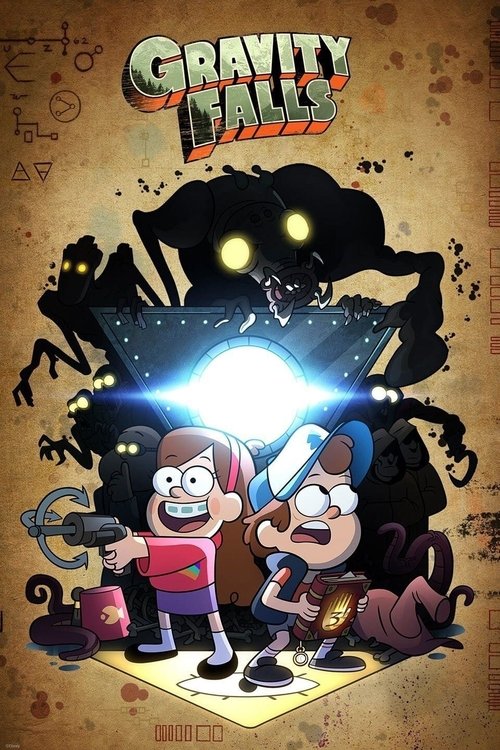
Gravity Falls
"Just west of weird."
Overview
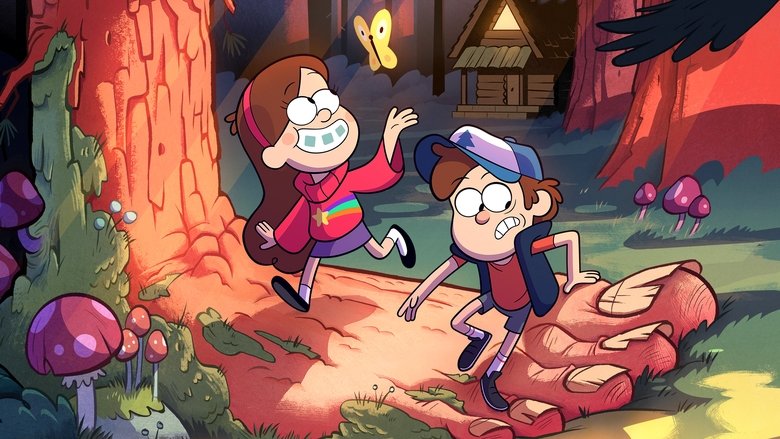
"Gravity Falls" follows the adventures of 12-year-old twins Dipper and Mabel Pines, who are sent to spend their summer vacation with their great-uncle, "Grunkle" Stan, in the peculiar town of Gravity Falls, Oregon. Stan runs a tourist trap called the Mystery Shack, but the real mystery is the town itself, which is filled with supernatural creatures and paranormal phenomena. Soon after arriving, Dipper discovers a cryptic journal in the woods that details the town's strange occurrences.
Together, Dipper and Mabel, along with the Mystery Shack's quirky handyman Soos and the cool teenage cashier Wendy, begin to unravel the town's secrets. What starts as a series of monster-of-the-week adventures slowly builds into a complex overarching narrative involving the journal's mysterious author, secret societies, and a powerful, chaotic dream demon named Bill Cipher. The series masterfully balances comedy, adventure, and heartfelt emotion as the twins confront not only supernatural threats but also the personal challenges of growing up.
Core Meaning
At its heart, "Gravity Falls" is a story about the transition from childhood to adolescence and the bittersweet nature of growing up. It explores the powerful, unbreakable bond between siblings and the importance of family in the face of both mundane and extraordinary challenges. The series posits that while change is inevitable and sometimes frightening, the relationships we forge and the memories we create provide the strength to face the unknown. It champions curiosity and critical thinking, while also delivering a profound message about sacrifice, trust, and the idea that true family isn't just about blood relatives but also the people who stand by you.
Thematic DNA
Coming of Age and the End of Childhood
The entire series is framed by one fleeting summer, a classic metaphor for the end of an era. Dipper's desire to grow up too fast is contrasted with Mabel's fear of leaving childhood behind. This tension comes to a head in the final episodes, where Mabel is trapped in a fantasy world where summer never ends, and must choose to embrace the future with her brother. The show tenderly explores the anxieties of adolescence, from first crushes to discovering that the adults in your life are flawed and complex people.
Family and Sibling Bonds
The core relationship of the series is the bond between Dipper and Mabel. Their contrasting personalities—Dipper's analytical nature and Mabel's boundless optimism—are shown to be their greatest strength when they work together. The show elevates this theme by mirroring their dynamic with the broken relationship between Grunkle Stan and his long-lost twin brother, Ford, presenting a cautionary tale of what can happen when siblings grow apart. Ultimately, it is the Pines family's love and trust in one another that saves the world.
Trust vs. Paranoia
The motto of the series could easily be "Trust No One," a phrase Dipper adopts from the mysterious journal. Throughout the show, he is often paranoid and suspicious of those around him, especially Grunkle Stan. A major turning point is the episode "Not What He Seems," where Dipper's trust in his great-uncle is pushed to its absolute limit. The series explores the difficulty of knowing who to trust in a world full of secrets and deception, ultimately concluding that placing faith in loved ones, despite their flaws, is a necessary and powerful act.
Character Analysis
Dipper Pines
Jason Ritter
Motivation
Initially, Dipper is driven by a desire for knowledge and a need to solve the mysteries presented by the journal. He wants to be seen as a hero and an adult. As the series progresses, his motivation shifts from personal validation to protecting his family and friends from the very real dangers he uncovers, especially the threat of Bill Cipher.
Character Arc
Dipper begins the series as a curious but physically weak and insecure 12-year-old, obsessed with uncovering the town's secrets and proving his maturity. His journey is about learning to balance his intellectual pursuits with emotional intelligence. Throughout the series, he gains confidence, learns to be a leader, and comes to appreciate the value of his family, particularly his bond with Mabel. He learns that growing up isn't about rushing into adulthood but about facing challenges with courage and relying on others.
Mabel Pines
Kristen Schaal
Motivation
Mabel's primary motivation is to have an epic summer romance and embrace fun and silliness at every turn. She is driven by her emotions and a deep-seated fear of things changing and growing apart from her brother. Her core motivation evolves to wanting to protect the happiness and unity of her family, realizing that true happiness comes from facing reality together, not escaping it.
Character Arc
Mabel starts as a relentlessly cheerful, boy-crazy, and somewhat selfish character who lives in her own whimsical world. Her arc involves confronting the reality that her relentless optimism can't solve every problem and that growing up means accepting imperfection and change. She learns to be more considerate of others' feelings, especially Dipper's, and discovers that her greatest strength is her creativity and her capacity for love, which ultimately plays a key role in saving the world.
Stanley "Grunkle Stan" Pines
Alex Hirsch
Motivation
For most of the series, Stan's apparent motivation is making easy money. However, his true, hidden motivation is to reactivate a universal portal hidden beneath the Mystery Shack to rescue his twin brother, Stanford, who has been trapped in other dimensions for 30 years. After Ford's return, his motivation becomes protecting the children and mending his broken relationship with his brother.
Character Arc
Grunkle Stan is introduced as a cynical, greedy con man who runs the Mystery Shack. His character arc is one of the most dramatic, revealing his gruff exterior to be a mask for a lifetime of regret and deep, protective love for his family. The revelation that he has been secretly working for decades to save his long-lost twin brother, Ford, completely recontextualizes his actions. He transforms from a simple comic relief character into a tragic hero who is willing to sacrifice everything, including his own mind, for his family.
Bill Cipher
Alex Hirsch
Motivation
Bill's motivation is to escape the decaying "Nightmare Realm" he comes from and merge it with our dimension, allowing him to exist physically and impose his brand of chaotic, rule-free weirdness on all of existence. He is driven by a desire for absolute power, liberation from all physical laws, and a sadistic sense of amusement derived from the suffering and chaos of others.
Character Arc
Bill Cipher is a two-dimensional dream demon who can enter people's minds. He is introduced as a manipulative but seemingly minor threat. His presence and influence grow exponentially throughout the series, escalating from a personal antagonist for the Pines to a cosmic-level threat bent on bringing chaos and destruction to the entire universe. He doesn't have a traditional character arc of growth but rather an 'arc' of revelation, as the full, terrifying scope of his power and nihilistic goals are gradually unveiled, culminating in the "Weirdmageddon" finale where he brings his nightmare realm into reality.
Symbols & Motifs
The Journals (1, 2, and 3)
The journals represent knowledge, mystery, and the dangerous pursuit of the unknown. They are Dipper's guide to the supernatural world of Gravity Falls but also a source of peril. They symbolize the double-edged sword of knowledge: a tool for understanding and protection, but also a lure for those who would use it for evil, like Bill Cipher.
Dipper finds Journal 3 in the first episode, and his quest to find the author and the other two journals drives the main plot of the series. The journals are central to nearly every mystery, containing information about creatures and instructions for dealing with supernatural threats. The revelation of their author and the quest to unite all three is a major turning point in the series.
Bill Cipher's Wheel
The Zodiac, or Bill Cipher's Wheel, symbolizes destiny, prophecy, and the interconnectedness of the key characters. Each symbol on the wheel represents a specific character in the town who has a role to play in the prophecy to defeat Bill Cipher. It highlights the idea that everyone, from the main protagonists to seemingly minor characters, has a part to play in the larger story.
The wheel appears in visions and ancient texts throughout the series, most notably in the opening credits and during encounters with Bill Cipher. The meaning of the symbols is a long-running mystery for fans. In the series finale, "Weirdmageddon 3: Take Back The Falls," the main characters attempt to use the wheel to banish Bill, with each character standing on their corresponding symbol, making its purpose explicit.
Mabel's Sweaters
Mabel's uniquely designed sweaters symbolize her vibrant, creative, and unapologetically optimistic personality. Each sweater, often matching the theme of the episode, is a visual representation of her boundless imagination and her refusal to conform. They are a constant source of brightness and levity, even in the darkest of situations, much like Mabel herself.
Mabel wears a different, hand-knitted sweater in almost every episode. The designs often foreshadow events or reflect the episode's plot or a particular emotion she's feeling. They are a key part of her character design and a memorable, recurring visual motif throughout the entire series.
Memorable Quotes
Remember! Reality is an illusion, the universe is a hologram, buy gold, bye!
— Bill Cipher
Context:
Bill says this at the end of his first physical appearance in Season 1, Episode 19, "Dreamscaperers," after being summoned by Gideon Gleeful and making a deal. It's his parting message as he leaves the characters' minds.
Meaning:
This is Bill's signature sign-off, encapsulating his chaotic, nihilistic worldview. It's a darkly comedic line that hints at the deeper, reality-bending nature of the show's mysteries and positions Bill as a being who sees our existence as a meaningless joke.
When you're a kid, you think the universe revolves around you. [...] But then you grow up and you realize... you're not the center of the universe.
— Grunkle Stan
Context:
This line is from Season 2, Episode 5, "Soos and the Real Girl," where Stan is trying to give Soos advice on talking to women, but it also reflects the broader character arcs of Dipper and Mabel.
Meaning:
This quote speaks to one of the central themes of the show: growing up. It's a moment of surprising wisdom from Stan, reflecting on the transition from the self-centeredness of childhood to the more complex understanding of the world that comes with maturity.
This is what I've been working for. For 30 years... And it's finally paying off.
— Grunkle Stan
Context:
Stan says this at the climax of Season 2, Episode 11, "Not What He Seems," just as the portal he's been building is successfully activated, right before the author of the journals emerges.
Meaning:
This is a pivotal line that reveals the true purpose behind all of Stan's secrecy and suspicious behavior. It marks the moment where the series' central mystery shifts, revealing that Stan's motivations were never about greed, but about a decades-long, desperate mission to save his brother.
Episode Highlights
Tourist Trapped
The pilot episode masterfully establishes the show's core elements: the charmingly bizarre town, the dynamic between the earnest Dipper and the goofy Mabel, and the central mystery kicked off by the discovery of Journal 3. It sets the perfect tone of humor, heart, and supernatural intrigue.
This episode lays the foundation for the entire series. It introduces the main characters, the central setting of the Mystery Shack, and the journal that drives the overarching plot. It immediately engages the audience with the show's blend of monster-of-the-week stories and a larger, hidden narrative.
Dreamscaperers
This episode introduces the series' main antagonist, the terrifyingly charming dream demon Bill Cipher. Dipper, Mabel, and Soos must venture into Grunkle Stan's mind to stop Bill from stealing the deed to the Mystery Shack. It's a visually inventive episode that also deepens the relationship between Dipper and Stan.
The introduction of Bill Cipher is a game-changer, elevating the stakes from local monsters to a cosmic threat. It establishes the rules of the mindscape and sets up the central conflict that will dominate the second season and the series finale.
Gideon Rises
In the action-packed Season 1 finale, the Pines family loses the Mystery Shack to their rival, Gideon Gleeful. The episode culminates in a giant robot battle and a shocking reveal: Stan has been secretly in possession of Journal 1, adding a new layer to the central mystery.
This episode concludes the first major story arc with Gideon and significantly expands the overarching mystery. Stan's reveal about the first journal and his secret passage behind the vending machine sets the stage for the darker, more serialized storytelling of Season 2.
Not What He Seems
Widely regarded as one of the best episodes, this suspenseful installment sees Stan arrested by government agents as his mysterious doomsday device counts down. Dipper and Mabel's trust in their Grunkle is tested as they must decide whether to stop the machine or believe in him, culminating in the monumental reveal of the journal's author.
This episode is the climax of the first half of the series. The reveal that Stan's long-lost twin brother, Stanford Pines, is the author of the journals fundamentally changes the show's dynamic and answers the question that had been driving the plot since the very first episode.
A Tale of Two Stans
Following the previous episode's cliffhanger, this episode is an extended flashback detailing the entire backstory of Stan and his brilliant but reckless twin brother, Ford. It explains how Ford discovered Gravity Falls' secrets, wrote the journals, built the portal, and ended up trapped, and how Stan spent 30 years trying to bring him back.
This episode provides crucial exposition and emotional depth to the series' mythology and its most complex characters. It recontextualizes Stan's entire personality and actions, and establishes the new family dynamic that defines the latter half of the season.
Weirdmageddon 3: Take Back The Falls
The epic, hour-long series finale sees the Pines family and the entire town of Gravity Falls band together to fight Bill Cipher and his minions for the fate of their reality. The episode is packed with action, callbacks, emotional resolutions for every character, and a final, heartbreaking sacrifice.
This episode provides a deeply satisfying conclusion to the entire series. It resolves the central conflict with Bill Cipher, completes the character arcs of Dipper, Mabel, and Stan, and reinforces the show's core themes of family and growing up, ending on a perfect, bittersweet note.
Philosophical Questions
What is the nature of growing up, and is it something to be feared or embraced?
The series explores this question through the opposing viewpoints of its twin protagonists. Dipper is eager to accelerate the process, believing maturity will bring him respect and understanding. Mabel fears it, associating adulthood with the loss of joy and the end of her close bond with Dipper. The show doesn't present a simple answer but suggests that growing up is an inevitable, complex process of learning to accept change and responsibility without losing one's essential self. The finale reinforces that change doesn't have to mean loss, but evolution, as the twins accept they can grow up without growing apart.
Can you ever truly know or trust another person?
This is a central theme, particularly in Dipper's relationship with Grunkle Stan. Dipper spends much of the series investigating Stan, convinced he's a fraud and a liar. The show demonstrates that people are often more complicated than they appear. Stan is indeed a liar and a con man, but his deceptions hide a deeper, nobler motivation. 'Gravity Falls' suggests that absolute trust is difficult and perhaps naive, but that choosing to have faith in family, despite their flaws and secrets, is a powerful and necessary act of love.
Does knowledge come with a moral responsibility?
Dipper's quest for knowledge via the journal often leads to dangerous situations. The story of Ford Pines serves as a cautionary tale: his insatiable curiosity led him to summon Bill Cipher, unleashing a great evil upon the world. The show argues that the pursuit of knowledge for its own sake, without considering the consequences, can be catastrophic. It suggests that true wisdom lies not just in knowing things, but in understanding the potential impact of that knowledge and using it responsibly to protect others.
Alternative Interpretations
One popular area for interpretation revolves around the true nature of the town's weirdness. While the show presents the supernatural elements as real, some viewers have explored the idea that the events could be interpreted through a more psychological lens, representing the anxieties and fears of growing up. Bill Cipher, in this reading, could be seen as a manifestation of the chaos and uncertainty of the future that the twins, particularly Mabel, are so afraid of.
Another point of discussion is the ending for Grunkle Stan. While his memory is restored by Mabel's scrapbook, some fans interpret this recovery as being incomplete. They suggest that the Stan who emerges is a slightly different, simplified version of his former self, built from the memories his family has of him. This adds a layer of bittersweet tragedy to his heroic sacrifice, implying that a part of him was truly lost in the defeat of Bill Cipher.
Cultural Impact
"Gravity Falls" premiered in 2012 and quickly became a cultural phenomenon, earning critical acclaim for its writing, characters, humor, and multi-layered storytelling. It was part of a wave of animated shows in the 2010s, alongside series like 'Adventure Time' and 'Steven Universe', that pushed the boundaries of children's television. These shows proved that animation could tell complex, serialized narratives with deep emotional resonance that appealed to audiences of all ages, not just children.
The series had a significant influence on subsequent animated shows, popularizing the format of a mystery-driven plot with clues, ciphers, and secrets for a dedicated fanbase to solve. This interactive element fostered a massive and passionate online community that actively engaged with the show, decoding cryptograms and speculating on theories, which enhanced the viewing experience and contributed to its longevity. Despite creator Alex Hirsch having a clear beginning, middle, and end in mind for the story and choosing to conclude it after only two seasons, the demand for more content has remained high. The show's legacy continues through supplementary materials like the best-selling real-life replica of 'Journal 3' and the graphic novel 'Lost Legends'.
Audience Reception
"Gravity Falls" received widespread critical acclaim and garnered a large and exceptionally passionate fanbase composed of children, teenagers, and adults. The show was praised for its clever writing, which seamlessly blended witty humor for all ages with moments of genuine emotion and surprising darkness. The complex, overarching mystery, complete with intricate codes and foreshadowing, was a major point of praise, fostering a highly interactive viewing experience.
The series maintained high ratings throughout its run, becoming one of Disney XD's highest-rated shows. While the decision to end the show after two seasons was met with some disappointment from fans who wanted more, creator Alex Hirsch's commitment to telling a complete, finite story was largely respected and praised for maintaining the narrative's quality and integrity. The show's legacy remains strong, and it is consistently cited as one of the best animated series of the 21st century.
Interesting Facts
- Creator Alex Hirsch based the characters of Dipper and Mabel on himself and his own twin sister, Ariel. Mabel's habit of wearing quirky sweaters was directly inspired by Ariel.
- Grunkle Stan was inspired by Hirsch's own grandfather, who was also named Stan and was reportedly a large man who wore a gold chain and told tall tales.
- The town of Gravity Falls was inspired by the real town of Boring, Oregon.
- Soos is based on a college friend of Alex Hirsch named Jesus Chambrot.
- The number 618 appears frequently throughout the series as an Easter egg. It refers to Alex Hirsch's birthday, June 18th (6/18).
- At the end of each episode's credits, there is a cryptographic substitution cipher that, when solved, reveals a secret message related to the episode.
- A whisper can be heard at the end of the opening theme song. When played backward, it provides a clue on how to solve the cryptograms in the credits (e.g., "Three letters back").
- Neil deGrasse Tyson guest-starred as the voice of the hyper-intelligent pig, Waddles, in the episode "Little Gift Shop of Horrors."
Easter Eggs
Connections to 'Rick and Morty'
Creator Alex Hirsch is good friends with 'Rick and Morty' co-creator Justin Roiland. In one episode of 'Rick and Morty', a pen, a notepad, and a mug from Grunkle Stan's desk fly out of a portal. Conversely, an image of Bill Cipher can be seen on a monitor in a 'Rick and Morty' episode. These references are fun nods between two creators who were working on their respective shows around the same time.
Blendin Blandin's Hidden Appearances
The time traveler from the future, Blendin Blandin, can be spotted in the background of several episodes before he is formally introduced in Season 1's "The Time Traveler's Pig." He can be seen in the very first episode hiding in the bushes, hinting at the show's intricate planning and timeline from the beginning.
Slenderman Cameo
In the episode "The Legend of the Gobblewonker," a figure resembling the popular internet creepypasta character Slenderman can be briefly seen in the background, adding to the show's mysterious and sometimes spooky atmosphere.
Frequent use of the letter 'H'
The letter 'H' is hidden in numerous backgrounds throughout the series, particularly within the Mystery Shack. This is a simple visual signature for the show's creator, Alex Hirsch.
⚠️ Spoiler Analysis
Click to reveal detailed analysis with spoilers
Frequently Asked Questions
Explore More About This Movie
Dive deeper into specific aspects of the movie with our detailed analysis pages
Comments (0)
No comments yet. Be the first to share your thoughts!