Skip to content
Gurren Lagann
A roaring, drill-tipped mecha epic where defiance burns hotter than any sun, and a boy buried underground claws through the ceiling of the world, then of the universe, on pure spiraling willpower.
Gurren Lagann

Gurren Lagann

天元突破グレンラガン

"Your drill is the drill that will pierce the Heavens!"

01 April 2007 — 30 September 2007 Japan 1 season 27 episode Ended 8.2 (629)

Cast: Tetsuya Kakihara, Katsuyuki Konishi, Marina Inoue, Kiyoyuki Yanada, Nobuyuki Hiyama

Animation Sci-Fi & Fantasy Action & Adventure Willpower and defying limits Coming of age and inheritance Belief in others Grief and loss Evolution, freedom and responsibility

Overview

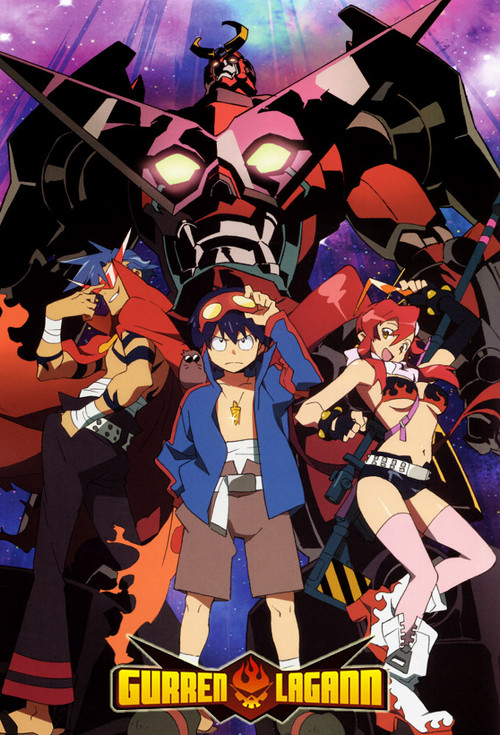
Gurren Lagann (Tengen Toppa Gurren Lagann) is a 27-episode mecha anime from studio Gainax, directed by Hiroyuki Imaishi and written by playwright Kazuki Nakashima. It aired on TV Tokyo from April 1 to September 30, 2007. It is set in a future where the Spiral King, Lordgenome, rules the Earth and forces humanity to live in isolated underground villages.

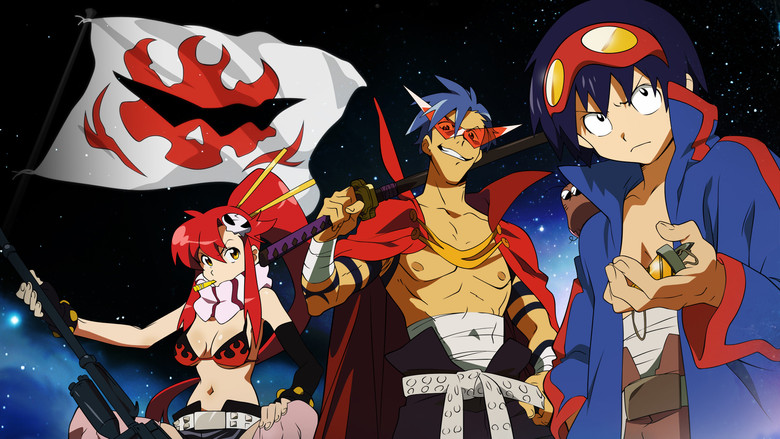
Two young men from one such village, the timid digger Simon and his swaggering older "brother" Kamina, find a small mecha called Lagann and break through to the surface. They meet the gunner Yoko and gather a ragtag band, Team Gurren, to fight the beastmen armies with giant "Gunmen" machines. Each victory raises the scale of the fight, and the stakes grow to include the human race's future.

Part comedy, part coming-of-age story, and part escalating cosmic spectacle, the series is built on over-the-top action and sincere emotion. It is about growing up, inheriting other people's dreams, and learning what you are capable of when you refuse to accept limits.
Core Meaning

The series argues that human potential comes from willpower, from the courage to keep moving forward, and from the bonds that carry that courage from person to person. The spiral, which drills outward and grows without end, stands for evolution, generational inheritance and refusing to treat any ceiling as final.

It is also a story about growth. Simon starts out relying on Kamina's confidence and has to learn to build his own belief. Kamina's famous teaching is to believe in "the me that believes in you". It points to a faith that comes from other people and is only later turned into self-belief. The series also admits that unlimited growth has a cost, and it treats responsibility and the passing of the torch as part of the same spiral.

Thematic DNA

Willpower and defying limits 30%
Coming of age and inheritance 25%
Belief in others 20%
Grief and loss 15%
Evolution, freedom and responsibility 10%

Willpower and defying limits

The series opens with digging through a ceiling and ends on drilling through the boundaries of the universe. Each arc raises the scale, and each time the heroes treat impossibility as something to be broken through. The ethos is stated in the catchphrase 'drill the heavens'.

Coming of age and inheritance

Simon moves from a shy digger who hides behind Kamina to a leader who carries Kamina's will. Other characters also grow into adulthood. The story is told across generations, and each generation inherits and passes on responsibility.

Belief in others

Kamina's line about the 'me that believes in you' turns confidence into a shared resource. Team Gurren is held together by trust. Faith in another person is shown as the start of faith in oneself.

Grief and loss

Kamina's death in episode 8 reshapes the series. Simon sinks into depression and has to find a way forward without his mentor. The later episodes treat loss as something to be absorbed and carried, not skipped over.

Evolution, freedom and responsibility

The villains' fear of what unchecked spiral growth could do raises the question of whether limitless progress is wise. The story answers by pairing growth with responsibility and by championing the unfinished future over safe stagnation.

Character Analysis

Simon

Katsuyuki Konishi

Archetype: Reluctant hero who becomes a leader Key Trait: Quiet determination that grows into legendary resolve

Motivation

At first he wants to follow his brother and see the sky. Later he fights to protect the friends and the world Kamina's example gave him.

Character Arc

Simon begins as a timid digger who lets Kamina do the believing for him. After Kamina's death he falls into depression, and he rebuilds himself with the help of friends. By the final arc he has become a leader who surpasses his mentor and carries humanity's future.

Kamina

Tetsuya Kakihara

Archetype: Charismatic mentor and catalyst Key Trait: Reckless, contagious bravado

Motivation

To escape the underground, defy the ruling order and prove he and his friends can do the impossible.

Character Arc

Kamina is an arrogant, loud dreamer who drags Simon to the surface and inspires the whole movement. Production notes say his death in episode 8 was written to give Simon character development and make him the main character. His influence outlives him.
All 4 characters and cast

Symbols & Motifs

The spiral and the drill

Meaning: Evolution, endless growth and the will to break through any barrier.
Context: The drill appears on the mecha, the necklace Simon wears and the title incantation. It is the weapon and the philosophy together, and its scale grows from digging tunnels to piercing the heavens.

Kamina's sunglasses and cape

Meaning: Bravado, style and the borrowed courage that is later passed on.
Context: Kamina's flamboyant look defines the early series. After his death, Simon wears his shades, which shows him taking on his mentor's role.

The ceiling and the sky

Meaning: Imposed limits, and freedom beyond them.
Context: The underground villages are literally capped by a ceiling. The surface, then space and the whole universe, become ever larger skies to reach.

Team Gurren's flag and skull emblem

Meaning: Collective identity and defiance built on bonds rather than blood.
Context: The brigade's emblem is worn by an ever-growing crew. The band grows with humanity itself, so the emblem comes to stand for the whole species.

Lagann, the key

Meaning: Simon's hidden potential.
Context: The tiny Gunman is a literal key to the surface and also to Simon's growth. It is the core of the machines that Simon helps combine as the story escalates.

Memorable Quotes

Don't believe in yourself. Believe in the me that believes in you!
— Kamina

Context

Said by Kamina to Simon in the first season's opening episode, and later recalled by Simon as a mantra.

Meaning

The core of the series' ethic: faith can be borrowed from others until it becomes your own.
Just who the hell do you think I am?!
— Kamina

Context

One of Kamina's most famous lines, repeated throughout the early episodes and echoed by other characters afterward.

Meaning

A defiant assertion of identity and refusal to be underestimated, and the series' signature war cry.
All 3 quotes

Episode Highlights

Bust Through the Heavens with Your Drill!

S1E1
In the underground village of Giha, Simon and Kamina meet Yoko when a Gunman crashes through the ceiling. They find the small Gunman Lagann and use it to fight the intruder and escape to the surface.
Significance: It establishes the series' tone, the central partnership and the drill as the key image.

Episode 2

S1E2
With Lagann, Kamina and Simon take Yoko back to her home village of Littner, where they find life on the surface is harsh in its own way.
Significance: It widens the world and begins the formation of Team Gurren.

Episode 8: Kamina's death

S1E8
Kamina dies in the eighth episode. According to production notes this was done to push Simon's development and make him the main character.
Significance: The key emotional turning point of the series, which sets up the later arc of grief and growth.

Episodes 9 to 15: Simon after Kamina

S1E9
Simon sinks into depression after Kamina's death, and meets Nia, Lordgenome's daughter.
Significance: The tonal shift is a major dividing point for audiences, and it defines Simon as a protagonist in his own right.

Final arc: the Anti-Spirals

S1E24
The true enemy, the Anti-Spirals, is revealed, and Nia is taken over by a cold personality called Messenger Nia. Simon rescues her, but because her existence is tied to the Anti-Spirals, she fades away once they are defeated, though she lives long enough to marry Simon.
Significance: It is the culmination of the escalating scale and of Simon's arc, in which he surpasses Kamina.

Philosophical Questions

Can willpower alone overcome any limit?

The series literalises the idea, pushing from underground to the universe. It also shows that willpower is sustained by relationships and by those who came before.

Does unlimited growth endanger the world?

The antagonists' fear of runaway evolution gives the question weight, and the heroes answer by pairing progress with responsibility.

How do we carry on after losing the person who believed in us?

Simon's depression after Kamina's death and his recovery show belief passing from one person to another and becoming his own.

How It Ends

Alternative Interpretations

Some viewers read the story as a straightforward shonen power fantasy about willpower. Others read the later arcs as a more nuanced meditation on whether unbounded evolution needs restraint. Kamina's death can be read as a loss that matures the show, or, by critics who prefer the early hype, as a point at which the tone shifted.

Full ending explanation

Cultural Impact

Gurren Lagann is widely regarded as one of the defining anime of its decade. Anime News Network gave it a full A rating, with the reviewer calling it one of the liveliest series of the decade. It was described by critics as a love letter to boisterous, macho mecha action, and as influenced by earlier works in the genre.

Its lines became internet staples, especially Kamina's catchphrases, and it spawned two films, a manga, games, and appearances in the Super Robot Wars series. Imaishi's high-energy style also shaped later Studio Trigger work.

Audience Reception

Reception has been strongly positive. IMDb reviewers praise the series' emotional range and call it epic and endlessly quotable, and MyAnimeList reviewers rate it highly for its story and characters. Anime News Network gave it an A.

The main point of division is the tonal shift after Kamina's death. Some appreciate the mature treatment of grief in the following episodes, while others prefer the unrelenting hype of the first act. Overall, it is remembered as an exuberant modern classic.

Interesting Facts

  • The series was produced by Gainax and directed by Hiroyuki Imaishi, with series composition by playwright Kazuki Nakashima.
  • It aired on TV Tokyo and other TXN stations from April 1 to September 30, 2007, in 27 episodes plus two specials.
  • The English version began airing on Sci-Fi's Ani-Monday block on July 28, 2008.
  • North American rights were first announced for ADV Films, moved to Bandai Entertainment in 2008, then to Aniplex of America in 2013.
  • The project had been in development since Imaishi took part in the mecha-themed episodes of Gainax's Abenobashi.
  • The team wanted to focus more on underground life and Simon's imprisonment, but those ideas could not be used.
  • Two films followed: a 2008 recap film and a 2009 sequel, The Lights in the Sky are Stars.
  • The anime won several awards at the Tokyo International Anime Fair, Animation Kobe and the Japan Media Arts Festival.

Frequently Asked Questions

Explore More About This Movie

Dive deeper into specific aspects of the movie with our detailed analysis pages

Comments (0)

Leave a comment

No comments yet. Be the first to share your thoughts!

Similar Movies