Skip to content
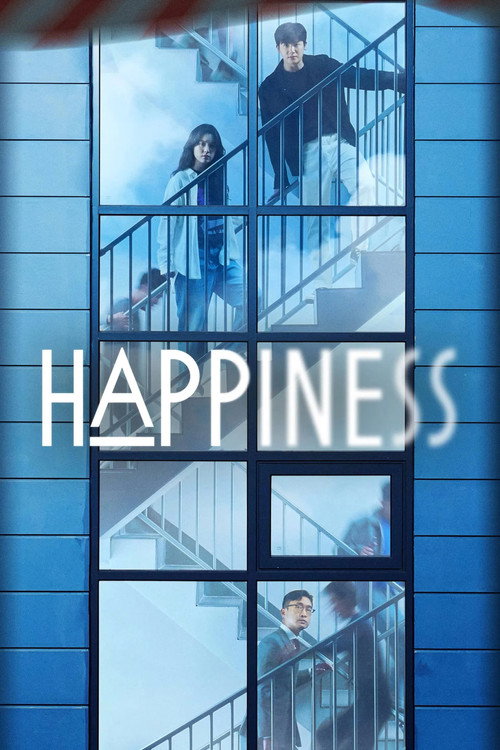
Happiness
A claustrophobic siege thriller where human empathy clashes with feral greed inside a quarantined high-rise, proving the true contagion is not viral thirst, but the venom of social privilege.
Happiness

Happiness

해피니스

"Trust disappears. unbearable thirst. there's no going back."

05 November 2021 — 11 December 2021 South Korea 1 season 12 episode Ended 8.1 (581)

Cast: Han Hyo-joo, Park Hyung-sik, Joo Jong-hyuk, Lee Ju-seung, Jo Woo-jin

Drama Sci-Fi & Fantasy Mystery Social Stratification and Real Estate Fetishism The Dual Nature of Contagion: Biological Sickness vs. Moral Rot The Meaning of 'Home' and Domestic Belonging State Control, Utilitarianism, and Moral Compromise

Overview

Happiness is a 12-episode South Korean apocalyptic psychological thriller written by Han Sang-woon and directed by Ahn Gil-ho, produced by Studio Dragon. Set in the immediate aftermath of the COVID-19 pandemic, the narrative unfolds in a society transitioning into a fragile 'new normal'. This tranquility is shattered by the emergence of the rabies-like 'Mad Person Disease' (Lytta virus), triggered as an adverse reaction to a failed pneumonia treatment pill dubbed 'Next', causing the infected to cycle between lucidity and murderous, blood-drinking fury.

The story follows Special Operations Unit officer Yoon Sae-bom and violent crimes detective Jung Yi-hyun, long-time friends who enter into a pragmatic contract marriage to secure a lease in the newly constructed Seyang Forest Le Ciel apartment complex. Shortly after moving into Building 101, outbreaks prompt Lieutenant Colonel Han Tae-seok of the Armed Forces Medical Command to place the high-rise under total military quarantine, severing all external supplies, utilities, and communication.

Across its run, the series evolves from an infectious disease procedural into an intense social laboratory and psychological pressure cooker. Trapped within the sealed residential tower, Sae-bom and Yi-hyun must navigate the biological threat of infected neighbours while confronting the escalating cruelty, greed, paranoia, and moral decay of uninfected upper-class residents fighting ruthlessly to preserve their social status.


Core Meaning

The central thesis of Happiness lies in its satirical and ironic title: true 'happiness' is fundamentally relational and communal, yet late-stage capitalist societies distort it into an insatiable accumulation of physical assets, social status, and personal isolation.

Through the lens of an infectious disease that mimics vampiric and rabid thirst, the physical virus merely strips away societal decorum, exposing the predatory egoism and class bigotry already infecting humanity. The drama posits that moral resilience, unconditional solidarity, and domestic emotional safety are the only true antidotes to systemic collapse and existential terror.

Thematic DNA

Social Stratification and Real Estate Fetishism 35%
The Dual Nature of Contagion: Biological Sickness vs. Moral Rot 25%
The Meaning of 'Home' and Domestic Belonging 20%
State Control, Utilitarianism, and Moral Compromise 20%

Social Stratification and Real Estate Fetishism

The layout of Building 101 explicitly manifests Korea's housing divide—floors 1 through 5 are public rental units, while floors 6 through 15 are luxury private flats. The owners enforce physical discrimination by locking stairwells and banning renters from communal amenities, treating them as inferior vectors of disease and showing how socio-economic prejudice outlasts survival instincts.

The Dual Nature of Contagion: Biological Sickness vs. Moral Rot

Unlike traditional zombie media, those infected with the Lytta virus oscillate between lucidity and violent thirst. While many infected strive desperately to suppress their cravings to protect loved ones, uninfected elites act as ruthless sociopaths who deliberately sacrifice others for personal and financial gain.

The Meaning of 'Home' and Domestic Belonging

Sae-bom's lifelong dream was owning an apartment to achieve security. During the quarantine, the illusion that physical concrete guarantees safety dissolves, replaced by the realization that 'home' exists entirely in mutual trust, loyalty, and emotional intimacy with Yi-hyun.

State Control, Utilitarianism, and Moral Compromise

Explored through Han Tae-seok's authoritarian lockdown strategies, the series interrogates whether individual human rights can be legitimately sacrificed for the collective good and examines how state organs weaponize secrecy during civic emergencies.

Character Analysis

Yoon Sae-bom

Han Hyo-joo

Archetype: The Resilient Warrior / Protector Key Trait: Intuitive decisiveness and unshakeable moral backbone

Motivation

Securing permanent domestic stability, which evolves into safeguarding the vulnerable and protecting Yi-hyun.

Character Arc

Transitions from an emotionally guarded SWAT officer who views life as a transactional point system into a selfless protector who embraces vulnerability and deep emotional connection.

Jung Yi-hyun

Park Hyung-sik

Archetype: The Moral Anchor / Steadfast Guardian Key Trait: Tactical intelligence, grounded empathy, and extreme physical resilience

Motivation

Protecting Sae-bom at all costs and maintaining societal justice.

Character Arc

Overcomes the trauma of a ruined athletic career; when infected, he harnesses his love for Sae-bom to maintain cognitive control and overcome the predatory urges of the virus.

All 5 characters and cast

Symbols & Motifs

Seyang Forest Le Ciel (Building 101)

Meaning:

A vertical microcosm of modern societal hierarchy and class apartheid, demonstrating structural exclusion.

Context:

Used throughout the series where locked fire doors and separate entrances divide public rental tenants on lower floors from private luxury owners on upper floors.

The 'Next' Pill

Meaning:

Represents reckless capitalism, cosmetic vanity, and the dangerous pursuit of academic and physical shortcuts.

Context:

Initially marketed as a diet and concentration supplement, its illicit circulation in gyms and clubs triggers the outbreak.

The Baseball & Bat

Meaning:

Symbolizes lost dreams transformed into an instrument of non-lethal justice and the choice to protect rather than exploit.

Context:

Carried by Yi-hyun as a reminder of his abandoned athletic career, utilized as his primary weapon to defend residents without killing them.

Water and Blood Thirst

Meaning:

A metaphor for unbridled human greed, economic consumption, panic, and moral dryness.

Context:

Manifests both in the physiological burning throat of the infected and the cut utilities driving uninfected residents to selfish violence.

Sae-bom's Blood

Meaning:

Represents biological salvation, hope, and the commodification of the human body by elite power structures.

Context:

Containing rare antibodies, her blood becomes a coveted asset sought by Han Tae-seok to synthesize a national cure.

Memorable Quotes

우리의 미래는 무한해. 괜찮으니까 그냥 해봐. '아님 말고'의 정신으로.
— Yoon Sae-bom

Context

Spoken to Jung Yi-hyun on the high school roof in Episode 1 after his career-ending knee injury.

Meaning

Encapsulates Sae-bom's resilient, pragmatic philosophy of life and initiates her transformative decade-long bond with Yi-hyun.

너 나랑 결혼할래?
— Yoon Sae-bom

Context

Sae-bom proposing a contract marriage to Yi-hyun in Episodes 1 and 2 to qualify for civil-servant housing quotas.

Meaning

Sets the primary narrative vehicle in motion, blending transactional pragmatism with subconscious mutual trust.

All 5 quotes

Episode Highlights

Infection Emergence

S1E1

Establishes the post-pandemic setting, the dynamic between Sae-bom and Yi-hyun, and uncovers the first illicit sales of 'Next' at the police training academy.

Significance:

Introduces the viral mechanics and sets up the central contract marriage and apartment lottery premise.

The Lockdown Commences

S1E4

Seyang Forest Le Ciel is abruptly cordoned off by military barbed wire and armored personnel carriers as infections appear inside.

Significance:

Solidifies the physical isolation and transforms the socio-economic division between upper and lower floors into an operational cold war.

The Thirst Spreads

S1E6

Water utilities are cut, driving residents to desperation while Dr. Oh Joo-hyung distributes 'Next'-spiked drinks to provoke outbreaks.

Significance:

Demonstrates that uninfected human malice and sabotage are far more dangerous than the biological pathogen itself.

The Swapped Pills

S1E8

Yi-hyun outsmarts Oh Joo-hyung by feigning ingestion of the virus to counter the doctor's manipulative schemes.

Significance:

Showcases Yi-hyun's tactical intelligence and highlights the extreme paranoia overtaking the building's residents.

The Mask Removed

S1E10

Andrew is revealed to be a psychopathic serial killer hiding in plain sight, while Yi-hyun gets infected during a struggle.

Significance:

Shifts the stakes by introducing an internal human predator and forcing Yi-hyun into a secret battle for his own sanity.

Sacrifice and Blood

S1E11

Sae-bom discovers Yi-hyun's infection, and Han Tae-seok orchestrates her extraction from the complex to harvest her antibodies.

Significance:

Brings the emotional core to a climax as Yi-hyun stays behind to defend against Andrew, prompting Sae-bom's realization of what truly constitutes 'home'.

Happiness Restored

S1E12

Sae-bom breaks back into the quarantine zone with an experimental cure to save Yi-hyun, defeat Andrew, and bring the corrupt elites to justice.

Significance:

Concludes the narrative arc with the lifting of the quarantine, the restoration of justice, and the couple finding authentic domestic peace.

Philosophical Questions

What defines humanity when survival instincts are triggered?

The series examines whether moral integrity is an intrinsic human trait or merely an expendable luxury sustained only during times of comfort and abundance.

Can state utilitarianism be justified during existential crises?

Through Han Tae-seok's tactical decisions to sacrifice Building 101, the narrative questions the ethics of abandoning an isolated minority for the survival of the wider collective.

Is social class fundamentally incompatible with collective empathy?

The drama explores how structural economic inequality and property ownership prevent mutual solidarity, even when facing common biological destruction.

What constitutes a meaningful life and true happiness?

The juxtaposition between Oh Joo-hyung's pursuit of material enrichment and Sae-bom and Yi-hyun's mutual sacrifice questions what genuinely fulfills human existence.

Alternative Interpretations

The Sociological Allegory: The apartment complex functions as a vertical capitalist prison where social capital decays; uninfected homeowners willingly commit atrocities to protect property values, framing wealth as a catalyst for moral bankruptcy.

Full ending explanation

Cultural Impact

Produced during the peak of global COVID-19 fatigue in late 2021, Happiness was among the first major television series to directly integrate pandemic trauma, quarantine anxiety, and public health command structures into its worldbuilding.

While achieving modest domestic cable ratings on tvN (around 3.3% to 4.2%), it became a major global sleeper hit on platforms like Netflix and Viki, entering the Global Top 10 Non-English category. Lead actress Han Hyo-joo won the Popular Star Award at the 2022 Blue Dragon Series Awards. The series redefined the K-zombie subgenre by shifting narrative focus from visceral gore to a claustrophobic psychological siege exploring hoarding, class resentment, and institutional distrust.

Audience Reception

Critical and audience reception has been broadly enthusiastic, earning strong ratings on aggregator platforms (8.5/10 on IMDb and 8.8/10 on MyDramaList). Critics widely praised the unmatched romantic chemistry and equal partnership between Han Hyo-joo and Park Hyung-sik, the fresh mechanics of the lucid-versus-rabid infection cycle, and the biting social satire confined to a single location.

Minor criticisms focused on the intentionally infuriating, unrepentant nature of supporting villains such as Oh Joo-hyung and Oh Yeon-ok, occasional pacing slowdowns during apartment meetings in Episodes 6 through 8, and a somewhat rushed legal resolution in the final minutes of Episode 12.

Interesting Facts

  • Happiness marked Park Hyung-sik's first acting project immediately after completing his mandatory military service in January 2021, retaining his muscular physique for the role.
  • Director Ahn Gil-ho and screenwriter Han Sang-woon previously collaborated on the critically acclaimed 2019 OCN psychological crime thriller Watcher.
  • Production took place during the active COVID-19 pandemic in 2021, requiring constant PCR screening and mask protocols during table reads and rehearsals.
  • The movement of the infected was deliberately choreographed to alternate between sudden rabies-like predatory sprints and normal human posture, distinguishing it from traditional zombie media.
  • Studio Dragon custom-built the Building 101 interior set to emphasize vertical socio-economic division, using contrasting lighting, ceiling heights, and materials for rental versus private units.

Easter Eggs

Lee Kyu-hyung Cameo

Actor Lee Kyu-hyung, who starred in director Ahn Gil-ho's Stranger, makes a pivotal appearance in Episodes 1–3 as Sae-bom's bitten colleague Lee Seung-young.

COVID-19 Real-world Parallels

Incorporates actual pandemic artifacts such as KF94 masks, hand sanitizers, and rapid test kits to blur documentary reality with speculative fiction.

Korean Housing Lottery Satire

The plot mechanics around civil-servant points and housing subscription scores directly satirize the hyper-competitive Seoul real estate market.

Frequently Asked Questions

Explore More About This Movie

Dive deeper into specific aspects of the movie with our detailed analysis pages

Comments (0)

Leave a comment

No comments yet. Be the first to share your thoughts!

Similar Movies