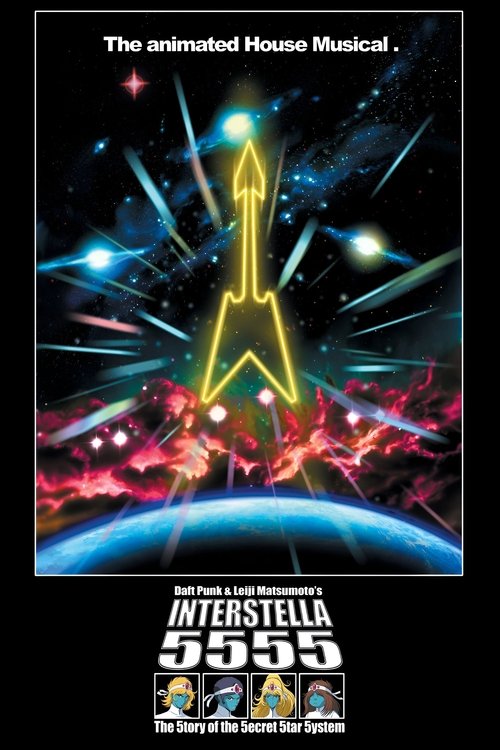
Interstella 5555: The 5tory of the 5ecret 5tar 5ystem
"The animated House Musical."
Overview
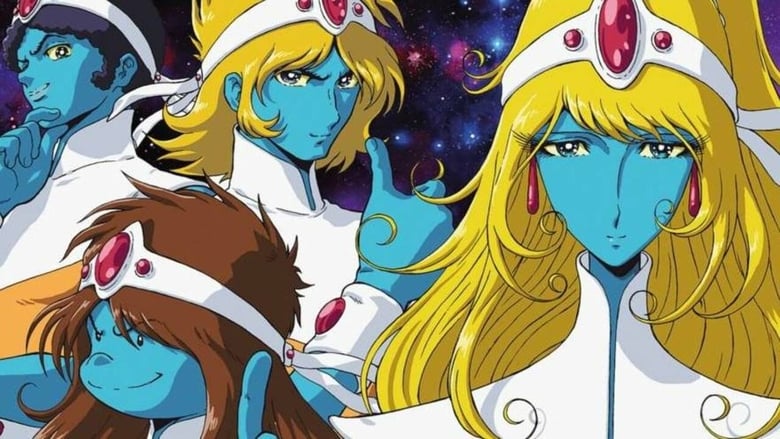
Interstella 5555: The 5tory of the 5ecret 5tar 5ystem is a groundbreaking feature-length anime musical that serves as a visual companion to Daft Punk's seminal 2001 album, Discovery. The film is a dialogue-free experience, relying entirely on visual storytelling and the album's 14 tracks to narrate an intergalactic saga of abduction, exploitation, and heroism. The project was a dream collaboration between the French electronic duo and their childhood hero, legendary manga artist Leiji Matsumoto, whose iconic aesthetic defines the film's retro-futuristic look.
The story begins on a distant planet inhabited by blue-skinned humanoids, where a popular alien band is performing to a massive crowd. Their concert is violently interrupted by an invading force from Earth that kidnaps the four musicians. While a heroic space pilot named Shep pursues the kidnappers through a wormhole, the band members are subjected to a dark process on Earth: their memories are wiped, their skin is changed to appear human, and they are placed under mind control. Rebranded as "The Crescendolls," they become the world's biggest pop sensation, unaware of their true origins or the sinister agenda of their manager, the Earl de Darkwood.
Core Meaning
The film is a poignant satire of the music industry and the commercialization of art. At its heart, it explores how industry "machinery" can strip artists of their identity, turning their creative essence into a manufactured product for mass consumption. The director and Daft Punk use the alien abduction metaphor to illustrate the feeling of being "kidnapped" by a record label. Ultimately, the film celebrates the liberation of the creative spirit and the idea that music is a universal language that transcends physical forms, cultures, and even galaxies.
Thematic DNA
Commercial Exploitation
The film critiques the music industry's tendency to treat artists as disposable commodities. The process of "humanizing" the aliens reflects how labels often manufacture an image for artists, stripping away their authentic selves to maximize profit.
Identity and Memory
The central conflict involves the band regaining their stolen memories. The "memory disks" represent the core of who they are, suggesting that true art comes from one's unique history and experiences, which cannot be truly fabricated.
Sacrifice and Heroism
Shep's journey is defined by noble sacrifice. His character embodies the selfless love for art and artists, willing to travel across the cosmos and give his life to ensure that the band is freed from their mental and physical chains.
The Power of Music
Music is shown as a force capable of bridging different worlds. It is the only thing the Earl cannot fully control, as the inherent joy in the band's music eventually helps awaken their true selves and connects Earth with the alien planet.
Character Analysis
Stella
N/A (Animated)
Motivation
To regain her autonomy and reunite with her people after being exploited as a fashion icon and pop star.
Character Arc
Initially the bassist of a free alien band, she becomes the face of the Crescendolls. Her development involves breaking through the corporate haze to remember her connection to Shep and her true home.
Shep
N/A (Animated)
Motivation
Driven by his deep love for Stella and a sense of duty to rescue the abducted musicians.
Character Arc
A lone pilot who moves from daydreaming about a distant star to becoming the catalyst for a planetary revolution and the savior of the band.
Earl de Darkwood
N/A (Animated)
Motivation
To achieve universal dominion by harvesting the creative energy of alien musicians in the form of gold records.
Character Arc
A centuries-old being who has orchestrated the rise and fall of countless musicians throughout history for his own gain.
Arpegius, Octave, and Baryl
N/A (Animated)
Motivation
To escape their "human" prison and return to their original planet where they can play music freely.
Character Arc
The band members function as a collective unit representing the stolen soul of music, eventually leading the charge to reclaim their memories.
Symbols & Motifs
5,555 Gold Records
Symbolizes the ultimate peak of commercial success and the greed of the industry.
The Earl de Darkwood needs exactly 5,555 gold records from kidnapped alien musicians to complete a ritual that will give him god-like power over the universe.
Blue Skin
Represents purity, authenticity, and the "true" self.
The band members are originally blue; their transformation into peach-skinned humans signifies their loss of identity and submission to Earth's commercial standards.
The Guitar Ship
The literal vehicle of music as a means of exploration.
Shep's spacecraft is shaped like a guitar, emphasizing that his mission is intrinsically tied to the world of music and harmony.
Sunglasses
The physical manifestation of mind control and the masks of fame.
The band members wear sunglasses that emit a controlling light, preventing them from seeing the truth or acting of their own free will.
Memorable Quotes
Musicians are magicians. That's what I always say.
— Leiji Matsumoto (Prologue)
Context:
Spoken by the visual supervisor in a black-and-white interview clip that precedes the film on some releases.
Meaning:
Sets the philosophical tone for the film, suggesting that artists possess a transformative power that industry figures seek to exploit.
Veridis Quo
— The Earl's Journal
Context:
The title of the secret book found by the band that reveals the Earl's history of kidnapping musical legends like Mozart and Hendrix.
Meaning:
A linguistic pun on the French phrase "Où est-ce que tu vas?" (Where are you going?) or "Veridis Quo" (True/Where the truth is). It represents the discovery of the villain's ancient secrets.
I need you more than anything in my life.
— Lyrics from 'Digital Love'
Context:
Plays during Shep's dream sequence where he imagines being with Stella among the stars.
Meaning:
While not spoken dialogue, the lyrics function as the internal monologue of the characters, specifically Shep's longing for Stella.
Philosophical Questions
Can art retain its 'soul' once it has been commercialized?
The film shows the band performing while brainwashed; the music remains popular, but the performers are hollow. It asks if the audience's enjoyment is enough, or if the artist's intent and freedom are essential to the value of the work.
Is identity defined by memory or by action?
When the band members lose their memories, they become different people. The film explores whether the 'true self' still exists underneath the manufactured layers of a corporate persona.
Alternative Interpretations
One popular interpretation is the 'Dream Theory' suggested by the film's final scene, which shows a young boy asleep in a room filled with Daft Punk toys and Discovery memorabilia. This implies the entire epic space battle was merely the vivid imagination of a child listening to the album. Another reading focuses on Alchemical Symbolism; the pursuit of 'Gold' Records and the transformation of the 'Blue' (spirit) into 'Peach' (flesh) can be seen as a reverse-alchemy where the divine is corrupted into the material. Critics also often view the Earl as a literal personification of the music industry's greed, suggesting that even if one Earl is defeated, the 'machinery' he represents remains a constant threat to artistic integrity.
Cultural Impact
Interstella 5555 is regarded as a landmark in the "visual album" genre. It bridged the gap between Western electronic dance music and Japanese anime culture at a time when both were seeing a massive surge in global popularity. Historically, it introduced a new generation of Western fans to the aesthetic of Leiji Matsumoto and the themes of classic 1970s space operas. Critics praised its ambition, while audiences embraced it as the definitive way to experience the Discovery album. Its influence can be seen in later projects like Kanye West's Runaway film and the rise of narrative-driven electronic music videos. It remains a cult classic, celebrated for its unique fusion of French house music and traditional hand-drawn animation.
Audience Reception
The film holds a strong legacy among fans of both Daft Punk and anime. It is frequently praised for its meticulous pacing—matching the highs and lows of the music to the narrative beats—and its emotional depth despite the lack of dialogue. Some critics initially found it to be merely a "feature-length music video," but over time, it has been vindicated as a legitimate piece of cinema. The 2024 theatrical re-release received mixed technical reviews due to the use of AI upscaling on the visuals, but the emotional response from the audience remained overwhelmingly positive, highlighting the film's status as a nostalgic touchstone for the 'Toonami generation.'
Interesting Facts
- The film's budget was approximately $4 million, and it was produced over the course of three years.
- The title '5555' is pronounced 'Four Five' in the Japanese title, referencing the '5tory' of the '5ecret' system, but also the count of 5,555 gold records.
- The character designs for the band members are inspired by musical terms: Arpegius (arpeggio), Octave, Baryl, and Stella (Latin for 'star').
- There is no spoken dialogue in the entire movie; only the lyrics of the songs and minimal ambient sound effects tell the story.
- The Earl de Darkwood's collection of captured musicians includes caricatures of Mozart, Jimi Hendrix, and Janis Joplin.
- A 2024 remastered version was released in theaters globally to celebrate the film's 20th anniversary and Daft Punk's legacy.
Easter Eggs
Daft Punk Cameo
During the songs 'High Life' and 'Too Long,' animated versions of Thomas Bangalter and Guy-Manuel de Homem-Christo appear in the audience and at an awards ceremony, wearing their iconic robot helmets.
France vs. Japan Football
In one scene, security guards are shown watching a soccer match between France and Japan on television, a nod to the two countries that collaborated to create the film.
Leiji Matsumoto References
The film contains numerous references to Matsumoto's earlier works; for instance, the guitar ship is reminiscent of the Arcadia from Captain Harlock, and Stella shares a strong resemblance to Maetel from Galaxy Express 999.
⚠️ Spoiler Analysis
Click to reveal detailed analysis with spoilers
Frequently Asked Questions
Explore More About This Movie
Dive deeper into specific aspects of the movie with our detailed analysis pages
Comments (0)
No comments yet. Be the first to share your thoughts!