Skip to content
Is This Thing On?
A tender, wry portrait of a marriage coming apart at forty-something — two people learning that the spotlight you step into alone can be the only place left to tell the truth.
Is This Thing On?

Is This Thing On?

19 December 2025 United Kingdom 121 min 6.6 (204)

Director: Bradley Cooper

Cast: Will Arnett, Laura Dern, Andra Day, Bradley Cooper, Christine Ebersole

Drama Comedy Romance The end of a long marriage, without villains Performance as self-discovery and therapy The cost of a woman's deferred self Co-parenting and love that changes shape Middle age and the second adolescence
Budget: $15,000,000
Box Office: $10,134,166

Overview

Bradley Cooper's third feature as director is a comedy-drama about Alex Novak (Will Arnett), a New York husband and father of two who hits middle age at the same moment his twenty-year marriage to Tess (Laura Dern) collapses. The film is loosely based on the life of English comedian John Bishop, who receives a story credit, and was co-written by Cooper with Arnett and Mark Chappell.

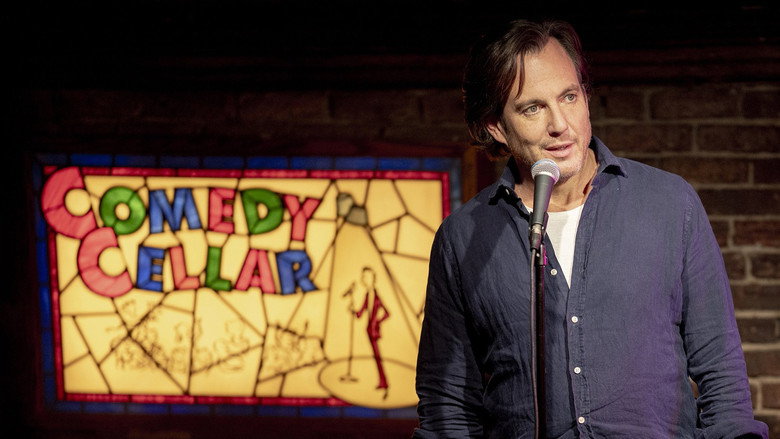
After the couple separates, Alex drifts into the city's comedy underground almost by accident: unable — or unwilling — to pay the cover at the Olive Tree Cafe, he puts his name down for the open mic at the Comedy Cellar downstairs. What begins as a fluke becomes a habit, then a compulsion. Onstage, the things he can't say at home come out as material. Along the way he has a fling with Jill, a fellow comic, and finds a second, stranger adolescence in a room full of strangers.

Tess, meanwhile, is running her own reckoning in parallel. The film gives her the harder, quieter half of the story: a woman taking inventory of the ambitions she folded away for the family, and asking what's left of her when the marriage that justified those sacrifices is gone. Rather than a war, the film stages a negotiation — over co-parenting, over identity, over whether the love between two people can survive by changing shape instead of ending.

Core Meaning

The film argues that divorce is not the failure of love but a forced renegotiation of it — and that the honesty a marriage couldn't sustain sometimes arrives only after the marriage is over. Cooper, Arnett and Chappell aren't interested in blame; there's no villain, no affair-as-inciting-incident, no courtroom. What they're interested in is the far more ordinary horror of two decent people who stopped being legible to each other.

Stand-up is the film's central metaphor for that. The microphone is the one place where Alex is required to be truthful, because a lie doesn't get a laugh. Performance becomes a rebound reflex and, unexpectedly, a form of therapy: to build five minutes of material about your own life, you have to first admit what actually happened. The joke is the confession Alex couldn't make at the kitchen table.

Crucially, the film gives Tess an equal and opposite arc. Her silence is the mirror image of his new-found voice — she spent two decades being the audience for someone else's life, and her liberation is the right to stop. The meaning lands in the gap between them: a self you build too late is still a self worth building, even if it costs you the person who watched you not build it.

Thematic DNA

The end of a long marriage, without villains 30%
Performance as self-discovery and therapy 25%
The cost of a woman's deferred self 20%
Co-parenting and love that changes shape 15%
Middle age and the second adolescence 10%

The end of a long marriage, without villains

Alex and Tess split after roughly twenty years, and the film deliberately withholds the single catastrophic cause a divorce movie usually supplies. Critics noted it mines sly humor from a mature portrait of a failing marriage rather than melodrama. The attrition is cumulative: routine, unspoken resentment, two people who kept functioning as parents long after they stopped being curious about each other.

Performance as self-discovery and therapy

Alex's accidental turn at the Comedy Cellar open mic becomes the mechanism of his self-examination. Stand-up here is not a career fantasy but a confessional booth with a two-drink minimum — the process of writing jokes forces him to name what went wrong, and the audience's laughter functions as the validation his marriage stopped providing.

The cost of a woman's deferred self

Tess's storyline confronts the sacrifices she made for the family. Dern plays her not as the abandoned wife but as someone auditing a life she co-signed and now questions. Her arc runs on a separate track from Alex's, which is the film's structural argument: the divorce is happening to two people, not to one person and a consequence.

Co-parenting and love that changes shape

With two children in the middle, the couple must invent a relationship that isn't marriage and isn't estrangement. The film keeps returning to logistics — pickups, holidays, the choreography of a house that's now two houses — and finds that affection survives inside the paperwork. The open question is whether love can take a new form rather than simply stop.

Middle age and the second adolescence

Alex's immersion in the comedy scene puts a man in his forties back into a young person's world of open mics, hierarchies and late-night rooms. The film treats this both affectionately and skeptically: the fling with Jill, the new friendships and the nightly hit of applause are genuine growth and obvious flight at the same time.

Character Analysis

Alex Novak

Will Arnett

Archetype: Reluctant everyman / late bloomer Key Trait: Defensive wit concealing genuine grief

Motivation

To feel legible again — to matter to a room, and, underneath that, to understand what happened to a marriage he didn't notice ending.

Character Arc

Begins as a father of two sliding through middle age and an impending divorce, emotionally mute and coasting. An accidental open-mic slot at the Comedy Cellar cracks him open; he becomes a regular, discovers a talent and a compulsion, and takes up with Jill, a fellow comic. The arc is less rags-to-riches than mute-to-articulate — he doesn't find fame, he finds language.

Tess Novak

Laura Dern

Archetype: Mirror protagonist / awakening realist Key Trait: Clear-eyed candor

Motivation

To recover a self that was deferred for two decades, and to end the marriage honestly rather than let it rot in place.

Character Arc

Moves from the exhaustion of a marriage she has been carrying to a hard-won reckoning with the sacrifices she made for the family. Rather than receding into the ex-wife role, she reclaims an independent life and forces the film to hold her ambitions as seriously as Alex's stage time.

All 3 characters and cast

Symbols & Motifs

The microphone (and the title phrase)

Meaning:

The title is a comic's throwaway line — the ritual tap before anyone has agreed to listen. As a symbol it's the whole film compressed: a plea to be heard, addressed by a man who spent twenty years assuming someone was listening and has only just discovered that no one was.

Context:

It hovers over every open-mic scene, but its real target is the marriage: the question 'is this thing on?' is one Alex and Tess might both have asked of each other years earlier.

The Comedy Cellar / Olive Tree Cafe

Meaning:

The basement club is the film's underworld — a place you descend into to find out who you are. That Alex ends up onstage because he wouldn't pay the cover charge makes his transformation comically accidental: identity as a clerical error.

Context:

Scenes were shot in the actual Comedy Cellar in Greenwich Village, and the Olive Tree Cafe sits directly above it in real life — the geography of the joke is literally true.

The stage light and the darkened room

Meaning:

The lit performer and the invisible crowd stage the film's central asymmetry: total exposure met by anonymous judgment. It's the inverse of a marriage, where you are known completely and applauded never.

Context:

Recurs through Alex's escalating sets, where the audience he can't see gives him something the wife he knows intimately no longer can.

The joke as confession

Meaning:

Material drawn from a real divorce turns private pain into public property. The symbol cuts both ways — it's Alex's healing and Tess's violation, since her life is being narrated nightly by a man she left.

Context:

Every laugh Alex earns is built from something that belonged to two people, which quietly indicts the redemption the film otherwise grants him.

The divided household

Meaning:

Two addresses for one family: the physical proof that love has been reorganized rather than deleted, and the children's inheritance of their parents' compromise.

Context:

Runs through the co-parenting sequences, where doorways and handoffs replace the shared rooms of the first act.

Philosophical Questions

Can you only tell the truth about your life to strangers?

Alex is candid onstage with an audience he cannot see and evasive with the woman who knows him best. The film keeps testing the proposition that intimacy makes honesty harder, not easier — that the safety of anonymity is what licenses confession, while love breeds the self-protection that eventually starves it.

Is love that changes form still love, or just its residue?

By centering co-parenting and a negotiated post-marital relationship rather than a clean break, the film refuses the binary of together/apart. It asks whether the bond between Alex and Tess is a surviving love that has been reorganized, or a habit of care that outlasts the feeling it came from — and it declines to settle the question.

Who owns the story of a shared life?

Alex builds his act from a marriage that belonged to two people. Every joke is simultaneously his therapy and Tess's exposure. The film quietly raises the ethics of the confessional artist: the material is honestly his, and it is also not only his.

What do you owe the self you set aside?

Tess's confrontation with the sacrifices she made for the family poses the question without sentimentality. The film neither pretends the deferred ambitions can be recovered intact nor accepts that the deferral was owed — it sits in the arithmetic of a life spent on other people.

Is reinvention at forty-five courage or flight?

The comedy scene offers Alex a new identity at exactly the moment his old one fails. The film presents his nightly sets as both real work and real avoidance, declining to grade the difference — suggesting that in middle age the two may not be separable.

Alternative Interpretations

Reading one — the redemption story. Alex's journey to the microphone is genuine growth: a man who could not speak learns to, and the marriage had to end for that to happen. On this reading the divorce is a liberation for both parties, and the film's warmth toward its characters is earned.

Full ending explanation

Cultural Impact

The film arrived as a deliberate entry in the long American tradition of the divorce picture — the lineage of Kramer vs. Kramer, Scenes from a Marriage and, most immediately, Marriage Story — but it redirects that genre through the stand-up film, a form that boomed alongside the comedy-special economy of the 2010s and 2020s. Its premise, drawn from John Bishop's real path from a collapsing marriage to an open mic, gave the movie a claim to authenticity that pure fiction in this space usually lacks.

It premiered in a position of prestige — closing night of the 2025 New York Film Festival on October 10 — before Searchlight released it in the United States on December 19, 2025, squarely in awards season. Reviews were mostly positive, with critics singling out the performances of Arnett and Dern and Cooper's direction. Several framed it as another terrific relationship study from Bradley Cooper and as an ideal showcase for Arnett's dramatic capabilities, a notable pivot for an actor best known for comic bombast in Arrested Development and BoJack Horseman.

Its most durable cultural effect may be that repositioning of Arnett, plus the consolidation of Cooper's reputation as a director of intimate, performance-driven character work following A Star Is Born and Maestro — here on a deliberately smaller canvas. The film also functions as a loving document of the Comedy Cellar itself, filming inside an institution that American comedy mythology has treated as sacred ground.

Audience Reception

Critical response was mostly positive, with a consistent throughline in the praise: the performances of Will Arnett and Laura Dern and Bradley Cooper's direction were singled out repeatedly. Reviewers described the film as unexpectedly touching and at times laugh-out-loud funny, and credited it with mining sly humor from a mature portrait of a failing marriage rather than reaching for melodrama. Arnett's dramatic turn drew particular attention as a reframing of an actor long typecast in broad comedy, while Dern was praised for refusing to let Tess be a supporting grievance.

Cooper's work behind the camera was read as a deliberate scaling-down after Maestro — smaller in scope, more grounded in sensibility, yet with critics noting his attention to romantic affection may be sharper here than in his earlier features. Some detected a Silver Linings Playbook-era David O. Russell influence in the grounded texture and idiosyncratic camera choices.

The reservations clustered around tone and consistency. Less enthusiastic responses argued the film only intermittently achieves the emotional depth it reaches for, flickering with feeling rather than sustaining it, and that the familiar shape of the divorce dramedy limits how far its observations travel. The blend of improvisation and structure — a product of Cooper and Arnett rewriting on the day — struck some as lived-in and others as loose. Overall verdict: a warm, well-acted and unusually generous divorce story whose ambitions are modest by design, carried by two performances that critics broadly agreed are the reason to see it.

Interesting Facts

  • Bradley Cooper directed and co-stars, and co-wrote the screenplay with Will Arnett and Mark Chappell — his third feature as a director.
  • The film is loosely based on the life of English comedian John Bishop, who receives a story credit. Like Alex, Bishop was going through a divorce and signed up for an open mic at a pub because he didn't want to pay the cover charge.
  • Scenes were filmed at the real Comedy Cellar in New York City, as well as other venues.
  • While scouting locations, the Comedy Cellar's manager persuaded Will Arnett to go onstage — Arnett ended up performing there every night for six weeks in preparation.
  • Cooper described his process as inseparable from writing: 'I don't know how to shoot anything that I haven't written and been part of the writing process.'
  • Cooper and Arnett rewrote scenes on the day throughout the shoot, with Cooper noting they were 'able to rewrite them on the day, every day,' and both have discussed improvising on set.
  • The supporting cast includes Andra Day, Amy Sedaris, Sean Hayes, Christine Ebersole and Ciarán Hinds.
  • The film premiered as the closing night selection of the 2025 New York Film Festival on October 10, 2025.
  • Searchlight Pictures released it in the United States on December 19, 2025.
  • Cooper and Arnett are long-time friends off-screen, which both cited as the foundation for the film's collaborative, improvisational shoot.

Easter Eggs

The Olive Tree Cafe cover charge

Alex's origin story — he goes onstage because he can't pay the cover at the Olive Tree Cafe — is lifted almost directly from John Bishop's real life, where a reluctance to pay a pub cover charge launched a comedy career. The film's most implausible-sounding plot point is the documented one.

Shooting inside the actual Comedy Cellar

Rather than build a set, the production used the real Greenwich Village club, a landmark of American stand-up. For comedy fans the room itself is the cameo — the brick wall behind Arnett is the same one that has framed decades of famous sets.

Will Arnett's six-week open-mic apprenticeship

Arnett genuinely performed nightly at the Cellar for six weeks before shooting, so the film's stage sequences carry the texture of real club time rather than choreographed performance — an off-screen fact that reads on screen.

Bradley Cooper directing himself opposite his actual best friend

Cooper appears in the film alongside Arnett, with whom he has a long off-screen friendship. Critics have read the on-screen ease between them as an extension of that real relationship, giving the male-friendship scenes a documentary charge.

Frequently Asked Questions

Explore More About This Movie

Dive deeper into specific aspects of the movie with our detailed analysis pages

Comments (0)

Leave a comment

No comments yet. Be the first to share your thoughts!

Similar Movies