Skip to content
Just an Illusion
A bittersweet 1980s coming-of-age dramedy wrapping family turmoil in disco neon and suburban melancholy, where adolescence feels like standing on a trembling high-wire above adult disillusionment.
Just an Illusion

Just an Illusion

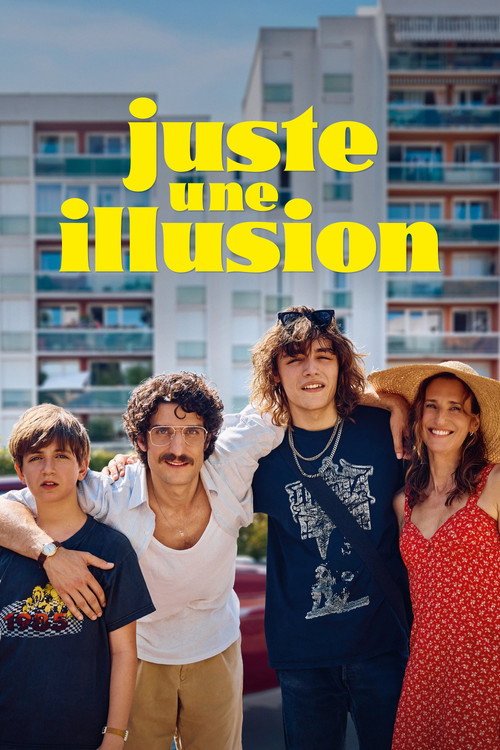
Juste une illusion

"A comedy about that period of childhood when the hope of changing the world was not “just an illusion”..."

15 April 2026 France 119 min 7.4 (170)

Director: Olivier Nakache, Éric Toledano

Cast: Louis Garrel, Camille Cottin, Simon Boublil, Alexis Rosenstiehl, Pierre Lottin

Drama Comedy The Loss of Childhood Innocence & Growing Up The Facade of Social Status & Masculine Pride Immigrant Heritage & Assimilation in 1980s France Female Emancipation & Shifting Domestic Roles Brotherhood & Intergenerational Solidarity
Box Office: $15,742,625

Overview

Set in suburban Paris (Yvelines) in 1985, Just an Illusion (Juste une illusion) centers on Vincent Dayan, a sensitive 12-going-on-13-year-old boy navigating the awkward threshold between childhood and young adulthood. Approaching his Bar Mitzvah, Vincent grapples with first love, cultural heritage, and the unspoken fractures splintering his North African Jewish working-to-middle-class household.

His father, Yves, has recently been laid off from his managerial role at home-appliance giant Moulinex but desperately conceals his unemployment from everyone by pretending to head to an office every morning. Meanwhile, his mother, Sandrine, exhausted by financial strain and marital tension, throws herself into computer retraining to achieve autonomy while unintentionally drawing the romantic attention of their eccentric apartment concierge, Étienne Berger.

Torn between an abrasive older brother Arnaud, his budding crush on classmate Anne-Karine, and his father's fragile facade, Vincent turns to his Rabbi and his own observations to make sense of the adult world. Directed by Olivier Nakache and Éric Toledano, the film captures a pivotal transitional period in French social history through gentle humor, heartfelt sincerity, and nostalgic realism.

Core Meaning

The film explores how both youth and adulthood are anchored in necessary illusions. For adults, self-deceptions—such as holding onto lost professional prestige or romanticized social stability—act as shields against humiliation and existential failure. For children, growing up means recognizing that parents do not possess all the answers and are merely imperfect humans improvising through crisis. Ultimately, the filmmakers convey that while life's promises may often be illusions, the shared emotional bonds and resilience of family provide authentic ground to stand on.

Thematic DNA

The Loss of Childhood Innocence & Growing Up 30%
The Facade of Social Status & Masculine Pride 25%
Immigrant Heritage & Assimilation in 1980s France 20%
Female Emancipation & Shifting Domestic Roles 15%
Brotherhood & Intergenerational Solidarity 10%

The Loss of Childhood Innocence & Growing Up

Vincent’s passage toward his Bar Mitzvah serves as a framework for discovering the flaws, compromises, and vulnerability of the adults he once viewed as infallible.

The Facade of Social Status & Masculine Pride

Explored through Yves Dayan’s desperate charade after losing his corporate job, highlighting the 1980s economic shifts and the fragile male ego tied to being the family breadwinner.

Immigrant Heritage & Assimilation in 1980s France

Grounded in the Dayan family's identity as North African Sephardic Jews (rapatriés) balancing integration into French society against lingering cultural displacement and the emergence of movements like SOS Racisme.

Female Emancipation & Shifting Domestic Roles

Embodied by Sandrine's pursuit of informatics skills to gain financial agency amid the breakdown of traditional domestic power dynamics.

Brotherhood & Intergenerational Solidarity

Revealed in the evolving, rough-and-tumble relationship between Vincent and Arnaud, shifting from teenage antagonism to mutual protection.

Character Analysis

Vincent Dayan

Simon Boublil

Archetype: The Innocent / Seeker Key Trait: Inquisitive, observant, and quietly empathetic

Motivation

To find his place, understand love, and survive growing up.

Character Arc

Moves from an anxious, passive child into a perceptive young man who accepts his family’s imperfections.

Yves Dayan

Louis Garrel

Archetype: The Fallen Patriarch / Anti-Hero Key Trait: Proud, neurotic, and well-intentioned

Motivation

To maintain dignity and preserve his role as the household provider.

Character Arc

Transitions from destructive, prideful denial about his unemployment to vulnerable honesty.

All 5 characters and cast

Symbols & Motifs

The Suit and Briefcase

Meaning:

Symbolizes the hollow performance of bourgeois pride and desperate concealment of professional decline.

Context:

Yves dresses in his executive suit and carries an empty briefcase each day to spend his hours wandering Parisian benches.

The Minitel / Early Computers

Meaning:

Represents the dawn of modernity, technological progress, and a doorway to female autonomy.

Context:

Seen through Sandrine’s clunky desktop and informatics retraining classes as she seeks financial independence.

The Bar Mitzvah Torah Scroll

Meaning:

Represents spiritual maturity, inherited legacy, and the heavy moral expectation placed on a boy becoming a man.

Context:

Serves as the central ritual focal point Vincent prepares for throughout the narrative.

The 1980s Pop Track 'Just an Illusion' (Imagination)

Meaning:

Functions as a thematic refrain illustrating the discrepancy between outward appearances and emotional reality.

Context:

Echoes throughout key sequences of the film to reflect the characters' inner struggles and social pretenses.

The Broken Elevator in the HLM Building

Meaning:

Serves as a metaphor for stalled social mobility and the friction inside suburban community housing.

Context:

Managed erratically by concierge Berger within the family's apartment building.

Memorable Quotes

À treize ans, tu crois que les grands savent où ils vont. En fait, ils font juste semblant avec de plus grands mots.
— Vincent Dayan

Context

Vincent narrates his voice-over as he watches his parents argue over kitchen bills.

Meaning

Highlights the core realization that adults are equally lost and merely masking uncertainty with sophisticated language.

Un cadre ne pointe pas au chômage, Sandrine. Il cherche un nouveau challenge.
— Yves Dayan

Context

Yves defensively tries to justify hiding his layoff from his family.

Meaning

Illustrates his stubborn clinging to corporate status and masculine executive pride.

All 4 quotes

Philosophical Questions

Is self-deception necessary for psychological survival?

The film demonstrates how illusions often protect individuals from social shame and existential defeat until confronting the truth becomes unavoidable.

What defines the boundary between childhood and adulthood?

It posits that maturity begins not at an arbitrary age or religious ritual, but when a child learns to recognize and forgive their parents' shortcomings.

How does collective historical trauma shape parenting?

Through the parents' North African heritage, the narrative explores how past displacement creates subconscious anxieties about financial and social vulnerability.

Alternative Interpretations

The film invites several interpretive viewpoints:

Full ending explanation

Cultural Impact

Released in French theaters in April 2026, Just an Illusion arrived at a time when French cinema had developed a strong appetite for introspective, historical comedies exploring late-20th-century working-class realities. The film captures a pivotal moment in 1985 France: the fading post-war industrial boom, the rise of modern corporate restructuring, and the integration experiences of North African Jewish repatriation. Critics noted that the film expands Nakache & Toledano’s reputation for humanistic, crowd-pleasing social dramedies, drawing favorable comparisons to Nos jours heureux and Le Sens de la fête.

Audience Reception

The film received widespread praise from critics and audiences for its authentic retro production design, GoGo Penguin’s dynamic jazz score, Louis Garrel’s against-type comedic performance, and the tender chemistry between Simon Boublil and Camille Cottin.

While some reviewers noted that the film adheres closely to Nakache & Toledano’s familiar feel-good formula and coming-of-age tropes, it proved to be a critical and commercial success (averaging ~4/5 on aggregators like AlloCiné), celebrated for its emotional resonance and nostalgia without cynicism.

Interesting Facts

  • Directors Olivier Nakache and Éric Toledano turned 13 in the mid-1980s, basing the suburban setting and family dynamics directly on their personal childhood memories.
  • The roles of Yves and Sandrine were written specifically for Louis Garrel and Camille Cottin to contrast Garrel’s neurotic energy with Cottin’s grounded warmth.
  • The filmmakers collaborated with UK contemporary jazz/breakbeat trio GoGo Penguin to compose the original instrumental score.
  • Production designer Jean Rabasse reconstructed mid-80s suburban interiors with historical accuracy, sourcing period-accurate Minitel terminals and vintage Chevignon jackets.
  • Lead actor Simon Boublil was chosen out of hundreds of auditioning young actors due to his natural comedic timing and melancholic innocence.

Easter Eggs

Claude Lelouch Guest Direction and Musical Homage

Legendary New Wave director Claude Lelouch directed a vintage car-ride dialogue scene with Garrel and Cottin, featuring Vincent singing Francis Lai's 'Da ba da ba da' theme from Lelouch’s 1966 classic A Man and a Woman.

Director Cameo Appearance

Filmmakers Olivier Nakache and Éric Toledano make a brief, humorous cameo appearance early in the film in a vintage video rental store scene.

1980s French Political and Cultural Artifacts

Includes period broadcasts from François Mitterrand’s presidency, the SOS Racisme badge ('Touche pas à mon pote'), and classic TV channel jingles of Antenne 2 and TF1.

Frequently Asked Questions

Explore More About This Movie

Dive deeper into specific aspects of the movie with our detailed analysis pages

Comments (0)

Leave a comment

No comments yet. Be the first to share your thoughts!

Similar Movies