Skip to content
Karma
A suffocating noir labyrinth of escalating desperation and dread, where fragile moral compromises ignite an uncontrollable chain of dominoes across rain-slicked asphalt.
Karma

Karma

악연

"Twisted by fate. Doomed by destiny."

04 April 2025 — 04 April 2025 South Korea 1 season 6 episode Ended 7.5 (112)

Cast: Park Hae-soo, Shin Min-a, Lee Hee-jun, Kim Sung-kyun, Lee Kwang-soo

Drama Crime The Retributive Cycle of Bad Faith Desperation, Debt, and Commodification Unresolved Trauma and Vengeance Complicity and the Illusion of Choice Class Inequality and Disposable Lives

Overview

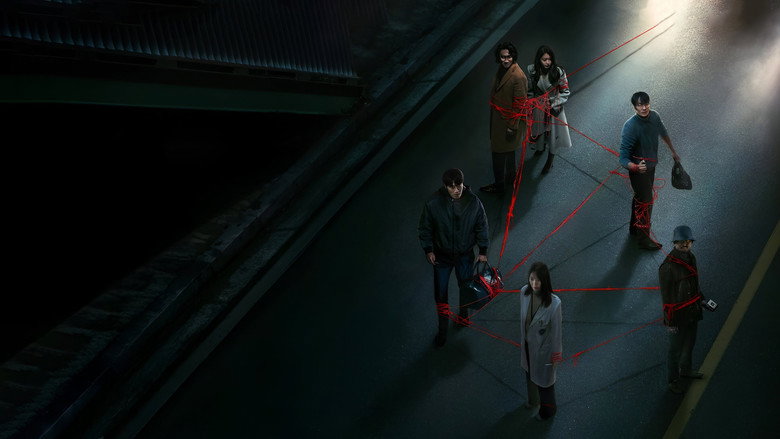
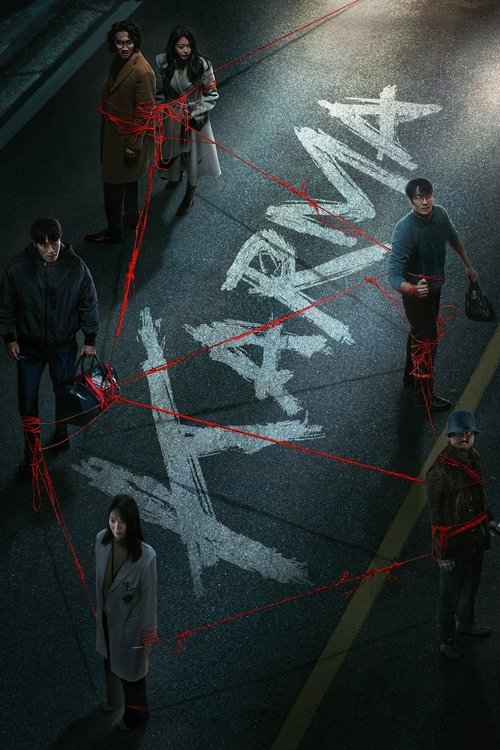
Karma (Korean: 악연, Akyeon, literally "Ill-Fated Relationship") is a six-part South Korean neo-noir crime thriller directed and written by Lee Il-hyung, adapted from the acclaimed Kakao webtoon by Choi Hee-seon. Released worldwide on Netflix on April 4, 2025, the series constructs an intricate web of misfortune, where six distinct individuals find their lives irrevocably stitched together following a hit-and-run incident and an opportunistic cover-up.

The narrative operates through interlocking perspectives that dismantle conventional cause-and-effect storytelling. A surgeon burdened by unresolved childhood trauma, an indebted man crushed by devastating financial losses, an unfairly discarded worker desperate for a payday, an ambitious traditional medicine doctor, his enigmatic companion, and an opportunistic bystander all cross paths in a relentless descent into peril.

As each character attempts to evade accountability, resolve urgent debts, or pursue personal retribution, their self-serving choices collide. What initially begins as isolated acts of desperation snowballs into an inescapable karmic vortex, demonstrating how small moral concessions can unravel multiple lives in an instant.

Core Meaning

The core thesis of Karma is encapsulated by its title: every moral shortcut, concealed misdeed, and act of greed generates an equal and devastating retributive force. The series argues that human beings are never fully insulated from the repercussions of their self-interest; attempting to exploit or escape another person's tragedy inevitably entangles the perpetrator in the very catastrophe they sought to evade.

Through its multi-perspective structure, the creators critique modern materialism—specifically speculative financial greed, exploitation of labor, and casual cruelty—illustrating that the illusion of control is the first casualty when ethics are subordinated to convenience.

Thematic DNA

The Retributive Cycle of Bad Faith 30%
Desperation, Debt, and Commodification 25%
Unresolved Trauma and Vengeance 20%
Complicity and the Illusion of Choice 15%
Class Inequality and Disposable Lives 10%

The Retributive Cycle of Bad Faith

The series repeatedly shows that deceptive solutions breed greater crises. Characters continually choose deceit or violence to cover up initial errors, setting off chain reactions of ruin.

Desperation, Debt, and Commodification

Modern financial pressures—such as predatory cryptocurrency collapses and loan-shark debt—act as the primary catalyst for moral rot, driving ordinary people to treat human lives as insurance payouts or leverage.

Unresolved Trauma and Vengeance

Centered on Ju-yeon’s storyline, the show examines how deep psychological wounds demand closure, exploring whether confronting one's tormentor brings true healing or merely restarts the cycle of suffering.

Complicity and the Illusion of Choice

Characters continually rationalize that their hand was forced, yet the narrative demonstrates that every crossroad offered a moral alternative that was deliberately rejected for immediate gain.

Class Inequality and Disposable Lives

Juxtaposing high-end Gangnam practitioners with marginalized and disenfranchised laborers highlights how the powerful attempt to offload danger onto the vulnerable.

Character Analysis

The Eyewitness

Park Hae-soo

Archetype: The Opportunistic Antihero / Catalyst Key Trait: Cold pragmatic adaptability under pressure

Motivation

Driven by sudden self-interest and survival after stumbling upon a deadly crime scene.

Character Arc

Evolves from a seemingly detached observer into an active orchestrator whose calculated blackmail entangles him in the very nightmare he attempted to exploit.

Lee Ju-yeon

Shin Min-a

Archetype: The Traumatized Seeker / Wounded Healer Key Trait: Hyper-vigilant resolve masked beneath clinical stoicism

Motivation

To overcome debilitating childhood trauma and confront the architect of her past suffering.

Character Arc

Transitions from a guarded surgeon haunted by recurring nightmares to a determined agent seeking justice when fate places her past abuser directly in her path.

All 5 characters and cast

Symbols & Motifs

The Struck Body / The Corpse on the Road

Meaning:

Symbolizes the inescapable gravity of collective guilt and shared moral catastrophe.

Context:

Serves as the central physical hub and point of convergence around which all characters' lives collide.

The Eyeglasses

Meaning:

Represents social status, calculated intellectualism, and a warped, clinical detachment from empathy.

Context:

Associated with Dr. Han Sang-hun ("Glasses") throughout his attempts to maintain a polished facade.

Insurance Contracts and Debt Ledgers

Meaning:

Tangible representations of the commodification of human life in modern society.

Context:

Used as transactional plot devices where family bonds and human existence are reduced to monetary figures and leverage.

Scalpel / Surgical Precision vs. Crude Violence

Meaning:

A visual motif contrasting clean, controlled healing with brutal, destructive desperation.

Context:

Contrasts Ju-yeon’s sterile pursuit of biological healing in the hospital with the messy, blunt brutality executed by desperate men in back alleys.

The Car / Blind Roads at Night

Meaning:

Represents the characters' moral blindness and inability to foresee the disastrous consequences of their immediate choices.

Context:

Employed during key driving sequences on dark rural roadways and foggy highways.

Memorable Quotes

우리가 여기서 마주친 건 우연이 아니야.
— Lee Ju-yeon (Shin Min-a)

Context

Spoken in Episode 3 during a tense confrontation when Ju-yeon identifies the person connected to her past trauma.

Meaning

Captures the core fatalism of the series—the concept that past sins inevitably draw victims and victimizers back together.

한 번만 눈감으면, 우리 둘 다 살 수 있는 길이야.
— The Eyewitness (Park Hae-soo)

Context

Spoken in Episode 1 during the illicit proposition following the road accident.

Meaning

The fundamental moral compromise of the narrative; illustrates how rationalizing silence creates inescapable complicity.

All 4 quotes

Episode Highlights

The Collision / The Deal

S1E1

Establishes the inciting incident: Jae-young contracts Gil-ryong to murder his father Park Dong-sik for insurance money; the body is left on the road and struck by Dr. Han Sang-hun, witnessed by an opportunistic bystander.

Significance:

Sets the entire six-way collision in motion by binding disparate lives to a single crime scene.

Fractured Roads

S1E2

Introduces Dr. Lee Ju-yeon’s perspective and past trauma, contrasting her clinical precision in the hospital with the unraveling cover-up conducted by Sang-hun and the Debtor.

Significance:

Broadens the drama's scope from a hit-and-run cover-up to an exploration of long-term trauma and retribution.

Ill-Fated Crossings

S1E3

Ju-yeon crosses paths with the figure responsible for her childhood torment, while the Eyewitness begins squeezing the other parties for leverage.

Significance:

Shifts the tone into an active psychological game of cat-and-mouse.

The Price of Blood

S1E4

The insurance payout scheme collapses under scrutiny; Gil-ryong turns against his conspirators as paranoia consumes Sang-hun.

Significance:

Marks the point of no return where peaceful resolution becomes impossible.

The Convergence

S1E5

All six narrative strands intersect directly in a high-stakes standoff where secrets are exposed.

Significance:

Strips away character facades, leaving them face-to-face with the cumulative fallout of their lies.

Retribution / Akyeon

S1E6

The climax and resolution of the karmic loop; reveals the ultimate fate of the Eyewitness, the Debtor, Gil-ryong, Sang-hun, and Ju-yeon's search for closure.

Significance:

Delivers poetic justice, closing the loop with absolute finality.

Philosophical Questions

Is fate preordained or manufactured by human choice?

The series examines whether "ill-fated relationships" are cosmic destiny or the predictable outcome of compounded moral cowardice.

Can justice exist outside the formal rule of law?

It questions whether personal retribution ever balances moral scales or simply deepens complicity.

What is the true monetary value of human life when ethics are removed?

Explores how severe financial pressure strips away societal civility and reduces relationships to transactions.

Alternative Interpretations

The Fatalistic Interpretation: The narrative suggests that all characters were cosmically bound from the start; their crossing paths was not a series of random coincidences, but an inevitable squaring of debts dictated by their internal moral flaws.

Full ending explanation

Cultural Impact

Karma reflects contemporary South Korean societal anxieties regarding speculative debt, economic volatility, and extreme socioeconomic disparity. The integration of cryptocurrency wipeouts and fraudulent life insurance schemes directly echoes real-world economic pressures faced by middle- and working-class citizens.

As part of Netflix’s 2025 Korean slate, the six-episode tight format represented a continuing industry shift away from traditional 16-episode melodramas in favor of condensed, cinematic prestige miniseries.

Audience Reception

Critics and audiences lauded the compact 6-episode pacing, praising the absence of filler and the tight, non-linear screenplay. Park Hae-soo's grounding performance and Lee Kwang-soo's nuanced dramatic turn were singled out as standout highlights.

Some reviewers noted the relentless bleakness, dark subject matter, and graphic violence made it challenging for sensitive viewers.

Overall, it is regarded as a gripping, finely constructed Korean crime thriller with an 8.1 rating across community trackers and strong global Netflix viewership performance.

Interesting Facts

  • The series is a direct adaptation of the Kakao webtoon Akyeon (악연) by Choi Hee-seon, which ran from April 2019 to January 2020.
  • Director Lee Il-hyung, widely known for major box-office feature films such as A Violent Prosecutor (2016) and Remember (2022), made his episodic series directorial and writing debut with Karma.
  • Produced jointly by Moonlight Film (led by acclaimed director Yoon Jong-bin), Baram Pictures, and Kakao Entertainment.
  • Lead actor Park Hae-soo continued his extensive relationship with Netflix following Squid Game, Narco-Saints, Yaksha: Ruthless Operations, and Money Heist: Korea, earning widespread praise for anchoring the tension.
  • The score was composed by veteran music director Hwang Sang-jun, featuring the moody theme "We Met By Chance".
  • Lee Kwang-soo earned critical acclaim and won Best Supporting Actor for his portrayal of Dr. Han Sang-hun at the Blue Dragon Series Awards.

Easter Eggs

High-Profile Guest Appearances

Features notable special and supporting appearances by prominent South Korean actors including Cho Jin-woong, Kim Nam-gil, and Park Ho-san.

Cinematic Collaboration

Producer Yoon Jong-bin (The Spy Gone North, Nameless Gangster) frequently collaborates with cast members Park Hae-soo and Lee Sung-kyun, infusing the production with distinct Moonlight Film neo-noir signatures.

Visual Symmetry

The opening accident scene mirrors the framing of the final episode's standoff, visually illustrating the cycle of retribution (Karma) coming full circle.

Frequently Asked Questions

Explore More About This Movie

Dive deeper into specific aspects of the movie with our detailed analysis pages

Comments (0)

Leave a comment

No comments yet. Be the first to share your thoughts!

Similar Movies