Skip to content
Monogatari
A surreal psychological mystery drenched in melancholy and razor-sharp wit, where human trauma bleeds into supernatural hauntings like shattered glass reflecting a twilight sky.
Monogatari

Monogatari

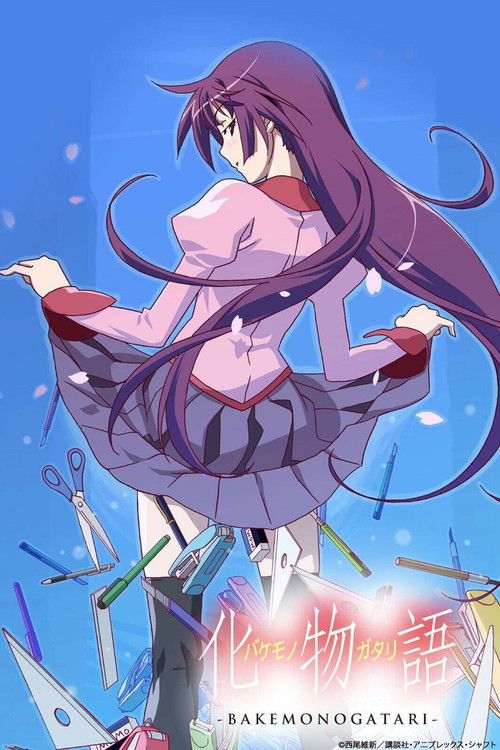
化物語

03 July 2009 — 19 October 2024 Japan 5 season 73 episode Returning Series 8.1 (526)

Cast: Yui Horie, Hiroshi Kamiya, Chiwa Saito, Maaya Sakamoto, Satsuki Yukino

Drama Animation Comedy Mystery Self-Salvation and Personal Responsibility Authenticity vs. Deception ("The Real and the Fake") Repression, Guilt, and the Shadow Self Subjectivity of Truth and Unreliable Narration Maturation and the Transition into Adulthood

Overview

Monogatari (beginning with Bakemonogatari in 2009) centers on Koyomi Araragi, a third-year high school student in a quiet Japanese suburb who survives a vampire attack during spring break. Retaining residual supernatural abilities such as accelerated healing and heightened senses, Araragi finds himself drawn into the hidden world of "aberrations" or "oddities" (kaii)—supernatural entities rooted in Japanese folklore that afflict high school girls in his town.

Across its multi-season narrative arc—spanning First Season, Second Season, and Final Season—the overarching story follows Araragi as he collaborates with eccentric occult experts to assist these young women. However, the series constantly subverts conventional supernatural monster-hunting tropes. Oddities do not randomly attack innocent victims; rather, they are supernatural catalysts that manifest directly from an individual's repressed emotions, unspoken trauma, internal guilt, and toxic coping mechanisms.

As the franchise progresses, the focus expands beyond isolated episodic cases into a deeply interconnected web of personal growth. The broad overarching narrative chronicles Araragi’s transition from a self-loathing adolescent with a martyrdom complex into a mature adult capable of establishing healthy boundaries, taking responsibility for his choices, and accepting both his own flaws and those of the people around him.
Core Meaning

The fundamental message of the Monogatari series is that true salvation cannot be granted by an external savior; individuals must face, accept, and take responsibility for their own emotional burdens.

Through its externalized supernatural oddities, the series demonstrates that repressing trauma, envy, or self-hatred creates destructive psychological "monsters". Araragi’s compulsion to constantly sacrifice his own well-being to "save" others is exposed not as altruism, but as a selfish savior complex born from personal guilt. The creators convey that true healing occurs only when individuals stop running from reality, integrate their "shadow selves," and voluntarily undertake the difficult work of self-betterment.

Thematic DNA

Self-Salvation and Personal Responsibility 30%
Authenticity vs. Deception ("The Real and the Fake") 20%
Repression, Guilt, and the Shadow Self 20%
Subjectivity of Truth and Unreliable Narration 15%
Maturation and the Transition into Adulthood 15%

Self-Salvation and Personal Responsibility

Summarized by Oshino Meme's core mantra—"People have to save themselves on their own"—this theme evolves from a seemingly cold philosophy in Bakemonogatari into the ultimate emotional truth of the franchise. Initially, Araragi recklessly throws his body into harm's way to fix others' problems. By Second Season and Owarimonogatari, characters like Hanekawa and Nadeko learn that real growth requires taking personal ownership of their flaws rather than relying on Araragi. Araragi himself eventually learns to step back and let others heal on their own terms.

Authenticity vs. Deception ("The Real and the Fake")

Introduced prominently in Nisemonogatari through the conman Kaiki Deishuu and the Araragi sisters, this theme explores whether a deliberate attempt to be good (a "fake") holds more value than innate, unthinking virtue (the "real"). Over time, the series posits that deliberate effort to embody an ideal requires conscious agency, making the intentional "fake" uniquely valuable.

Repression, Guilt, and the Shadow Self

Oddities are literal manifestations of suppressed feelings. In Bakemonogatari, Hitagi represses her grief and trauma. In Nekomonogatari and Second Season, Hanekawa’s repressed stress and jealousy create Black Hanekawa and the tiger Kako. By the Final Season, Araragi’s own buried guilt and harsh self-criticism take physical form as Ougi Oshino, forcing him to directly confront his internal self-hatred.

Subjectivity of Truth and Unreliable Narration

In early seasons, events are filtered strictly through Araragi's perspective, framing him as a hero and framing the world through his adolescent gaze. In Second Season and Hanamonogatari, shifting perspectives to Hanekawa, Kanbaru, and Kaiki reveals that Araragi's narrative is heavily skewed, exaggerated, and unreliable.

Maturation and the Transition into Adulthood

High school graduation serves as an overarching ticking clock. The franchise depicts adolescence as a turbulent period of identity formation, with oddities representing the emotional growing pains that must be resolved before stepping into the adult world.

Character Analysis

Koyomi Araragi

Hiroshi Kamiya

Archetype: Deconstructed Savior / Flawed Protagonist Key Trait: Pathological, self-sacrificing empathy

Motivation

Initially driven by intense survival guilt; evolves into a desire to build genuine, healthy human relationships.

Character Arc

Starts as a self-loathing teenager who recklessly sacrifices his own flesh to help others to assuage his guilt over spring break. Over five seasons, he learns that his martyr complex hurts those around him. In Owarimonogatari, he faces his own self-criticism, lets go of his savior complex, and successfully transitions into adulthood.

Hitagi Senjougahara

Chiwa Saito

Archetype: Subverted Tsundere / Deconstructed Heroine Key Trait: Razor-sharp, sarcastic candor masking fierce loyalty

Motivation

Protecting herself from hurt; evolves into protecting her relationship with Araragi and securing a stable future.

Character Arc

Begins as a cold, dangerous recluse who uses verbal violence and stationary items to ward off humanity after surviving sexual assault and family ruin. After accepting her weight, she grows into a deeply loving, supportive partner who actively works to rehabilitate her life and pursue a corporate career.

All 5 characters and cast

Symbols & Motifs

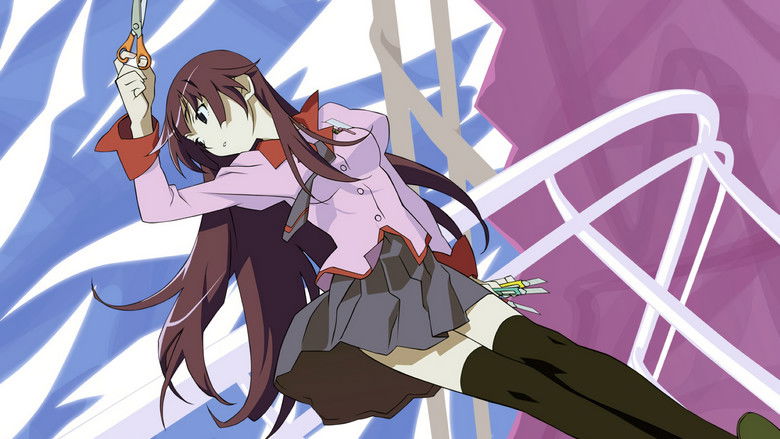
The Stapler and Office Supplies

Meaning:

They symbolize her emotional isolation, trauma-induced paranoia, and the sharp physical armor she builds to protect her fragile interior.

Context:

Used by Hitagi Senjougahara in Bakemonogatari as defensive weapons.

Traffic Lights and Crossings

Meaning:

Red, yellow, and green signal cuts symbolize internal conflict, moral choices, psychological pauses, and the boundary between mundane society and the supernatural world.

Context:

Pervasive visual motifs across Shaft’s direction.

The Abandoned Eram (Cram) School

Meaning:

It symbolizes limbo—a ruined, liminal space detached from society where characters stuck between humanity and aberrations pause to figure out their path forward.

Context:

Oshino Meme's temporary base of operations.

Snakes and Snake Pins

Meaning:

They symbolize hidden hostility, suppressed sexual desires, and the dangerous venom of a girl trapped behind a forced "cute and helpless" persona.

Context:

Associated with Nadeko Sengoku.

The Starry Night Sky (Deneb, Altair, Vega)

Meaning:

Represents absolute vulnerability, genuine intimacy, and offering everything one possesses to another person despite having little material wealth.

Context:

Featured prominently in Bakemonogatari Episode 12.

Shadows

Meaning:

This symbolizes inescapable past mistakes, codependency, and the psychological subconscious that accompanies a person everywhere.

Context:

Shinobu resides physically within Araragi’s shadow.

Memorable Quotes

なんでもは知らないわよ。知ってることだけ
— Tsubasa Hanekawa

Context

Spoken across multiple seasons whenever Araragi marvels at her intelligence.

Meaning

Hanekawa's signature phrase. It highlights her modesty while subtly deflecting attention from her omniscience and internal struggles.

人は一人で勝手に助かるだけ。誰かが誰かを助けることなんてできない
— Oshino Meme

Context

Bakemonogatari Episode 2 ("Hitagi Crab, Part 2") during Araragi's first consultation.

Meaning

The underlying thesis of the franchise, rejecting the concept of external savior figures.

All 5 quotes

Episode Highlights

Tsubasa Cat, Part 3

S1E12

Araragi and Hitagi's starry night date.

Significance:

Under the summer triangle, Hitagi lays bare her emotional poverty and affection, creating one of anime's most acclaimed romantic moments.

Tsubasa Cat, Part 5

S1E15

The climax of the initial season.

Significance:

Shinobu steps out of Araragi's shadow to subdue Black Hanekawa, solidifying their eternal vampire-master bond.

Karen Bee, Part 8

S2E8

The viral "toothbrush scene" episode.

Significance:

A masterclass in subverting viewer expectation, boundaries, and Shaft's hyper-stylized animation techniques.

Tsubasa Tiger, Part 5

S3E5

Hanekawa confronts her inner emotions and writes a letter to her tiger aberration Kako.

Significance:

Hanekawa writes a letter to her tiger aberration Kako, accepting her inner dark feelings, and experiences emotional closure.

Onimonogatari, Part 4

S3E20

Mayoi Hachikuji is targeted by "The Darkness" for remaining as a lost ghost.

Significance:

She bids a tearful farewell to Araragi before disappearing, marking a turning point in Araragi's view of mortality.

Hitagi End, Part 6

S3E26

Kaiki Deishuu confronts the newly ascendant snake god Nadeko Sengoku.

Significance:

Kaiki Deishuu successfully deceives the newly ascendant snake god Nadeko Sengoku into giving up her divinity to pursue her dream of drawing manga.

Ougi Formula

S4E1

A double-length locked-room classroom mystery episode.

Significance:

Demonstrates the power of Nisio Isin's dialogue-driven storytelling through abstract visual staging.

Ougi Dark, Part 3

S5E7

The ultimate climax of Araragi's high school story.

Significance:

Araragi saves Ougi (his subconscious self-criticism) from erasure, completes his character growth, and graduates high school.

Philosophical Questions

Can one human truly save another?

Explored through Oshino Meme’s philosophy. The series asserts that external help is only a tool; true salvation requires the victim's willingness to help themselves.

Is a conscious fake more valuable than a natural original?

Explored through Kaiki Deishuu. A person who is born good does not choose virtue, but a "fake" who consciously strives to be good exercises moral effort, making their fake virtue superior.

Is absolute self-sacrifice a noble virtue or toxic self-indulgence?

Explored through Koyomi Araragi's vampire nature. His constant desire to die or bleed for others is exposed as selfish martyrdom that strips the victims of their personal growth.

Alternative Interpretations

The Psychological Reading (Mental Illness Metaphor): Critics suggest oddities are not real supernatural entities, but physical manifestations of untreated mental health disorders: Hitagi suffers from PTSD and emotional numbness; Mayoi represents unresolved grief; Hanekawa suffers from dissociative identity disorder born from severe domestic abuse; and Araragi suffers from survivor guilt and chronic self-hatred.

Full ending explanation

Cultural Impact

Historical Context: Debuting in 2009, Bakemonogatari revolutionized the light novel adaptation meta. At a time when action anime dominated, it proved that a dialogue-heavy series could become a commercial hit.

Influence on Television: Studio Shaft’s signature style—rapid jump cuts, kinetic typography, and avant-garde staging—heavily influenced modern directors and shows like Call of the Night (Yofukashi no Uta) and Rascal Does Not Dream of Bunny Girl Senpai.

Philosophical References: The series blends Japanese Shinto/Yokai folklore with Xunzi's Legalist philosophy (that human nature is inherently selfish/fake) and Adlerian teleological psychology (that individuals create their own emotional ailments to serve a purpose).

Legacy: Bakemonogatari became one of the best-selling anime Home Video (BD/DVD) releases in Japanese history, averaging over 100,000 units sold per volume.

Audience Reception

Season-by-Season Reception:

  • Bakemonogatari (2009): Universally acclaimed as an avant-garde masterpiece that redefined modern anime direction.
  • Nisemonogatari (2012): Polarizing; praised for its dialogue and visual flair, but criticized for excessive fan-service (most notably the toothbrush scene).
  • Monogatari Series: Second Season (2013): Considered by fans and critics as the absolute peak of the franchise due to deep character arcs (Hanekawa, Nadeko, Kaiki).
  • Owarimonogatari (2015–2017): Praised for delivering a deeply satisfying, cohesive resolution to Araragi's high school journey.

Praised Aspects: Sharp dialogue, voice acting performances, iconic soundtrack, and avant-garde art direction.

Main Criticisms: Boundary-pushing fanservice, rapid text flashes that require pausing, and dense pacing.

Overall Verdict: Widely regarded as a landmark masterpiece of modern animation.

Interesting Facts

  • Author Nisio Isin wrote Bakemonogatari believing it was inherently unadaptable into animation due to its heavy reliance on wordplay and internal text. Directors Akiyuki Shinbo and Tatsuya Oishi convinced him by developing a brand-new visual language using fast text cards and kinetic typography.
  • Codified in Bakemonogatari, the iconic 180-degree neck tilt was used by Studio Shaft animators to break visual monotony during long dialogue scenes and signal intense emotional shifts.
  • Bakemonogatari suffered severe budget and scheduling issues during its original 2009 TV run, leading to unfinished frames replaced by solid color cuts and live-action slides. This constraint accidentally birthed Shaft's praised minimalist art style.
  • For Nisemonogatari Episode 8, virtually the entire Studio Shaft animating team—including top directors—volunteered to key-animate the infamous toothbrush scene, resulting in fluid production quality.
  • Announced in 2011, the Kizumonogatari prequel film trilogy took five years to complete due to director Tatsuya Oishi's meticulous, art-house visual ambitions.

Easter Eggs

Homage to Classic Anime

Characters frequently break the fourth wall to mimic voice lines and poses from Doraemon, Dragon Ball, Gundam, and JoJo’s Bizarre Adventure during comedic banter.

Madoka Magica Visual Cameos

Studio Shaft inserted subtle easter eggs referencing Puella Magi Madoka Magica within Monogatari's background art, including surreal labyrinth geometry and silhouette cameos.

Blade Runner Scene Recreation

In Hitagi End, the scene where Kaiki dries his hair with a towel in a dimly lit hotel room directly mimics Harrison Ford’s Rick Deckard in Ridley Scott’s Blade Runner (1982).

Real-World Architectural Scenery

Despite the surrealist layout, many background bridges, train crossings, and shrines are traced from real locations in Suginami, Tokyo, and Kobe.

Frequently Asked Questions

Explore More About This Movie

Dive deeper into specific aspects of the movie with our detailed analysis pages

Comments (0)

Leave a comment

No comments yet. Be the first to share your thoughts!

Similar Movies