
Skip to content
Black Butler
Gothic horror laced with dry aristocratic wit, following a traumatized child who sells his immortal soul to a ravenous demon just to burn down the shadows of his past.
Black Butler

Black Butler

黒執事

02 October 2008 — 28 June 2025 Japan 5 season 70 episode Ended 7.8 (286)

Cast: Daisuke Ono, Maaya Sakamoto, Yukari Tamura, Jun Fukuyama, Junichi Suwabe

Drama Animation Sci-Fi & Fantasy Comedy Mystery Revenge & Self-Destruction The Façade of Victorian High Morality & Hypocrisy Mastery, Servitude, and the Faustian Dynamic Trauma, Fractured Identity, and Lost Childhood

Overview

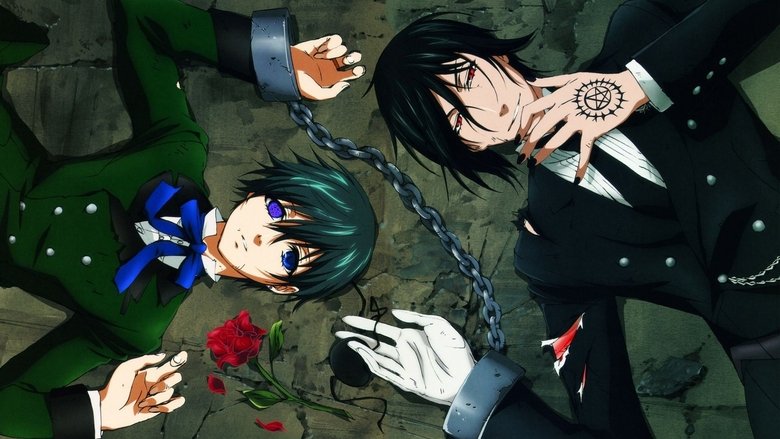
Black Butler (Kuroshitsuji) unfolds in an atmospheric, Victorian-era London steeped in gothic mystery, occult horror, and dark satire. The story centers on Earl Ciel Phantomhive, a twelve-year-old orphaned aristocrat who inherits the Phantomhive noble line and the Funtom toy manufacturing empire following the gruesome murder of his parents and the destruction of his family estate. Beneath his public identity as an innocent boy earl, Ciel acts as Queen Victoria’s "Watchdog," an undercover investigator policing Britain’s supernatural and criminal underworld. To survive his trauma and avenge his desecrated lineage, Ciel has forged an inescapable Faustian pact with Sebastian Michaelis—a calculating demon masquerading as a peerless head butler who pledged to serve him unconditionally until Ciel achieves absolute retribution, at which point Sebastian will consume his soul.

Throughout the series, Ciel and Sebastian navigate perilous investigations ranging from the Jack the Ripper slayings to rogue Grim Reapers, corrupted aristocrats, underground cults, and sinister resurrection experiments. While the television franchise originally diverged into anime-original plotlines during Seasons 1 and 2—introducing rival contract-holders and alternate conclusions—later installments (Book of Circus, Book of Murder, Book of the Atlantic, and the Public School Arc) returned faithfully to Yana Toboso’s canonical manga storyline. The overarching narrative tracks Ciel's unyielding descent into vengeance, unmasking the rot within high society and confronting supernatural horrors, all while the ticking clock of his demonic bargain looms overhead.


Core Meaning

The fundamental philosophical message across Black Butler is an uncompromising examination of the destructive nature of vengeance, the illusion of innocence, and the transactionality of human morality. The creators illustrate that trauma and obsession strip away humanity far more completely than demonic malevolence ever could. Ciel is not a traditional hero seeking justice to heal the world; he is a broken survivor who chooses self-annihilation and damnation as long as his tormentors burn with him. Sebastian is not an ethical guide but a predator honoring a contract. The series posits that once a person binds their identity to absolute revenge, there is no redemption or peace—only an aesthetic descent into the abyss.

Thematic DNA

Revenge & Self-Destruction 35%
The Façade of Victorian High Morality & Hypocrisy 25%
Mastery, Servitude, and the Faustian Dynamic 20%
Trauma, Fractured Identity, and Lost Childhood 20%

Revenge & Self-Destruction

The engine of the entire franchise. Ciel repeatedly rejects mercy, healing, or heavenly salvation. In the Red Butler/Jack the Ripper arc, Book of Circus, and the anime-original storylines, every case emphasizes that pursuing vengeance does not restore lost loved ones; it only produces collateral casualties and tightens the noose around Ciel’s neck.

The Façade of Victorian High Morality & Hypocrisy

The contrast between Britain's aristocratic refinement and gruesome underworld depravity. From child trafficking rings hidden behind philanthropic circuses to human experimentation sanctioned by religious or medical elites (the Aurora Society), the series reveals that the high-society establishment is often more monstrous than the supernatural demons lurking in the shadows.

Mastery, Servitude, and the Faustian Dynamic

Explores the delicate power struggle between a human master and a supernatural predator. Sebastian’s subservience is absolute only because the contract requires it; he constantly tests Ciel's resolve, waiting for his soul to ripen into the ultimate delicacy.

Trauma, Fractured Identity, and Lost Childhood

Ciel manufactures an aloof, ruthless adult persona to survive in an unforgiving world, masking intense panic attacks, vulnerability, and unresolved grief. His childhood is permanently arrested in exchange for power and pride.

Character Analysis

Sebastian Michaelis

Daisuke Ono

Archetype: Demonic Trickster / Inhuman Servant Key Trait: Demonic perfection masked under flawless etiquette.

Motivation

To faithfully execute Ciel’s commands until the contract finishes, ultimately feasting on his soul.

Character Arc

Shifts from an aloof monster adjusting to the petty details of human domestic service to an impeccably polished, terrifying predator whose obsession with Ciel’s soul grows ever more refined.

Ciel Phantomhive

Maaya Sakamoto

Archetype: Tragic Antihero / Vengeful Prodigy Key Trait: Cold, tactical intellect driven by pride.

Motivation

To hunt down and punish all conspirators responsible for the massacre of his family.

Character Arc

Hardens from a terrified captive into an icy, calculating underworld watchdog who repeatedly chooses ruthlessness over mercy, sacrificing pieces of his humanity with every resolved investigation.

All 5 characters and cast

Symbols & Motifs

The Faustian Contract Sigil

Meaning:

Symbolizes total surveillance, spiritual bondage, and the inescapable demonic bargain.

Context:

Inscribed on Ciel’s right eye (concealed under an eyepatch) and Sebastian’s left hand. The placement on the eye ensures Sebastian can track and perceive Ciel everywhere.

Chess & The Chessboard

Meaning:

Represents cold strategic calculus and viewing human lives as expendable pieces rather than individuals deserving empathy.

Context:

Featured prominently in openings, dialogue, and confrontations where Ciel frames moral choices as strategic checkmates using pawns, knights, and kings.

The Blue Hope Diamond Ring

Meaning:

Signifies the crushing burden of noble legacy and Ciel’s determination to rebuild his identity from the ashes of his family's destruction.

Context:

Passed down through generations of Phantomhive earls, shattered, and remade by Ciel.

Tea and Silver Cutlery

Meaning:

Represents the stark juxtaposition between civilized domestic refinement and unrestrained demonic violence.

Context:

Displayed during Sebastian's precise afternoon tea preparations and his lethal weaponization of silver dinnerware during combat.

Spider Lilies and Spiderwebs

Meaning:

Symbolizes death, entanglement in inescapable fate, and predatory traps spun around human souls.

Context:

Emphasized heavily in anime scene transitions and across Season 2 via the Trancy family motif.

Memorable Quotes

あくまで執事ですから (Akumade shitsuji desu kara)
— Sebastian Michaelis

Context

Delivered across all seasons whenever he performs impossible superhuman feats or executes lethal assignments.

Meaning

Sebastian’s defining catchphrase featuring a Japanese pun (akuma de meaning "merely/to the end," while akuma means "demon"), highlighting his double nature as an obedient servant and a lethal monster.

御意、ご主人様 (Gyoi, goshujin-sama / Yes, My Lord)
— Sebastian Michaelis

Context

The formal phrase spoken with hand over heart every time Sebastian accepts an absolute command from Ciel.

Meaning

Demonstrates absolute submission and the ironclad binding nature of their supernatural contract.

All 4 quotes

Episode Highlights

His Butler, Able / His Butler, at the Funeral

S1E5

Adapts the climax of the Jack the Ripper arc, revealing Madame Red and Grell Sutcliff as the murderers.

Significance:

Ciel refuses to show mercy despite familial bonds, cementing his resolute dedication to his role as the Queen's ruthless Watchdog.

His Butler, Fluent

S1E24

The original anime finale where Ciel defeats the fallen angel Ash/Angela across a burning London and surrenders his soul to Sebastian on a quiet boat.

Significance:

Provides a definitive, poetic, and non-canonical conclusion to the original 2008 broadcast run.

Black Butler

S2E12

Hannah Anafeloz fulfills Alois Trancy’s dying wish, causing Ciel to be reborn as an immortal demon.

Significance:

Concludes the anime-original second season by trapping Sebastian in eternal servitude without ever being able to consume Ciel's soul.

His Butler, Performing

S3E10

Ciel orders the complete burning of Baron Kelvin's estate with the kidnapped children inside, devastating Joker.

Significance:

Serves as a pivotal canonical turning point exposing the unyielding, merciless darkness born of Ciel's past trauma.

Book of Murder (Part 2)

S3E2

Adapts the locked-room murder mystery at Phantomhive Manor, featuring the deduction prowess of author Arthur.

Significance:

Showcases Sebastian's deceptive intellect and serves as an intricate bridge between the major manga story arcs.

Book of the Atlantic

S3E3

Aboard the luxury liner Campania, Undertaker is revealed as a rogue Shinigami reanimating Bizarre Dolls, Elizabeth reveals her elite swordsmanship, and Sebastian is critically wounded.

Significance:

Provides the cinematic climax of the franchise's action lore while unmasking Undertaker as the series' overarching mastermind.

His Butler, Final Exam

S4E11

Climax of the Weston College investigation where Ciel exposes the Prefect 4 and Headmaster for murdering students and resurrecting them via the Aurora Society.

Significance:

Expands the reach of Undertaker's Bizarre Doll conspiracy into British elite institutions.

Philosophical Questions

Can vengeance ever heal trauma?

The series argues that vengeance never brings peace or closure; instead, destroying one's abusers only hardens the soul, perpetuates trauma, and generates innocent collateral victims.

Where does humanity end and monstrousness begin?

Through human antagonists like Madame Red, Baron Kelvin, and the Weston College prefects, the story demonstrates that human atrocities driven by love, vanity, and tradition often surpass the malice of actual demons.

Is an absolute contract the ultimate form of loyalty or the ultimate slavery?

Sebastian's flawless servitude is entirely mechanical and devoid of genuine care, questioning whether loyalty possesses any moral value when it is forced by a binding contract rather than free will.

Alternative Interpretations

The narrative can be analyzed through several distinct lenses:

Full ending explanation

Cultural Impact

Debuting during the late 2000s renaissance of gothic and dark fantasy anime, Black Butler became a global commercial hit that heavily shaped anime fandom, Western convention culture, and Japanese visual kei fashion. Sebastian and Ciel emerged as enduring cosplay icons for over a decade. Critically, the series subverted the traditional "butler anime" archetype by swapping lighthearted wish-fulfillment for dark psychological horror, and set an industry precedent for reviving faithful manga storylines years after diverging into anime-original filler.

Audience Reception

The series has enjoyed strong but distinct reception across its varied production eras:

  • Season 1 (2008–2009): Acclaimed for its striking gothic aesthetic, memorable voice work, and moody atmosphere, though purists criticized its divergence into filler in the second half.
  • Season 2 (2010): Highly polarizing due to controversial characters Alois Trancy and Claude Faustus and heavy deviations from canon, though its dark ending retains a cult following.
  • Book of Circus & Book of Murder (2014): Received widespread critical acclaim for restoring canonical fidelity, higher animation quality, and emotional gravity.
  • Book of the Atlantic (2017) & Public School Arc (2024): Praised for dynamic action choreography, cinematic presentation, and CloverWorks' modern visual polish, cementing the franchise's lasting legacy.

Interesting Facts

  • The series was created by mangaka Yana Toboso and originally debuted in Square Enix's Monthly GFantasy in 2006.
  • Seasons 1 through 3, Book of Murder, and Book of the Atlantic were animated by A-1 Pictures, before production moved to CloverWorks in 2024.
  • Daisuke Ono (Sebastian) and Maaya Sakamoto (Ciel) have voiced their characters continuously across all TV seasons, OVAs, films, and drama CDs since 2008.
  • Season 1 caught up to the manga by episode 15, requiring director Toshiya Shinohara and writers to craft an anime-original ending and subsequent second season.
  • Renowned video game composer Yasunori Mitsuda composed the orchestral scores for Book of Circus, Book of Murder, and Book of the Atlantic.

Easter Eggs

Sir Arthur Conan Doyle Meta-Reference

In Book of Murder, the character Arthur Wordsmith directly homages Sir Arthur Conan Doyle, incorporating elements and narrative structures reminiscent of The Hound of the Baskervilles and Sherlock Holmes mysteries.

RMS Titanic and 1997 Film Homage

In Book of the Atlantic, the luxury liner Campania collides with an iceberg, directly parodying iconic scenes from James Cameron's Titanic, including steerage flooding and the famous bow pose (the "Phoenix" pose).

Historical Victorian Figures and Events

The story integrates real Victorian history, referencing Queen Victoria, Prince Albert, the 1888 Jack the Ripper murders, the Anglo-Afghan wars via Prince Soma and Agni, and the British boarding school prefect system.

Demonology Naming of Sebastian

The name Sebastian Michaelis is derived from Sébastien Michaëlis, a 17th-century French inquisitor and demonologist who authored an influential demon classification system.

Frequently Asked Questions

Explore More About This Movie

Dive deeper into specific aspects of the movie with our detailed analysis pages

Comments (0)

Leave a comment

No comments yet. Be the first to share your thoughts!

Similar Movies