Regular Show
A surrealist comedy that blossoms into an epic space opera, exploring the chaotic, hilarious, and often poignant journey from slackerdom to adulthood against a backdrop of cosmic absurdity.
Regular Show

Regular Show

"It's anything but."

06 September 2010 — 16 January 2017 United States of America 8 season 245 episode Ended ⭐ 8.6 (2,140)
Cast: J.G. Quintel, William Salyers, Mark Hamill, Sam Marin, Roger Craig Smith
Animation Comedy
Coming of Age and Maturation Friendship and Loyalty The Mundane vs. The Surreal Nostalgia and Pop Culture

Overview

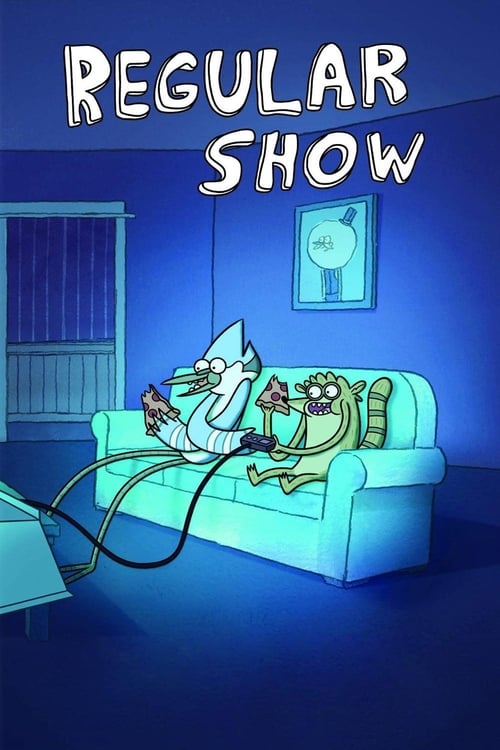
"Regular Show" chronicles the lives of two 23-year-old best friends, a blue jay named Mordecai and a raccoon named Rigby. They work as groundskeepers at a local park under the perpetually stressed supervision of their gumball machine boss, Benson. Their main goal is to avoid work and entertain themselves by any means necessary, which invariably leads to mundane problems escalating into surreal, supernatural, or science-fiction catastrophes. These misadventures often drag in their eccentric co-workers: the wise, immortal yeti Skips; the jovial, lollipop-headed Pops; the boisterous Muscle Man; and his spectral companion, Hi-Five Ghost.

While early seasons focus on standalone episodic adventures filled with 1980s and '90s pop culture references, video games, and junk food, the series gradually develops more complex, overarching narratives. It explores Mordecai's romantic entanglements, Rigby's surprising journey toward maturity, and the hidden depths of the supporting cast. The show's scope expands dramatically in its later seasons, evolving from a workplace sitcom into a sweeping space opera, culminating in a battle to save the universe itself. Across its run, the series masterfully balances its absurdist humor with genuine emotional weight, telling a surprisingly profound story about friendship, responsibility, and the bittersweet process of growing up.
Core Meaning

The core meaning of "Regular Show" is a celebration of the transition from aimless youth to meaningful adulthood, without losing the friendships and sense of fun that define one's formative years. The series argues that growing up doesn't mean becoming boring; rather, it's about finding a way to integrate responsibility with personal joy. Through the escalatingly absurd adventures of Mordecai and Rigby, the show illustrates that even the most mundane aspects of life can be epic and meaningful. Ultimately, it is a story about the profound power of friendship to navigate life's challenges, the importance of facing one's flaws to achieve personal growth, and the bittersweet reality that change and loss are inevitable parts of life's journey, as symbolized by the show's poignant finale.

Thematic DNA

Coming of Age and Maturation 35%
Friendship and Loyalty 30%
The Mundane vs. The Surreal 25%
Nostalgia and Pop Culture 10%

Coming of Age and Maturation

This is the central theme of the entire series. Initially, Mordecai and Rigby are archetypal slackers, defined by their avoidance of responsibility. Over eight seasons, the show charts their slow, often hilarious, and surprisingly emotional journey toward maturity. Rigby's arc is particularly pronounced; he evolves from a selfish troublemaker to a responsible adult who goes back to high school for his girlfriend Eileen, eventually marrying her and starting a family. Mordecai navigates complicated romantic relationships and career aspirations, ultimately leaving the park to pursue his art. The final season solidifies this theme, as the characters must literally save the universe, forcing them into their most adult roles yet and culminating in a flash-forward that shows their grown-up lives.

Friendship and Loyalty

The unbreakable bond between Mordecai and Rigby is the series' emotional anchor. Despite constant arguments, jealousy, and life-threatening situations caused by their antics, their loyalty to each other is absolute. Episodes like "Eggscellent" showcase the lengths they will go to for one another, with Mordecai facing mortal danger to win a hat for a comatose Rigby. This theme extends to the entire park crew, who evolve from mere coworkers into a found family. Their collective efforts in crises, especially in later seasons during the "Save the Park" and space arcs, demonstrate that their bonds are strong enough to overcome universe-ending threats.

The Mundane vs. The Surreal

"Regular Show"'s signature comedic formula is the violent collision of everyday, relatable problems with extraordinary, surreal consequences. An argument over who gets to be Player 1 in a video game leads to summoning a demonic beast. Trying to set up chairs for a party accidentally sends a coworker to the moon. This theme suggests that adventure and chaos lie just beneath the surface of ordinary life. It taps into a feeling of youthful boredom and the desire to make daily existence more exciting, showing how a simple attempt to slack off can spiral into an epic quest involving gods, monsters, and interdimensional beings.

Nostalgia and Pop Culture

The series is a love letter to the 1980s and 1990s. Its aesthetic and plotlines are heavily influenced by the creators' own experiences growing up, featuring countless references to classic video games (beat 'em ups, 8-bit RPGs), action movies, hair metal, and obsolete technology like cassette tapes and laserdiscs. This isn't just window dressing; the nostalgia often drives the plot, with cursed arcade machines or magical keyboards serving as catalysts for adventure. This theme resonates with an older audience who grew up with these cultural touchstones, creating a shared language between the creators and viewers.

Character Analysis

Mordecai

J.G. Quintel

Archetype: The Relatable Protagonist
Key Trait: Conscientious but prone to simping

Motivation

Initially, Mordecai's motivation is simply to have fun, avoid work, and win the affection of his crush, Margaret. As the series progresses, his motivations become more complex. He desires a meaningful romantic relationship, but his fear of commitment and poor communication skills sabotage his efforts. Ultimately, his motivation shifts toward self-fulfillment, leading him to art school and a life beyond the park, seeking a sense of purpose that his slacker lifestyle could never provide.

Character Arc

Mordecai begins the series as the more responsible, yet still lazy, half of the main duo. He is often the voice of reason that Rigby ignores. His primary arc revolves around his struggles with love and maturity. He endures a long, complicated on-again, off-again relationship with Margaret, followed by a turbulent romance with CJ, often fumbling these relationships due to his own indecisiveness and insecurity. While Rigby undergoes a more dramatic external transformation, Mordecai's journey is more internal. By the end of the series, he has learned from his romantic failures, parts ways with his friends at the park to pursue his passion for art, and eventually finds a stable, happy relationship with a new character, showing he has finally matured and moved on from his youthful hesitations.

Rigby

William Salyers

Archetype: The Chaotic Sidekick / The Underdog
Key Trait: Impulsive and lazy, with surprising potential

Motivation

Rigby's initial motivation is pure, uncut hedonism: he seeks maximum fun with minimum effort. He is driven by impulse and a deep-seated jealousy of Mordecai. As the show develops, his motivation evolves. He becomes motivated by his love for Eileen and a newfound desire for self-respect. He wants to prove to himself and others—especially Mordecai—that he is not a complete failure. This culminates in his decision to graduate high school, a quest driven by a genuine desire to better himself.

Character Arc

Rigby has the most significant character arc in the series. He starts as an impulsive, selfish, and deeply insecure slacker who consistently makes terrible decisions that endanger everyone. For much of the show, he lives in Mordecai's shadow. The turning point for his character is his relationship with Eileen. Her belief in him inspires him to become a better person. In a major seasonal arc, he decides to go back and get his high school diploma, a goal he achieves in the Season 7 finale. This marks his transformation from the show's biggest screw-up to its most inspiring example of growth. In the finale's flash-forward, he is shown to be a married father, having achieved a level of maturity that would have been unthinkable in the early seasons.

Benson Dunwoody

Sam Marin

Archetype: The Beleaguered Authority Figure
Key Trait: High-strung with a hidden heart of gold

Motivation

Benson's primary motivation is to keep his job and maintain order in the park, a task made nearly impossible by Mordecai and Rigby. He craves competence and respect, both from his employees and his own boss. Underneath his rage is a deep-seated loneliness and a desire for companionship, which he eventually finds, allowing him to become less defined by his professional frustrations.

Character Arc

Benson is introduced as the perpetually furious, workaholic manager of the park and the primary antagonist to Mordecai and Rigby's slacking. His character is defined by his explosive temper and his constant threats to fire the duo. Over time, the show reveals the immense pressure he is under from his boss, Mr. Maellard, and explores his lonely personal life. Episodes like "150 Piece Kit" reveal his past as a legendary rock drummer, adding layers of depth beyond his angry exterior. His arc is one of softening; he develops a grudging affection for his employees, becoming more of a father figure. In the finale, he finds love and continues to manage the park, but with a newfound sense of peace and family.

Pops Maellard

Sam Marin

Archetype: The Innocent / The Chosen One
Key Trait: Jovial, naive, and cosmically important

Motivation

Pops' motivation is simple: to see the good in everything and enjoy the company of his friends. He is driven by kindness and a genuine love for the world. In the final season, his motivation shifts to protecting his friends and the universe from his brother's nihilistic desire for erasure. He is a reluctant hero, motivated not by a thirst for glory, but by the love he feels for the family he has found on Earth.

Character Arc

For most of the series, Pops is a sweet, naive, and childlike man-child with a lollipop-shaped head who finds joy in the simplest things. He serves as a source of gentle, oddball comedy. However, the final seasons radically redefine his character. It is revealed that he is an alien from the planet Lolliland and a being of pure good named Mega Kranus, destined to fight his evil twin brother, Anti-Pops, in a cyclical battle that resets the universe every 14 billion years. His arc transforms him from a simple comic relief character into the literal savior of the universe. He must learn to fight and embrace his destiny, culminating in his ultimate sacrifice, where he breaks the cycle not with violence, but with love, destroying both himself and his brother to save his friends and all of existence.

Skips

Mark Hamill

Archetype: The Mentor / The Stoic Guardian
Key Trait: Wise, immortal, and eternally dependable

Motivation

Skips is motivated by a sense of duty to protect the park and its inhabitants. His immortality comes with the responsibility of preventing cosmic disasters, which conveniently aligns with cleaning up Mordecai and Rigby's messes. He is also motivated by the memory of his lost love, choosing to use his eternal life to help others and prevent them from suffering the kind of loss he experienced.

Character Arc

Skips is an immortal yeti and the park's most competent employee. He is a seemingly all-knowing figure who often provides the solution to the supernatural problems Mordecai and Rigby create. His arc is one of backstory and emotional revelation. The special episode "Skips' Story" reveals his tragic past: he was originally named Walks, but was granted immortality by the Guardians of Eternal Youth after his true love, Mona, died in a battle with a powerful foe. He skips instead of walks to constantly honor her memory. This knowledge recasts his stoic, helpful nature as a product of immense loss and eternal duty. He remains a steadfast protector of his friends throughout the series, and the finale shows him continuing his work at the park, a timeless anchor as his mortal friends move on.

Symbols & Motifs

The Park

Meaning:

The Park symbolizes the characters' state of arrested development and serves as the crucible for their growth. It's a bubble where they can remain youthful slackers, shielded from the full responsibilities of the outside world. It represents a phase of life—that post-adolescent, pre-adulthood stage—that is both comfortable and limiting.

Context:

For the first seven seasons, almost every story begins and ends within the confines of the park. Leaving the park often signifies a major step in a character's development. In the finale, the characters moving on from the park for good represents their final transition into adulthood. The monument to Pops erected in the park solidifies its role as a place of memory and significant life events.

Video Games

Meaning:

Video games symbolize both the characters' desire for escapism and the unexpected challenges of life. They are the primary way Mordecai and Rigby avoid work, representing their slacker ethos. However, the games often bleed into reality, with their rules, bosses, and high-stakes conflicts becoming real-world threats they must overcome, mirroring how life's challenges are often more complex than they appear.

Context:

Throughout the series, cursed arcade cabinets, overpowered game controllers, and virtual reality headsets frequently initiate the central conflict of an episode. In "Exit 9B," the park's greatest villains return as if they were video game bosses from previous levels. The characters' skill (or lack thereof) in games is often a metaphor for their competence in handling real problems.

The Golf Cart

Meaning:

The golf cart is a symbol of the characters' limited freedom and their haphazard approach to responsibility. It is their primary tool for work, yet they almost exclusively use it for reckless joyriding and as a getaway vehicle during their misadventures. It represents their tendency to misuse the tools of adulthood for childish pursuits.

Context:

The cart is a constant presence in the show, involved in countless chases and surreal events. Its frequent destruction and subsequent repair mirror the cyclical nature of Mordecai and Rigby's behavior: they cause chaos, face the consequences, and then reset, only to do it all over again. It's an emblem of their specific brand of irresponsible work ethic.

Memorable Quotes

You can't touch music, but music can touch you.

— Mordecai

Context:

In the Season 2 episode "This Is My Jam," Rigby gets an annoying, catchy song stuck in his head. The song manifests as a giant, sentient cassette tape that physically haunts him. Mordecai delivers this line while trying to explain the situation, just before the musical entity begins to physically attack them.

Meaning:

This nonsensical but strangely profound line perfectly encapsulates the show's blend of stoner-like logic and surrealism. It's a comedic observation that hints at the powerful, intangible nature of art and emotion, a recurring element in a show where abstract concepts often become literal, dangerous entities.

A bunch of baby ducks, send 'em to the moon.

— Rigby

Context:

From the pilot episode, "The Power," Mordecai and Rigby need to fix a hole in the wall. Rigby finds a magical keyboard that can do anything. Instead of fixing the hole, they use it for random acts, including sending a group of baby ducks they encounter to the moon by playing a little song. The ducks later return as cosmic, super-powered beings.

Meaning:

This quote is the embodiment of the show's early, chaotic, and random sense of humor. It showcases Rigby's impulsive and nonsensical problem-solving skills, establishing the series' core premise where simple issues are resolved in the most absurdly over-the-top manner possible.

MY MOM!

— Muscle Man

Context:

Muscle Man uses this phrase constantly throughout the entire series, typically as a punchline to a terrible joke he tells. A classic example is in the episode "My Mom," where Benson tells him, "Muscle Man, if you say 'my mom', you're fired." Muscle Man pauses, then yells, "MY MOM!" Benson fires him, and Muscle Man proclaims, "It was worth it!"

Meaning:

This is Muscle Man's iconic, abrasive, and nonsensical catchphrase. It represents his unique brand of obnoxious humor and his tendency to insert himself into any situation. The joke became a running gag so legendary that its humor comes not from the joke itself, but from its constant, predictable, and context-defying repetition.

Jolly good show.

— Pops

Context:

Pops says this frequently throughout the series when he is pleased. Its most significant use is in the final moments of the series finale, "A Regular Epic Final Battle." After sacrificing himself to save the universe, his voice is heard from the afterlife, watching his friends' lives unfold. He sees them grow up and find happiness, and delivers the line as his final, heartfelt words before a tape of the show is ejected, ending the series.

Meaning:

This is Pops' signature phrase, expressing his innocent delight and appreciation for the world around him. Its gentle, old-fashioned sincerity stands in stark contrast to the chaos that usually surrounds him. In the context of the series finale, it takes on a deeply poignant meaning, serving as his final, fourth-wall-breaking verdict on the entire series and the life he lived with his friends.

Episode Highlights

The Power

S1E1

The pilot episode perfectly establishes the series' core formula. To fix a hole in the wall, Mordecai and Rigby use a magical keyboard stolen from a wizard, leading to them teleporting things, creating monsters, and sending baby ducks to the moon. It introduces the dynamic of a mundane problem escalating into a surreal crisis that must be solved through equally surreal means.

Significance:

This episode is the quintessential introduction to the show's premise, characters, and unique brand of absurdist humor. It sets the tone for the entire series and contains several elements, like the baby ducks, that become important recurring characters in later, more epic episodes.

Eggscellent

S3E17

After Rigby suffers a severe allergic reaction trying to win a trucker hat by eating a massive omelet, he falls into a coma. Wracked with guilt, Mordecai embarks on an epic quest to finish the eating challenge himself to win the hat, believing it is the only thing that can save his friend. The episode is a parody of over-the-top 80s training montages and action films.

Significance:

This episode won "Regular Show" a Primetime Emmy Award. It is widely considered one of the best episodes for its perfect blend of absurd comedy and genuine, heartfelt emotion, showcasing the incredible depth of Mordecai and Rigby's friendship.

Exit 9B

S4E1

This half-hour special sees the return of nearly every villain from the show's first three seasons, all resurrected by a new antagonist who plans to destroy the park by building a highway exit ramp through it. The park crew must band together and fight in an all-out war, with callbacks to dozens of previous episodes.

Significance:

"Exit 9B" marked a turning point for the series, shifting from mostly self-contained stories to larger, lore-heavy, serialized arcs. It was the show's first truly epic battle and established the idea of the park crew as a family of heroes defending their home, a theme that would dominate the later seasons.

Skips' Story

S5E22

A 30-minute special that delves into the tragic backstory of the immortal yeti, Skips. It reveals his original name was Walks, his life centuries ago, and his romance with a woman named Mona. Her death on the day of their wedding is what leads him to be granted immortality and why he always skips, as a tribute to her memory.

Significance:

This episode gave incredible emotional depth to a fan-favorite character who was previously shrouded in mystery. It demonstrated the show's capacity for serious, poignant storytelling amidst its usual wackiness and is often cited by fans and critics as one of the series' most powerful and well-crafted episodes.

Rigby's Graduation Day Special

S7E36

The culmination of Rigby's season-long arc of returning to high school. The episode focuses on Rigby's anxieties about giving his valedictorian speech and Mordecai's jealousy over his friend's newfound maturity. Rigby delivers a heartfelt speech, marking the completion of his character development.

Significance:

This episode is the emotional climax of Rigby's transformation from a slacker into a responsible adult. It also serves as a shocking cliffhanger for the final season, as immediately after the ceremony, the entire park is encased in a giant dome and launched into deep space, setting the stage for the show's final, cosmic arc.

A Regular Epic Final Battle

S8E27

The three-part series finale sees the park crew in a final confrontation against the evil Anti-Pops to prevent the destruction and resetting of the universe. The battle is immense, featuring giant mechs and the return of many beloved side characters. It ends with Pops making the ultimate sacrifice by hugging his brother and flying them both into the sun, breaking the cycle of destruction forever.

Significance:

This episode is the grand, emotional culmination of the entire series. It provides a definitive and bittersweet conclusion to the story, tying together themes of friendship, sacrifice, and growing up. The epilogue, which flashes forward 25 years to show the characters' adult lives, offers a deeply satisfying sense of closure for longtime fans and is regarded as one of the best finales in modern animation.

Philosophical Questions

What does it truly mean to grow up?

The series constantly explores this question through the contrasting developments of Mordecai and Rigby. Initially, it seems maturity is about being more responsible, like Mordecai. However, the show ultimately argues that growing up is a more complex process of self-improvement and finding personal fulfillment. Rigby, the initial slacker, achieves a more profound maturity by actively working to better himself—finishing school, committing to a relationship—while Mordecai stagnates for a time due to his romantic indecisiveness. The show suggests that maturity isn't just about abandoning childish things, but about integrating them into a responsible life and making conscious choices to evolve.

Can you escape your destiny, or must you face it?

This question becomes central in the final seasons with the introduction of Pops' cosmic destiny. Pops is a pacifist and a being of pure kindness, yet he is destined to engage in a universe-destroying battle with his brother. The series explores his struggle to accept this violent role. Ultimately, the show offers a nuanced answer: Pops cannot escape his fated confrontation, but he can change its outcome. He faces his destiny not by conforming to its violent expectations, but by remaining true to his own nature. He defeats his brother with an act of love—a hug—sacrificing himself to break the cycle. This suggests that while one may not be able to avoid fate, one can choose how to meet it.

Alternative Interpretations

One popular interpretation views the entire series, particularly its surreal elements, as a metaphor for the anxieties and escapist fantasies of young adulthood. Mordecai and Rigby's struggles with boredom and responsibility at a dead-end job are universal. The supernatural monsters and cosmic threats they face can be read as exaggerated externalizations of their internal fears about failure, commitment, and the pressures of growing up. Their adventures are a form of wish-fulfillment, transforming their mundane reality into something epic and important.

Another reading, especially in light of the finale, interprets the show through a meta-fictional lens. The reveal of Pops' cyclical battle and the universe resetting suggests a commentary on the nature of episodic television itself, where characters often reset at the end of each story. The finale's fourth-wall-breaking moments, including showing Pops scenes from his original student film creation, hint that the characters are becoming aware of their own fictional status. Pops' ultimate sacrifice is not just about saving the universe, but about breaking free from the narrative loop he's trapped in, giving his friends a definitive, lasting future instead of another reboot. This interpretation sees the show as a meditation on storytelling, endings, and what it means for a story to truly be over.

Cultural Impact

"Regular Show" premiered in 2010 as part of a renaissance for creator-driven animation on Cartoon Network, alongside "Adventure Time." It stood out for its unique blend of slacker comedy, surrealism, and a distinct sensibility aimed at both kids and the young adults who had grown up in the '80s and '90s. Its humor, which often derived from taking mundane workplace situations to insane, supernatural conclusions, resonated with a wide audience and was praised by critics for its creativity and wit.

The show's heavy reliance on retro pop culture—from classic arcade games and action films to 80s power ballads—became one of its defining features. This nostalgic lens not only provided a deep well of comedic material but also allowed the show to connect with an older demographic, making it a program that parents could genuinely enjoy with their children. This cross-generational appeal was a significant factor in its success and influence.

Over its eight-season run, the show evolved significantly, transitioning from episodic comedy to a series with deep emotional arcs and serialized storytelling. It tackled themes of growing up, relationship failures, and the transition into adulthood with a surprising level of sincerity, influencing subsequent animated shows to balance humor with genuine pathos. The character development, particularly Rigby's transformation from a lazy joke to a mature and responsible adult, is often cited as one of the best character arcs in modern animation. The series finale was lauded as a masterful conclusion, providing an emotional and satisfying end that cemented the show's legacy as a modern classic that was anything but regular.

Audience Reception

"Regular Show" received widespread critical acclaim throughout its run and garnered a large, loyal fanbase. Critics praised its zany, bizarre, and hilarious tone, complimenting its inventive animation, strong character dynamics, and clever writing. The show was particularly noted for its appeal to a wide range of age groups, with its blend of slapstick humor for younger viewers and subtle, adult-oriented jokes and nostalgic 80s/90s pop culture references for older audiences.

Audience reception was overwhelmingly positive, with the show maintaining high ratings across its seasons. Fans grew deeply attached to the characters and their development. The evolution of the series from a simple episodic comedy to a show with complex emotional arcs and serialized plots in later seasons was generally well-received, with many praising the increased depth. However, some viewers preferred the earlier, more formulaic and less plot-heavy seasons. The finale, "A Regular Epic Final Battle," is widely considered by fans to be a masterpiece and one of the most satisfying conclusions to a modern cartoon, praised for its emotional weight, epic scale, and poignant ending that provided closure for the beloved characters.

Interesting Facts

  • The series creator, J.G. Quintel, developed the show from characters he created for his student films at CalArts, titled "The Naïve Man from Lolliland" and "2 in the AM PM". The former featured an early version of Pops, while the latter included prototypes for Mordecai and Benson.
  • J.G. Quintel, the creator, also provides the voice for the main character Mordecai and for Hi-Five Ghost.
  • The character of Mordecai is loosely based on Quintel's own experiences in college, capturing the feeling of hanging out with friends and getting into absurd situations.
  • The character of Rigby was developed when Quintel randomly drew a raccoon hula-hooping and decided he liked the design.
  • Mark Hamill, famous for playing Luke Skywalker, voices the immortal yeti Skips.
  • Each episode took approximately nine months to complete from conception to final animation, which was done in South Korea.
  • The show is known for its frequent use of licensed 80s music, with songs like "You're the Best Around" and "Holding Out for a Hero" appearing in key moments.
  • A movie, titled "Regular Show: The Movie," was released in 2015, featuring a time-travel plot where Mordecai and Rigby must go back in time to save the universe from a vengeful volleyball coach.
  • On June 12, 2024, it was announced that a new series set in the "Regular Show" universe has been greenlit, with J.G. Quintel returning.

Easter Eggs

Numerous references to retro video games are embedded in the series.

The show frequently pays homage to classic gaming. The episode "Video Game Wizards" is a clear parody of the 1989 Nintendo-centric film "The Wizard." The fighting styles in "Death Punchies" are reminiscent of "Street Fighter," including a "Hadouken"-like energy attack. The appearance of the character Garrett Bobby Ferguson is a direct reference to real-life competitive gamer Billy Mitchell.

Obsolete Media Formats as Characters

In the episode "The Last Laserdisc Player," the heroes must protect the last Laserdisc player from being destroyed by its enemies, DVD and Blu-Ray, who are depicted as powerful warriors. The guardians of other obsolete formats, like Betamax and 8-Track, also appear as characters, serving as a deep-cut reference for media enthusiasts.

J.G. Quintel's Student Film Cameos

The finale contains a meta-reference to J.G. Quintel's student film, "The Naïve Man from Lolliland." As Pops confronts the nature of his existence, he is shown scenes from this original short, implying he is becoming aware of his own fictional nature as a cartoon character drawn by a creator.

⚠️ Spoiler Analysis

Click to reveal detailed analysis with spoilers

Frequently Asked Questions

Explore More About This Movie

Dive deeper into specific aspects of the movie with our detailed analysis pages

Comments (0)

Leave a comment

No comments yet. Be the first to share your thoughts!