Skip to content
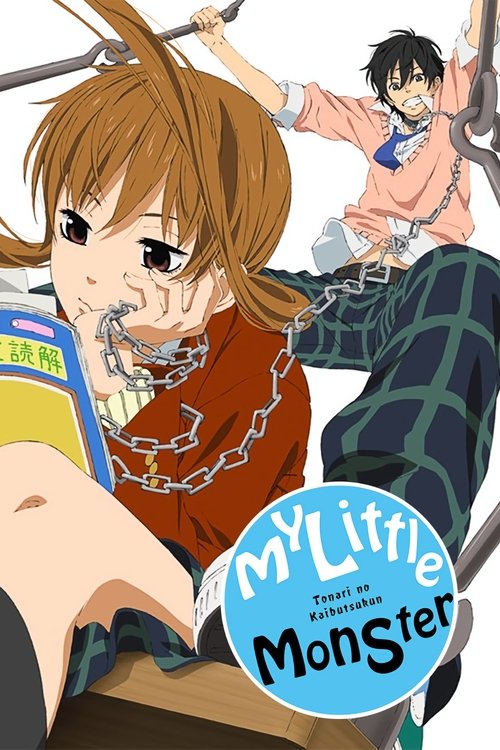
My Little Monster
A shoujo comedy where a straight-A loner and an unpredictable "monster" collide: love confessed before it is understood, like a chalkboard equation nobody knows how to solve.
My Little Monster

My Little Monster

となりの怪物くん

02 October 2012 — 25 December 2012 Japan 1 season 13 episode Ended 8.2 (377)

Cast: Haruka Tomatsu, Takuma Terashima, Tatsuhisa Suzuki, Kana Hanazawa, Atsumi Tanezaki

Animation Comedy Love confessed before it is understood Isolation and the accidental formation of a group Ambition versus intimacy Violence, sincerity and the label of 'monster' Family as inheritance

Overview

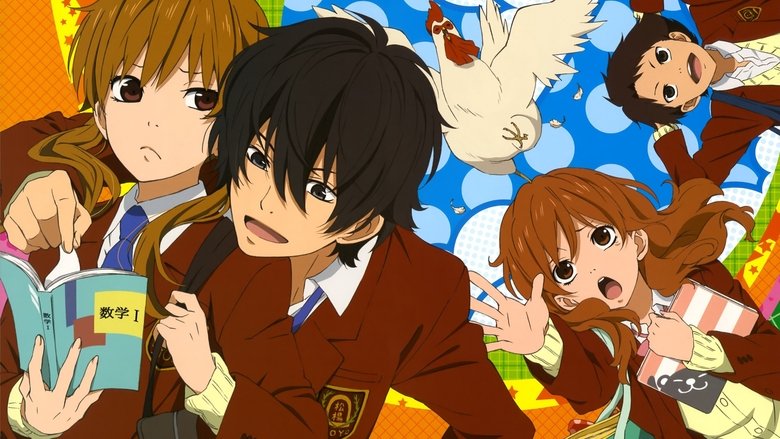
My Little Monster (Tonari no Kaibutsu-kun) adapts Robico's manga, serialized in Kodansha's Dessert magazine from August 2008 to June 2013, into a thirteen-episode television series produced by Brain's Base and broadcast from October 2 to December 25, 2012, with a simulcast on Crunchyroll. It begins with a chore: Shizuku Mizutani, a girl with no interests beyond studying and her plans for the future, is asked to deliver class printouts to the home of Haru Yoshida, the boy who sits next to her and almost never comes to school. Haru reads the errand as an act only a friend would perform, declares them friends on the spot, and shortly afterward confesses that he loves her.

From that inverted starting point — the confession arrives first, and the understanding has to be built backwards — the series follows what happens when two socially isolated people are forced into each other's orbit. Haru returns to school, where his inability to read social protocol produces a running series of bizarre incidents; Shizuku, refusing to be outpaced by a boy who is a natural genius, recasts him as her academic rival and studies harder. Around them a small group slowly assembles: Asako Natsume, beautiful and painfully awkward with other girls; Sōhei Sasahara, the easygoing athlete who acts as the group's social glue; and rivals and relatives who complicate everyone's feelings.

The arc across the run is less about whether the two will get together than about whether either of them can name what they feel and still hold on to who they are. Shizuku must weigh her single-minded discipline against the time and vulnerability a relationship demands; Haru must learn that being loved does not mean being owned, and that friendship is something you maintain rather than declare. Directed by Hiro Kaburaki with Noboru Takagi as script supervisor, the series moves through a school year of summer breaks, festivals, Christmas and New Year's, ending as spring approaches.

Core Meaning

The series argues that love is not a revelation but a skill — something learned slowly, awkwardly, and with a great deal of failure. By putting the confession in the first episode and spending the remaining twelve on the aftermath, the story refuses the usual shoujo engine of deferred longing and asks a harder question instead: once someone has said the words, what do you actually do with them?

Its second claim is that isolation is the shared condition, not the deviation. Shizuku's emotional flatness and Haru's volatility look like opposites but are two responses to the same problem — neither of them was taught how to be with people. What draws them together is not complementarity but recognition. The "monster" of the title is finally revealed as a misnomer: what the world calls monstrous is mostly untranslated sincerity.

Underneath sits an unusually clear-eyed message about the cost of ambition. Shizuku is never asked to abandon her future for a boy, and the series treats her refusal to do so as integrity rather than coldness — the tension between a life plan and a person is presented as real, unresolved, and worth living inside.

Thematic DNA

Love confessed before it is understood 28%
Isolation and the accidental formation of a group 22%
Ambition versus intimacy 20%
Violence, sincerity and the label of 'monster' 18%
Family as inheritance 12%

Love confessed before it is understood

The series inverts the standard romance structure: Haru declares friendship in episode one and confesses soon after, leaving the entire run to work backwards from a statement neither party can yet decode. Reviewers repeatedly singled this out as the show's genre-breaking move — the drama comes from two people struggling to understand the extent of each other's love rather than from whether it exists.

Across the thirteen episodes the confession is re-tested rather than resolved: it is repeated, withdrawn, misread, and answered out of sync, so that saying 'I like you' turns out to be the easy part and meaning it consistently turns out to be the work.

Isolation and the accidental formation of a group

Both leads begin the story alone — Shizuku by choice and discipline, Haru by exclusion and temperament — and it is precisely this shared isolation that makes them match. The series then widens outward: Natsume, unable to trust other girls, and Sasayan, who quietly does the emotional labour of holding people together, accrete into a circle none of them planned.

The middle stretch shifts weight from the couple to the group, so that by the festival and holiday episodes the show is as interested in whether friendship can be sustained as in whether romance can. The final episode literalises this: Haru's frantic search for something inadvertently pulls the whole gang into one place.

Ambition versus intimacy

Shizuku's defining conflict is being forced to choose between an extreme study habit and time spent with Haru — a tension the series stages as genuinely two-sided rather than as an obstacle to be swept away. Her grades are not a flaw to be cured by romance; they are the shape of a self she built alone.

The arc develops as she discovers that neither pole can be surrendered without loss, and that disappointing someone you love is sometimes the price of remaining yourself. Haru, correspondingly, has to learn that wanting her attention is not the same as being entitled to it.

Violence, sincerity and the label of 'monster'

Haru is introduced through reputation: the boy everyone fears, quick to violence, whose punk acquaintances exploit his sincerity in the opening episode. The show steadily dismantles the label, showing that his fists are a translation error rather than a nature.

Over the run he becomes measurably less violent and gains friends, but the series is careful not to present this as a cure — the reputation follows him, family history explains part of it, and the softening is incremental rather than redemptive.

Family as inheritance

Both leads carry households that formed them offscreen: Shizuku's home shapes her self-sufficiency and her belief that effort is the only reliable currency, while the Yoshida family is given a dedicated episode that reframes Haru's volatility as something learned rather than innate.

The theme recurs quietly at seasonal beats — summer break, the year's end — where the domestic sphere keeps reasserting itself as the thing the characters are trying to grow out of, and the thing they keep returning to.

Character Analysis

Shizuku Mizutani

Haruka Tomatsu

Archetype: Rationalist heroine / reluctant protagonist Key Trait: Uncompromising honesty, including with herself

Motivation

Initially a future secured by pure effort — grades as the one variable she controls. That motive is never discarded; instead it acquires a rival claim, and her arc is the negotiation between the life she planned alone and the person she did not plan for. By the later episodes she wants both, and the series treats wanting both as legitimate rather than greedy.

Character Arc

She begins with absolutely no interests except studying and her plans for the future — emotionally flat, socially self-sufficient, and openly dismissive of anything that does not convert into a grade. Being made to deliver printouts to Haru's house drags her into a relationship she never budgeted for.

Across the run she reframes Haru first as a nuisance, then as an academic rival worth beating, then as a person whose absence costs her something. Reviewers describe her as becoming gradually more accepting of romance, but the change is incremental: her growth is not the softening of a cold girl so much as the discovery that she has feelings she has no vocabulary for, and the slow, resented acquisition of that vocabulary.

Haru Yoshida

Tatsuhisa Suzuki

Archetype: Holy fool / feared outsider Key Trait: Total, unfiltered sincerity

Motivation

To be kept — to have one person who does not leave. It begins as a possessive, almost feral attachment to Shizuku and broadens, as the group forms, into a wish to be someone others choose to stand near. The shift from 'be mine' to 'let me stay' is his real arc.

Character Arc

Introduced as the boy who sits beside Shizuku but rarely attends, feared for his violence and exploited by punk acquaintances who take advantage of his sincerity until Shizuku tells him the truth. He responds by confessing that he loves her — the first of many gestures that skip every social step in between.

He returns to school, where his inability to distinguish social protocols causes a wave of bizarre actions; from there his development is a long, uneven lesson in restraint and belonging. Over the series he becomes noticeably less violent and manages to gain friends, and a dedicated episode on the Yoshida family recontextualises his temper as inherited rather than innate.

All 5 characters and cast

Symbols & Motifs

The class printouts

Meaning:

The errand that starts everything symbolises how obligation can be mistaken for affection — and how, sometimes, the mistake is generative. A bureaucratic task becomes a covenant because one person chooses to read it generously.

Context:

In the first episode Shizuku is tasked with delivering classwork to Haru's house; he interprets it as something only a friend would do and declares them friends. The motif of a small, dutiful act carrying enormous private weight recurs whenever the characters cannot say what they mean directly.

The empty desk beside Shizuku

Meaning:

Haru's chronically vacant seat stands for presence as a choice: the classroom counts bodies, but the story counts attendance of the heart. The desk is proximity without contact — the show's opening condition in one image.

Context:

Established by the first episode's title, Sitting Next to Yoshida-kun, and by Haru's habit of skipping school. His returns and disappearances from that seat function throughout as a barometer of how connected he currently feels.

The 'monster' epithet

Meaning:

The title's kaibutsu names the gap between how a person is perceived and who they are. It marks social misreading as the true antagonist of the series — nobody in the show is villainous, but almost everybody is illegible to somebody.

Context:

Applied to Haru by classmates and teachers from the outset and gradually emptied of force as the group learns to translate him; by the later episodes the word describes the world's failure of imagination more than it describes him.

Study and test scores

Meaning:

Grades operate as an emotional exchange rate — the only metric Shizuku trusts, and therefore the only language in which she can initially express rivalry, respect, and eventually desire.

Context:

After Haru's return to school Shizuku deems him her rival and studies hard, and the ranking board recurs as a site of competition, apology and courtship. Her later dilemma between studying and spending time with Haru turns the same symbol against her.

The seasonal calendar

Meaning:

Summer break, the school festival, Christmas, the year's end and approaching spring mark time as the thing romance actually runs on: feelings are measured not in confessions but in how many seasons two people are still standing next to each other.

Context:

The episode titles trace an unbroken school-year cycle — Summer Break, Come Down to Syoyo Festival, Christmas, The Year Draws to a Close, Spring Is Near — so that the series' structure is itself a calendar rather than a plot.

Episode Highlights

Sitting Next to Yoshida-kun

S1E1

Shizuku is tasked with delivering classwork to Haru Yoshida's house. Haru sees this as something only a friend would do and declares that they are friends. When his punk acquaintances take advantage of his sincerity and Shizuku reveals the truth to him, he responds by confessing that he loves her.

Significance:

The premiere front-loads the confession that most romances save for their finale, establishing the series' defining structure — everything afterwards is the work of understanding a declaration already made. It also establishes the pattern of Shizuku's blunt honesty acting as the trigger for Haru's emotional leaps.

Weird

S1E2

Haru returns to school, where his inability to distinguish social protocols causes a wave of bizarre actions, and Shizuku responds by deeming him her rival and studying hard.

Significance:

Converts the premise into an engine: Haru's social illiteracy becomes the comedy motor, and Shizuku's decision to reframe him as academic competition establishes the study-versus-feeling tension that will define her entire arc.

Nuisance

S1E3

The pair's proximity hardens into an actual, if unwilling, relationship as Shizuku is forced to admit that Haru has become a fixture rather than an interruption.

Significance:

Marks the transition from incident to entanglement — the point at which the series stops being about a girl handling a strange boy and starts being about two isolated people whose isolations fit together.

Summer Break

S1E4

The first seasonal set piece removes the classroom scaffolding and puts the characters into unstructured time together, where roles like 'classmate' and 'rival' no longer supply an excuse for closeness.

Significance:

Opens the calendar structure that organises the whole run and forces the relationship out of its institutional framing, testing whether the bond survives without school to justify it.

Yoshida Family Matters

S1E5

The series turns to Haru's family, supplying the backstory that reframes his volatility and reputation. It stands among the better-rated episodes of the run on IMDb.

Significance:

The single biggest deepening of the male lead: the 'monster' label is traced to a history rather than a temperament, and the show's comedy acquires an undertow of real damage that colours everything after it.

Girls Feeling Melancholy

S1E6

Focus shifts to the female cast and their interior lives, with Natsume's difficulty in trusting other girls and Shizuku's unfamiliarity with her own feelings placed side by side.

Significance:

Broadens the show from a two-hander into an ensemble and establishes friendship between women as a parallel arc rather than a subplot to the romance.

The Distance Between Us

S1E7

The midpoint measures how far the leads have actually travelled and finds the gap larger than either assumed — proximity has increased while understanding has not kept pace.

Significance:

The pivot of the series: it converts the show from an escalating romance into a study of misalignment, setting up the second half's recurring failures to answer each other at the same moment.

Come Down to Syoyo Festival

S1E8

The school festival gathers the full ensemble in one place, using the traditional shoujo showcase to expose who has been standing where, and for how long.

Significance:

Crystallises the group as a group and brings the rival dynamic into the open, redistributing emotional weight across the cast rather than concentrating it on the central pair.

All or Nothing

S1E9

The absolutist title names Haru's fundamental problem — his inability to hold anything in moderation — and forces the question of whether the relationship can be something other than total possession or total loss.

Significance:

The emotional crisis of the back half, pushing both leads to state terms they have avoided and defining the compromise the finale will have to live with.

Christmas

S1E10

The most romantically loaded date on the Japanese calendar arrives, with all the expectation and potential for anticlimax that entails for a couple who cannot say what they mean.

Significance:

Uses genre convention against itself: the episode where the confession should pay off instead demonstrates how much distance remains, deepening the series' argument that love is practice rather than event.

The Yamaguchis' Son, Kenji-kun

S1E11

A late spotlight on Yamaken, giving the rival his own interiority and family context instead of leaving him as an obstacle.

Significance:

Completes the series' refusal of villains — every apparent antagonist turns out to be another isolated person — and sharpens by contrast what Shizuku actually wants.

The Year Draws to a Close

S1E12

The turn of the year forces a reckoning with what has and has not changed over the school year, as the characters take stock before the calendar resets.

Significance:

Functions as the true emotional climax of the adaptation, consolidating the year's growth immediately before a finale that deliberately steps sideways.

Spring Is Near

S1E13

The finale follows Haru's frantic search for something, which inadvertently brings the gang together. Reviewers widely characterised it as an anime-original filler episode largely disconnected from the main storyline, ending the run without resolving several plot threads.

Significance:

The most contested episode of the series: it delivers a warm image of the group Haru has accidentally built, but its refusal to conclude the central romance left the adaptation open-ended and sent many viewers to Robico's manga, which continued until June 2013.

Philosophical Questions

Can you love someone before you understand them — or is that simply wanting them?

By placing the confession in the first episode, the series makes this its founding problem. Haru declares love almost immediately, on the basis of a delivered stack of printouts; the remaining twelve episodes examine whether that declaration was insight or projection. The show never disqualifies his feeling, but it repeatedly shows him loving a Shizuku he has partly invented, and shows her unable to answer because she has no evidence to reason from.

Is it selfish to keep your own future when someone needs you?

Shizuku's dilemma — study or spend time with Haru — is staged without a thumb on the scale. The series treats the fear of disappointing someone you love as a real force and still declines to make surrender the correct answer. Its position, developed across the run, is that a person who dissolves into a relationship has nothing left to offer it.

Who decides whether a person is a monster?

The title's epithet belongs to the crowd, not the boy. Haru is feared, avoided and exploited by people who have read him as dangerous, and the story's method is to keep showing the reader the interior that the school cannot see. The question sharpens when the family episode supplies causes: if monstrousness is inherited and reinforced, the label describes a social process rather than a soul.

Is loneliness cured by another person, or only recognised by one?

What binds the leads is shared isolation, not compatibility — the series is explicit that this is what makes them well matched. The group that forms around them offers a second answer: Natsume and Sasayan suggest that loneliness ends not through romantic pairing but through the slow accumulation of people who keep showing up. The final episode's gathering makes that the last image the show leaves you with.

Does emotional honesty require the ability to name what you feel?

Shizuku is scrupulously truthful and almost entirely inarticulate about her interior; Haru is fluent in declarations and blind to their consequences. Neither is dishonest, yet they persistently fail to reach each other — the series proposes that sincerity without vocabulary and vocabulary without self-knowledge are equally insufficient, and that the missing skill is learned rather than felt.

Alternative Interpretations

The finale as failure versus the finale as thesis. The dominant reading treats the last episode as a mistake — reviewers at the time called it completely filler, unrelated to what actually happened in the story, and complained that it left plot threads dangling. A minority reading takes the opposite view: since the episode consists of Haru's frantic search for something that inadvertently brings the whole gang together, it can be read as the series quietly announcing that the real subject was never the romance but the accidental community, and that ending on the group rather than the couple is thematically consistent even if commercially unsatisfying.

Full ending explanation

Cultural Impact

Historical context. My Little Monster arrived in the autumn 2012 season as part of a wave of shoujo adaptations aimed at both the domestic Dessert readership and a newly consolidated international streaming audience — its Crunchyroll simulcast made it one of the shoujo titles that Western viewers watched week-to-week rather than discovering years later on disc. Its source manga ran from 2008 to 2013 in Kodansha's Dessert, placing it in the same generation of school romances that were then redefining the genre's tone away from pure wish-fulfilment.

Structural influence. The series' most-cited contribution is formal: reviewers noted that it defies the conventional formula by starting out with the confession and working backwards, letting the audience watch characters handle romantic problems rather than merely anticipate them. That inversion — confession as premise instead of climax — became one of the reference points critics reach for when discussing shoujo romances that front-load their central relationship.

Reception across the run. Response was durably mixed. Its early stretch was praised as a refreshing and enjoyable shoujo title, and the show has been described as a simple but beautiful portrayal of two young people learning about love and friendship with hilarious and heart-warming consequences. Detractors were equally consistent: the series was called a high-school love story too slight to do justice even to that setting, hamstrung by being far too short and by clumsy pacing, with unnecessary drama undercutting the appeal of its leads. It holds a roughly 7.1 rating on IMDb — the numeric signature of a title that is well-liked but not canonised.

Legacy. The anime's chief cultural function has been as a gateway: because the adaptation stopped well short of the manga's 2013 conclusion and closed on an original filler episode, it drove a substantial portion of its audience to Robico's source material. Haruka Tomatsu's \"Q&A Recital!\" has outlived the series as a live-performance staple, and the show retains a steady afterlife in streaming rotation and in retrospective 'throwback' reviews, where it is regularly revisited as a flawed but distinctive entry in the early-2010s shoujo canon.

Audience Reception

Overall verdict. Reception settled into a durable split, reflected in an IMDb score around 7.1: warmly liked by shoujo audiences, persistently frustrating to critics. It is most often summarised as a lighthearted rom-com with adorable leads whose pacing problems and unnecessary drama hold it back.

What was praised. The early episodes drew the strongest response — one review of episodes 1–6 called it a refreshing and enjoyable shoujo title — and the near-universal point of admiration was structural: the show begins with the confession and works backwards, which reviewers described as genre-breaking and as letting the audience watch characters actually handle romantic problems. The leads themselves were widely found appealing, and the series was credited with a simple but beautiful portrayal of two young people learning about love and friendship, with the shared isolation between Haru and Shizuku singled out as what makes the pairing convincing. Viewers also noted measurable growth on both sides: Shizuku becoming more accepting of romance, Haru becoming less violent and gaining friends.

What was criticised. Pacing was the recurring complaint — the series was called clumsily paced and hamstrung by being far too short, cramming manga material into thirteen episodes at the cost of coherence. Harsher assessments dismissed it as a cliché high-school love story too weak to do justice even to that simple setting, and at least one reviewer framed it as an unsympathetic love story whose leads are difficult to root for. Haru's violence remains the most divisive element, read by some as characterisation and by others as behaviour the comedy lets off the hook.

The controversial ending. Episode 13 concentrated most of the negative response. Reviewers described it as completely filler and unrelated to anything that actually happened in the story, following Haru's mad search for something that inadvertently brings the gang together, and judged the ending pointless for leaving viewers with unresolved plot threads. Because the manga did not conclude until June 2013, the adaptation had no ending available to it, and audience opinion over time has softened somewhat on this point — later retrospective reviews tend to treat the anime as an incomplete but affectionate introduction to Robico's story rather than as a self-contained work that failed.

Interesting Facts

  • The series is based on the manga written and illustrated by Robico, serialized in Kodansha's shoujo magazine Dessert from August 23, 2008 to June 24, 2013 — meaning the anime aired while the source manga was still roughly six months from finishing, which is why the adaptation could not deliver a conclusive ending.
  • The anime was produced by studio Brain's Base and broadcast from October 2 to December 25, 2012, running exactly thirteen episodes.
  • Hiro Kaburaki directed the series, with Noboru Takagi serving as script supervisor.
  • Beyond the thirteen broadcast episodes, the production also produced one OVA.
  • The series was simulcast in English-speaking territories on Crunchyroll under the title My Little Monster, which is how most Western viewers encountered it during its original run.
  • The opening theme, "Q&A Recital!" (Q&Aリサイタル!), is performed by Haruka Tomatsu, who also voices Shizuku; it was released as Tomatsu's tenth single and she has continued to perform it live at concerts years after the series ended.
  • The ending theme, "White Wishes," is performed by the Japanese idol group 9nine.
  • The thirteen episode titles track a full school year in sequence — from "Sitting Next to Yoshida-kun" through "Summer Break," "Christmas" and "The Year Draws to a Close" to "Spring Is Near" — so the season's structure follows the calendar rather than a conventional plot escalation.
  • The final episode was an anime-original story rather than an adaptation of manga material, a decision that drew substantial criticism from reviewers at the time of broadcast.
  • The series was later released in North America as a Complete Collection Premium Edition on Blu-ray and DVD, and has remained in circulation on streaming services including RetroCrush.

Frequently Asked Questions

Explore More About This Movie

Dive deeper into specific aspects of the movie with our detailed analysis pages

Comments (0)

Leave a comment

No comments yet. Be the first to share your thoughts!

Similar Movies