High School D×D
ハイスクールD×D
"Fueled by the fires of perversion!"
Overview
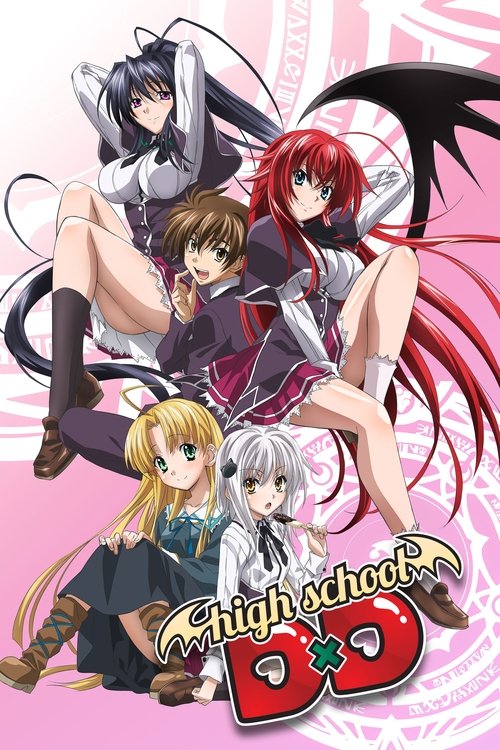
High School D×D follows Issei Hyodo, a perverted but good-natured high school student whose dream is to become a "Harem King." His life takes a drastic turn when his first-ever girlfriend brutally kills him on their date, revealing herself to be a fallen angel. He is promptly resurrected by Rias Gremory, a beautiful, high-ranking devil and the school's idol, who makes Issei a member of her devil household. Now bound to serve her, Issei must navigate a new, dangerous world hidden from ordinary humans.
Across four seasons, Issei trains to master his newfound demonic powers and the legendary sacred gear within him, the Boosted Gear, which houses the spirit of a powerful Welsh Dragon named Ddraig. Alongside the other members of the Occult Research Club—Rias's peerage—he battles against fallen angels, rogue devils, and angels, who are all vying for power and control. The series blends intense action, slapstick comedy, and a surprising amount of world-building based on various mythologies. As Issei grows stronger, his simple desire to protect his friends and his master, Rias, evolves into a crucial role in maintaining the fragile peace between the supernatural factions.
Core Meaning
At its core, High School D×D explores the idea that one's origins and inherent nature do not define their destiny or worth. Issei, initially driven by simplistic and lecherous desires, gradually transforms into a genuine hero who commands respect through loyalty and self-sacrifice. The series posits that true power comes not from birthright or demonic rank, but from the bonds forged with others and the will to protect what one holds dear. It deconstructs traditional notions of good and evil, presenting angels, devils, and fallen angels as complex political factions with their own virtues and flaws, suggesting that morality is a matter of action and intent rather than supernatural alignment. The journey is a testament to personal growth and finding a noble purpose in the most unexpected of circumstances.
Thematic DNA
Power and Ambition
The pursuit of power is a central theme, though motivations vary wildly. Issei's initial ambition is the comical and superficial goal of becoming a 'Harem King,' which serves as his primary drive to become stronger. However, this evolves into a genuine desire to protect his friends. Other characters, like Rias, seek power to secure their freedom and protect their household, while villains crave it for domination or destruction. The series constantly questions what one does with power and whether the ends justify the means.
Friendship and Loyalty
The bonds between the members of the Occult Research Club form the emotional bedrock of the series. Issei's transformation from a lone pervert to the heart of a powerful and loyal team is a key arc. The concept of Rias's 'peerage,' modeled after chess pieces, institutionalizes this theme, turning servitude into a familial bond built on trust and mutual protection. Battles are often won not by individual strength, but by the coordinated efforts and unwavering support the characters have for one another.
Redemption and Self-Discovery
Many characters grapple with their pasts and identities. Kiba seeks revenge for his fallen comrades, Akeno struggles with her mixed heritage as a devil and fallen angel, and Asia Argento must reconcile her faith after being cast out by the Church. Issei's journey is the most prominent, as he discovers there's more to him than his perverted nature, finding courage and a noble purpose. The series suggests that anyone, regardless of their past sins or perceived flaws, can strive for a better future and redefine who they are.
Deconstruction of Morality
High School D×D subverts traditional religious dichotomies. Devils can be honorable and kind, while angels can be rigid and ruthless. The three factions—Angels, Devils, and Fallen Angels—are portrayed as political entities with complex histories and internal conflicts, rather than absolute forces of good and evil. This moral ambiguity forces characters and the audience to judge individuals based on their actions and character rather than their species or affiliation.
Character Analysis
Issei Hyodo
Yuki Kaji
Motivation
Initially, his motivation is purely carnal: to become a "Harem King." This simple, comical goal serves as a catalyst for him to gain power. However, his motivation quickly evolves. The core driver of his actions becomes the fierce, unwavering desire to protect Rias from her arranged marriage and, later, to protect all his friends and family from the numerous threats they face. His perverted desires often become a comedic source for his power-ups, linking his base instincts to his heroic feats.
Character Arc
Issei begins as a comically perverted and weak high schooler whose primary goal is to have a harem. After his reincarnation as a devil, his arc is one of exponential growth. Initially driven by his desire to protect Rias and his new friends, he slowly transforms from a liability into the group's powerhouse. He learns to master the Boosted Gear, unlocking powerful forms like the Scale Mail and confronting his inner demons. Over the seasons, while retaining his perverted nature, he matures emotionally, becoming a reliable leader who inspires loyalty and is willing to sacrifice everything for those he cares about.
Rias Gremory
Yoko Hikasa
Motivation
Her primary motivation is freedom—both for herself from unwanted political marriages and for her peerage to live happily. She carries the immense pressure of the Gremory family name and wishes to be seen for who she is, not just her title. Her love for Issei becomes a central motivation, as he is the first person to see her simply as 'Rias' rather than a high-ranking noble.
Character Arc
Rias is introduced as a confident, powerful, and kind master to Issei, the heir to the esteemed Gremory devil clan. Her initial arc revolves around her desperation to escape an arranged marriage to Riser Phenex, seeing Issei as her potential key to freedom. After Issei saves her, her character arc shifts to her developing genuine romantic feelings for him. She learns to shed her formal 'master' persona and reveal a more vulnerable, age-appropriate side. She grows from being Issei's protector into his partner, learning to trust in his strength and standing by him as an equal.
Akeno Himejima
Shizuka Itoh
Motivation
Her early motivation is to serve Rias, her best friend who saved her from persecution. However, her deeper, underlying motivation is to find self-acceptance. Her seemingly flirtatious and sadistic personality is a coping mechanism for her internal conflict. As she develops feelings for Issei, her motivation also includes finding a place where she is loved for who she truly is, including the parts of herself she despises.
Character Arc
Akeno is initially presented as the Occult Research Club's second-in-command, a graceful and gentle beauty with a hidden sadistic streak. Her main arc revolves around confronting her painful past and mixed heritage as the child of a fallen angel and a human. She harbors deep resentment towards her father and is ashamed of her fallen angel side. Throughout the series, with Issei's help and encouragement, she learns to accept both halves of herself, finally embracing her full power and reconciling with her father. This allows her to move past her trauma and pursue her own happiness.
Asia Argento
Azumi Asakura
Motivation
Asia's core motivation is to love and be loved. Having been abandoned and betrayed, her greatest desire is to have a family and a place where she belongs. She is fiercely devoted to Issei, who was the first person to show her kindness and treat her like a normal girl. Her actions are almost always driven by her desire to help and heal others, even at great personal risk.
Character Arc
Asia is introduced as a gentle, devout nun who is exiled by the Church for her ability to heal devils and fallen angels. After being killed and resurrected as a devil by Rias, her arc focuses on finding a new sense of belonging and family. She struggles with the fact that, as a devil, she can no longer pray to God. Over the seasons, she grows more confident and assertive, becoming the emotional support of the group. While remaining kind and innocent, she develops a strong will and the courage to fight alongside her friends, proving that kindness is its own form of strength.
Symbols & Motifs
Chess Pieces (Evil Pieces)
The Evil Pieces, modeled after chess pieces (King, Queen, Rook, Bishop, Knight, Pawn), symbolize hierarchy, strategy, and the unique value of each individual within a team. A devil's peerage is a reflection of their leader's judgment and ability to cultivate diverse talents. For Issei, being a Pawn initially signifies his weakness, but his ability to 'promote' to any other piece in enemy territory symbolizes his limitless potential for growth.
The system is introduced in the first season when Rias explains that she used her Pawns to reincarnate Issei. Throughout the series, the roles and abilities associated with each piece are central to the strategy in Rating Games (official devil competitions) and real battles. The composition of Rias's peerage and how she utilizes each member's unique skills is a recurring strategic element.
Dragons
Dragons, particularly the two Heavenly Dragons, Ddraig and Albion, represent overwhelming, primal power that exists outside the established hierarchy of angels and devils. They symbolize raw ambition and eternal rivalry. For Issei, hosting Ddraig within his Sacred Gear (the Boosted Gear) symbolizes his potential to disrupt the world's balance of power and become a being of immense strength, capable of killing gods.
Ddraig's consciousness resides within Issei's arm, acting as both a source of power and a mentor. His rivalry with the Vanishing Dragon, Albion (hosted by Issei's rival, Vali Lucifer), is a major plot driver across all seasons, leading to several fated and destructive confrontations. Issei's ultimate forms, like the Juggernaut Drive and Diabolos Dragon, are manifestations of this draconic power.
Wings
Wings are a direct visual representation of a character's species and status. Devil wings are bat-like, angel wings are feathery and white, and fallen angel wings are black. The appearance and number of wings denote power and rank. Akeno's single devil wing and single fallen angel wing symbolize her conflicted heritage, a source of deep personal shame that she must learn to accept.
Wings are used for flight and are a common feature in battle. Issei's initial inability to fly and his subsequent pride in manifesting his own devil wings mark a significant step in his development. Akeno's struggle with her heritage is a key part of her character arc, particularly in the second season, culminating in her acceptance of both sides of her lineage.
Episode Highlights
I'm Done Being a Human!
The first episode establishes the series' unique blend of comedy, ecchi, and supernatural horror. It introduces Issei Hyodo, his perverted nature, and his shocking death at the hands of his first girlfriend, Yuma Amano (the fallen angel Raynare). His subsequent resurrection by Rias Gremory sets the entire plot in motion.
This episode is the foundational block for the entire series. It introduces the core concepts of devils, fallen angels, and reincarnation, immediately establishing the stakes and the central conflict of Issei's new life.
I'm Picking a Fight!
The climax of the first season. Issei, having trained relentlessly, challenges the nigh-invincible Riser Phenex to a one-on-one duel to save Rias from their arranged marriage. By sacrificing his arm to Ddraig for a temporary burst of immense power, Issei manages to defeat Riser in a dramatic and emotional battle.
This is Issei's first true moment as a hero. It solidifies his devotion to Rias, proves his potential for growth, and establishes the series' central romance. His victory fundamentally changes his relationship with Rias from master-servant to genuine partners.
Go, Occult Research Club!
The Occult Research Club faces off against the powerful fallen angel leader Kokabiel, who threatens to start another great war between the three factions. The episode features intense team combat and reveals shocking truths about the death of God in the previous war.
This episode significantly expands the world-building and lore, revealing the fragile state of the celestial power balance. It also marks a turning point where the threats become much larger in scale, moving beyond personal conflicts to world-altering events.
Clash of the Twin Sky Dragons!
The leaders of the three factions (devils, angels, and fallen angels) meet for a peace summit, which is attacked by the Khaos Brigade. The episode culminates in the first major confrontation between the two Heavenly Dragons: Issei (Ddraig) and Vali Lucifer (Albion).
This episode is pivotal for establishing Issei's long-term rival, Vali, and introducing the overarching antagonists of the series, the Khaos Brigade. It elevates the conflict to a new level, showcasing the immense power of the Heavenly Dragons.
Any Time, For All Time!
Issei unleashes the incomplete Juggernaut Drive, a terrifying and self-destructive transformation, after witnessing what he believes to be Asia's death. He becomes an uncontrollable monster of pure power, forcing Rias and the others to risk everything to bring him back from the brink by communicating with him through the power of her breasts.
This episode showcases the terrifying depths of Issei's power and the strength of his bond with the girls. It's a dramatic climax that highlights both his immense potential and the dangerous nature of the dragon sealed within him. However, this arc deviates significantly from the light novel source material.
Lion Heart of the School Festival
The culmination of the fourth season, where Issei faces Sairaorg Bael in a highly anticipated Rating Game. The fight is brutal and pushes both combatants to their absolute limits. Issei must unlock a new power, the Cardinal Crimson Promotion, to win. The episode also features Issei finally confessing his love to Rias and calling her by her name for the first time.
This episode represents a major milestone in Issei's character development, both as a fighter and as a person. His confession to Rias is the payoff to a romantic arc built over four seasons, fundamentally evolving their relationship and marking his maturation.
Philosophical Questions
What is the true nature of good and evil?
The series consistently challenges the traditional definitions of good and evil associated with its mythological figures. The devils, led by Sirzechs Lucifer, are shown to be an organized society that values order and the well-being of its citizens. The angels can be dogmatic, and the fallen angels are a mixed group of renegades and researchers. The primary antagonists are often extremists from any of these factions who threaten the established peace. The series explores the idea that morality is defined by one's actions and principles, not by the label one is born with.
Can a person's initial, selfish desires lead to selfless, heroic outcomes?
Issei's entire character arc is an exploration of this question. His quest for power begins with the shallow and selfish goal of becoming a 'Harem King'. However, to achieve this, he must become strong enough to protect the women he cares about. This need for strength forces him into heroic situations where he repeatedly chooses to risk his life for others. The series suggests that the origin of one's motivation is less important than how that motivation evolves and what actions it inspires. Issei's base desires are a catalyst for his journey toward genuine heroism.
Does destiny define an individual, or does an individual define their destiny?
Many characters are born into roles with heavy expectations—Rias as the heir of the Gremory clan, Vali as the descendant of the original Lucifer, and Issei as the host of the Welsh Dragon. The series follows their struggles against these pre-defined paths. Rias fights an arranged marriage to choose her own partner. Issei, a seemingly ordinary human, rises to a level of power capable of challenging gods. The narrative champions the idea that through will, effort, and the bonds with others, one can break free from the constraints of their lineage and forge their own destiny.
Alternative Interpretations
While High School D×D presents itself as a straightforward action-harem series, some alternative readings exist. One interpretation views the series as a satire of shonen power fantasies. Issei's perverted nature and his 'Harem King' dream can be seen as a parody of the typical male protagonist's desire for power and recognition, grounding his epic abilities in comically mundane and lecherous motivations. His power-ups, often triggered by sexual stimuli, could be interpreted as a commentary on the genre's tendency to link male power with female affection.
Another perspective focuses on the political allegory within the celestial conflict. The uneasy truce and complex diplomacy between the angels, devils, and fallen angels can be read as a metaphor for real-world geopolitics. The factions are not monolithic forces of good and evil but complex societies with internal power struggles, extremist factions (like the Khaos Brigade), and a desire for self-preservation. This interpretation suggests the story is less about a battle between heaven and hell and more about the challenges of maintaining peace and balance in a world with multiple competing superpowers.
Cultural Impact
High School D×D emerged as a prominent and highly popular series within the ecchi, harem, and supernatural action genres of the 2010s. Its success helped solidify a formula that blended extensive fan service with a surprisingly deep and intricate plot, influencing subsequent works in the genre. The series doesn't shy away from its ecchi elements; in fact, it often integrates them directly into the plot and power system, which was a notable aspect of its identity.
Critically, the reception was often divided. Mainstream critics were sometimes put off by the overt sexual content, while anime-centric reviewers often praised the series for its engaging action sequences, compelling character development (particularly for Issei), and extensive world-building that draws from Christian, Norse, and other mythologies. The first two seasons were generally well-received for their relatively faithful adaptation of the light novels. The third season, BorN, became controversial among fans for its significant deviations from the source material, which led to a studio change for the fourth season, Hero. Season 4 was praised by novel readers for returning to the canon storyline and adopting an art style closer to Miyama-Zero's original illustrations, though the change in visual style was jarring for some anime-only viewers.
In pop culture, characters like Rias Gremory have become iconic and are frequently subjects of cosplay and fan art. The series has maintained a dedicated fanbase, largely due to the continuation of the story in the light novels long after the anime's last season. Its legacy lies in its ability to be both a self-aware, comedic ecchi series and a serious fantasy epic, proving that a show can successfully cater to multiple audience desires without sacrificing a coherent and engaging narrative.
Audience Reception
Audience reception for High School D×D has been largely positive, particularly among fans of the action, harem, and ecchi genres. The series is frequently praised for having a more engaging and developed plot than is typical for its genre, with many viewers noting that they "came for the fan service, but stayed for the story." The character development, especially of the protagonist Issei Hyodo, is often highlighted as a major strength; his evolution from a simple-minded pervert to a genuinely caring and powerful hero resonates with many viewers.
The first two seasons, High School D×D and New, are generally considered to be strong adaptations. However, the third season, BorN, was met with significant criticism from light novel readers for its major deviations from the source material and its anime-original ending, which skipped and altered key plot points. The fourth season, Hero, was praised by fans of the novels for retconning the end of BorN and faithfully adapting the original story. However, the drastic change in art style due to the switch in animation studios from TNK to Passione was a point of contention, with some viewers preferring the older designs while others appreciated the new style's closer resemblance to the light novel illustrations. Despite these issues, the series maintains a strong and loyal fanbase.
Interesting Facts
- The series is based on a light novel series written by Ichiei Ishibumi and illustrated by Miyama-Zero.
- The author, Ichiei Ishibumi, originally did not plan for Issei to be a perverted character; this trait was added at the suggestion of his editor.
- Rias Gremory was not initially planned to be a character in the series. The story would have been significantly different without its main heroine.
- The third season of the anime, High School DxD BorN, significantly deviated from the light novel's plot, leading to dissatisfaction from the author and fans. It adapted parts of volumes 5, 6, and 7 but created an anime-original ending.
- The change in animation studio from TNK (Seasons 1-3) to Passione (Season 4) was partly due to the author's desire for the anime to adhere more closely to the source material's art style and plot.
- The name of Rias's family, Gremory, is taken from the Ars Goetia, a 17th-century grimoire, which describes a duke of Hell who appears as a beautiful woman.
- The character Azazel was originally intended to be a major villain before being repurposed into a mentor figure for Issei and the club.
⚠️ Spoiler Analysis
Click to reveal detailed analysis with spoilers
Frequently Asked Questions
Explore More About This Movie
Dive deeper into specific aspects of the movie with our detailed analysis pages
Comments (0)
No comments yet. Be the first to share your thoughts!