
Skip to content
My Name
A rain-soaked crime noir of blood-bound retribution and fractured trust, where a grieving daughter transforms into a venomous blade, carving through neon-drenched shadows and deadly deceit to unmask the monster who slaughtered her world.
My Name

My Name

마이 네임

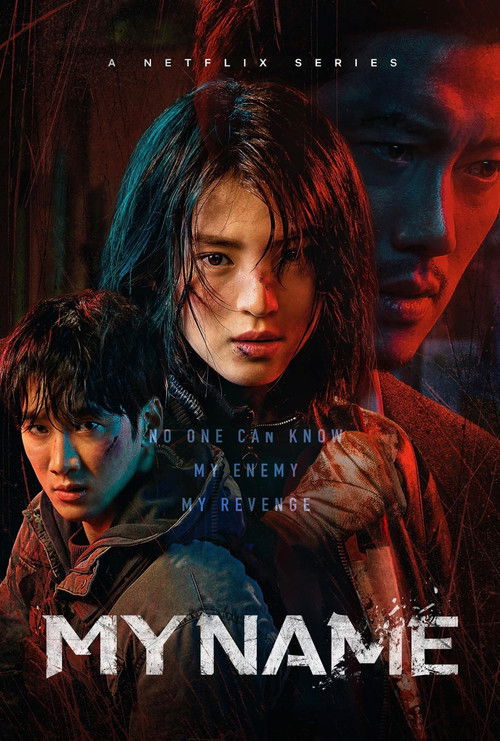
"No one can know. My enemy, my revenge."

15 October 2021 — 15 October 2021 South Korea 1 season 8 episode Ended 8.2 (1,071)

Cast: Han So-hee, Park Hee-soon, Ahn Bo-hyun, Kim Sang-ho, Lee Hak-ju

Drama Crime Mystery Vengeance as Self-Destruction Identity, Names, and Duality Twisted Mentorship and Manipulative Trust Solitude vs. Human Vulnerability The Arbitrary Border of Legality and Morality

Overview

My Name is an eight-episode South Korean action-crime noir miniseries that chronicles the relentless journey of Yoon Ji-woo (Han So-hee), a seventeen-year-old high school student whose life is shattered when her father, Yoon Dong-hoon, is brutally murdered in front of her apartment door. Abandoned by an indifferent police force unwilling to investigate a suspected gangster's death, Ji-woo pledges her life to extrajudicial vengeance. She seeks help from Choi Mu-jin (Park Hee-soon), the enigmatic and lethal kingpin of Dongcheon, Korea’s largest drug cartel and her father’s former associate.

Taking Ji-woo into his fold, Mu-jin subjects her to brutal physical combat training in Dongcheon’s illegal underworld gym. Under Mu-jin’s direction, Ji-woo sheds her identity, assumes the alias "Oh Hye-jin," and infiltrates the police force as a mole for the cartel. Five years later, she earns a transfer to the elite Drug Investigation Unit led by Team Leader Cha Gi-ho (Kim Sang-ho) and partnered with principled detective Jeon Pil-do (Ahn Bo-hyun).

Operating on a knife's edge between gang loyalty and police investigations, Ji-woo uses her position to hunt down the police officer Mu-jin claims killed her father. However, as narcotics raids escalate and hidden truths surface, Ji-woo discovers that the boundaries between protector and murderer, ally and enemy, are built upon a foundation of absolute deception.


Core Meaning

The core message of My Name is that vengeance is a parasitic force that strips away humanity, identity, and moral agency, turning the avenger into the very monster they seek to destroy. Through Ji-woo's trajectory, the creators illustrate how trauma can be weaponized by manipulative figures who prey on vulnerability under the guise of paternal care.

Furthermore, the title My Name highlights the tragic loss and ultimate reclamation of self. Ji-woo loses her youth, her future, and her birth name to live a lie imposed by a sociopathic criminal boss. The series demonstrates that breaking free from cycles of violence requires stripping away false aliases and confronting devastating truths, even when the ultimate cost is total emotional isolation.

Thematic DNA

Vengeance as Self-Destruction 30%
Identity, Names, and Duality 25%
Twisted Mentorship and Manipulative Trust 20%
Solitude vs. Human Vulnerability 15%
The Arbitrary Border of Legality and Morality 10%

Vengeance as Self-Destruction

Revenge is depicted not as a righteous triumph, but as a slow suicide. Ji-woo explicitly abandons her future to become a weapon. As the series progresses, her obsession destroys every genuine human bond she touches, culminating in the tragic loss of Pil-do and forcing her to become a cold-blooded killer.

Identity, Names, and Duality

The series revolves around lived lies and stolen identities. Ji-woo moves from Yoon Ji-woo to Oh Hye-jin, and finally to Song Ji-woo. Similarly, her father lived a double life as a cop (Song Joon-soo) and a gangster (Yoon Dong-hoon). The show examines how living undercover erodes one's internal compass until the boundary between the mask and the true self dissolves.

Twisted Mentorship and Manipulative Trust

The dynamic between Choi Mu-jin and Ji-woo explores toxic power dynamics. Mu-jin acts as a surrogate father while harboring the monstrous secret that he murdered her real father. His demand for total loyalty juxtaposed with his constant betrayal of those who serve him underscores the delusional nature of mob authority.

Solitude vs. Human Vulnerability

Throughout the series, isolation is presented as an armor against pain. Ji-woo’s emotional fortress begins to crack only when Detective Pil-do offers unconditioned empathy, teaching her that showing pain and trusting another person is essential to remaining human.

The Arbitrary Border of Legality and Morality

My Name blurs the line between police operations and criminal cartels. Both police team leader Cha Gi-ho and mob boss Choi Mu-jin sacrifice individuals as expendable pawns for their grand strategy, revealing a systemic corruption of ethics on both sides of the law.

Character Analysis

Yoon Ji-woo / Oh Hye-jin

Han So-hee

Archetype: Avenger / Tragic Antiheroine Key Trait: Relentless resilience and high physical pain tolerance.

Motivation

Initially to kill her father’s murderer; later evolves into uncovering the truth of her identity and surviving the web of lies spun around her.

Character Arc

Transforms from a traumatized, bullied high school student into a lethal gang fighter, then into a stoic undercover narcotics cop, and finally into a soul-bare avenger who slays her mentor.

Choi Mu-jin

Park Hee-soon

Archetype: Corrupt Mentor / Sociopathic Dark Father Figure Key Trait: Cold, calculated ruthlessness paired with an intense obsession with loyalty.

Motivation

Protecting his drug empire while enforcing absolute, unyielding loyalty from those he considers his own.

Character Arc

Functions as a charismatic savior and cartel leader who grooms Ji-woo, but descends into unhinged jealousy and paranoia as his web of deception unravels.

All 5 characters and cast

Symbols & Motifs

The Police-Issued Switchblade / Knife

Meaning:

Symbolizes false clues, bloodlines, and the cruel irony that the weapon given to her by Mu-jin to find the killer was supplied by the killer himself.

Context:

The weapon used to kill Ji-woo's father, serving as the primary catalyst for her investigation.

Names, Police Badges, and Identification Cards

Meaning:

Physical IDs represent the suppression of true selfhood, while the final tombstone showing "Song Ji-woo" symbolizes the ultimate reclamation of her father's true bloodline and identity.

Context:

Used throughout her time operating under the Oh Hye-jin police badge and false police records.

Choi Mu-jin’s Zippo Lighter and Smoke

Meaning:

Signals looming menace, authority, and calculated execution. It is a motif associated with his calm, sociopathic demeanor right before unleashing extreme violence.

Context:

Featured in recurring scenes whenever Mu-jin prepares to order or execute violence.

Boxing Gloves and Wrapped Hands

Meaning:

Symbolizes physical pain as a coping mechanism. Her physical scars replace her emotional agony, reflecting her metamorphosis into a combatant.

Context:

Seen during Ji-woo’s hand-wrapping routine and training sessions at Dongcheon's illegal gym.

The Framed Black-and-White Photograph

Meaning:

Embodies twisted nostalgia, obsession, guilt, and betrayal. It serves as a visual reminder of the bond Mu-jin destroyed and his toxic attachment to Dong-hoon's memory.

Context:

Kept displayed inside Mu-jin's private office, depicting himself and Dong-hoon.

The Beach and Sea Horizon

Meaning:

Symbolizes short-lived peace, emotional cleansing, and the life Ji-woo could have had if she chose love over revenge.

Context:

Appears in Episode 8 at Pil-do's seaside retreat.

Memorable Quotes

멈추기에는 이미 늦었습니다.
— Yoon Ji-woo (Han So-hee)

Context

Episode 4, as she reiterates her commitment to her undercover assignment despite rising danger.

Meaning

Marks Ji-woo's total point-of-no-return when committing herself to undercover gang operations.

아빠 죽인 새끼 잡겠다고 미래도 이름도 다 버렸어.
— Yoon Ji-woo (Han So-hee)

Context

Episode 7, during her high-stress confrontation while realizing her identity has been completely erased.

Meaning

Concise summary of the entire series' narrative premise and character drive.

All 6 quotes

Episode Highlights

Episode 1

S1E1

High schooler Ji-woo witnesses her father shot through the apartment door peephole. Police abandon the investigation, leading Ji-woo to confront Choi Mu-jin.

Significance:

Sets up the revenge engine, Ji-woo's isolation, and her alliance with Dongcheon.

Episode 2

S1E2

Ji-woo trains at Dongcheon's fighting gym, defeats Do Kang-jae in the ring, survives an attempted assault, and is given the new police identity "Oh Hye-jin" by Mu-jin.

Significance:

Completes her physical metamorphosis into a fighter and initiates her undercover police career.

Episode 4

S1E4

Hye-jin participates in a high-stakes police raid against Dongcheon, managing to covertly save Mu-jin while keeping her dual identity hidden from her new partner, Jeon Pil-do.

Significance:

Establishes the intense suspense of her mole status within the Narcotics unit.

Episode 7

S1E7

Team Leader Cha Gi-ho is critically injured. Before slipping into a coma, he hands Ji-woo evidence revealing that her father was actually an undercover cop (Song Joon-soo) and that Choi Mu-jin murdered him.

Significance:

The central narrative twist; shatters Ji-woo's world and redirects her revenge directly toward Mu-jin.

Episode 8

S1E8

Pil-do convinces Ji-woo to pursue legal justice, and they share an intimate night at his seaside home. Moments later, Mu-jin assassinates Pil-do. A rage-consumed Ji-woo single-handedly slaughters Dongcheon’s forces and slays Mu-jin in a knife fight before visiting her father’s and Pil-do’s graves under her true identity, Song Ji-woo.

Significance:

Wraps up all character arcs in a bloody climax, highlighting the devastating cost of vengeance.

Philosophical Questions

Is revenge ever worth the absolute destruction of the avenger's humanity?

The show demonstrates how hate hollows out the soul until the avenger becomes indistinguishable from their enemy.

What defines true identity—a birth name, an alias, or one's personal choices?

Through Ji-woo's multiple names, the series asks whether identity is an external label assigned by authority or an internal truth.

Can genuine affection exist within a dynamic built entirely on lies and manipulation?

Mu-jin’s dark mentorship questions whether twisted care can exist alongside deceit.

Is extrajudicial violence justified when state institutions fail to protect the innocent?

The narrative examines the failure of the justice system, forcing Ji-woo to choose between legal inaction and personal violence.

Alternative Interpretations

The "Twisted Fatherly Attachment" Reading: Some viewers and critics interpret Choi Mu-jin's relationship with Ji-woo as genuinely affection-driven, albeit through a sociopathic lens. In this view, Mu-jin killed her father for betraying their gang brotherhood, but trained Ji-woo because he wanted her to become a "monster like him," ensuring he would no longer be alone in the dark.The "Empty Victory...

Full ending explanation

Cultural Impact

Released in October 2021, My Name arrived during a global wave of interest in Korean Netflix Originals following Squid Game. Positioned as a dark action noir, the show broke away from traditional K-drama tropes by featuring a female lead in a role typically dominated by male actors in Korean cinema.

The show shattered the submissive or purely romantic image of Han So-hee (who had previously starred in The World of the Married and Nevertheless), cementing her status as a viable action star. My Name charted in the Netflix Top 10 across more than 80 countries, demonstrating that global audiences eagerly embrace high-intensity, gritty Korean crime thrillers.

Audience Reception

Praised Aspects: Viewers and critics praised the exceptional, realistic fight choreography, kinetic stunt work, Han So-hee’s committed performance, Park Hee-soon’s charismatic portrayal of Choi Mu-jin, and the gritty visual style with a driving electronic music score.

Criticisms: Some critics noted a predictable central mystery (many viewers easily identified Mu-jin as the killer early on) and reliance on standard crime-noir tropes without deeply reinventing the genre.

Controversies: The sudden intimacy scene between Ji-woo and Pil-do in Episode 8 sparked debate among fans; director Kim Jin-min clarified it was meant to show Ji-woo briefly regaining her human warmth before the final fight.

Overall Verdict: A sleek, gripping 8-episode revenge noir that delivers punchy action and strong performances, solidifying its spot among Netflix Korea's standout thrillers.

Interesting Facts

  • Han So-hee gained 10 kilograms (22 lbs) of muscle weight through intensive weight training and martial arts practice to play an action-ready fighter.
  • The main cast spent nearly three months before shooting attending a professional stunt and action academy to perform almost all fight scenes without body doubles.
  • Actor Jang Ryul lost 10 kilograms (22 lbs) to achieve a gaunt, knife-like, menacing appearance for Do Kang-jae’s return.
  • Director Kim Jin-min previously directed the acclaimed dark teen-crime Netflix Original Extracurricular (2020).
  • My Name was selected to screen its first three episodes at the 26th Busan International Film Festival in October 2021 in the "On Screen" section.
  • Han So-hee reported that rigorous rehearsal and safety coordination ensured minimal injuries occurred during production despite the brutal look of the fights.

Easter Eggs

The Ep 1 Mystery Phone Call

Right after Dong-hoon asks Tae-ju to leave on the night of his murder, Tae-ju immediately makes a suspicious call, notifying Mu-jin of Dong-hoon's location.

Matching Black Motorcycle Attire

The assassin who shoots Dong-hoon wears an all-black leather jacket and helmet—the exact outfit Ji-woo later wears on undercover hits for Dongcheon, visually linking her to her father's killer before the twist is revealed.

Noir Film Homages

The multi-agent infiltration setup echoes Infernal Affairs (2002), the dark gang loyalty mirrors New World (2013), and the female-led action style pays homage to The Villainess (2017).

The Symbolic Lighter Click

Choi Mu-jin’s Zippo lighter produces a distinct metallic click right before major orders of violence, serving as an auditory harbinger of doom.

Gravesite Name Transition

In the final episode's cemetery scene, the memorial urn reads "Song Ji-woo" and "Song Joon-soo," confirming she has shed both "Yoon Ji-woo" and "Oh Hye-jin" to permanently reclaim her birth father's real family name.

Frequently Asked Questions

Explore More About This Movie

Dive deeper into specific aspects of the movie with our detailed analysis pages

Comments (0)

Leave a comment

No comments yet. Be the first to share your thoughts!

Similar Movies