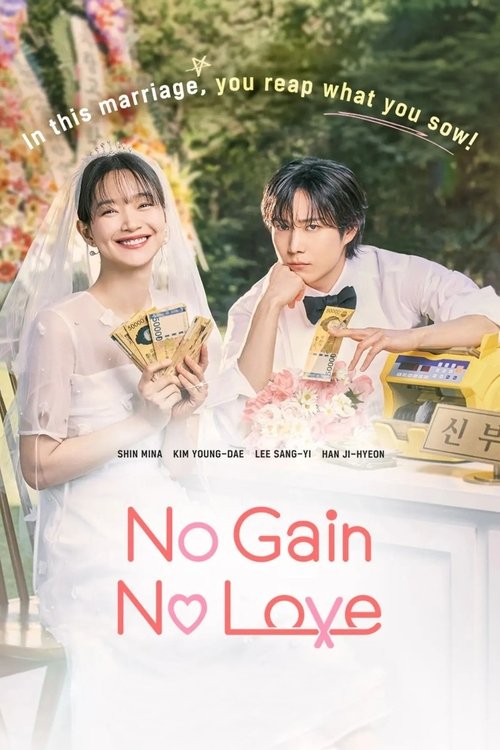
No Gain No Love
손해 보기 싫어서
"In this marriage, you reap what you sow!"
Overview
No Gain No Love is a 2024 romantic comedy that dissects the modern obsession with fairness and the avoidance of loss. The story follows Son Hae-yeong, a high-performing employee at Kkulbee Education who has lived her entire life by a strict emotional and financial balance sheet. To secure a long-awaited promotion—which is unofficially reserved for married women—and to reclaim the wedding gift money she has spent on others over the years, she decides to stage a fake wedding. Her unlikely partner in this charade is Kim Ji-uk, a mysterious and kind-hearted part-time worker at her neighborhood convenience store who is known for his inability to ignore those in need.
As the fake marriage progresses from a transactional agreement to a complex emotional entanglement, the series expands to include a rich ensemble of characters. This includes Bok Gyu-hyun, the cynical CEO of Hae-yeong’s company, and Nam Ja-yeon, a web novel author who writes under a pseudonym. The narrative moves beyond the office and the altar to explore the hidden scars of their pasts, including foster care dynamics and childhood traumas that shaped their current worldviews. Across its 12 episodes, the show balances slapstick comedy with poignant drama, ultimately questioning whether true happiness can ever be calculated.
Core Meaning
The core message of No Gain No Love is that love is the only "loss" worth taking. Through the journey of Son Hae-yeong, the series argues that while a calculative mindset can provide security and fairness, it also acts as a shield against genuine connection. The creators highlight that life is inherently "unfair" and that true growth comes from the willingness to be vulnerable and "suffer a loss" for the sake of another. It emphasizes that found family and emotional authenticity carry a value that cannot be quantified on a ledger or a corporate promotion track.
Thematic DNA
The Calculus of Relationships
The series explores the tension between emotional profit and loss. Hae-yeong views her life as a series of transactions, but her relationship with Ji-uk forces her to realize that some of the best moments in life come from giving without expecting an immediate return. This theme evolves from a literal focus on money (wedding gifts) to a metaphorical focus on emotional energy.
The Fluidity of Family
Through the foster-sister relationship between Hae-yeong, Ja-yeon, and Hui-seong, the show portrays family as a choice rather than a biological obligation. It delves into the complicated feelings of biological children feeling neglected by parents who foster others, eventually resolving into a beautiful depiction of a diverse, chosen support system.
Corporate Misogyny and Survival
The plot is grounded in the harsh reality of South Korean workplace culture, where single women are often disadvantaged. Hae-yeong’s decision to fake a marriage is a satirical and desperate response to systemic inequalities, highlighting how women must navigate archaic social expectations to succeed professionally.
Atonement and Hidden Trauma
As the series progresses, it uncovers layers of childhood trauma. Whether it is Ja-yeon’s abusive father or Ji-uk’s status as a hidden illegitimate son, the characters must confront their pasts to move forward. Love acts as a catalyst for this healing process, proving that sharing pain is the first step toward overcoming it.
Character Analysis
Son Hae-yeong
Shin Min-a
Motivation
Originally motivated by financial and professional security (winning a promotion/bonus). This evolves into a desire to protect her chosen family and find a place where she is the priority.
Character Arc
Hae-yeong begins as a hyper-calculative woman who views emotions through a loss-mitigation lens due to feeling neglected by her mother’s foster work. By the end, she learns to embrace the "loss" of self-sacrifice and finds peace with her mother’s legacy, transitioning from a solitary calculator to a warm, connected leader of her own family.
Kim Ji-uk
Kim Young-dae
Motivation
Driven by a sense of duty and kindness, often at his own expense. He eventually learns that his own happiness is a valid goal.
Character Arc
Ji-uk starts as a man who lives as a "promise" to others—hiding his identity and suppressing his own desires to avoid causing trouble. Through Hae-yeong, he finds the courage to claim his own life, eventually traveling the world and returning as a man who chooses his own path rather than following a script written by his family.
Bok Gyu-hyun
Lee Sang-yi
Motivation
Initially motivated by corporate image and self-preservation. Later, his sole focus becomes the safety and happiness of Nam Ja-yeon.
Character Arc
A chaebol CEO who hates the idea of marriage and writes hate comments on web novels. His arc involves a humbling transformation into a devoted lover who uses his power and resources to protect his partner, even at the cost of his own reputation.
Symbols & Motifs
The Convenience Store
Symbolizes the liminal space between strangers. It is a place where social hierarchies (office worker vs. part-timer) are flattened and where the protagonists' journey begins with a negotiation.
It serves as the primary setting for Hae-yeong and Ji-uk’s early interactions and the place where the fake proposal and the eventual real reunion occur.
Wedding Rings
Initially symbolizes transactional status and societal armor. Later, it represents genuine commitment and the shedding of pretenses.
Hae-yeong buys cheap rings for the fake wedding; in the finale, the removal and eventual return of the rings signify their choice to live for themselves rather than for others' expectations.
Jellies/Gummies
Symbolizes innocence and care. Ji-uk uses these small treats as a way to offer comfort without words.
Ji-uk’s convenience store proposal involves shelves of jellies, and they are frequently shared as a silent language of affection between the leads.
The 1+1 Promotion
A metaphor for partnership and mutual benefit. In marketing, it’s a gain; in life, it’s about finding a person who completes the equation.
Often referenced in the context of Hae-yeong's job at the education company and her view of the marriage as a "buy one, get one free" deal for her promotion.
Memorable Quotes
Hate is the giver's loss, not the receiver's.
— Son Hae-yeong
Context:
Episode 1, during a reflection on why she doesn't hold grudges despite her calculative nature.
Meaning:
Reflects her philosophy on emotional efficiency. She believes that holding onto negative emotions only hurts the person carrying them.
Go where you want to go, see who you want to see, and live as you wish to live.
— Son Hae-yeong
Context:
Episode 12, as she breaks up with Ji-uk to let him pursue his own life in Canada.
Meaning:
A pivotal moment of unselfish love. She releases Ji-uk from his "promises" to others, giving him the freedom she never had.
Just like you can like someone without loving them, you can love someone without liking them.
— Son Hae-yeong
Context:
A conversation with Ji-uk regarding her mother's dementia and fostering history.
Meaning:
Explains the complex resentment-filled love she feels for her mother, capturing the nuance of familial duty versus affection.
Episode Highlights
Loss is the Beginning of Gain
Introduces Hae-yeong's backstory and her "loss-prevention" lifestyle. The episode culminates in her drunken, business-like proposal to Ji-uk at the convenience store.
Sets the thematic foundation of the show and establishes the antagonistic-yet-curious chemistry between the leads.
The Most Beautiful Fake Wedding
The actual wedding ceremony takes place. Ji-uk undergoes a "makeover," revealing his striking looks, and the two share a surprisingly touching moment at the altar.
A tonal shift where the pretense begins to crack, and both characters realize their connection might be deeper than a contract.
The Husband Intern
Ji-uk is blackmailed into joining Hae-yeong’s company as an intern. Their secret marriage is accidentally revealed to the entire office during a chaotic confrontation.
Elevates the stakes from a personal secret to a corporate crisis, forcing the characters to protect each other in a professional setting.
The Farewell and the Return
The finale deals with the death of Hae-yeong's mother and the emotional fallout. Hae-yeong breaks up with Ji-uk to set him free, only for him to return months later as a man who chose her on his own terms.
Provides closure for the foster-family arc and solidifies the message that love is a choice, not a debt.
Philosophical Questions
Can a relationship built on profit ever truly become selfless?
The series explores this by showing that Hae-yeong and Ji-uk’s contract provided a safe boundary that allowed them to be more honest with each other than they were with anyone else, eventually turning professional honesty into emotional intimacy.
Is the avoidance of pain worth the sacrifice of connection?
Hae-yeong’s life is a case study in emotional hedging. The show concludes that while avoiding loss keeps you safe, it also keeps you empty, and that 'gaining' a life requires the 'loss' of total control.
Alternative Interpretations
Some critics have interpreted the ending not just as a romance, but as a parable of self-parenting. Hae-yeong's act of setting Ji-uk free is seen as her finally providing the 'selfless attention' to someone else that she felt she lacked from her mother, thereby healing her own inner child. Another reading suggests that the entire series is a satire of the institution of marriage, showing that a 'fake' marriage based on mutual respect and honesty is actually more successful than the 'real' marriages (like Hae-yeong's ex) which are built on infidelity and superficiality.
Cultural Impact
No Gain No Love resonated strongly with audiences for its realistic portrayal of office politics and societal pressure on single individuals in South Korea. It sparked discussions on 'Small Wedding' trends and the 'Single Person Tax' (the idea that single people miss out on corporate benefits). The series was praised for its feminist undertones, specifically its rejection of the 'passive heroine' trope. Internationally, it became a top-trending series on Amazon Prime Video, proving the global appeal of character-driven, mature K-dramas that balance humor with social commentary.
Audience Reception
The audience reception was overwhelmingly positive, particularly regarding the chemistry between Shin Min-a and Kim Young-dae, despite their real-life age gap. Viewers praised the 12-episode format for avoiding the 'mid-series slump' typical of longer K-dramas. While some found the birth-secret subplot involving the CEO’s family to be a bit cliché, the strong performances of the secondary couple (Lee Sang-yi and Han Ji-hyeon) provided a refreshing counter-balance that kept fans engaged until the very end. The show maintained a high rating on cable networks, often topping its time slot.
Interesting Facts
- The series marks the long-awaited return of Shin Min-a to the romantic comedy genre, earning her the title of 'Rom-Com Queen' once again.
- A two-episode spin-off titled 'Spice Up Our Love' was released shortly after the finale, focusing on the secondary couple (Lee Sang-yi and Han Ji-hyeon).
- Kim Young-dae replaced the originally cast actor Lee Jong-won due to scheduling conflicts.
- The screenwriter, Kim Hye-young, also wrote the popular rom-com 'Her Private Life'.
- Many scenes were filmed at actual convenience stores in Seoul, leading to a temporary boost in the sales of the specific snacks shown in the drama.
Easter Eggs
The 'Dildo-Saber' Battle
In a hilariously absurd scene in the final episodes, CEO Bok Gyu-hyun uses sex toys from a nearby box to fight off an attacker. It’s a meta-commentary on the show's willingness to embrace adult-themed humor while subverting typical action hero tropes.
The Convenience Store Cat
The cat named 'Baby' represents Ji-uk’s soft spot for the marginalized. His insistence that Hae-yeong care for the cat as part of their deal mirrors his own entry into her life as a 'stray' who needs a home.
⚠️ Spoiler Analysis
Click to reveal detailed analysis with spoilers
Frequently Asked Questions
Explore More About This Movie
Dive deeper into specific aspects of the movie with our detailed analysis pages
Comments (0)
No comments yet. Be the first to share your thoughts!