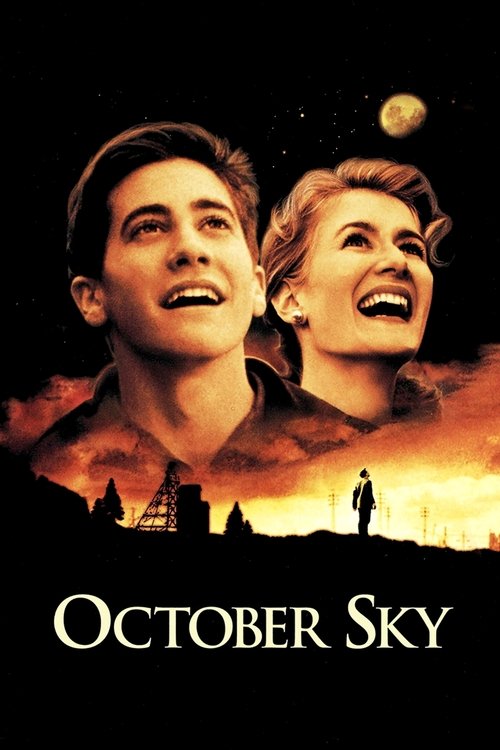
October Sky
An inspiring biographical drama bathed in the warm, rustic hues of autumn. A touching tale of youthful ambition defying gravity, where amateur rockets piercing a coal-dusted sky become a powerful metaphor for escaping a predetermined destiny.
October Sky

October Sky

"Sometimes one dream is enough to light up the whole sky."

19 February 1999 United States of America 107 min ⭐ 7.7 (1,394)
Director: Joe Johnston
Cast: Jake Gyllenhaal, Chris Cooper, Chris Owen, Laura Dern, William Lee Scott
Drama
The Pursuit of Dreams vs. Societal Expectations Father-Son Conflict and Generational Divide The Transformative Power of Education and Mentorship Perseverance and the Scientific Method
Budget: $25,000,000
Box Office: $34,698,685

Overview

In 1957, the launch of Sputnik 1 captures the imagination of the world, including Homer Hickam, a teenager living in the tight-knit but restrictive coal mining town of Coalwood, West Virginia. While most boys in Coalwood are expected to follow their fathers into the hazardous depths of the mines, Homer becomes captivated by the idea of building his own rockets.

Teaming up with his friends and guided by the unwavering support of their science teacher, Miss Riley, the newly formed "Rocket Boys" embark on a journey of trial and error. Their explosive experiments often draw the ire of the townspeople and local authorities, but their relentless determination pushes them to refine their designs, ultimately setting their sights on the National Science Fair.

However, Homer's greatest obstacle isn't rocket science, but his own father, John Hickam, a proud mine superintendent who views his son's celestial dreams as foolish and impractical. As Homer strives to perfect his rockets, he must navigate the deeply rooted expectations of his community and a complex, strained relationship with a father who fundamentally misunderstands him, making for an emotional narrative about forging one's own path.


Core Meaning

The film masterfully explores the clash between inherited tradition and personal ambition, illustrating that true potential cannot be confined by one's circumstances. Director Joe Johnston highlights the transformative power of education, mentorship, and perseverance.

The core message is that while one's roots and community provide a foundation, every individual has the right to look upward and define their own destiny. It speaks to the human spirit's desire to reach beyond its limitations—both literally, by breaking the bonds of Earth's gravity, and metaphorically, by escaping the gravitational pull of societal expectations and familial pressures.

Thematic DNA

The Pursuit of Dreams vs. Societal Expectations 35%
Father-Son Conflict and Generational Divide 25%
The Transformative Power of Education and Mentorship 20%
Perseverance and the Scientific Method 20%

The Pursuit of Dreams vs. Societal Expectations

This theme drives the narrative, pitting Homer's lofty goal of reaching space against the grounded, gritty reality of Coalwood. The town functions as an ideological cage where the boys are predetermined to become coal miners, highlighting the courage required to break free from the status quo.

Father-Son Conflict and Generational Divide

The strained relationship between Homer and his father, John, serves as the emotional core of the film. It represents the clash between old-world, working-class practicality and the new-world optimism of the Space Age, illustrating the painful but necessary process of generational evolution.

The Transformative Power of Education and Mentorship

Through the character of Miss Riley, the film underscores how critical a supportive teacher can be in changing a student's trajectory. Her belief in the boys equips them not only with scientific knowledge but with the self-worth needed to challenge their perceived destinies.

Perseverance and the Scientific Method

The boys' journey is marked by numerous explosive failures. The film champions the scientific method—testing, failing, calculating, and trying again—as a powerful metaphor for resilience and problem-solving in life.

Character Analysis

Homer Hickam

Jake Gyllenhaal

Archetype: The Dreamer / Hero
Key Trait: Unwavering perseverance

Motivation

To escape the inevitable fate of the coal mines, prove his intellectual worth to his skeptical father, and contribute to the dawning Space Age.

Character Arc

Homer evolves from a directionless teenager seemingly destined for the coal mines into a determined, self-taught amateur rocket engineer who discovers his own voice and learns to stand up to his father's imposing will.

John Hickam

Chris Cooper

Archetype: The Stern Patriarch / Threshold Guardian
Key Trait: Stubborn practicality

Motivation

To provide for his family, protect his sons from false hopes, and maintain the legacy and functionality of the coal mine that sustains the town.

Character Arc

He starts as a stubborn, traditionalist mine superintendent who expects his sons to follow his path. He gradually, albeit reluctantly, comes to respect Homer's dedication and ultimately accepts and supports his son's different trajectory.

Miss Riley

Laura Dern

Archetype: The Mentor
Key Trait: Nurturing inspiration

Motivation

To nurture the potential within her 'unlucky' students and give them the educational tools to achieve greatness beyond the borders of Coalwood.

Character Arc

She remains a steadfast beacon of encouragement throughout the film, battling her own terminal illness while ensuring her students have the knowledge and courage to escape the town's limitations.

Quentin Wilson

Chris Owen

Archetype: The Intellect / Ally
Key Trait: Analytical brilliance

Motivation

To apply his vast scientific knowledge practically and secure a college scholarship to escape his impoverished background.

Character Arc

Begins as a socially awkward outcast mocked by his peers, but finds belonging, respect, and deep friendship through his vital role as the intellectual backbone of the Rocket Boys.

Symbols & Motifs

The Rockets (Auk Series / Miss Riley)

Meaning:

The rockets symbolize escape, ambition, and the soaring potential of youth. They are physical manifestations of the boys' intellect and determination rising above the darkness of their circumstances.

Context:

They are tested repeatedly at 'Cape Coalwood.' Their progression from explosive duds to sleek, high-flying projectiles mirrors the boys' own intellectual and emotional growth throughout the film.

The Coal Mine

Meaning:

The mine represents tradition, the inescapable weight of expectations, and the grueling, dangerous reality of the working-class life that threatens to bury the boys' futures.

Context:

It is a constant, looming presence both visually and narratively. The elevator descending into the dark pit sharply contrasts with the rockets ascending into the bright sky.

Sputnik 1

Meaning:

The satellite acts as the catalyst for change, symbolizing the spark of inspiration, the dawn of a new technological era, and the realization that the sky is no longer the limit.

Context:

It is seen in the opening act crossing the starry night sky as the entire town of Coalwood watches in awe, directly igniting Homer's obsession with rocketry.

The October Sky

Meaning:

It symbolizes clarity, the season of autumn (a time of transition), and the vast, limitless canvas upon which the boys can project their dreams.

Context:

Visually highlighted during the boys' successful launches, providing a bright, expansive blue backdrop that contrasts with the gray, suffocating dust of the mining town.

Memorable Quotes

Coal mining may be your life, but it's not mine. I'm never going down there again. I wanna go into space.

— Homer Hickam

Context:

Delivered during a heated, emotional argument with his father after Homer decides to quit his temporary job at the mine and return to school.

Meaning:

This is Homer's definitive declaration of independence. It marks the moment he fully rejects his father's expectations and firmly commits to his own dreams.

Sometimes you really can't listen to what anybody else says. You just gotta listen inside. You're not supposed to end up in those mines.

— Miss Riley

Context:

Spoken by Miss Riley from her hospital bed, comforting and encouraging a doubtful Homer to continue his work despite overwhelming obstacles.

Meaning:

A poignant piece of advice that encapsulates the film's core message of self-belief and intuition over societal conformity.

Let 'em have outer space. We got rock 'n' roll.

— Roy Lee

Context:

Said as the boys are looking up at the sky, discussing the Soviet Union's launch of Sputnik.

Meaning:

A humorous, culturally reflective line that captures the carefree attitude of 1950s youth, contrasting with the intense geopolitical stakes of the Cold War Space Race.

Miss Riley, once in a while... a lucky one... will get out on a football scholarship. The rest of 'em work in the mines. / How 'bout I believe in the unlucky ones? Hmm? I have to, Mister Turner, I'd go out of my mind.

— Principal Turner and Miss Riley

Context:

An argument in the school hallway regarding whether it is cruel to give the boys 'false hopes' about winning the science fair.

Meaning:

This exchange highlights the ideological conflict between the school administration's cynical pragmatism and Miss Riley's unwavering idealism and dedication to teaching.

Philosophical Questions

Does society have a moral obligation to foster the talents of its youth, even when those talents conflict with local economic needs?

The film contrasts Miss Riley's belief in nurturing intellectual potential against Principal Turner's and John Hickam's pragmatic view that the boys must eventually serve the immediate needs of the coal mine, questioning the balance between individual fulfillment and civic duty.

What constitutes meaningful work: providing tangible resources for the present, or pushing the boundaries of human knowledge for the future?

The ideological clash between John's deep pride in powering the nation with coal and Homer's desire to explore the cosmos via rocketry asks viewers to weigh the value of blue-collar foundational labor against pioneering scientific exploration.

Can individual ambition truly thrive without the foundation of a supportive community?

Despite Homer's fierce individual drive, the narrative demonstrates that his success relies heavily on the collective help of his friends, his teacher, the local machinist Bykovsky, and eventually the entire town of Coalwood, challenging the myth of the purely self-made man.

Alternative Interpretations

While October Sky is primarily viewed as a straightforward, uplifting biographical drama, some critics and scholars offer alternative readings of its themes and ideological undertones.

A Critique of Neoliberal Ideology: Some cultural analysts view the film through the lens of 1990s Third Way politics. In this interpretation, the film subconsciously champions neoliberal individualism—the idea that systemic economic decline (the dying coal industry) can be overcome purely through individual exceptionalism and merit (winning a science fair). This reading suggests the film glosses over the harsh realities of collective labor struggles, positioning Homer's escape as a personal triumph rather than addressing the broader tragedy of the trapped working class.

The Atonement with the Father: Viewed through Joseph Campbell's Hero's Journey, the film is less about rocketry and more about a psychological 'atonement with the father.' John Hickam is not merely an antagonist, but a pragmatic protector. His stubbornness is interpreted as an expression of love and realistic survival in a harsh world. Homer's ultimate launch of the 'Miss Riley' rocket, with his father watching, is not a victory over his father, but a synthesis of John's grounded work ethic and Homer's skyward ambition.

Cultural Impact

October Sky emerged at the turn of the millennium as a deeply resonant piece of Americana, tapping into the nostalgic zeitgeist of the late 1990s. Set against the backdrop of the 1957 Cold War space race, the film captured the tension between working-class traditionalism and the dawn of technological advancement.

Critically, the film was lauded for its earnest storytelling and was warmly received by audiences, earning an 'A' CinemaScore and a 90% on Rotten Tomatoes. It has since become a staple in educational settings, frequently shown in science and history classrooms to inspire students in STEM (Science, Technology, Engineering, and Mathematics) fields and to spark discussions about perseverance and the scientific method.

Culturally, the film cemented Jake Gyllenhaal as a rising star and Chris Cooper as a formidable character actor. Philosophically, it contributed to the broader discourse on the 'American Dream,' highlighting that true exceptionalism often comes from community support, mentorship, and individual resilience rather than sheer providence. Its legacy continues through the annual 'Rocket Boys Festival' held in West Virginia, celebrating the enduring true story that inspired the film.

Audience Reception

Audiences enthusiastically embraced October Sky for its heartfelt sincerity, labeling it a triumph of old-fashioned, inspirational filmmaking. The film boasts a high audience approval rating across platforms like Rotten Tomatoes (where it holds an 88% Popcornmeter score) and CinemaScore.

Praised Aspects: Viewers frequently highlight the emotional depth of the father-son dynamic, anchored by powerful performances from a young Jake Gyllenhaal and veteran actor Chris Cooper. The authentic production design, the evocative autumnal cinematography, and Mark Isham's soaring musical score are also widely praised for creating a deeply immersive 1950s Appalachian atmosphere.

Points of Criticism: Some critics and modern viewers note that the film occasionally leans heavily into Hollywood sentimentality and predictable coming-of-age tropes. A few historical purists and fans of the original memoir point out the simplification of the real 'Rocket Boys' and the manufactured dramatic tension regarding the stolen railroad equipment and the boys' brief arrest.

Overall Verdict: October Sky remains a beloved, feel-good classic. It is cherished as a moving testament to the power of education, the necessity of dreaming big, and the poignant complexities of family expectations.

Interesting Facts

  • The title 'October Sky' is an anagram of 'Rocket Boys,' the title of the Homer Hickam memoir the film is based on. The studio changed the title because market research suggested women over thirty would not go to see a movie called 'Rocket Boys.'
  • The real Homer Hickam's father was named Homer Hickam Sr., and Homer Jr. was nicknamed 'Sonny.' The film changed the father's name to John and used 'Homer' for the boy to avoid confusing the audience.
  • In the movie, Homer briefly spots his idol, Wernher von Braun, at the National Science Fair but doesn't realize who he is until he turns away. In reality, von Braun was actually looking for the boys' exhibit, but they missed each other entirely.
  • While there are four 'Rocket Boys' in the film, there were actually six in real life: Homer Hickam Jr., Quentin Wilson, Jimmy O'Dell Carroll, Roy Lee Cooke, Billy Rose, and Sherman Siers.
  • Although set in West Virginia, the movie was primarily filmed in rural East Tennessee, utilizing towns like Oliver Springs and Harriman to authentically replicate the look of a 1950s Appalachian coal mining community.

Easter Eggs

The real Homer Hickam's cameo

The real Homer Hickam makes a brief cameo appearance in the film as one of the coal mine workers, providing a subtle nod to the author of the original memoir.

The name of the final rocket: 'Miss Riley'

The boys name their ultimate, flawless rocket 'Miss Riley' as a tribute to their teacher. This references the real-life Freida Riley, who deeply inspired the boys and tragically passed away from Hodgkin's disease at the age of 31.

⚠️ Spoiler Analysis

Click to reveal detailed analysis with spoilers

Frequently Asked Questions

Explore More About This Movie

Dive deeper into specific aspects of the movie with our detailed analysis pages

Comments (0)

Leave a comment

No comments yet. Be the first to share your thoughts!