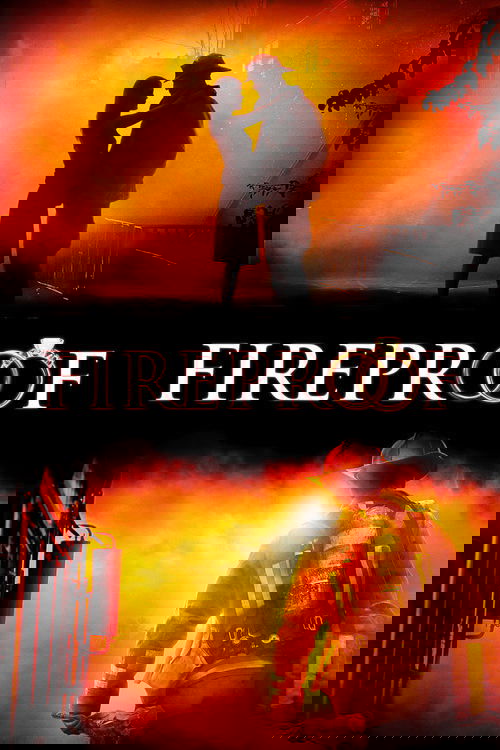
Fireproof
"Never leave your partner behind."
Overview
Caleb Holt is a heroic fire captain who strictly adheres to the old firefighter's adage: Never leave your partner behind. However, inside his own home, his seven-year marriage to Catherine is on the verge of collapse. Driven apart by constant arguments, Caleb's addiction to internet pornography, and his selfish desire to buy a $24,000 boat while Catherine's mother faces mounting medical bills, the couple reaches a breaking point. As Catherine prepares to file for divorce and begins receiving attention from a flirtatious doctor at her hospital, Caleb's father steps in with an unconventional request.
His father asks Caleb to delay the divorce proceedings for 40 days in order to complete The Love Dare, a daily guided journal designed to teach the principles of unconditional love. Initially, Caleb approaches the dare as a mere checklist, growing deeply frustrated when Catherine continually rejects his forced acts of kindness. It is only after a profound conversation with his father about the nature of grace that Caleb realizes he cannot truly love his wife without first receiving the unconditional love of God.
Upon dedicating his life to Christ, Caleb's motivations shift from selfish preservation to genuine sacrifice. He begins to fight for his wife's heart not out of obligation, but out of devotion. The film culminates in a powerful testament to forgiveness, showcasing how a seemingly unsalvageable relationship can be completely transformed when built upon a foundation of faith, selflessness, and mutual grace.

Core Meaning
The core message of Fireproof is that marriage is a sacred, lifelong covenant rather than a disposable contract. Director Alex Kendrick communicates that human effort alone is often insufficient to sustain love through deep trials and resentments. The film posits that true, enduring love is not merely a fleeting emotion, but an act of the will—a daily choice to sacrifice for one's spouse. Ultimately, the film asserts that a marriage can only become truly "fireproof"—able to withstand the inevitable fires of hardship and conflict—when it is grounded in a shared faith and the unconditional love of God.
Thematic DNA
The Covenant of Marriage vs. Casual Commitment
The film sharply contrasts the modern, secular view of marriage as a conditional contract with the biblical view of marriage as a lifelong covenant. Through the character of Michael, Caleb is reminded that wedding vows are meant for "better or worse," emphasizing that one cannot simply walk away when the relationship becomes difficult. The film argues that leaving divorce out of the vocabulary forces a couple to do the hard work of reconciliation.
Unconditional Love and Sacrifice
Caleb's character arc embodies this theme as he transitions from extreme selfishness to radical sacrifice. Initially hoarding money for a boat while his wife struggles to care for her ailing mother, Caleb ultimately embraces true love by secretly donating his entire $24,000 savings to purchase her mother's medical equipment. The film defines love not by what one receives, but by what one is willing to give up.
Faith as the Foundation of Transformation
A central tenet of the narrative is that Caleb fails at The Love Dare as long as he relies on his own strength. It is only after he accepts Christ that he finds the capacity to love a wife who continually rejects him. The film portrays a relationship with God as the necessary wellspring from which genuine marital love flows.
Forgiveness and Redemption
Both Caleb and Catherine must navigate the painful waters of forgiveness. Caleb must repent for his emotional neglect and pornography addiction, while Catherine must overcome her deep-seated bitterness and willingness to seek emotional intimacy outside the marriage with Dr. Keller. Their eventual reconciliation highlights the healing power of unmerited grace.
Character Analysis
Caleb Holt
Kirk Cameron
Motivation
Initially motivated by a desire to appease his father and quickly "fix" his marriage. Later, his motivation shifts to a genuine desire to honor God and sacrificially win back his wife's heart.
Character Arc
Caleb begins as an arrogant, self-centered husband who demands respect at home while neglecting his wife and indulging in internet pornography. Through the trials of The Love Dare, he confronts his own hypocrisy, accepts Christ, and transforms into a humble, fiercely devoted, and sacrificial husband.
Catherine Holt
Erin Bethea
Motivation
She desperately seeks to feel valued, respected, and emotionally supported, especially during the crisis of her mother's failing health.
Character Arc
Catherine starts as a deeply resentful, emotionally starved wife who is ready to abandon her marriage and is tempted by another man. Over the course of the film, as she witnesses Caleb's undeniable behavioral changes and immense sacrifice, her hardened heart slowly softens into forgiveness and renewed love.
Michael Simmons
Ken Bevel
Motivation
Motivated by his deep Christian faith and a brotherly love for Caleb, he wants to prevent his friend from making a catastrophic, life-altering mistake.
Character Arc
Michael remains a steadfast, morally grounded presence throughout the film. He acts as Caleb's conscience, continually challenging Caleb's secular views on marriage and guiding him toward spiritual maturity.
Symbols & Motifs
Fire
Represents the inevitable trials, conflicts, and crises that attack a marriage, as well as the destructive nature of unchecked anger and lust.
It is used literally in Caleb's profession as a heroic firefighter, and metaphorically throughout the dialogue. Michael explicitly uses it when he explains that a fireproof marriage isn't one that never sees fire, but one that can withstand it.
The Salt and Pepper Shakers
Symbolizes the permanent, unbreakable bond of the marriage covenant, where two distinct and different individuals are joined together as one flesh.
In a memorable scene, Michael superglues the firehouse's salt and pepper shakers together. When Caleb tries to pull them apart, Michael stops him, demonstrating that attempting to separate what has been permanently bonded will only break one or both of them.
The Boat
Represents Caleb's selfishness, misplaced priorities, and his emotional and financial isolation from his wife.
Caleb stubbornly guards his $24,000 savings to buy the boat, viewing it as his escape. The ultimate proof of his transformation occurs when he sacrifices the boat fund to anonymously pay for his mother-in-law's medical bed.
The Ring
Symbolizes the lifelong vow made before God and the active choice to honor one's spouse.
Michael frequently points to Caleb's wedding ring when challenging Caleb's desire to give up on Catherine, reminding him that the ring represents a promise that transcends current feelings.
The Love Dare Book
Represents the daily, intentional work and discipline required to rebuild trust and foster love.
Given to Caleb by his father, it acts as a physical guide and spiritual journal that leads Caleb out of his selfishness and toward salvation and marital restoration.
Memorable Quotes
Fireproof doesn't mean the fire will never come. It means when the fire comes that you will be able to withstand it.
— Michael Simmons
Context:
Michael says this to Caleb at the fire station when Caleb argues that marriages aren't fireproof because people "get burned."
Meaning:
This is the central thesis of the film. It clarifies that a strong marriage is not exempt from arguments, hardships, or tragedies, but rather possesses the foundational strength to survive them.
You can't just follow your heart. Your heart can be deceived. You have to lead your heart.
— Michael Simmons
Context:
Spoken to Caleb as Caleb wrestles with his fading feelings for Catherine and his desire to give up on the marriage.
Meaning:
Challenges the popular cultural narrative of simply doing whatever feels right in the moment. It emphasizes that love is an active decision, and one must intentionally direct their affections and commitments.
How am I supposed to show love to somebody over and over and over who constantly rejects me?
— Caleb Holt
Context:
Caleb shouts this in frustration to his father after Catherine coldly rejects another one of his attempts to be kind. His father uses the question to explain that this is exactly how humanity treats God.
Meaning:
Highlights the exhaustion of trying to love unconditionally on human strength alone. It serves as the spiritual turning point of the film.
A woman's like a rose; if you treat her right, she'll bloom, if you don't, she'll wilt.
— Michael Simmons
Context:
Michael shares this piece of marital wisdom with Caleb to explain Catherine's current emotional state.
Meaning:
A metaphor illustrating the profound impact a husband's care, or lack thereof, has on his wife's emotional well-being and the health of the relationship.
Philosophical Questions
Is love primarily an emotion or an act of the will?
The film aggressively challenges the romanticized notion that love is something you helplessly "fall into" or "fall out of." Through Caleb's journey, the narrative explores the philosophy that true love is an active, daily choice to sacrifice for another person, even—and especially—when the feeling of love is absent.
Can human beings exercise truly unconditional love without a divine source?
When Caleb reaches his breaking point, his father posits that Caleb cannot give Catherine unconditional love because he has never experienced it himself. This raises the theological and philosophical question of whether humanity's capacity for selfless love is inherently limited without a connection to God.
What is the ethical distinction between a contract and a covenant?
The movie asks viewers to philosophically separate a contract (which is nullified if one party fails to uphold their end) from a covenant (an unconditional promise binding until death). The salt and pepper shaker metaphor forces an exploration of the permanence of vows.
Alternative Interpretations
The Nature of Catherine's Arc: Some secular film critics have analyzed the film through a feminist lens, arguing that the narrative possesses a patriarchal undertone. In this interpretation, Catherine is viewed as a largely passive character whose happiness and salvation are entirely contingent upon her husband's actions and spiritual awakening. Conversely, faith-based audiences interpret her arc as a realistic depiction of a deeply wounded spouse who rightfully waits for her husband to prove his repentance through sustained action before making herself vulnerable again.
Psychology vs. Spirituality of The Love Dare: While the film explicitly frames The Love Dare as a spiritual tool that requires divine intervention to succeed, some viewers interpret its effectiveness purely through the lens of behavioral psychology. From this secular perspective, consistently performing acts of service, showing patience, and refraining from arguments for 40 days will naturally de-escalate conflict and thaw a cold relationship through positive reinforcement, regardless of the user's religious conversion.
Cultural Impact
Fireproof stands as a watershed moment in the history of faith-based cinema. Released in 2008, it proved that independently produced, explicitly Christian films could achieve massive box-office success without the backing of major Hollywood studio interference. Its $30 million gross on a $500,000 budget laid the groundwork for future highly profitable evangelical films like Courageous and War Room.
Culturally, the film's most significant legacy is the real-world impact of The Love Dare. The movie sparked a massive movement within Christian marital counseling, prompting thousands of real-life couples to attempt the 40-day challenge. It also pushed boundaries within conservative media by openly addressing the destructive nature of internet pornography addiction in marriages, a topic previously considered taboo in mainstream evangelical entertainment.
While secular critics generally dismissed the film for its amateurish supporting acting, heavy-handed dialogue, and melodrama—with Variety dubbing it a mere "instructional tool"—its target audience embraced it fiercely. It resonated deeply with viewers seeking traditional family values on screen, cementing Kirk Cameron's status as a leading figure in conservative Christian media and establishing the Kendrick brothers as powerhouse filmmakers in the faith-based genre.
Audience Reception
Audience reception for Fireproof was highly polarized depending on the demographic. Target Faith-Based Audiences: Christian viewers overwhelmingly praised the film for its unapologetic biblical message, wholesome content, and practical approach to marriage restoration. Audiences found the emotional payoff deeply moving, often cheering in theaters during the finale, and appreciated the film's willingness to tackle raw issues like selfishness, respect, and pornography.
Mainstream Critics and Secular Audiences: Criticism largely focused on the film's cinematic execution. Reviewers pointed out the uneven acting from the volunteer supporting cast, slow pacing, and "on-the-nose" dialogue that often felt preachy. The film was frequently accused of telling the audience its themes rather than naturally showing them through narrative subtext.
Overall Verdict: Despite its technical and scriptwriting flaws, Fireproof was heralded as a massive success because it profoundly resonated with its intended audience, serving effectively as both an entertaining drama and a life-changing marriage counseling tool.
Interesting Facts
- Kirk Cameron refused to kiss his co-star Erin Bethea due to a personal religious vow to only kiss his real-life wife. For the final romantic kissing scene, Cameron's wife, Chelsea Noble, dressed as Catherine, and the scene was shot in silhouette/darkness so audiences wouldn't notice.
- The film was produced on a micro-budget of only $500,000 but went on to gross over $30 million, making it the highest-grossing independent film of 2008.
- The journal featured in the movie, 'The Love Dare', was written by the film's directors, Alex and Stephen Kendrick. It was published concurrently with the film and spent over 100 weeks on the New York Times bestseller list.
- Kirk Cameron did not accept an acting fee for his leading role. He chose instead to donate his salary to the ministries of Sherwood Baptist Church, the producers of the film.
- The production relied heavily on the local community of Albany, Georgia, utilizing a volunteer cast and crew of over 1,200 people to bring the large-scale firefighter action sequences to life.
Easter Eggs
Director Alex Kendrick's Cameo
Alex Kendrick, who directed and co-wrote the film, makes a brief on-screen appearance at the very end of the movie as the pastor who officiates Caleb and Catherine's vow renewal ceremony.
The Mother's Secret Dare
Throughout the film, Caleb operates under the assumption that his father used The Love Dare to save his parents' marriage years ago. In a late-stage twist, it is revealed that it was actually Caleb's mother who used the dare on his father, subverting expectations and proving that the fight for a marriage goes both ways.
⚠️ Spoiler Analysis
Click to reveal detailed analysis with spoilers
Frequently Asked Questions
Explore More About This Movie
Dive deeper into specific aspects of the movie with our detailed analysis pages
Comments (0)
No comments yet. Be the first to share your thoughts!