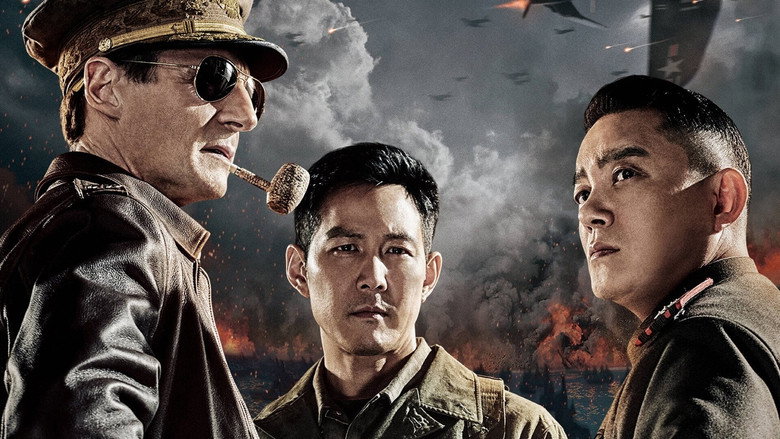
A war thriller lit by a single lighthouse beam: eight men in enemy uniforms walk into the dark of Incheon, knowing the light they must switch on will expose them.
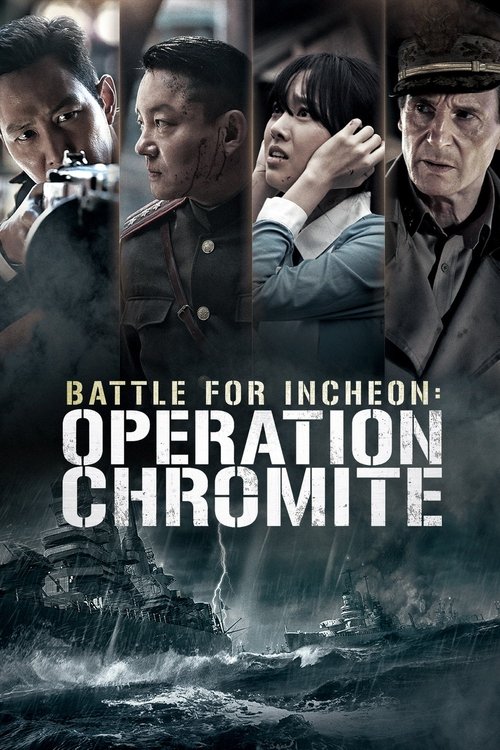
Operation Chromite
인천상륙작전
"The Odds Were 5000 to 1 … One was all They Needed."
27 July 2016
South Korea
111 min
5.8
(231)
Director: John H. Lee
Cast: Lee Jung-jae, Liam Neeson, Lee Beom-soo, Jin Se-yeon, Jung Jun-ho
Drama
War
History
Action
Sacrifice of the unnamed
Brothers on opposite sides of an ideology
The gamble against expert consensus
Identity under disguise
Patriotism as spectacle and as mourning
Budget:
$12,700,000
Box Office:
$49,196,532
Operation Chromite — Ending Explained
⚠️ Spoiler Analysis
<p><strong>Full spoilers follow.</strong></p>
<p><strong>The structure.</strong> MacArthur, needing to know where North Korean mines and coastal defences sit before he can land at Incheon, dispatches eight members of the Korean Liaison Office under Lieutenant Jang Hak-soo on Operation X-Ray. They enter the city disguised as a North Korean inspection unit and are immediately shadowed by the suspicion of Colonel Lim Gye-jin, who commands the port's defence and is too careful to be fooled for long. The film's suspense therefore runs on a fuse rather than a mystery: we know the disguise will fail, and we watch Lim close the distance.</p>
<p><strong>The lighthouse.</strong> The mission's decisive directive is to seize and light the Palmido lighthouse — the agreed signal without which MacArthur will not commit the fleet to Incheon's channel. This is the film's cruellest piece of construction: the act that saves the invasion is the act that makes the team visible and locatable in a blacked-out harbour. Once the lamp burns, the operatives have effectively announced their own position; the beam is simultaneously the beginning of the landing and the end of the men who caused it.</p>
<p><strong>The ending.</strong> All members of the X-Ray team are killed. Jang, the last standing, avenges his comrades by killing Lim Gye-jin before he too dies. The light is lit, the fleet enters, the landing succeeds and the war turns — and the families waiting at home will never see these men again or learn what they did. The victory arrives with nobody left to receive it.</p>
<p><strong>What becomes clear afterwards.</strong> In retrospect the MacArthur scenes read differently: every confident pronouncement in a briefing room is underwritten by a death that has not happened yet, and the general's celebrated audacity is revealed as something eight strangers paid for. The mirroring of Jang and Lim also resolves into the film's real thesis — two Koreans, equally disciplined and equally certain, destroying each other so that a country can survive its own division. The famous history books record Incheon as a masterstroke of command; the film's closing argument is that it was a signal switched on by hand, in the dark, by men whose names the masterstroke did not keep.</p>
Alternative Interpretations
<p><strong>As patriotic monument.</strong> The most straightforward reading, and the one the film's own rhetoric invites: a tribute to real, largely forgotten intelligence operatives, with the annihilation of the X-Ray team functioning as sanctified martyrdom. Domestic box office suggests this is how millions of viewers took it.</p>
<p><strong>As propaganda, read against itself.</strong> Several critics argued the film sacrifices history to flag-waving — that almost nothing of the real events survives the dramatisation, and that its recruitment of a Hollywood star to bless a nationalist narrative is itself the point. In this reading the ending is less elegy than ideological reassurance: the deaths are pre-justified by the victory.</p>
<p><strong>As tragedy of fratricide.</strong> A third reading concentrates on Jang and Lim. Because the two men are built as mirrors and both die, the finale can be seen not as triumph but as mutual destruction — a civil war in which the winner is also consumed. On this view the lighthouse beam illuminates a shared catastrophe rather than a national success.</p>
<p><strong>As a film about intelligence, not combat.</strong> Some viewers value it chiefly as a study of the apparatus behind a battle: the landing itself is almost a coda, and the real subject is the unglamorous, deniable labour of espionage. The MacArthur scenes then read as deliberate contrast — myth-making in comfortable rooms, while the work happens in the dark.</p>
Explore More About This Movie
Dive deeper into specific aspects of the movie with our detailed analysis pages