Skip to content
Poetry
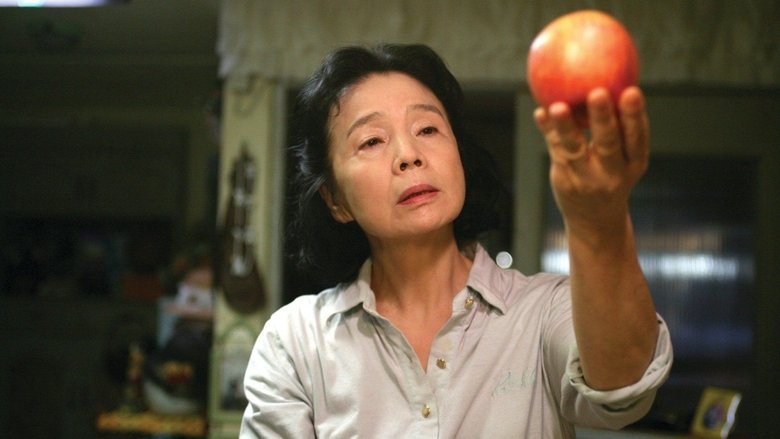
A luminous and devastating humanist drama that channels quiet sorrow and transcendent grace, evoking fallen apricots crushed upon damp earth as words slip into silence.
Poetry
Poetry

13 May 2010 South Korea 139 min 7.6 (350)

Director: Lee Chang-dong

Cast: Yoon Jeong-hee, David Lee, Kim Hee-ra, Ahn Nae-sang, Kim Yong-taek

Drama The Nature of Artistic Creation and "Seeing" Moral Responsibility vs. Social Complicity Cognitive Decline and the Fragility of Language Empathy, Grief, and Vicarious Atonement
Box Office: $349,899

Poetry — Ending Explained

⚠️ Spoiler Analysis

As the narrative unfolds, Mi-ja learns that her grandson Wook and five classmates sexually abused schoolmate Agnes Park Hee-jin over several months in a science lab, ultimately driving the girl to jump off a bridge into the river.

The fathers of the other boys arrange a private settlement: each family must contribute 5 million won (30 million won total) as hush money for Agnes’s impoverished mother in exchange for her silence, shielding the boys from criminal records. Penniless, Mi-ja is tasked with traveling to the countryside to negotiate with Agnes's mother. However, upon arriving, she is overwhelmed by the natural beauty and the mother’s grief, forgetting her mercenary mission and speaking instead of apricots and wildflowers before returning empty-handed.

To secure the required 5 million won, Mi-ja permits her employer, the stroke-paralyzed Mr. Kang, to have sexual relations with her. She delivers the money to the fathers to fulfill the settlement. Following this, she spends a quiet afternoon playing badminton with her grandson. During the game, the police arrive and arrest him; it is revealed that Mi-ja herself quietly reported Wook to the authorities, choosing moral reckoning over familial cover-up.

Mi-ja visits the poetry workshop one last time, leaving behind a bouquet of flowers and a completed poem titled "Agnes' Song" on the teacher's desk. As the film ends, the poem is recited: the voiceover begins as Mi-ja’s and seamlessly transforms into Agnes’s voice, moving across the spaces both inhabited, ending upon the tranquil surface of the flowing river.

Alternative Interpretations

Critics and scholars have read the ambiguous conclusion through multiple lenses:

  • The Transcendent Disappearance / Suicide Interpretation: The final sequence—where Mi-ja's voiceover shifts into Agnes’s voice and the camera settles on the river—suggests that Mi-ja, having settled her debts, surrendered her grandson to justice, and left her poem, took her own life in the same waters as Agnes.
  • The Cognitive Erasure Interpretation: Mi-ja did not die physically, but wandered away as her Alzheimer’s reached total disconnection from her previous life, leaving her poem as the final relic of her conscious self.
  • The Complete Spiritual Merger Interpretation: The voiceover transition represents a metaphysical merging of two souls across generations, where the living grandmother becomes the voice of the silenced girl, transcending linear narrative boundaries.

Explore More About This Movie

Dive deeper into specific aspects of the movie with our detailed analysis pages

Similar Movies