Skip to content
Poetry
A luminous and devastating humanist drama that channels quiet sorrow and transcendent grace, evoking fallen apricots crushed upon damp earth as words slip into silence.
Poetry

Poetry

13 May 2010 South Korea 139 min 7.6 (350)

Director: Lee Chang-dong

Cast: Yoon Jeong-hee, David Lee, Kim Hee-ra, Ahn Nae-sang, Kim Yong-taek

Drama The Nature of Artistic Creation and "Seeing" Moral Responsibility vs. Social Complicity Cognitive Decline and the Fragility of Language Empathy, Grief, and Vicarious Atonement
Box Office: $349,899

Overview

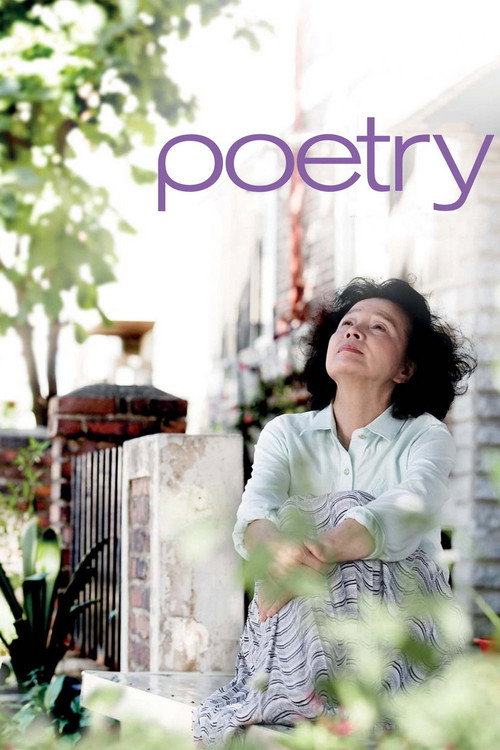
Poetry (, 2010), written and directed by South Korean master Lee Chang-dong, centers on Yang Mi-ja, an eccentric, softly spoken woman in her late sixties living in a picturesque suburban town in Gyeonggi Province. Dressed in floral patterns and delicate hats, Mi-ja earns a modest living as a caregiver for an elderly, stroke-afflicted man while raising her sullen, unresponsive teenage grandson, Jong-wook, whose mother lives and works in Busan. When Mi-ja begins to experience minor bouts of forgetfulness, a medical visit confirms her worst fear: the early stages of Alzheimer’s disease.

In an attempt to hold onto language and discover meaning before her memories slip away, Mi-ja enrolls in a local cultural center’s poetry-writing workshop taught by a real-world poet. There, she is told that writing a poem requires the rare discipline of truly seeing the world rather than merely looking at it. Mi-ja takes this instruction to heart, carrying a small notepad to record fleeting sensory details of trees, fruits, and skies.

Her gentle quest for aesthetic beauty is abruptly shattered when she discovers that her grandson is implicated in a heinous collective crime involving the tragic death of a local middle-school girl named Agnes Park Hee-jin. As the fathers of the other boys attempt to orchestrate a cynical financial cover-up to protect their sons’ futures, Mi-ja finds herself trapped between moral horror, familial duty, cognitive decay, and her solitary artistic endeavor.
Core Meaning

Lee Chang-dong explores the existential relationship between art, moral responsibility, and suffering. The film posits that genuine poetry and beauty cannot exist as an escapist fantasy detached from harsh reality. Instead, true artistic and human communion requires unflinching confrontation with tragedy, evil, and the agony of others. While language fails biologically through Alzheimer’s and morally through patriarchal complicity, poetry becomes an act of radical empathy, confession, and atonement.

Thematic DNA

The Nature of Artistic Creation and "Seeing" 30%
Moral Responsibility vs. Social Complicity 30%
Cognitive Decline and the Fragility of Language 25%
Empathy, Grief, and Vicarious Atonement 15%

The Nature of Artistic Creation and "Seeing"

The film questions what it means to create art. The poetry instructor emphasizes that writing is not a mechanical craft but a spiritual posture: the willingness to genuinely observe the universe. While others seek superficial verse, Mi-ja learns that real poetry requires absorbing pain and experiencing another soul's devastation.

Moral Responsibility vs. Social Complicity

Contrasted against the fathers of the delinquent boys—who view their sons' horrific assault purely as an inconvenience to be settled with cash—Mi-ja is the only character who feels genuine, agonizing guilt. The film indicts patriarchal indifference and suburban complacency that prioritizes status over human decency.

Cognitive Decline and the Fragility of Language

Mi-ja’s Alzheimer’s diagnosis introduces an urgent temporal limit. As common nouns and ordinary words vanish from her brain, her effort to write a single poem turns into a fight to crystallize her moral consciousness before total oblivion sets in.

Empathy, Grief, and Vicarious Atonement

Mi-ja moves beyond her familial allegiance to take on the suffering of Agnes, the victim. In doing so, she blurs the boundaries of her own identity to speak for and with the dead girl when nobody else will honor her memory.

Character Analysis

Yang Mi-ja

Yoon Jeong-hee

Archetype: Tragic Truth-Seeker / Martyr Key Trait: Unflinching empathy and dignified elegance.

Motivation

To write one meaningful poem before losing her cognitive facilities, while reconciling her conscience.

Character Arc

Begins as a naive, whimsical woman avoiding painful realities; evolves into a courageous moral agent who sacrifices everything to atone for a crime.

Jong-wook (Wook)

Lee David (Lee Da-wit)

Archetype: Apathetic Youth / Antagonist Key Trait: Chilling indifference and emotional numbness.

Motivation

To play video games, eat, and avoid accountability.

Character Arc

Remains detached, sullen, and morally inert throughout, showing no remorse or emotional growth.

All 5 characters and cast

Symbols & Motifs

The Apricot (살구 - Salgu)

Meaning:

Symbolizes life that throws itself to the ground, crushed and bruised in preparation for rebirth or continuation.

Context:

Fallen apricots rotting on the orchard path directly foreshadow both Agnes’s fate and Mi-ja’s eventual sacrifice.

The Apple (사과 - Sagwa)

Meaning:

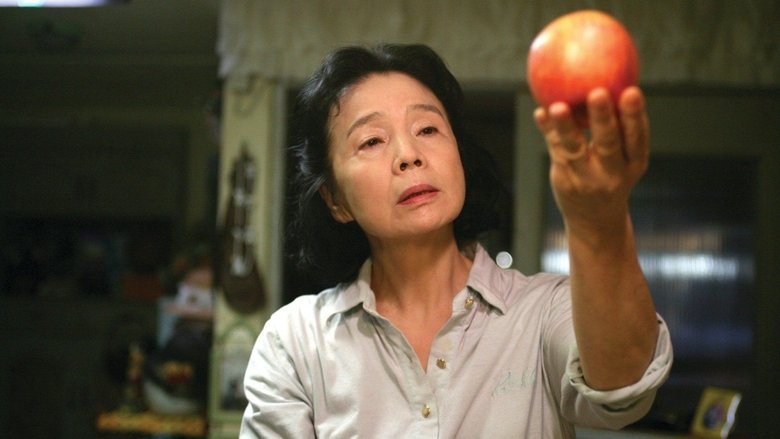
In Korean, sagwa is a homophone for both apple and apology/amends. Deeply examining it represents true artistic contemplation and the unvoiced confession Mi-ja feels compelled to make.

Context:

Introduced by the poetry teacher as a visual and philosophical exercise in class.

The River and Flowing Water

Meaning:

Serves as a silent witness where life and death converge, embodying transit and mortality.

Context:

Appears at the opening carrying Agnes’s floating body and culminates in the black river crossed in the final poem.

The White Fedora / Floral Hats

Meaning:

Represents innocent yearning for elegance, dignity, and youth.

Context:

Worn by Mi-ja throughout the film as she maintains personal grace even as harsh moral squalor encroaches.

The Dead Girl’s Photograph

Meaning:

Anchors Mi-ja's conscience, compelling her to gaze directly at the human cost of the crime.

Context:

Mi-ja takes the framed portrait of Agnes from the memorial altar and carries it with her.

Memorable Quotes

시를 쓰는 건 어려운 게 아니라, 시를 쓸 마음을 갖는 게 어려운 겁니다.
— Poetry Teacher (Kim Yong-taek)

Context

Spoken during the community center poetry workshop.

Meaning

Emphasizes that artistic creation is an ethical and emotional disposition of the soul, not merely a literary technique.

살구가 스스로 땅에 몸을 던져요. 다음 생을 위해 밟히고 짓이겨지는 거예요.
— Yang Mi-ja

Context

Written in Mi-ja's notebook while observing fallen fruit in an orchard.

Meaning

Captures the core visual metaphor of martyrdom and sacrificial transformation running through the narrative.

All 3 quotes

Philosophical Questions

Can art exist in isolation from moral responsibility?

The film argues that art divorced from truth and suffering is empty aestheticism; true creation requires confronting pain and ethical reality.

What constitutes authentic justice when legal systems and social institutions prioritize convenience and power?

Through her personal choices, Mi-ja enacts an ethical justice that subverts patriarchal transactional settlements.

How does human consciousness retain meaning in the face of inevitable mental dissolution?

Mi-ja’s poetry becomes an assertion of human dignity and moral awareness against the void of Alzheimer's.

Alternative Interpretations

Critics and scholars have read the ambiguous conclusion through multiple lenses:

Full ending explanation

Cultural Impact

Released in 2010 during a pivotal period of South Korean cinema, Poetry reflected deep societal anxieties regarding moral decay in rapid modernization, the alienation of youths raised in consumerist detachment, and the marginalization of the elderly in a hyper-competitive society.

Director Lee Chang-dong, who previously served as South Korea’s Minister of Culture, was later revealed to have been placed on conservative political blacklists due to his socially critical cinema. Poetry solidified his status as one of global cinema’s foremost humanist auteurs. It swept major awards at South Korea’s Grand Bell Awards and Blue Dragon Film Awards, and international critics such as Roger Ebert championed it as an empathetic masterpiece.

Audience Reception

Poetry received widespread, near-unanimous critical acclaim upon release:

  • Praised Elements: Praise centered on Yoon Jeong-hee’s deeply restrained masterclass performance and Lee Chang-dong’s nuanced screenplay for examining agonizing subject matter without resorting to melodrama. It earned a rare 100% approval rating on Rotten Tomatoes upon its initial critical rollout.
  • Criticisms & Controversies: A minority of viewers found the deliberate, unhurried pacing and lack of conventional dramatic climaxes overly demanding. The scene in which Mi-ja agrees to a sexual encounter with the paralyzed Mr. Kang to secure settlement money sparked critical debate regarding power dynamics and sacrifice.
  • Verdict: Widely regarded by film scholars as one of the defining masterpieces of 21st-century world cinema and an extraordinary meditation on empathy.

Interesting Facts

  • Yoon Jeong-hee, one of South Korea’s leading cinematic icons of the 1960s and 1970s, came out of a 16-year retirement specifically because Lee Chang-dong wrote the script with her in mind.
  • The poetry instructor in the film is played by Kim Yong-taek, a renowned, award-winning South Korean poet in real life, bringing authentic literary gravitas to the classroom scenes.
  • Director Lee Chang-dong stated that the initial inspiration came from combining news reports about a brutal teenage gang assault case, a schoolgirl's suicide, and the image of an elderly woman writing poetry.
  • In a poignant parallel to her character Mi-ja, actress Yoon Jeong-hee was diagnosed in real life with Alzheimer’s disease and lived with it for years until her passing in 2023.
  • The film premiered at the 63rd Cannes Film Festival in 2010, winning the prestigious Best Screenplay Award for Lee Chang-dong, as well as the Prize of the Ecumenical Jury (Special Mention).

Easter Eggs

Cameo by Real-World Poet

Casting Kim Yong-taek as the instructor bridges the film's fictional narrative directly with modern South Korean lyric literature.

The Global Televised Grief

In an early hospital waiting-room scene, Mi-ja watches a television broadcast showing a Palestinian mother grieving her dead child, subtly establishing a universal motif of maternal grief and injustice before Agnes's death is revealed.

The Artificial Flowers

In the doctor's office, Mi-ja admires vibrant red camellias on the windowsill only to learn they are plastic—a quiet metaphor for the deceptive, superficial beauty she must look past.

Frequently Asked Questions

Explore More About This Movie

Dive deeper into specific aspects of the movie with our detailed analysis pages

Comments (0)

Leave a comment

No comments yet. Be the first to share your thoughts!

Similar Movies