Skip to content
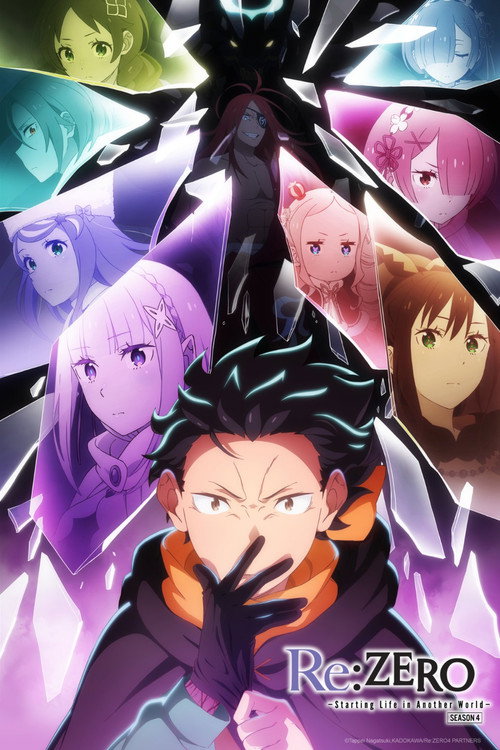
Re:ZERO -Starting Life in Another World-
A psychologically grueling dark fantasy that plunges viewers into raw existential agony and profound hope, acting as a fractured hourglass where every agonizing death slowly carves out genuine human redemption.
Re:ZERO -Starting Life in Another World-

Re:ZERO -Starting Life in Another World-

Re:ゼロから始める異世界生活

"Racing through the journey of memories——"

04 April 2016 — 17 June 2026 Japan 1 season 85 episode Returning Series 8.0 (730)

Cast: Inori Minase, Yusuke Kobayashi, Rie Takahashi, Yumi Uchiyama, Rie Murakawa

Drama Animation Sci-Fi & Fantasy Action & Adventure Mystery Trauma, Self-Worth, and Self-Acceptance The Weight of Memory and Solitude Deconstruction of Entitlement and the Hero Complex Unconditional Love and Emotional Connection Perseverance Through Agonizing Failure

Overview

Re:ZERO -Starting Life in Another World- centers on Subaru Natsuki, an ordinary, socially withdrawn teenager who is abruptly summoned to a medieval fantasy realm. Expecting a typical power fantasy, Subaru quickly discovers he possesses no superhuman strength or magic talent. Instead, he gains a horrifying ability dubbed "Return by Death," which automatically rewinds time to a past "checkpoint" whenever he dies. While time resets for the rest of the world, Subaru retains every excruciating memory of his deaths and the deaths of those he cares about, isolating him in a silent loop of psychological trauma.

Across its multi-season narrative arc, the series shifts from an unraveling mystery into a sprawling political and psychological saga. Subaru pledges his devotion to Emilia, a half-elf candidate competing for the throne of the Dragon Kingdom of Lugunica. In doing so, he becomes entangled in deadly feuds, ancient curses, terrifying demonic beasts, and the murderous zealots of the Witch Cult. Forced to face overwhelming threats like the Sin Archbishops and ancient monsters, Subaru must repeatedly endure failure, adapt his strategy, and confront his own deep-seated toxic flaws to alter tragic fates.

Rather than focusing on power progression, the overall series arc tracks Subaru’s emotional maturation and the unraveling mysteries of the fantasy world. As new allies join his cause and ancient motives are revealed—spanning ancient spirits, machiavellian benefactors, and the enigmatic Witch of Envy—the show highlights the immense mental burden of carrying erased timelines and the transformative power of genuine self-acceptance.
Core Meaning

The core meaning of Re:ZERO lies in its radical deconstruction of the power fantasy trope. The creators convey that true strength is not physical dominance, unyielding arrogance, or effortless heroic success. Instead, real heroics require vulnerability, self-awareness, emotional honesty, and the courage to lean on others.

Subaru’s greatest enemy throughout the show is never the Witch Cult or monstrous beasts, but his own toxic narcissism, entitlement, and visceral self-hatred. Through the grueling mechanism of Return by Death, the series emphasizes that one cannot save others while treating oneself as disposable. The narrative emphasizes that every individual’s life has inherent value, and true growth begins only when one stops putting on a performance for validation and learns to accept both their own flaws and the unconditional support of those around them.

Thematic DNA

Trauma, Self-Worth, and Self-Acceptance 30%
The Weight of Memory and Solitude 25%
Deconstruction of Entitlement and the Hero Complex 20%
Unconditional Love and Emotional Connection 15%
Perseverance Through Agonizing Failure 10%

Trauma, Self-Worth, and Self-Acceptance

Introduced as Subaru masks his deep insecurities behind theatrical bravado. As death loops stack up, his psyche breaks down, culminating in intense mental crises where he must abandon his self-loathing. Across subsequent seasons, this theme evolves from merely surviving trauma to actively learning to value his own life rather than treating his body as a disposable tool.

The Weight of Memory and Solitude

Because Subaru cannot reveal Return by Death without fatal consequences, he carries the emotional weight of erased timelines completely alone. This theme deepens as he realizes that relationships built in erased loops must be earned all over again, forcing him to move away from manipulation and build authentic emotional trust.

Deconstruction of Entitlement and the Hero Complex

The series directly critiques the expectation that helping someone entitles a person to their romantic affection or obedience. Subaru’s early delusion that he is the "protagonist" leads to public humiliation and fractured relationships. Over time, this matures into a profound respect for others' autonomy and agency.

Unconditional Love and Emotional Connection

Explored through key relationships (Rem, Emilia, Beatrice), showing how genuine affection can pull a person back from the brink of despair. Love is presented not as a reward to be won, but as an active, mutual force of healing and emotional accountability.

Perseverance Through Agonizing Failure

Demonstrated by Subaru’s iterative problem-solving. Progress in the series is never linear; failure is treated as a painful yet necessary teacher, proving that resolve is defined by getting back up even when the odds are stacked against you.

Character Analysis

Natsuki Subaru

Yusuke Kobayashi

Archetype: Subversive Anti-Power-Fantasy Hero / Flawed Protagonist Key Trait: Unyielding emotional persistence despite severe psychological trauma.

Motivation

To protect Emilia and his friends from tragic fates, evolving from a selfish desire for personal validation into a self-sacrificing, genuine devotion to their happiness and growth.

Character Arc

Begins as an arrogant, socially detached NEET with a self-absorbed hero complex. Through horrific physical deaths and psychological trauma, he breaks down completely, sheds his inflated ego, and reconstructs himself into a genuinely empathetic, strategically grounded leader who learns to value his own life.

Emilia

Rie Takahashi

Archetype: Heroine / Reluctant Royal Candidate Key Trait: Deep-seated compassion and unwavering moral integrity.

Motivation

To win the Royal Selection in order to thaw the frozen elves of Elior Forest and prove that half-elves deserve equal dignity.

Character Arc

Starts as an isolated, self-doubting half-elf burdened by public prejudice due to her resemblance to the Witch of Envy. With Subaru’s encouragement, she confronts her tragic past during the Sanctuary trials, gains independence from her spirit protector Puck, and emerges as a confident, self-reliant royal contender.

All 5 characters and cast

Symbols & Motifs

Appas (Apples)

Meaning:

Represents normalcy and reality check points. Serving as a visual anchor throughout the series, this local fantasy equivalent of apples anchors Subaru to tangible reality.

Context:

Sold by the merchant Kadomon in the capital. Whenever Subaru resets in the capital, the appa stand marks his return to square one.

The Metronome / Rewind Sound Effect

Meaning:

Symbolizes the ticking time bomb of Subaru’s psyche and the inescapable burden of his rewind curse.

Context:

An auditory motif that accompanies every activation of Return by Death throughout the series.

The Witch's Shadow / Miasma

Meaning:

Represents guilt, taboo secrets, and the oppressive mark of Satella’s obsessive possession.

Context:

Appears as unseen dark hands and a sickening dark aura surrounding Subaru whenever Return by Death is triggered or spoken of.

Silver Hair and Amethyst Eyes

Meaning:

Visually contrasts societal prejudice against Emilia's inner innocence and purity, as these physical traits evoke historical terror due to her resemblance to the Witch of Envy.

Context:

Prominently featured on Emilia, causing widespread fear and mistrust among the populace during the Royal Selection.

The Gospel / Unwritten Books

Meaning:

Symbolizes fatalism and predestination, standing in direct conflict with Subaru’s fight for free will and unpredictable outcomes.

Context:

Cryptic books carried by Witch Cultists and Roswaal that detail future events for their owners to follow.

Mayonnaise

Meaning:

Represents Subaru’s connections to his original world, used as a grounding element of comfort and camaraderie amidst dark trials.

Context:

A recurring lighthearted motif brought up by Subaru during interactions with the mansion residents and allies.

Memorable Quotes

「ここから、始めましょう。一から…いいえ、ゼロから!」
— Rem

Context

Season 1, Episode 18 ("From Zero"), on a balcony in the capital city after Subaru breaks down in complete self-loathing.

Meaning

Serves as the thematic core of the series; Rem restores Subaru's crushed spirit, convincing him that failure is not the end, but a clean slate to rebuild himself.

「俺は…俺が大嫌いだよ!」
— Natsuki Subaru

Context

Season 1, Episode 18 ("From Zero"), during his emotional confession to Rem.

Meaning

Subaru lays bare his raw insecurities, acknowledging that his arrogance was just a facade to cover up his deep-seated feelings of worthlessness.

All 5 quotes

Episode Highlights

The Outside of Madness

S1E15

Features Subaru's total psychological collapse, Petelgeuse's brutal torture of Rem, and Puck's monstrous transformation.

Significance:

Dark Turning Point: Established Re:ZERO as an uncompromising psychological thriller.

From Zero

S1E18

Consists almost entirely of an emotional dialogue between Subaru and Rem where Subaru sheds his ego and confronts his self-hatred.

Significance:

Emotional Climax: Recommits Subaru to becoming a genuine hero and serves as the emotional turning point of the series.

A Wager That Defies Despair

S1E21

Subaru leads the joint coalition in an explosive combat operation to defeat the terrifying White Whale.

Significance:

Action Peak: Marks Subaru's transition from a helpless victim into a capable, strategic leader.

Parent and Child

S2E4

Takes place in Echidna's trial, forcing Subaru to face phantom memories of his parents back on Earth.

Significance:

Psychological Depth: Resolves Subaru's deep lingering guilt over vanishing from his original world.

The Witches' Tea Party

S2E12

Subaru discovers the true horrifying nature of Echidna's greed and confronts the concept of erased timelines.

Significance:

Philosophical Conflict: Forces Subaru to reject using his life as a disposable tool under Echidna's manipulation.

Choose Me

S2E24

Subaru rescues Beatrice from her 400-year solitude in the burning library, solidifying their contract.

Significance:

Climactic Redemption: Marks a major victory over Roswaal's scheme and establishes a powerful new partnership.

Gharfiel's Stand / City Siege

S3E8

Shifts the series scale into a full-blown military siege against multiple Sin Archbishops in Watergate City Priestella.

Significance:

Sprawling Warfare: Tests Subaru's tactical leadership under high-stakes multi-front combat.

Julius Juukulius

S4E6

Centers on the Pleiades Watchtower trial where Julius faces Reid Astrea.

Significance:

Character Peak: Tackles themes of forgotten identity and knightly pride through high-stakes combat trials.

Philosophical Questions

Is suffering an absolute prerequisite for personal growth, or does unmitigated trauma eventually erode human dignity?

Explored through Subaru's mental stability; the show illustrates that while pain forces self-examination, total isolation without support destroys the mind.

Does a person's life have intrinsic value independent of their utility or achievements?

Addressed through Subaru's realization that he doesn't need to die or perform heroic feats to earn the love of those around him.

If a person's actions and sacrifices are erased from everyone else's memory, do those erased timelines hold moral significance?

Explored through the unseen psychological burdens Subaru carries from timelines that technically "never happened" to anyone else.

Alternative Interpretations

Viewers interpret Subaru’s violent journey through three main lenses:

Full ending explanation

Cultural Impact

Releasing during the peak mid-2010s "isekai boom"—an era dominated by wish-fulfillment stories featuring instantly overpowered protagonists—Re:ZERO broke onto the scene as a sharp subversion. It interrogated the mental consequences of being thrown into a hostile foreign world without superpowers.

Re:ZERO popularized dark, psychologically realistic subversions of fantasy tropes in modern anime, solidifying Studio White Fox's reputation for faithful adaptations and spawning iconic pop-culture moments such as "I love Emilia" and "Who's Rem?".

Audience Reception

The series received widespread acclaim for its phenomenal voice acting—particularly Yusuke Kobayashi’s visceral portrayal of emotional distress—its uncompromising psychological realism, and Kenichiro Suehiro's haunting musical score. Audiences appreciated the narrative's willingness to make the protagonist profoundly unlikable before earning his redemption.

Main points of criticism centered on early Arc 3 Subaru (Season 1, Episodes 12–17), where his extreme arrogance caused severe viewer discomfort, and Season 2's Sanctuary arc, which faced minor pacing criticism due to heavy dialogue inside limited settings. However, viewers who initially criticized Subaru in early Season 1 largely turned into passionate fans after witnessing his self-awareness and emotional maturation from Episode 18 onward.

Interesting Facts

  • Author Tappei Nagatsuki revealed in interviews that the entire series was created specifically because he wanted to write a story about a silver-haired girl.
  • Studio White Fox frequently omitted opening and ending theme sequences, cut commercial break cuts, and extended episode runtimes beyond 25 minutes to fit as much source content into single broadcasts.
  • During the recording session for Episode 18 ('From Zero'), voice actor Yusuke Kobayashi (Subaru) pushed his vocal cords to absolute exhaustion, leaving him physically drained.
  • Series composition writer Masahiro Yokotani was so unsettled by the mental brutality of Arc 3 that he jokingly admitted to passing off the heaviest scripts to co-writers.
  • Tappei Nagatsuki writes alternate web-novel timelines on April Fools' Day (known as Sloth, Pride, Wrath, Greed, and Lust IFs) exploring darker realities where Subaru makes morally compromised choices.

Easter Eggs

KonoSuba Cross-References

Tappei Nagatsuki and KonoSuba author Natsume Akatsuki are close real-life friends. Subaru occasionally rambles about tropes reminiscent of KonoSuba, and both franchises share official crossover animated projects like Isekai Quartet.

Season 1 Opening Foreshadowing

In the first opening sequence (Redo by Konomi Suzuki), subtle single-frame flashes reveal Satella's dark silhouette smiling, while Emilia's visual reflection faces backward, giving subtle hints at their deep narrative connection.

Otaku Pop-Culture Dialogue

Coming from modern Japan, Subaru frequently drops real-world pop-culture references in the light novels and early episodes, including jokes referencing Hunter x Hunter, Attack on Titan, Dragon Ball, and retro games.

Kadomon the Appa Merchant

The appa vendor Kadomon Risch functions as a subtle reset indicator; his dialogue shifts subtly depending on Subaru’s mental state at each checkpoint.

Frequently Asked Questions

Explore More About This Movie

Dive deeper into specific aspects of the movie with our detailed analysis pages

Comments (0)

Leave a comment

No comments yet. Be the first to share your thoughts!

Similar Movies