Skip to content
Bungo Stray Dogs
A stylish neo-noir supernatural thriller imbued with melancholy and existential yearning, where wounded souls navigate shadowy urban alleys like stray wolves chasing a distant lantern light in the dark.
Bungo Stray Dogs

Bungo Stray Dogs

文豪ストレイドッグス

07 April 2016 — 20 September 2023 Japan 1 season 60 episode Returning Series 8.2 (447)

Cast: Mamoru Miyano, Yuto Uemura, Masaaki Mizunaka, Hiroyuki Yoshino, Sumire Morohoshi

Crime Animation Sci-Fi & Fantasy Action & Adventure Mystery Traumatic Past and Self-Forgiveness Purpose, Existential Meaning, and the "Reason to Live" Moral Duality and the Interdependence of Light and Shadow Found Family and Camaraderie Among Outcasts The Dual Nature of Power and Justice

Overview

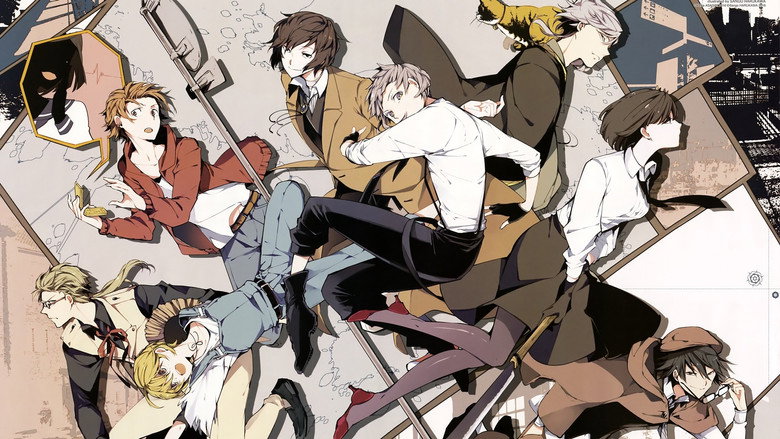
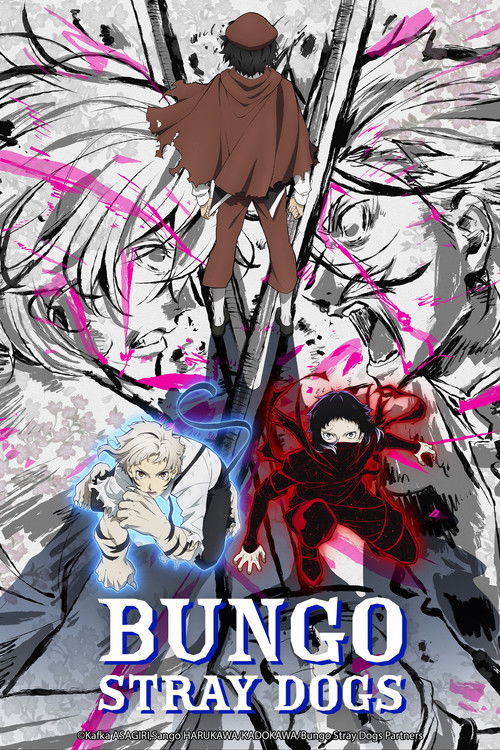
Bungo Stray Dogs is a supernatural mystery and action television series set in the bustling port city of Yokohama. The narrative centers on Atsushi Nakajima, an orphaned boy cast out onto the streets who discovers he possesses a dangerous latent ability to transform into a monstrous white tiger. After crossing paths with the eccentric, death-obsessed detective Osamu Dazai, Atsushi is recruited into the Armed Detective Agency—a specialized private firm made up of individuals wielding unique supernatural powers who take on perilous criminal cases beyond the scope of ordinary law enforcement.

As Atsushi learns to master his power and find a reason to live, the Agency finds itself locked in escalating territorial and ideological battles. The conflict begins with Yokohama’s ruthless underworld syndicate, the Port Mafia, expands into an international clash against the North American conglomerate known as the Guild, and culminates in high-stakes global conspiracies orchestrated by the shadowy cabals the Rats in the House of the Dead and the Decay of the Angel.

Across its overarching narrative, Bungo Stray Dogs balances fast-paced tactical battles, detective investigations, and dark character psychology. The show builds an expansive urban mythos around a mystical artifact known simply as The Book, examining how fractured outcasts from opposing sides of the law must repeatedly form uneasy alliances to protect their city and their shared humanity.
Core Meaning

At its core, Bungo Stray Dogs explores the existential search for self-worth and belonging among those broken by trauma, societal rejection, and guilt. Dedicated to "people who are not good at living"—the societal outcasts and "stray dogs" wandering the fringes of life—the narrative conveys that morality is fundamentally a choice rather than an inherent destiny.

Light and darkness do not define a person's ultimate worth; rather, salvation and purpose are carved out through human connection, the conscious choice to protect others, and the courage to transcend the painful words and scars of one's past.

Thematic DNA

Traumatic Past and Self-Forgiveness 30%
Purpose, Existential Meaning, and the "Reason to Live" 25%
Moral Duality and the Interdependence of Light and Shadow 20%
Found Family and Camaraderie Among Outcasts 15%
The Dual Nature of Power and Justice 10%

Traumatic Past and Self-Forgiveness

Trauma is the foundational catalyst for character development in the series. Atsushi begins paralyzed by the abusive voices of the orphanage director, Akutagawa is chained to his desperate thirst for validation from a harsh mentor, and Yosano grapples with battlefield exploitation. Across the seasons, characters evolve from passive victims of their histories into individuals who consciously integrate their trauma to protect others.

Purpose, Existential Meaning, and the "Reason to Live"

The series constantly questions what gives life value. This is embodied most starkly by Osamu Dazai, who navigates profound nihilism and suicidal ideation, seeking a tangible spark to justify his existence. Through pivotal moments like Sakunosuke Oda’s dying plea, purpose is reframed not as an innate truth waiting to be discovered, but as a path created by actively choosing the "side that saves people".

Moral Duality and the Interdependence of Light and Shadow

Rather than presenting a simple binary of good versus evil, the series establishes the "Tripartite Framework"—a balance between the Armed Detective Agency (day/twilight), the Port Mafia (night), and the Special Division for Unusual Powers (government). The show demonstrates that light cannot exist without shadow, requiring sworn enemies to collaborate against greater existential threats to preserve their shared home.

Found Family and Camaraderie Among Outcasts

Nearly every core character is an orphan, outcast, or exile. The Armed Detective Agency functions as a sanctuary where broken misfits find mutual trust, unconditional acceptance, and domestic warmth, contrasting sharply with the transactional, fear-driven bonds of criminal organizations.

The Dual Nature of Power and Justice

Special abilities in the series are metaphors for human capabilities: inherently neutral tools capable of either tremendous destruction or salvation depending on the wielder's intent. The series frequently challenges dogmatic concepts of justice, highlighting how absolute righteousness can easily become tyrannical if stripped of empathy.

Character Analysis

Atsushi Nakajima

Yuto Uemura

Archetype: Hero / Reluctant Protector Key Trait: Unwavering Empathy

Motivation

To earn the right to exist and prove his life has worth by saving others.

Character Arc

Starts as a helpless, self-loathing runaway burdened by abuse; gradually grows into a resilient, compassionate defender who accepts his tiger ability and becomes the core pillar uniting former adversaries.

Osamu Dazai

Mamoru Miyano

Archetype: Trickster / Mentor / Antihero Key Trait: Brilliant Strategic Intellect

Motivation

To discover a tangible meaning to human existence and honor Oda’s dying plea.

Character Arc

Evolves from a chillingly ruthless, nihilistic Port Mafia executive into an enigmatic ADA detective and mastermind who honors his fallen friend Oda's wish to protect the innocent.

All 5 characters and cast

Symbols & Motifs

The White Tiger (Byakko)

Meaning:

Represents raw survival instinct, suppressed trauma, and untamed inner power.

Context:

Initially feared by Atsushi as an external predator haunting him, it transforms into an integrated source of strength and empathy as he accepts his true nature.

Bandages

Meaning:

Serves as both literal coverings for past self-harm wounds and a visual metaphor for emotional isolation, psychological scars, and the defensive barrier maintained between oneself and the world.

Context:

Worn prominently across the body by Osamu Dazai throughout his transitions from the Port Mafia to the Armed Detective Agency.

The Book and Blank Pages

Meaning:

Symbolizes the power of storytelling, human agency, free will, and the ability of individuals to author their own destinies despite predetermined fates.

Context:

A reality-altering mystical artifact sought by various factions where anything written becomes truth if composed as a coherent narrative.

Lupin Bar

Meaning:

Serves as a motif of fleeting innocence, quiet sanctuary, and the ephemeral nature of genuine companionship before being shattered by divergent loyalties.

Context:

The underground bar where Dazai, Sakunosuke Oda, and Ango Sakaguchi met during the Dark Era.

Sunset / Twilight

Meaning:

Represents moral ambiguity, mediator status, and the bridging of legitimate society with the criminal underworld.

Context:

The visual aesthetic and operational domain representing the Armed Detective Agency.

Memorable Quotes

人は誰かに「生きていていいよ」と言われなくちゃ、生きていけないんだ!
— Atsushi Nakajima

Context

Season 1, Episode 1.

Meaning

Lays bare the central psychological wound that drives Atsushi's character and encapsulates the foundational philosophy of the series regarding self-worth.

正しさが武器になる。人を傷つけはしても、救うことはできない。
— Osamu Dazai

Context

Season 1, Episode 6 / Dark Era reflections.

Meaning

Dazai questions dogmatic concepts of justice, arguing that enforcing rigid righteousness often leads to destruction rather than true salvation.

All 5 quotes

Episode Highlights

Fortune Is Unpredictable and Mutable

S1E1

Introduces Atsushi Nakajima, Osamu Dazai, the Armed Detective Agency, and the concept of Gifted abilities.

Significance:

Sets up Atsushi’s core inner conflict with the Beast Beneath the Moonlight and establishes the baseline world of Gifted powers.

The Dark Age

S2E13

Launches the acclaimed "Dark Era" prequel arc adapted from the light novels, shifting tone to a gritty noir thriller.

Significance:

Deepens the worldbuilding by exploring Dazai’s ruthless Port Mafia past and his formative bond with Sakunosuke Oda and Ango Sakaguchi.

Bungo Stray Dogs

S2E16

Features Oda’s tragic confrontation with André Gide and his dying conversation with Dazai.

Significance:

Acts as the emotional and thematic climax of Dazai’s character arc, explaining his departure from the Mafia and giving the series its overarching purpose.

If I May Shed This Burden Now

S2E24

The climax of the Guild War arc featuring the battle against Francis Scott Key Fitzgerald aboard the crashing Moby Dick.

Significance:

Delivers the first full-scale tactical alliance between Atsushi and Akutagawa, officially cementing the "Shin-Soukoku" dynamic.

Only a Diamond Can Polish a Diamond

S3E28

Concludes the "Dazai, Chūya, Age Fifteen" arc, exploring the founding dynamics of "Soukoku" (Double Black).

Significance:

Reveals strategic mind games between Dazai, Mori, and sets up the mysterious arrival of Fyodor Dostoevsky.

The Untold Origins of the Detective Agency

S4E40

Focuses on the fateful first meeting between Yukichi Fukuzawa and Ranpo Edogawa, adapted from the origin novel.

Significance:

Grounds the Agency's founding philosophy while exploring Ranpo’s hyper-deduction and psychological awakening.

You, A Pointless Sin of a Flower

S4E45

Explores Dr. Akiko Yosano's traumatic past during the Great War under Mori Ougai’s command.

Significance:

Provides a deeply emotional exploration of battlefield trauma, guilt, and human dignity that redefines Yosano's healing ability.

At the Port in the Sky (Part 2)

S5E55

A high-intensity siege episode featuring clashes between the Hunting Dogs, the Agency, and the Decay of the Angel.

Significance:

Features the tragic confrontation involving vampire Bram Stoker and the immense sacrifices made to protect the Page.

Twilight Goodbye

S5E60

The climactic resolution of the Meursault prison mind games between Dazai and Fyodor, the battle against Kamui (Fukuchi), and Chūya’s gravity-manipulation counter-gambit.

Significance:

Resolves the Decay of the Angel saga with major twists and delivers a massive cliffhanger that temporarily overtook the serialized manga's publication timeline.

Philosophical Questions

What gives human life intrinsic value when self-worth has been destroyed?

Atsushi’s arc consistently wrestles with the belief that one only deserves to live if they are useful to others, challenging viewers to contemplate unconditional self-worth versus transactional validation.

Can absolute morality exist in a fundamentally flawed world?

Through the contrasting philosophies of Fukuzawa, Mori, and Francis Fitzgerald, the series asks whether pragmatic moral compromise is necessary to maintain stability and prevent greater tragedy.

Does true personal freedom exist, or are individuals prisoners of their nature and past?

Characters like Nikolai Gogol pursue freedom by attempting to kill their closest friends to escape emotional attachment, while Dazai questions whether free will can triumph over destiny.

Is an ideal worth pursuing if it cannot withstand the cruelty of reality?

Explored through Kunikida’s struggle: the show investigates whether strict adherence to virtuous ideals leads to moral blindness or genuine heroism when innocent lives hang in the balance.

Alternative Interpretations

The series can be analyzed through three primary critical lenses:

Full ending explanation

Cultural Impact

Bungo Stray Dogs debuted during a renaissance of modern literary interest among Japanese youth, triggering a massive cultural phenomenon across Japan. Bookstores and libraries reported historic surges in sales and borrowings of classic Japanese literature, particularly works by Nakajima, Dazai, Akutagawa, and Ranpo. Japanese literary museums and historical sites partnered extensively with the production committee for tourism campaigns.

Internationally, the series expanded into a massive multimedia franchise including light novels, stage plays (Bungo Stray Dogs on Stage), live-action film adaptations, and the comedic spinoff Bungo Stray Dogs WAN!.

Audience Reception

Critical and audience reception evolved significantly across the series' five-season run:

  • Season 1 (2016): Received mixed-positive reception; praised for its animation, eccentric cast, and literary premise, but critiqued for abrupt tonal shifts between dark drama and slapstick comedy.
  • Season 2 (2016): Achieved widespread critical acclaim as a breakthrough season due to the emotional maturity of the opening Dark Era arc and dynamic Guild War battles.
  • Season 3 (2019): Received very positive reception for character depth and introducing Fyodor Dostoevsky as a psychological mastermind.
  • Seasons 4 & 5 (2023): Regarded as the dramatic zenith of the series, drawing high acclaim for sustained suspense during the terrorist framing arc and Meursault prison mind games.

Main criticisms across the series include frequent "fake-out" deaths, early over-reliance on Atsushi's orphanage flashbacks, and a fast-paced Season 5 finale that condensed intricate manga plot points.

Interesting Facts

  • Series creator Kafka Asagiri conceived the story from a thought experiment imagining classic world authors reimagined as young, stylish supernatural action heroes with abilities named after their famous books.
  • The anime adaptation was produced by Studio Bones (notably Bones Studio C), directed by Takuya Igarashi and written by series composition master Yōji Enokido.
  • Kafka Asagiri described Osamu Dazai's design philosophy as a 'donut'—a character intentionally built with a hollow, mysterious center surrounded by layers of masks.
  • Atsushi and Akutagawa were designed with contrasting black-and-white visuals and opposing ability styles to create a balanced yin-and-yang aesthetic dynamic.
  • The finale of Season 5 in September 2023 was adapted directly from Asagiri’s unreleased storyboard scripts, causing the anime to air events before they were published in the manga.
  • Bands GRANRODEO and SCREEN mode provided the series' hard-hitting opening themes, while indie rock band Luck Life performed all the melancholic ending themes across all five seasons.

Easter Eggs

Literary Biography Inversion

In real life, author Ryūnosuke Akutagawa was an idol to Osamu Dazai, who obsessively doodled his name. The series inverts this dynamic, making Akutagawa desperately crave Dazai's approval.

Real Bar Lupin in Ginza

The bar where Dazai, Oda, and Ango gather is a meticulous recreation of the historical Bar Lupin in Ginza, Tokyo, where the real-life Buraiha (Decadent School) literary trio famously drank and were photographed together in the late 1940s.

Ranpo Edogawa's Pseudonym

Ranpo Edogawa's name is a Japanese phonetic pun on Edgar Allan Poe (the pen name of Tarō Hirai). In the series, Ranpo and Poe share an intense competitive rivalry.

Gogol’s Cloak and Theater of the Absurd

Nikolai Gogol's ability "The Overcoat" directly references Nikolai Gogol’s famous short story, manifesting as spatial portal manipulation integrated into his jester attire.

Fyodor’s Usanka and Crime & Punishment

Fyodor Dostoevsky’s ability is named Crime and Punishment, and his organization "Rats in the House of the Dead" references his prison-camp novel The House of the Dead.

Frequently Asked Questions

Explore More About This Movie

Dive deeper into specific aspects of the movie with our detailed analysis pages

Comments (0)

Leave a comment

No comments yet. Be the first to share your thoughts!

Similar Movies