
Skip to content
Saga of Tanya the Evil
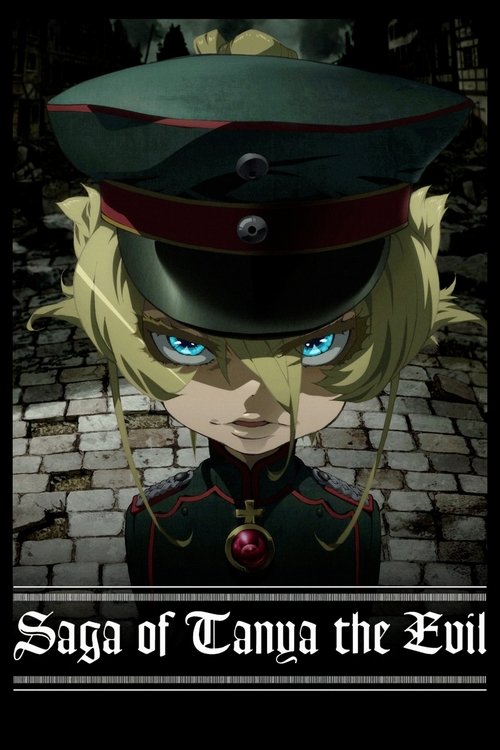
Set in an icy, diesel-drenched alternate World War, this dark military fantasy surges with cold adrenaline and existential fury. It visually captures a demonic porcelain soldier carving through thunderous battlefields with glowing magical energy.
Saga of Tanya the Evil

Saga of Tanya the Evil

幼女戦記

06 January 2017 — 05 August 2026 Japan 2 season 24 episode Returning Series 8.2 (454)

Cast: Aoi Yuuki, Saori Hayami, Shin-ichiro Miki, Tessyo Genda, Hochu Otsuka

Drama Animation Sci-Fi & Fantasy War & Politics Cold Rationalism vs. Human Emotion & Irrationality Free Will vs. Divine Determinism / Faith The Irony & Absurdity of War and Bureaucracy Totalitarian Ideology vs. Market Individualism

Overview

Saga of Tanya the Evil (Youjo Senki) follows an elite, ruthlessly pragmatic modern Japanese HR manager who, upon being murdered by a disgruntled employee, confronts an omnipotent entity named "Being X". Unmoved by divine authority and strictly clinging to cold logic, the salaryman is reincarnated into an alternate-history Europe on the brink of global conflict as Tanya Degurechaff—an orphaned girl endowed with terrifying magical aptitude. To survive Being X’s cosmic wager, avoid hell, and secure a comfortable, safe rear-line position, Tanya joins the Imperial Military, rapidly ascending through the officer ranks as a feared aerial mage commander.

As the conflict spreads across multiple fronts—mirroring World War I and World War II dynamics—Tanya’s unmatched tactical brilliance, hyper-rational understanding of military law, and terrifying combat prowess make her the Empire's ultimate weapon, known as the "Devil of the Rhine". However, her every attempt to prove her utility and secure a quiet desk job produces spectacular tactical victories that only drag the Empire deeper into total war. Across its seasons and narrative arcs, the series explores the escalating struggle between a lone individual’s uncompromising rationalism and a world consumed by geopolitical ambition, ideological fanaticism, and divine interference.


Core Meaning

At its core, Saga of Tanya the Evil is a satirical deconstruction of hyper-rationalism, corporate efficiency, and the absurdity of total war. The creators utilize Tanya’s reincarnation to examine how extreme adherence to logic, free-market principles, and strict compliance with legalistic frameworks can result in horrific atrocities when detached from empathy and human emotion.

The series posits that pure, unfeeling rationalism is not immune to madness; rather, it often breeds its own devastating forms of cruelty and war. Furthermore, it highlights the tragic irony of human conflict: an individual seeking total control and personal safety through system compliance ends up becoming a cog that perpetuates the very machine destroying the world.

Thematic DNA

Cold Rationalism vs. Human Emotion & Irrationality 30%
Free Will vs. Divine Determinism / Faith 25%
The Irony & Absurdity of War and Bureaucracy 25%
Totalitarian Ideology vs. Market Individualism 20%

Cold Rationalism vs. Human Emotion & Irrationality

Tanya represents the peak of modern bureaucratic logic, viewing people as human resources and decisions as cost-benefit calculations. Throughout the show, her inability to understand irrational human drives—such as religious zeal, patriotic fervor, and vengeance—continually undermines her plans, turning her logical victories into long-term strategic disasters.

Free Will vs. Divine Determinism / Faith

The central conflict pits Tanya’s fierce self-determinism against Being X’s desire to force her into genuine prayer and submission. To cast spells using her most powerful equipment (the Type 95 gem), Tanya is forced to recite prayers, creating a bitter psychological struggle where divine intervention corrupts her prized free will.

The Irony & Absurdity of War and Bureaucracy

The show satirizes military command structures and political institutions. Tanya uses strict legal loopholes (such as warning civilians of an attack in a child’s voice to comply with laws of war before bombarding a city) to execute brutal maneuvers. Her meticulous adherence to orders consistently results in unwanted promotions and deadlier front-line deployments.

Totalitarian Ideology vs. Market Individualism

Contrasting Tanya’s extreme capitalist mindset with the collectivists and nationalists around her, the series highlights how competing socio-political systems weaponize individual talent for state survival. As the war expands from localized border skirmishes to total global conflict against republics, empires, and communist federations, ideological hatred replaces rational strategy.

Character Analysis

Tanya von Degurechaff

Aoi Yuuki

Archetype: Antihero / Pragmatic Sociopath Key Trait: Hyper-rationality combined with terrifying ruthlessness

Motivation

To survive, defeat Being X's wager, and secure a safe, comfortable life in the rear lines.

Character Arc

Begins as an unyielding atheist salaryman determined to game the military system for personal security. As the series progresses, her extreme combat successes entrench her deeper into high command's most perilous operations, forcing her to evolve from a defensive survivor into a terrifying, war-defining strategic icon.

Viktoriya Ivanovna "Visha" Serebryakov

Saori Hayami

Archetype: Loyal Foil / Compassionate Companion Key Trait: Empathy balanced by military loyalty

Motivation

To perform her duty faithfully and protect her comrades and commander.

Character Arc

Introduced as a timid, inexperienced recruit struggling on the brutal Rhine Front. Under Tanya’s rigorous training and leadership, she transforms into a highly capable adjutant and elite aerial mage, acting as a humanizing bridge between Tanya and the rest of the battalion.

All 5 characters and cast

Symbols & Motifs

Elinium Type 95 Computation Gem

Meaning:

Symbolizes divine coercion and forced faith.

Context:

Designed by the eccentric Dr. Schugel under Being X’s guidance, it grants Tanya miraculous power, but only when she praises God, directly violating her atheist principles.

The Shovel / Entrenching Tool

Meaning:

Symbolizes industrial warfare, utilitarianism, and the blunt reality of frontline combat.

Context:

Tanya famously praises the shovel as a tool of civilization during battalion training, highlighting her practical, unsentimental approach to killing.

Flying Gear / Mage Blades & Rifles

Meaning:

Symbolizes the convergence of magic and modern technology and the escalation of war.

Context:

Used in aerial combat where human lives are augmented by industrial power to become mere artillery pieces.

Nutcrackers and Clocks

Meaning:

Represent mechanical puppet-mastery, ticking time, and the illusion of human control.

Context:

Motifs consistently associated with Being X throughout the series.

Silver Wings Assault Medal

Meaning:

Symbolizes the tragic irony of Tanya’s career.

Context:

Intended as an honor for supreme heroism, to Tanya it is merely a dangerous target on her back that guarantees further lethal missions.

Memorable Quotes

神よ、貴様を切り刻んで、豚の餌にでもしてやる!
— Tanya von Degurechaff

Context

Season 1, Episode 12 end-of-season speech.

Meaning

Tanya explicitly declares total ideological war on Being X, swearing to rip God to pieces rather than submit to coerced faith.

スコップは文明の利器である。文明万歳!
— Tanya von Degurechaff

Context

Season 1, Episode 5 / Light Novel Vol 3 during battalion training.

Meaning

Demonstrates Tanya’s extreme utilitarian worldview, elevating a basic trench tool into a high symbol of rational human progress.

All 4 quotes

Episode Highlights

The Devil of the Rhine

S1E1

Establishes the brutal aerial combat and dark tone while introducing Tanya as an extraordinarily ruthless mage commander on the Rhine Front before revealing her origins.

Significance:

Sets up the primary tactical setting and establishes Tanya's reputation as a feared combatant.

Prologue

S1E2

The pivotal flashback detailing the salaryman's death, meeting Being X, and reincarnation into Tanya.

Significance:

Sets up the core narrative engine and central conflict between Tanya and Being X.

Deus Vult

S1E3

Features Dr. Schugel’s development of the Type 95 gem where Tanya is forced into her first miraculous prayer to survive its detonation.

Significance:

Solidifies Being X’s active intervention in Tanya's military career through magical engineering.

My First Battalion

S1E5

Tanya forms and brutally trains the 203rd Aerial Mage Battalion.

Significance:

Turns a ragtag group into an elite, fanatically disciplined strike force that becomes her core unit.

The Trial of Fire

S1E8

The controversial Battle of Arene where Tanya uses strict legal interpretations of international military law to justify bombarding a city held by partisan rebels.

Significance:

Demonstrates her extreme legalistic dark side and willingness to commit horrors within legal boundaries.

Resistance

S1E11

Features the confrontation with Anson Sioux wielding a trench shotgun and receiving Allied support.

Significance:

Sets up Mary Sioux’s vengeance arc which drives major future conflicts.

How to Use Victory

S1E12

Tanya accurately predicts that failing to crush the retreating François Republic forces will lead to a prolonged global war, but High Command ignores her.

Significance:

Leads to her famous anti-god monologue and sets the stage for a wider, inescapable global conflict.

New War / Red Induction

S2E1

Marks the transition of the show into a multi-front total war involving the Eastern Front and the Russy Federation.

Significance:

Features heightened stakes and strategic desperation as the war escalates into global chaos.

Philosophical Questions

Can pure rationality exist without morality, or does it inevitably turn monstrous?

Explored through Tanya’s actions; every logical step she takes leads to bloodier warfare and human suffering.

Is coerced faith true religious devotion?

Explored through Being X’s dynamic; forcing Tanya to pray to activate the Type 95 gem results in resentment rather than genuine spiritual repentance.

Does compliance with legal codes excuse moral responsibility in war?

Explored in the Battle of Arene, where technical adherence to international evacuation warnings is used as justification to massacre city occupants.

Is human history driven by systemic economic forces or irrational emotion?

Explored as Tanya’s rational economic predictions constantly fail because people act on irrational motives like revenge and pride.

Alternative Interpretations

The series offers several compelling analytical frameworks:

Full ending explanation

Cultural Impact

Created in an era flooded with generic fantasy isekai power fantasies, Saga of Tanya the Evil stood out by delivering a gritty, politically complex military narrative. It drew heavily on 20th-century European military history, early modern economic theory (Chicago and Austrian schools of economics), and theological debates regarding free will.

The anime was praised by critics and audiences for its unsparing depiction of logistics, legalism, and strategic doctrine. It influenced subsequent anime by proving that dark, antihero-led, historical-military narratives could achieve mainstream commercial success.

Audience Reception

Praise: Viewers and critics widely praised Aoi Yuuki’s vocal performance, the subversion of traditional isekai tropes, complex military strategy, intense aerial dogfights, and Katayama’s rousing soundtrack.

Criticism & Controversies: Some viewers initially mistook the Empire’s aesthetics for Nazi iconography, though military history fans quickly pointed out the setting is modeled after Imperial WWI Germany (Kaiserreich). Others found Tanya’s unyielding sociopathy difficult to root for, or felt the heavy military terminology slowed narrative pacing.

Overall Verdict: Regarded as a modern cult classic and one of the most unique, intellectually engaging military fantasy anime of the 2010s/2020s.

Interesting Facts

  • Studio NUT was founded in 2017 specifically to produce Saga of Tanya the Evil as its inaugural anime project.
  • Light novel author Carlo Zen is a dedicated military history enthusiast who designed world and campaign maneuvers based on historical WWI and WWII operations, including the Schlieffen Plan and the Battle of Cannae.
  • Voice actress Aoi Yuki delivered an extraordinary performance switching between a cute young girl’s pitch, a military officer's stern commands, and unhinged, violent rants.
  • The anime studio intentionally made character designs grittier, sharper, and less conventionally moe compared to the light novels and manga to match the realistic, dark tone of war.
  • The production team created a custom written script and cipher alphabet seen on map graphics, official documents, and newspapers throughout the episodes.

Easter Eggs

Trench Gun Controversy (Ep. 11)

Tanya complains that Anson Sioux using a shotgun is a war crime and "barbaric". This directly references Imperial Germany’s real-world 1918 diplomatic protests against the United States using Winchester Model 1897 shotguns in trench warfare.

Reversal of Red Square Victory

In the movie/continuation, Tanya leads a stealth raid into the Russy Federation's capital and raises the Imperial flag over Red Square—a deliberate visual inversion of the iconic Soviet soldier raising the flag over the Berlin Reichstag in 1945.

Overlord References

Footnotes in the light novel and subtle background cues in the series nod to Overlord, as authors Carlo Zen and Kugane Maruyama are close friends. The characters also frequently interact in the crossover series Isekai Quartet.

Historical Figure Analogues

Major characters and nations mirror real history: Joseph Dzhugashvili/Loria represents Stalin/Beria in the Russy Federation, Pierre Michel d'Erlon represents the François Republic, and the Allied Kingdom represents Great Britain.

Frequently Asked Questions

Explore More About This Movie

Dive deeper into specific aspects of the movie with our detailed analysis pages

Comments (0)

Leave a comment

No comments yet. Be the first to share your thoughts!

Similar Movies