The Ancient Magus' Bride
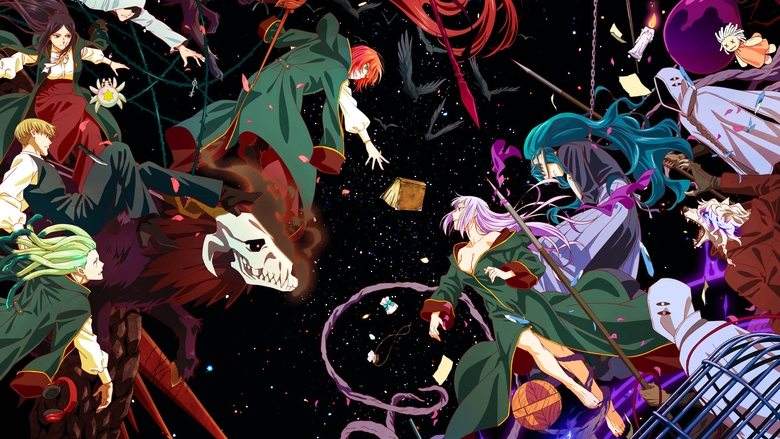
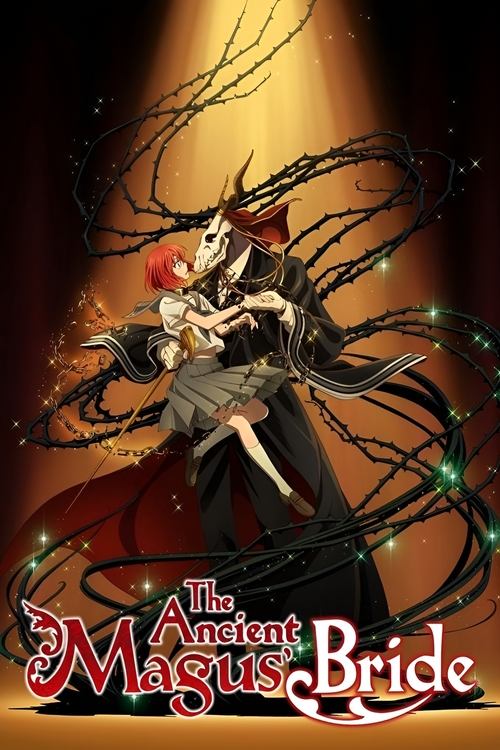
A haunting tapestry of Celtic myth and modern trauma, where a discarded girl finds a home within the shadow of a skull-headed mage. Magic blooms like blood-red poppies amidst a thicket of protective, stinging thorns.
The Ancient Magus' Bride

The Ancient Magus' Bride

魔法使いの嫁

"Will he bring her the light she desperately needs, or drown her in ever deeper shadows?"

08 October 2017 — 21 December 2023 Japan 2 season 48 episode Ended ⭐ 8.4 (412)
Cast: Atsumi Tanezaki, Ryota Takeuchi, Aya Endo, Koki Uchiyama, Satoshi Hino
Drama Animation Sci-Fi & Fantasy Action & Adventure
Healing and Trauma The Duality of Magic Belonging and Identity The Ethics of Care

Overview

The Ancient Magus' Bride follows the journey of Chise Hatori, a teenage girl who has lived a life of isolation and abuse due to her ability to see supernatural beings. Desperate for a place to belong, she sells herself at a magical auction, where she is purchased by Elias Ainsworth, a powerful but socially stunted magus with a canine skull for a head. Elias takes her to his home in rural England, declaring her his apprentice and his future bride, initiating a slow-burning exploration of what it means to be human and the weight of finding a family.

Across two seasons, the narrative expands from the reclusive, whimsical atmosphere of Elias’s cottage into the broader world of the College, a secret society of sorcerers. While the first season focuses on Chise’s survival and her struggle to value her own life, the second season dives into the complex politics of magical lineage and the trauma of familial expectations. The series masterfully balances pastoral beauty with Lovecraftian horror, emphasizing that magic is not a whimsical tool but a volatile force that demands an equal price for every miracle performed.


Core Meaning

At its heart, the series is a profound study of healing from deep-seated trauma and the transition from unhealthy co-dependency to mutual autonomy. It posits that love is not necessarily about possession or traditional romance, but about the slow, painful work of understanding another person’s soul. Through Chise and Elias, the creators explore the idea that monsters and humans are not so different: both are capable of immense cruelty and profound kindness, and both must learn that their worth is not determined by their utility to others, but by their inherent right to exist.

Thematic DNA

Healing and Trauma 35%
The Duality of Magic 25%
Belonging and Identity 20%
The Ethics of Care 20%

Healing and Trauma

The central pillar of the series is Chise’s slow recovery from suicidal ideation and abandonment. This theme evolves from Chise merely surviving her circumstances to her actively choosing to live, even while carrying the literal and metaphorical scars of her past. In Season 2, this theme extends to other characters like Philomela, showing that healing is a communal process of breaking generational cycles.

The Duality of Magic

Magic is depicted as both a source of wonder and a terrifying burden. It is intrinsically tied to nature and folklore, requiring sacrifice and balance. Throughout the show, magic acts as a metaphor for the characters' internal states—unstable, beautiful, and potentially self-destructive if not tempered by self-worth and restraint.

Belonging and Identity

Both Chise and Elias are outsiders; one is a Sleigh Beggy (a rare, fragile magic user) and the other is an ancient being who is neither human nor fae. Their journey is a search for a place where they are not viewed as tools or monsters, ultimately finding that 'home' is a space they must create through vulnerability and trust.

The Ethics of Care

The series constantly questions the boundaries of care. Elias’s early 'ownership' of Chise is problematic and explored as such; the show deconstructs the 'Beauty and the Beast' trope by highlighting how his protection can become possessive and stifling, forcing both characters to redefine their relationship as one of equals.

Character Analysis

Chise Hatori

Atsumi Tanezaki

Archetype: The Resilient Survivor
Key Trait: Empathy

Motivation

Originally driven by a desperate need to be 'needed' by anyone, her motivation matures into a desire to protect her found family and help others who suffer from similar loneliness.

Character Arc

Chise begins as a girl who has completely given up on life, selling herself because she sees no value in her own existence. Over two seasons, she grows from a submissive apprentice into a confident sorcerer who learns to set boundaries and value her own well-being over self-sacrifice.

Elias Ainsworth

Ryota Takeuchi

Archetype: The Inhuman Mentor
Key Trait: Emotional Naivety

Motivation

Driven by a profound curiosity about humanity and a deep-seated fear of being alone again, which initially manifests as controlling behavior.

Character Arc

Elias starts as a powerful mage with no understanding of human emotion, behaving like a curious but often possessive child. Through Chise, he learns the nuances of jealousy, fear, and love, eventually transitioning from a 'buyer' to a partner who respects Chise’s autonomy.

Ruth

Koki Uchiyama

Archetype: The Loyal Guardian
Key Trait: Unwavering Loyalty

Motivation

To protect Chise at all costs, acting as both her shadow and her conscience.

Character Arc

Once a grieving Church Grim named Ulysse, he finds new purpose as Chise's familiar. His arc is one of absolute devotion, as he shares Chise's physical and emotional pain through their soul-bond.

Philomela Sergeant

Maki Kawase

Archetype: The Broken Successor
Key Trait: Repressed Strength

Motivation

A desperate, fearful drive to meet her family's impossible expectations until she finds the courage to seek help.

Character Arc

The primary focus of Season 2, she begins as a hollowed-out puppet of her grandmother’s ambitions. Through Chise's intervention, she eventually breaks her internal silence and finds the strength to claim her own life.

Symbols & Motifs

Poppy Flowers

Meaning:

Symbolizes remembrance, sleep, and the cycle of death and rebirth. They are tied to Chise’s memories of her mother and represent the fragile beauty of her magic.

Context:

Used in Chise's first magical lesson and appearing frequently in her dreams and the opening sequences to signify her emotional growth and the lingering impact of her mother's suicide.

Thorns

Meaning:

Represents protection, pain, and isolation. Thorns are a literal part of Elias’s magic (he is the 'Child of Thorns') and symbolize the barriers the characters build to keep others away.

Context:

Elias uses thorns to defend Chise, but they also symbolize the 'stinging' nature of his own unrefined emotions and the prickly path of their relationship development.

The Collar and Necklace

Meaning:

Initially a symbol of slavery and possession, it is transformed into a symbol of protection and chosen connection.

Context:

The collar Chise wears at the auction is replaced by a magical stone necklace crafted by Elias, marking her transition from a slave to an apprentice with a permanent home.

The Dragon's Arm

Meaning:

Symbolizes the burden of survival and the physical manifestation of sacrifice.

Context:

After Chise absorbs a dragon's curse, her arm becomes a blackened, claw-like limb, serving as a constant reminder of the price she pays for her selflessness.

Memorable Quotes

I don't care if you treat me like a toy... but please, don't throw me away.

— Chise Hatori

Context:

Season 1, Episode 1. Chise speaks this to Elias upon arriving at his cottage, revealing her traumatic need for belonging.

Meaning:

Highlights the depths of Chise's early desperation and lack of self-worth.

You are not a tool. You are a person.

— Elias Ainsworth

Context:

Season 1, Episode 2. Elias counters Chise's self-deprecating view during their first days together.

Meaning:

A pivotal moment where Elias defines Chise's humanity, even if he doesn't fully understand it yet.

Magic is not something that makes things happen. It is something that allows them to happen.

— Angelica Varley

Context:

Season 1, Episode 2. During Chise's first lesson in alchemy and magic.

Meaning:

Explains the core philosophy of magic in this world—it is about facilitation and nature, not brute force.

Episode Highlights

April showers bring May flowers.

S1E1

The introduction of the magical world and the subversion of the slave-auction trope. It establishes the atmospheric tone and the initial dynamic between Chise and Elias.

Significance:

Sets the foundation for the entire series' exploration of belonging and the 'Sleigh Beggy' condition.

No need to keep your head down.

S1E12

Chise completes her wand-making process, involving a flight as a phoenix and a confrontation with her past.

Significance:

A major turning point where Chise accepts her future as a mage and begins to lift her head from her depression.

Live and let live.

S1E24

The finale of the first season where Chise and Elias exchange rings and reach a tentative, more healthy understanding of their bond.

Significance:

Resolves the primary conflict with Cartaphilus and sets the stage for Chise's entry into the human-magical society.

Conspicuous consumption.

S2E12

The climax of the first half of the College arc, where the mysteries of the forbidden book and the students' pasts begin to collide.

Significance:

Shifts the stakes from personal survival to preventing a larger magical catastrophe within the College.

The Ancient Magus' Bride

S2E24

The resolution of the Philomela arc and the reinforcement of Chise’s growth as a mentor and friend.

Significance:

Concludes the major threads of the College arc, emphasizing themes of community and the breaking of toxic family chains.

Philosophical Questions

Does a person's worth depend on their utility to others?

The series explores this through Chise’s belief that she only deserves a place to stay if she is a useful 'tool' for Elias, eventually deconstructing this into the realization that life has inherent value regardless of usefulness.

What defines a 'monster' vs. a 'human'?

By presenting a skull-headed mage who is kinder than many humans, and a 'heroic' girl capable of cold sacrifice, the show suggests that humanity is a set of choices rather than a physical form.

Alternative Interpretations

One popular interpretation is that Elias serves as a metaphor for neurodivergence; his struggle to understand social cues and facial expressions resonates with viewers on the autism spectrum. Another reading focuses on the series as a critique of the 'Savior Complex'—arguing that the show actually highlights how dangerous it is when characters (like early Chise) try to find their value solely through being 'useful' or self-sacrificing for others. Some audiences also view the 'Bride' aspect not as a romantic goal, but as a symbolic 'contract of permanence' in a world where everything else is fleeting.

Cultural Impact

The series is widely regarded as a modern anime classic for its sophisticated treatment of mental health and its rejection of typical 'harem' or 'isekai' tropes. It revitalized interest in authentic European folklore within the anime medium, moving away from generic fantasy settings toward a meticulously researched, atmospheric world. Critics have praised it for its pacing and emotional maturity, noting that it handles sensitive topics like slavery and suicide with a gravity rarely seen in the genre. Its legacy lies in being a standard-bearer for 'healing' anime (Iyashikei) that doesn't shy away from the darkness that makes healing necessary.

Audience Reception

Audience reception has been consistently high but polarized regarding the show’s premise. While the 'master/slave' starting point was controversial for some Western viewers, the vast majority of the audience praised the show for how it immediately begins to subvert and critique that dynamic. Season 1 was lauded for its breathtaking visuals and world-building, while Season 2 received praise for its ensemble cast and the psychological depth of the College arc. The shift in studios was met with initial apprehension but ultimately won fans over with Studio Kafka’s dedication to the source material's intricate magic systems.

Interesting Facts

  • The creator, Kore Yamazaki, personally traveled to England to research the landscapes and folklore for the series.
  • The term 'Sleigh Beggy' is derived from Manx folklore, where it refers to the 'Little People' or fairies.
  • Production shifted from Wit Studio (Season 1) to Studio Kafka (Season 2), a studio largely formed to continue this specific series.
  • Chise's eyes change from a dull, lifeless green to a vibrant, glowing shade as she gains magical proficiency and emotional stability.
  • The character design for Elias was inspired by traditional depictions of spirits from various European mythologies, blending wolf and goat features.

Easter Eggs

Celtic and English Folklore Cameos

Beings like the Leanan Sidhe, Selkies, and The Wild Hunt appear not just as background characters but as accurate representations of their mythological roots, rewarding viewers familiar with European lore.

The 'Thistle' and 'Thorn' Naming

Elias is often called 'Thorn,' while Chise is associated with flowers. This references the traditional 'Thistle and the Rose' imagery, symbolizing a protective but painful union.

⚠️ Spoiler Analysis

Click to reveal detailed analysis with spoilers

Frequently Asked Questions

Explore More About This Movie

Dive deeper into specific aspects of the movie with our detailed analysis pages

Comments (0)

Leave a comment

No comments yet. Be the first to share your thoughts!