Skip to content
Shakugan no Shana
A fiery urban fantasy where ordinary school days flicker beside silent blue flames, and a sword-wielding girl learns tenderness. Wistful, thrilling and aching, like a candle held steady against a storm of crimson sky.
Shakugan no Shana

Shakugan no Shana

灼眼のシャナ

06 October 2005 — 23 March 2012 Japan 3 season 72 episode Ended 7.4 (109)

Cast: Satoshi Hino, Rie Kugimiya, Masashi Ebara, Hitomi Nabatame, Mitsuo Iwata

Drama Animation Sci-Fi & Fantasy Action & Adventure Comedy Identity and being named Love versus duty Existence, loss and memory Balance of the worlds and coexistence Growth and the cost of war

Overview

Shakugan no Shana is a light-novel adaptation by J.C.Staff, based on the work of Yashichiro Takahashi with illustrations by Noizi Ito. It is set in Misaki City, where an age-old conflict plays out between the human world and the Crimson Realm. Crimson Denizens, called Tomogara, devour the "existence" of humans, which upsets the balance between worlds. Flame Hazes, human hosts bonded to Denizens, hunt them down. Humans killed this way are replaced by "Torches", fading stand-ins that keep the world from noticing the loss.

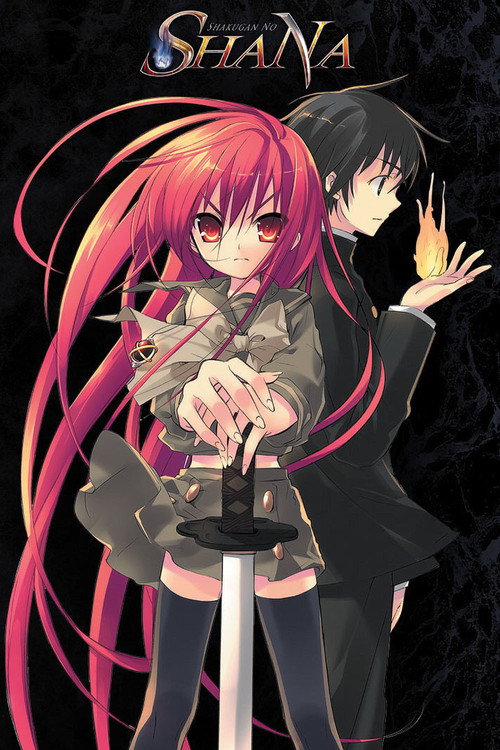
The story follows Yuji Sakai, an ordinary student who learns he is already a Torch. He befriends a young Flame Haze and names her "Shana" after her sword. She is cold, disciplined and defined by duty, and he is gentle and stubborn. Together with the Denizen Alastor, they face escalating threats from the Bal Masque faction and its scheming leaders.

Across three 24-episode seasons the show moves from monster-of-the-week encounters to a large war over the nature of the world. Along the way it follows a love triangle with the classmate Kazumi Yoshida, a growing cast of Flame Hazes and Denizens, and the question of what Shana and Yuji can become to each other.
Core Meaning

The series is about how a being built for a single purpose can gain a self, and about love as a force that changes that purpose. Shana starts as a weapon, a vessel for the "Flame-Haired Blazing-Eyed Hunter" with no name of her own. The act of being named, and later of being loved, lets her choose her own beliefs. She comes to see herself as Shana rather than as a role.

The final arc turns this into a conflict of ideals. Yuji wants to end the endless war by building a new world, and Shana won't accept a peace bought through betrayal and sacrifice. The resolution rejects both lonely duty and lonely penance. Peace comes through shared responsibility, with Shana choosing to walk beside Yuji instead of letting him atone alone.

Thematic DNA

Identity and being named 28%
Love versus duty 27%
Existence, loss and memory 20%
Balance of the worlds and coexistence 15%
Growth and the cost of war 10%

Identity and being named

Shana begins without a name, defined as a Flame Haze and a vessel. Yuji's naming of her opens a long journey toward selfhood. By the final season she separates herself from the legendary Hunter and declares she fights for her own beliefs.

Love versus duty

The Shana–Yuji–Kazumi triangle runs through all three seasons. It is resolved in the finale, when Shana's love becomes a source of strength and resolve instead of a weakness.

Existence, loss and memory

Humans devoured by Denizens vanish from the world's memory, and Torches are fading remnants. Yuji's own status as a Torch frames the series. Letters that survive his disappearance in the final season become a sign that he still exists.

Balance of the worlds and coexistence

The Flame Hazes defend balance, while Bal Masque seeks a place where Denizens need not feed on humans. The final season turns this into a moral debate over whether a perfect world can justify the means used to build it.

Growth and the cost of war

Shana grows from a lone fighter into a strategist and leader. Yuji grows from a passive bystander into a powerful, willing sacrificer, and both have to face what they have done.

Character Analysis

Shana

Rie Kugimiya

Archetype: Reluctant warrior hero Key Trait: Fierce tsundere pride that hides tenderness

Motivation

At first, to carry out her duty of keeping the world in balance. Later, to protect Yuji and to make her own choices.

Character Arc

She starts as a cold, duty-bound Flame Haze with no name. Through daily life in Misaki City and her bond with Yuji she learns to feel. In the final season she separates her own will from the legendary Hunter, becomes a leader and strategist, and fights Yuji to stop his plan. She then insists on going with him to Xanadu.

Yuji Sakai

Satoshi Hino

Archetype: Gentle everyman turned tragic idealist Key Trait: Kind but dangerously self-sacrificing

Motivation

To keep those he loves safe and end the cycle of bloodshed, even by unforgivable means.

Character Arc

He begins as an ordinary student who is calmly accepting of being a Torch. He becomes a capable fighter, then takes a drastic turn when he merges with the Snake of the Festival. He chooses to build a new world for the Denizens, and ends by accepting both Shana's love and the burden of atonement.
All 4 characters and cast

Symbols & Motifs

Flames and crimson light

Meaning: Power, existence and consumption, and also warmth and passion.
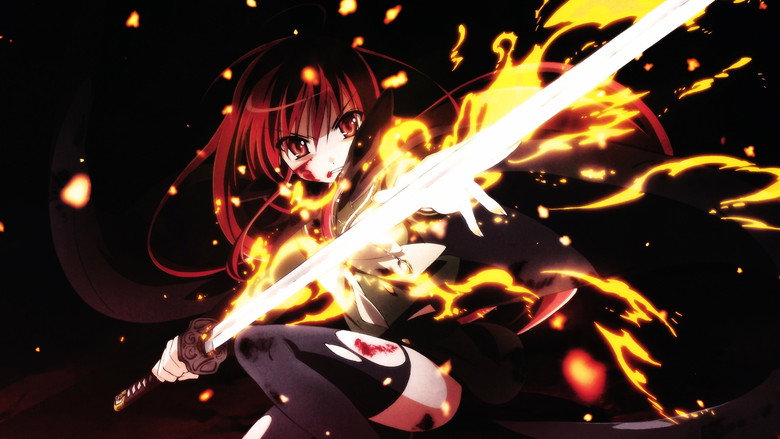
Context: Flame Hazes and Crimson Denizens are tied to fire, and Shana's burning hair and eyes mark her fighting self. The same fire softens as her feelings for Yuji grow.

The name "Shana"

Meaning: Selfhood granted by another person.
Context: In episode 1 Yuji names her after her sword, Nietono no Shana. It begins her transformation from a title into a person.

Torches

Meaning: Fading existence and borrowed time.
Context: Torches are stand-ins for the dead, burning down until they vanish. Yuji's status as one defines his early role and later sacrifices.

Letters

Meaning: Proof of connection that outlasts erasure.
Context: After Yuji disappears in the final season, the letters sent by Shana and Kazumi persist, which tells Shana he is still alive.

Melon bread

Meaning: Shana's growing human side and her ordinary pleasures.
Context: Shana's love of melon bread is a running gag that humanizes her and marks her adjustment to daily life.

Xanadu

Meaning: An idealized world and the price of utopia.
Context: The new world Yuji and the Snake of the Festival create in the final season. Shana adds a law forbidding the Denizens from eating humans.

Memorable Quotes

うるさい、うるさい、うるさい!
— Shana

Context

Used throughout the series whenever she is upset, annoyed or flustered.

Meaning

Her catchphrase, a cry of embarrassment and defiance that covers her vulnerability. It is rendered in English as "Shut up! Shut up! Shut up!"
Nietono no Shana. Then, your name is Shana.
— Yuji Sakai

Context

Episode 1, when Yuji first meets the Flame Haze, who tells him she has no name and is known only by her sword.

Meaning

The act of naming that gives the heroine a self and starts the central relationship.
All 4 quotes

Episode Highlights

The End of Everything

S1E1
Yuji is attacked and learns he is a Torch. He meets the Flame Haze he will name Shana.
Significance: Establishes the world, the central relationship and the naming that drives her arc.

Season 1 finale

S1E24
Shana confesses her love to Yuji at the end of the season, but he cannot hear it.
Significance: Sets up the romantic tension that carries through later seasons.

Season 2 finale

S2E24
A catastrophic battle against the Silver ends with Shana finally confessing and Yuji choosing her over Kazumi Yoshida.
Significance: Settles the romantic triangle for the time being and raises Yuji's hidden potential.

Yuji's disappearance

S3E1
Shana and Kazumi wait for Yuji at their separate locations, but he has vanished without a trace.
Significance: Starts the final war, and the surviving letters hint he still exists.

Shana imprisoned in the Seireiden

S3E13
Shana, imprisoned, goes through a psychological confrontation with Yuji and her own doubts. She then escapes and resolves to face him.
Significance: The turning point where she finds her resolve and gains the strength to oppose him.

Final episode

S3E24
The war over Xanadu ends. Yuji accepts Shana's love and the two kiss, then depart for the new world together.
Significance: Concludes the entire series, resolving both the romance and the conflict between the worlds.

Philosophical Questions

Can a perfect world justify the means used to create it?

Yuji joins the Snake of the Festival to build Xanadu, a world where Denizens need not devour humans. The Flame Hazes see this as a violation of balance and a betrayal. The series lets both arguments stand before Shana resolves the conflict with a law forbidding the consumption of humans.

Does a person exist if the world forgets them?

Humans eaten by Denizens vanish from memory and are replaced by Torches. Yuji's own status as a Torch and his disappearance raise the question of what existence means. The letters that remain suggest that connections persist beyond erasure.

Is identity given or chosen?

Shana is a vessel with a title but no name until Yuji names her. Her arc is a movement from received identity to chosen identity.

How It Ends

Alternative Interpretations

Some viewers read the finale as an affirmation of romantic love as the strongest "spell", the series' answer to cosmic problems. Others read it as a story of atonement: Yuji's choice to travel to Xanadu is a penance for his killings, and Shana's insistence on joining him reframes that penance as shared responsibility rather than solitary punishment.

Full ending explanation

Cultural Impact

Shakugan no Shana arrived in the mid-2000s light-novel boom. One AniDB commenter argued that, while Haruhi Suzumiya helped make light-novel adaptations popular, Shana helped popularize urban fantasy and "battle harem" stories. Its tsundere heroine and catchphrase became widely recognized, and she turns up in references in later anime.

The series ran for seven years across three seasons, a film and OVAs, and the final season concluded the main story. Reception varied by season: the early seasons were widely liked, and the last was mixed. The series remains a popular entry in the genre.

Audience Reception

Reviewers praised the characters, especially the central pair, the action and the soundtrack's strongest themes. Common criticism included uneven pacing, a languid, exposition-heavy start, a love triangle that some felt held back the serious plot, and animation quality that declined over time. One review noted that the first season's weaker spots were pacing and a general lack of substance, though it was still a good diversion.

The final season divided viewers. Anime News Network's review said its climactic battle, spread across about seven episodes, delivered the large-scale payoff many wanted. Other reviewers called the season a disappointment, criticized the characters and said it sold fewer volumes than earlier seasons. Another reviewer felt the plot only truly arrived in the last season.

Interesting Facts

  • Shakugan no Shana began as a light novel series written by Yashichiro Takahashi with illustrations by Noizi Ito.
  • J.C.Staff adapted the series between 2005 and 2012 into three 24-episode television series, a four-episode OVA series, an animated film and a standalone OVA episode.
  • The anime was directed by Takashi Watanabe, with scripts by Yasuko Kobayashi and character designs by Mai Otsuka, who based them on Ito's original concept.
  • The first season aired from October 6, 2005, to March 23, 2006, and Shakugan no Shana II aired from October 5, 2007, to March 28, 2008.
  • A promotional DVD, Prelude to Shana, was released in September 2005.
  • Super-deformed shorts were released under the collective title Shakugan no Shana-tan.
  • The manga adaptation was drawn by Ayato Sasakura, who was appointed to the project from February 2005.
  • A four-episode OVA series, Shakugan no Shana S, was released on BD and DVD from October 23, 2009, to September 29, 2010.

Easter Eggs

Shana appears briefly in a montage in the fifth episode of Eromanga-Sensei, saying her catchphrase.

A nod to her "Shut up!" line and her enduring place in light-novel anime culture.

Frequently Asked Questions

Explore More About This Series

Dive deeper into specific aspects of the series with our detailed analysis pages

Comments (0)

Leave a comment

No comments yet. Be the first to share your thoughts!

Similar Movies