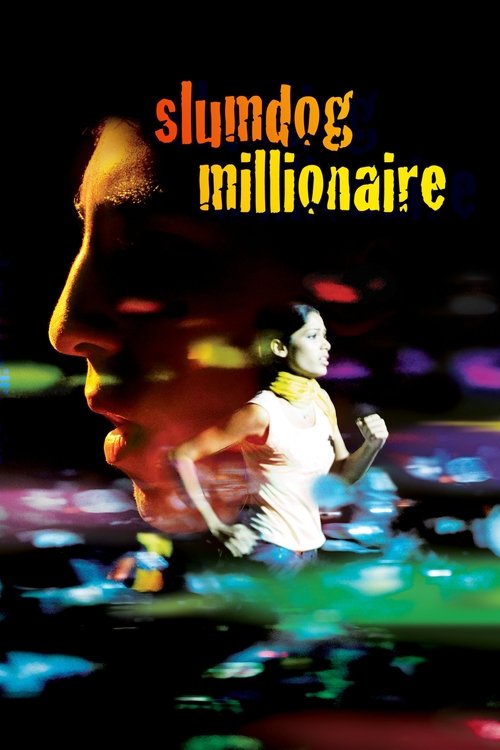
Slumdog Millionaire
A kinetic, vibrant fable where the grit of Mumbai meets the gloss of a game show. Destiny dances with brutality as a slumdog's life flashes before his eyes, proving that some answers are written in the scars of the past.
Slumdog Millionaire

Slumdog Millionaire

"What does it take to find a lost love?"

12 November 2008 United Kingdom 121 min ⭐ 7.7 (11,082)
Director: Danny Boyle
Cast: Dev Patel, Freida Pinto, Madhur Mittal, Anil Kapoor, Mahesh Manjrekar
Drama Romance
Destiny and Fate Knowledge through Experience Brotherhood and Loyalty Poverty vs. Wealth
Budget: $15,000,000
Box Office: $378,400,000

Overview

Slumdog Millionaire tells the riveting story of Jamal Malik, an 18-year-old orphan from the slums of Mumbai, who is one question away from winning a staggering 20 million rupees on India's version of Who Wants to Be a Millionaire?. Arrested on suspicion of cheating, Jamal undergoes a brutal interrogation where he recounts his life history to explain how he knows the answers. Each chapter of his life reveals a key piece of knowledge, demonstrating that his wisdom comes not from books, but from his harrowing struggle for survival.

The narrative weaves through three distinct timelines: the present-day game show, the police interrogation, and the chronological flashbacks of Jamal's life. We follow Jamal and his older brother Salim as they navigate the death of their mother during religious riots, escape child beggars' rings, and survive on the streets. At the heart of Jamal's journey is his enduring love for Latika, a girl from his childhood whom he is determined to find and rescue, believing that their reunion is his ultimate destiny.


Core Meaning

The central message of the film is encapsulated in the phrase "It is written." Danny Boyle explores the concept of destiny not as a passive predetermined path, but as the culmination of one's life experiences, choices, and resilience. The film posits that true knowledge is experiential rather than academic; every tragedy, joy, and struggle in Jamal's life served a purpose, equipping him with the specific wisdom needed to succeed when it mattered most. It is a celebration of the human spirit's ability to triumph over adversity through hope and love.

Thematic DNA

Destiny and Fate 30%
Knowledge through Experience 25%
Brotherhood and Loyalty 25%
Poverty vs. Wealth 20%

Destiny and Fate

The film's tagline, "It is written," drives the narrative. Jamal's success is presented not merely as luck, but as a cosmic alignment of his life's traumatic events with the game show's questions. The film suggests that his unwavering faith in finding Latika is what bends the universe in his favor.

Knowledge through Experience

The film juxtaposes street smarts against book smarts. Jamal, an uneducated "slumdog," outshines the educated elite (represented by the host and the doctor) because his knowledge is visceral and earned through survival, challenging classist assumptions about intelligence.

Brotherhood and Loyalty

The complex relationship between Jamal and Salim forms the film's emotional spine. While Jamal represents innocence and moral steadfastness, Salim embodies the necessary ruthlessness to survive. Despite their divergence, their bond remains unbreakable, culminating in Salim's ultimate act of redemption to protect his brother.

Poverty vs. Wealth

The film visually and thematically contrasts the extreme poverty of the Juhu slums with the glittering, superficial world of the game show and the emerging modern India. It critiques the disparity of wealth and the corruption that often accompanies upward mobility.

Character Analysis

Jamal Malik

Dev Patel

Archetype: The Resilient Hero
Key Trait: Unwavering Hope

Motivation

His sole motivation is Love. He joins the game show not for the money, but because he knows Latika watches it, hoping she will see him.

Character Arc

Jamal transitions from a vulnerable orphan to a national icon. His journey is one of steadfastness rather than change; he remains morally pure and focused on his goal (Latika) despite the corruption around him. He refuses to let the cruelty of the world harden him.

Salim Malik

Madhur Mittal

Archetype: The Tragic Protector / Anti-Hero
Key Trait: Ruthless Pragmatism

Motivation

Driven by a desire for Power and Survival. He believes money and dominance are the only ways to escape the slums.

Character Arc

Salim starts as a protective brother but descends into a life of crime and violence to survive. He becomes the antagonist to Jamal's innocence but ultimately redeems himself through a final act of self-sacrifice, allowing Jamal and Latika to escape.

Latika

Freida Pinto

Archetype: The Damsel / The Beacon
Key Trait: Endurance

Motivation

She seeks Freedom and Safety, which she ultimately finds through Jamal's persistence.

Character Arc

Latika endures a life of abuse and entrapment, serving as the passive object of Jamal's quest. While she suffers greatly, she maintains a flicker of hope, represented by her eventual attempt to answer the phone and reconnect with Jamal.

Prem Kumar

Anil Kapoor

Archetype: The Gatekeeper / Antagonist
Key Trait: Deceit

Motivation

Motivated by Ego and Control. He cannot accept that a "slumdog" could share his pedestal.

Character Arc

Prem represents the corrupt establishment. He pretends to be a benevolent mentor but is revealed to be jealous and manipulative, trying to sabotage Jamal to protect his own ego and the show's status.

Symbols & Motifs

The Yellow Motif

Meaning:

Yellow symbolizes hope, destiny, and Latika. It is the color that cuts through the grime of the slums to guide Jamal.

Context:

Latika wears yellow as a child, and again as an adult at the train station. The color acts as a visual anchor for Jamal, signifying that she is his ultimate prize, far more valuable than the money.

Trains

Meaning:

Trains represent movement, separation, and the passage of time. They are the vessels that carry the brothers away from their childhood and towards their fate.

Context:

Many pivotal scenes occur on or near trains: the brothers' escape from the beggars' ring, their life as chai-wallahs, and the heartbreaking separation from Latika. The train station is also the site of their final reunion.

The Three Musketeers

Meaning:

The story symbolizes the unbreakable bond between Jamal, Salim, and Latika, despite their lack of understanding of the actual literature.

Context:

Introduced in a school lesson they barely attended, the motif recurs throughout their lives. Jamal and Salim are Athos and Porthos, and Latika becomes the "Third Musketeer." Ironically, the final winning question asks for the name of the third musketeer (Aramis), completing the circle.

The Coin

Meaning:

The coin represents arbitrary decision-making versus destiny. It suggests that while some things are left to chance, others are fated.

Context:

Salim uses a coin to make pivotal decisions. In the film, it underscores his role as the one who takes charge of their fate, often protecting Jamal from the burden of difficult choices.

Memorable Quotes

It is written.

— Jamal Malik / Title Card

Context:

Appears as the answer to the multiple-choice question at the very beginning of the film and is spoken by Jamal at the end.

Meaning:

This is the film's definitive statement on destiny. It asserts that Jamal's victory was not luck, but a preordained conclusion to his life's journey.

I will wait for you. At the train station. Every day at 5.

— Jamal Malik

Context:

Spoken to Latika when they are briefly reunited, setting up the location for the film's climax.

Meaning:

Demonstrates Jamal's unconditional commitment and the simplicity of his desire. He doesn't want wealth; he just wants connection.

When somebody asks me a question, I tell them the answer.

— Jamal Malik

Context:

During the intense police interrogation when the inspector asks how he knows the answers.

Meaning:

Highlights Jamal's innocence and honesty. He is baffled by the accusations of cheating because, to him, the truth is simple and self-evident.

You wanted to see the real India? Here it is.

— Salim Malik

Context:

Salim says this while they are stripping parts from a car, showing the harsh survivalist nature of their existence.

Meaning:

A cynical commentary on poverty tourism and the brutal reality of their lives compared to the romanticized view of tourists.

Philosophical Questions

Is destiny predetermined or created by our choices?

The film presents the answer D: It is written. However, it explores this by showing that Jamal's 'destiny' was actually forged through his specific choices to survive, to be kind, and to pursue love. The film asks whether 'fate' is just the retrospective name we give to the outcomes of our persistence and character.

What is the value of 'useless' knowledge?

The film validates the knowledge of the subaltern—the street urchin—over the formal education of the elite. It questions what constitutes 'intelligence,' contrasting the memorized facts of the trivia game with the lived, often traumatic experiences that provided Jamal with the answers.

Alternative Interpretations

The 'Dying Dream' Theory: Some critics and viewers interpret the entire game show sequence and the happy ending as a hallucination or a dying dream. This theory suggests Jamal might not have survived the police torture, and the 'perfect' alignment of questions and the Bollywood dance ending represent his final fantasy of success and reunion, contrasting sharply with the bleak reality shown throughout the rest of the film. Another reading suggests the film is a modern fairy tale rather than a realistic drama, deliberately using archetypes and coincidences to function as a fable about the triumph of the human spirit over crushing socio-economic forces.

Cultural Impact

Slumdog Millionaire became a global phenomenon, winning 8 Academy Awards including Best Picture. It was hailed in the West as a masterpiece of kinetic energy and emotional storytelling, reviving interest in non-linear narratives and 'foreign' settings in mainstream Hollywood. However, in India, the reception was polarized. While many celebrated the involvement of A.R. Rahman and Resul Pookutty, critics and social commentators debated the film's title (specifically the use of 'dog') and accused it of 'poverty porn'—peddling images of Indian squalor for Western entertainment. Despite this, it launched the careers of Dev Patel and Freida Pinto and popularized the phrase 'Jai Ho' globally.

Audience Reception

Audiences worldwide were largely captivated by the film's energy, soundtrack, and emotional core. It holds a high score on Rotten Tomatoes and IMDB, with viewers praising the editing and the 'feel-good' underdog story. Western audiences found it an eye-opening, if stylized, look at India. However, some Indian audiences found the accents inauthentic (specifically the British-tinged English spoken by street kids) and felt the depiction of Mumbai was one-dimensional, focusing only on grime and crime while ignoring the city's complexity and middle class.

Interesting Facts

  • The pile of excrement Jamal jumps into to get Amitabh Bachchan's autograph was actually a mixture of peanut butter and chocolate.
  • Director Danny Boyle placed the money for the three child actors in a trust that was payable to them upon the completion of their education at 16 years old.
  • Approximately 20% of the film's dialogue is in Hindi, which was a specific request by Danny Boyle to maintain authenticity.
  • Boyle decided to use the silicon-imaging SI-2K digital camera for many scenes in the slums because it was small enough to not disturb the locals and allowed for greater agility.
  • The role of the game show host was originally offered to Shah Rukh Khan, who was the actual host of 'Kaun Banega Crorepati' at the time, but he turned it down.
  • Mercedes-Benz asked that their logos be removed from scenes taking place in the slums, fearing negative brand association.
  • The final dance number, 'Jai Ho', was choreographed by Longinus Fernandes, who was accidentally omitted from the credits. Danny Boyle publicly apologized and thanked him during his Oscar acceptance speech.

Easter Eggs

Amitabh Bachchan Reference

The film opens with Jamal desperately seeking an autograph from Amitabh Bachchan. In real life, Bachchan was the original host of the Indian version of Who Wants to Be a Millionaire?, adding a layer of meta-commentary to the game show setting.

Orpheus and Eurydice Opera

When the boys are stealing shoes at the opera, the performance on stage is of Orpheus and Eurydice. This mirrors the film's plot: a hero descending into the 'underworld' (the criminal underbelly of Mumbai) to rescue his beloved.

M.I.A.'s 'Paper Planes'

The song plays during the montage of the brothers traveling by train. M.I.A. herself is of Sri Lankan Tamil descent and her music often deals with themes of the third world, immigration, and poverty, aligning perfectly with the film's tone.

⚠️ Spoiler Analysis

Click to reveal detailed analysis with spoilers

Frequently Asked Questions

Explore More About This Movie

Dive deeper into specific aspects of the movie with our detailed analysis pages

Comments (0)

Leave a comment

No comments yet. Be the first to share your thoughts!