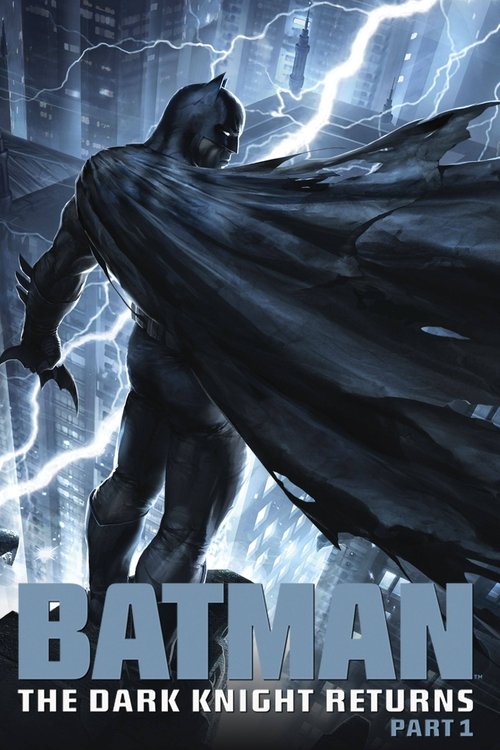
Batman: The Dark Knight Returns, Part 1
"Old heroes never die. They just get darker."
Overview
Ten years after retiring, an aging Bruce Wayne watches Gotham City succumb to a new breed of criminal chaos led by the barbaric Mutant gang. Tormented by the memory of his parents' murder and the restless inner demon that is the Batman, Wayne is forced to don the cape and cowl once more. His return is sparked by the reappearance of a rehabilitated Harvey Dent, whose physical restoration hides a shattered psyche.
As the Dark Knight wages a brutal war on the streets, he inspires a teenage girl named Carrie Kelley to take up the mantle of Robin. Together, they must dismantle the Mutant gang and confront its monstrous leader in a physical and psychological battle that tests the limits of Batman's endurance and tactical genius. The film culminates in a decisive showdown that re-establishes Batman's dominance while setting the stage for even greater threats.
Core Meaning
The central message of the film is the inescapability of one's true nature and the burden of destiny. Director Jay Oliva, adapting Frank Miller's work, posits that Batman is not a mask Bruce Wayne wears, but rather Bruce Wayne is the mask. The film explores the idea that a hero's drive is a compulsion akin to an addiction, one that cannot be silenced by age or societal pressure. It ultimately suggests that in a corrupt world, true justice requires a terrifying, uncompromising force.
Thematic DNA
Aging and Mortality
Unlike typical superhero narratives, this film highlights the physical limitations of its hero. Bruce is 55, aching, and slower. He must rely on experience, gadgets, and surgical precision rather than brute strength, transforming his age from a weakness into a tactical advantage.
Duality and Identity
The film contrasts Harvey Dent's failed rehabilitation with Bruce's return. While Dent's face is fixed, his mind is wholly consumed by 'Two-Face,' proving that the monster is internal. Conversely, Bruce accepts that his 'monster' (Batman) is his true self, finding wholeness only when he stops suppressing it.
Media Satire and Public Perception
Through constant news broadcasts and talking heads, the film critiques how the media shapes reality. The pundits debate whether Batman is a fascist or a savior, illustrating the polarized public reaction to vigilantism and the media's role in sensationalizing violence.
Legacy and Inspiration
Carrie Kelley represents the new generation inspired by the legend. Unlike previous Robins, she chooses the role herself, symbolizing that the Batman's mission is an idea that can transcend the individual and inspire hope in the youth, even in a bleak future.
Character Analysis
Bruce Wayne / Batman
Peter Weller
Motivation
Guilt, trauma, and an innate inability to stand idly by while his city suffers. He describes his return as a biological necessity, not a choice.
Character Arc
Bruce starts as a restless, death-seeking retiree suppressing his instincts. He transitions into a brutal, focused vigilante who accepts his compulsion. He moves from trying to fight like a young man to fighting like a smart man.
Carrie Kelley / Robin
Ariel Winter
Motivation
Admiration for the Batman and a desire to do something meaningful in apathetic times. She seeks excitement and purpose amidst the decay of Gotham.
Character Arc
An independent teenager who proactively buys her own costume and saves Batman. She proves her worth not through tragedy, but through competence and loyalty, earning her place at his side.
Harvey Dent / Two-Face
Wade Williams
Motivation
A compulsion to destroy and a belief that he is irredeemable. He wants the world to see the ugliness he feels inside.
Character Arc
Despite physical healing, his mind has completely collapsed. He believes his 'good' face is the mask and the scarred monster is his true reality. He spirals into a final act of terrorism before being stopped.
Mutant Leader
Gary Anthony Williams
Motivation
Dominance, chaos, and the primal urge to rule the weak.
Character Arc
The alpha predator of Gotham who believes might makes right. He defeats Batman initially but is physically and ideologically dismantled in their second encounter, losing his army to the victor.
Symbols & Motifs
The Mudhole
It symbolizes the primal, messy, and grounded nature of Batman's rebirth. It represents the stripping away of technology and wealth, forcing Bruce to rely on pure will and instinct.
During the climactic fight with the Mutant Leader, Batman drags him into a deep mud pit, neutralizing the Leader's speed advantage and turning the fight into a brawl where experience wins.
Two-Face's Coin
A symbol of the illusion of choice and the inescapability of fate. Even when the coin is 'clean' on both sides, Dent's psyche forces a binary, fatalistic worldview.
Harvey Dent uses the coin to decide the fate of his victims. When Batman discovers the coin is double-headed (and unscarred), it reveals that Dent's madness has no 'good' side left.
The Bat/The Shadow
Visualized as a demonic, imposing silhouette, it represents the subconscious compulsion and the terrifying power of the Batman persona that haunts Bruce.
In the opening scenes, the shadow of the Bat appears over Bruce, and he sees a bat-like creature breaking through the window in his hallucinations, signaling the inevitable return.
Memorable Quotes
This isn't a mudhole... It's an operating table. And I'm the surgeon.
— Batman
Context:
Spoken during the rematch in the mud pit, as Batman clinically breaks the Mutant Leader down.
Meaning:
This iconic line marks the shift in Batman's strategy. He stops fighting the Mutant Leader with brute force (which failed) and starts dismantling him methodically, targeting specific nerves and joints. It signifies wisdom triumphing over youth.
You don't get it, son.
— Batman
Context:
Right before the 'operating table' line, after the Mutant Leader taunts him.
Meaning:
A dismissal of the Mutant Leader's youthful arrogance. It underscores the generational gap and the difference between a thug who fights for glory and a veteran who fights for survival.
The rain on my chest is a baptism— I'm born again...
— Batman
Context:
Internal monologue (voiceover) as he dons the suit and takes to the rooftops for the first time in a decade.
Meaning:
This quote signifies Bruce Wayne's complete re-acceptance of the Batman identity. He views his return to violence not as a descent, but as a spiritual awakening and cleansing.
At least both sides match now, right?
— Harvey Dent
Context:
Spoken to Batman after he is captured, revealing his face is physically normal but mentally scarred.
Meaning:
Harvey reveals the depth of his dysmorphia. Even with his face surgically repaired, he sees himself as a monster. He believes the reconstruction was the lie, and his 'Two-Face' persona is the truth.
Philosophical Questions
Is true justice possible within the confines of the law?
The film suggests that the legal system is impotent against true chaos (Mutants) and psychological evil (Dent). Batman operates outside the law to achieve what he views as justice, raising the question of whether a 'civilized' society can survive without 'uncivilized' protectors.
Does the hero create the villain?
The media pundits in the film argue that Batman's return stimulates the criminals to ramp up their violence, suggesting a symbiotic relationship. The film asks if Batman is the cure for Gotham's disease or a symptom of it.
Can a person ever truly escape their nature?
Both Bruce Wayne and Harvey Dent attempt to bury their dual identities (Batman and Two-Face) but fail. The film posits a determinist view that one's essential nature (the 'shadow') will always surface, and suppression only leads to madness.
Alternative Interpretations
Some critics and viewers interpret the film as a critique of fascism, where Batman imposes his will on society through force, bypassing the law entirely. Others see it as a satire of the 1980s political climate, with the Mutants representing the fear of urban decay and Batman representing the conservative desire for 'law and order.' A psychological reading suggests the entire plot is a projection of Bruce Wayne's death drive; he seeks out dangerous foes like the Mutant Leader not just to save the city, but to find a worthy death that he was denied in retirement.
Cultural Impact
Batman: The Dark Knight Returns, Part 1 is a faithful adaptation of the graphic novel that fundamentally shifted the comic book medium in 1986. By bringing Frank Miller's 'grim and gritty' vision to animation, the film solidified the modern public perception of Batman as a psychological, brutal, and tank-like figure. It influenced the visual style of live-action films like Batman v Superman: Dawn of Justice (2016) and The Dark Knight Rises (2012). The film proved that adult-oriented, complex animated superhero movies could be commercially successful, paving the way for future DC Universe Animated Original Movies. It remains a touchstone for analyzing the character's psychology and the ethics of vigilantism.
Audience Reception
The film received widespread acclaim from both critics and fans, holding a 100% rating on Rotten Tomatoes. Audiences praised the faithful adaptation of Frank Miller's art style and dialogue, the intense action choreography, and the mature tone. However, some criticism was directed at Peter Weller's voice performance, which some viewers found too monotone and lacking the emotional range of Kevin Conroy. The animation quality was highlighted as a high point, particularly the fluid combat scenes. Overall, it is considered one of the best entries in the DC animated canon.
Interesting Facts
- Peter Weller, who voices Batman, is famous for playing RoboCop (1987). Frank Miller, the author of the original graphic novel, wrote the screenplay for RoboCop 2.
- Ariel Winter, who voices the 13-year-old Carrie Kelley, was actually 14 years old during recording, making her one of the few actors to be age-appropriate for the role of Robin.
- The film was originally planned as a single release but was split into two parts due to the density of the source material.
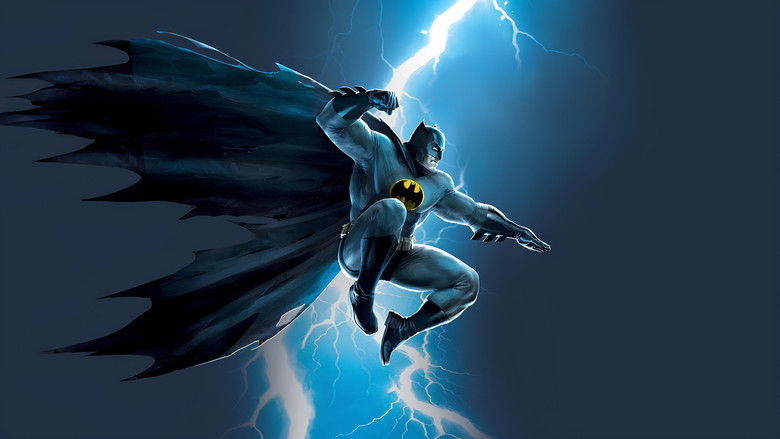
- Director Jay Oliva created a specific storyboard panel that mirrored the famous comic cover of Batman jumping in front of lightning, which appears in the film.
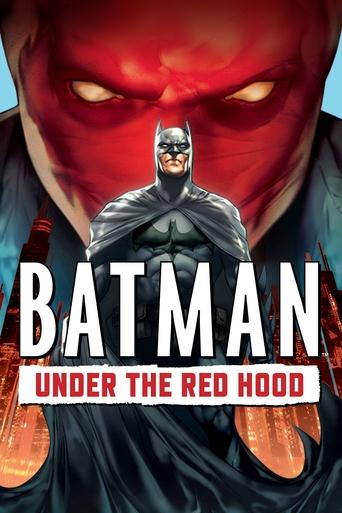
- Wade Williams, who voices Two-Face, previously voiced Black Mask in 'Batman: Under the Red Hood'.
Easter Eggs
DC Graphic Novels on Magazine Rack
In the scene where Commissioner Gordon is at a convenience store, the magazine rack displays covers of seminal 1980s DC comics: Watchmen, V for Vendetta, Sandman, and Swamp Thing. This pays homage to the era that redefined comics alongside The Dark Knight Returns.
Mutant Gang's Sunglasses
The Mutant gang members all wear red, visor-like sunglasses that strongly resemble the visor worn by Cyclops from the X-Men. Frank Miller had previously drawn X-Men comics.
RoboCop Connection
Casting Peter Weller is a meta-reference to Frank Miller's involvement with the RoboCop franchise, linking two iconic dystopian sci-fi properties from the 80s.
⚠️ Spoiler Analysis
Click to reveal detailed analysis with spoilers
Frequently Asked Questions
Explore More About This Movie
Dive deeper into specific aspects of the movie with our detailed analysis pages
Comments (0)
No comments yet. Be the first to share your thoughts!