
Skip to content
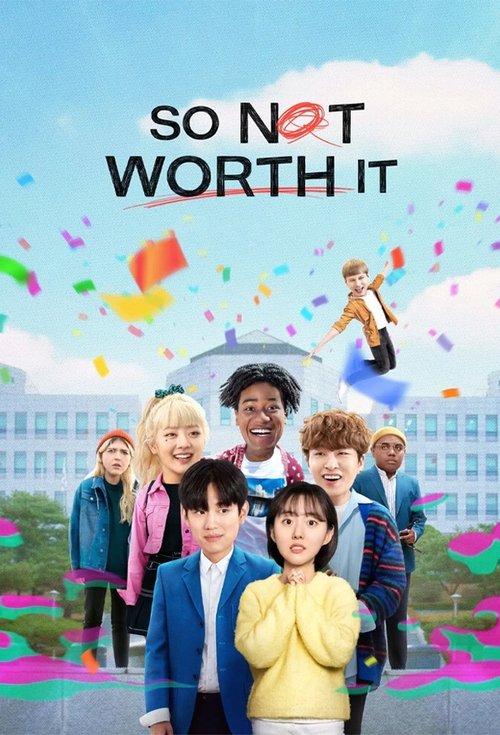
So Not Worth It
A candy-bright dorm comedy where homesickness and hope share a bunk bed — eight strangers from everywhere turn a cramped Seoul residence hall into the loudest, warmest place to survive being twenty.
So Not Worth It

So Not Worth It

내일 지구가 망해버렸으면 좋겠어

18 June 2021 — 18 June 2021 South Korea 1 season 12 episode Ended 7.7 (107)

Cast: Park Se-wan, Shin Hyeon-seung, Choi Young-jae, Minnie, Han Hyun-min

Drama Comedy Multiculturalism and the limits of belonging in Korea Chosen family and communal living Youth precarity and the dread of tomorrow Love, crushes and romantic collision Identity, self-invention and coming out

Overview

So Not Worth It (내일 지구가 망해버렸으면 좋겠어, literally "I wish the Earth would be destroyed tomorrow") is Netflix's first original Korean sitcom, released on 18 June 2021 across twelve episodes. It is set almost entirely inside the international residence hall of a fictional Seoul university, where a group of students from wildly different backgrounds are thrown together by the accident of housing assignment: Se-wan, the Korean resident assistant who runs the dorm; Jamie, a Korean American raised abroad by an adoptive parent; Sam, an Australian-Korean heir to a global food business; Minnie, a Thai student chasing a K-pop idol dream; Hyun-min, a native Korean constantly mistaken for a foreigner because of his dark skin; Hans, a Swedish graduate student; Terris, a Trinbagonian student working through questions about his sexuality; and Carson, an American taekwondo champion.

The show has no grand plot engine. Its arc is the slow conversion of a shared building into a chosen family: roommate feuds, part-time jobs, exam panic, crushes that ricochet around the friend group, visa and money anxieties, and the small daily indignities of being read as an outsider in a culture you are trying to belong to. Directors Kwon Ik-joon and Kim Jung-sik built the format as a deliberate hybrid — the multi-camera rhythms and laugh track of an American sitcom fused with the romance and emotional beats of a K-drama — and the writing team of Seo Eun-jung and Baek Ji-hyun brought lineage from the classic Korean campus sitcom Nonstop.

Across the twelve episodes the series widens from gag-driven vignettes into something quieter: a portrait of a generation that jokes about the world ending tomorrow because tomorrow is precisely what frightens them. Kwon has said the bleak title is a misdirection — the show's actual message is that young people should stop dreading the future long enough to enjoy the day they are in. Only one season was produced.


Core Meaning

The series argues that belonging is built, not inherited. Every resident of the dorm is, in some way, mis-sorted by the categories around them — the Korean who is treated as a foreigner, the foreigner who speaks flawless Korean, the adoptee who is neither, the idol hopeful judged before she opens her mouth. By confining the story to a single building, the show makes the point structurally: identity documents and passports decide nothing about who your people are; proximity, patience and shared noodles do.

Its second, quieter claim lives in the original Korean title. "I wish the Earth would be destroyed tomorrow" is what you say when you have an exam, a rent bill and no plan — apocalyptic language for ordinary dread. Director Kwon Ik-joon framed the title as intentionally bleak against a fundamentally positive show, saying that youth shouldn't worry about tomorrow and should simply enjoy today. The comedy is therefore a coping mechanism made visible: the laugh track is not just a format choice but a thesis, insisting that a life full of unresolved problems is still, minute to minute, funny and worth living.

Thematic DNA

Multiculturalism and the limits of belonging in Korea 28%
Chosen family and communal living 24%
Youth precarity and the dread of tomorrow 20%
Love, crushes and romantic collision 15%
Identity, self-invention and coming out 13%

Multiculturalism and the limits of belonging in Korea

The dorm is a deliberate cross-section: American, Australian-Korean, Thai, Swedish, Trinbagonian and Korean students sharing one kitchen. The series repeatedly stages the gap between legal identity and social reading — most pointedly through Hyun-min, a Korean by birth and language who is constantly addressed as a foreigner because of his skin, and through Jamie, whose Korean face buys him an assumption of fluency he cannot deliver.

Over the run the theme moves from punchline to premise: early episodes mine the misunderstandings for gags, later ones let the characters name the fatigue underneath. Critics were split here — several reviewers noted that after the opening episodes the international characters largely stop using their native languages, which flattens the very difference the show set out to celebrate.

Chosen family and communal living

The residence hall functions as the show's whole world; almost nothing happens off its premises. Roommate assignments turn into alliances, the shared lounge becomes a confessional, and Se-wan's role as RA makes her simultaneously the authority figure and the most emotionally exposed member of the group.

The arc across twelve episodes is the erosion of the door between 'people I live with' and 'people I love'. Conflicts that would end a friendship in a normal drama cannot be escaped here, so they must be metabolised — which is precisely how the group becomes a family.

Youth precarity and the dread of tomorrow

Behind the gags sit part-time jobs, tuition, visas, auditions and the flat terror of graduating into an economy that has no obvious slot for you. The Korean title voices it as gallows humour: better the world ends than that I have to face what comes next.

The show never resolves this anxiety — it reframes it. By the later episodes the characters are no less precarious, but they have each other as insulation, which the series presents as the only realistic answer available to twenty-year-olds.

Love, crushes and romantic collision

Attraction ricochets around a closed group, and the sitcom form lets the series run several romantic threads simultaneously without committing to a single endgame couple. Jamie and Se-wan's push-pull anchors the K-drama half of the hybrid format, while other pairings play as farce.

Because the season ends without tying off every thread, the romance functions less as destination than as ongoing weather — an argument that at this age, love is one more thing you are practising rather than deciding.

Identity, self-invention and coming out

Minnie's idol ambition, Carson's athletic discipline, Sam's inherited fortune and Terris's struggle with his sexuality are all versions of the same question: how much of who you are was assigned to you, and how much can you choose? The dorm, being far from home for most of them, is where that renegotiation is safe enough to attempt.

Terris's storyline in particular treats self-disclosure as a process rather than an event, and remains one of the elements viewers most often cite as unfinished business left for a second season that never arrived.

Character Analysis

Se-wan

Park Se-wan

Archetype: Reluctant caretaker / straight-man protagonist Key Trait: Deadpan competence masking a soft interior

Motivation

Initially: keep the dorm running, keep her own life on track, get through university without complications. Increasingly: protect the eight-person unit she never asked for, and let herself want something — and someone — for her own sake rather than the residents'.

Character Arc

She begins as the dorm's resident assistant — the Korean insider whose job is to enforce rules on people whose lives she has no interest in sharing. The RA badge gives her authority and a convenient excuse for distance.

Across the twelve episodes that professional boundary collapses. Managing the building turns into belonging to it, and by the closing stretch she is no longer the person who keeps order in the group but the person with the most to lose if it dissolves — including in her tangled dynamic with Jamie.

Jamie

Shin Hyun-seung

Archetype: Outsider-hero / fish out of water Key Trait: Disarming openness that keeps colliding with cultural blind spots

Motivation

Starts as a search for origin — understanding where the Korean half of him comes from. Evolves into something less abstract: wanting to be known by specific people rather than claimed by a country.

Character Arc

A Korean American newcomer adopted as a baby by an American pop star, Jamie arrives with a Korean face, a foreign upbringing and no clear place to stand. He is read as local and behaves as a visitor.

His run is the show's identity thesis in one body: he stops trying to pass as either fully Korean or comfortably foreign and instead builds a self out of the dorm's mixed company, with his relationship with Se-wan as the emotional spine of that transition.

All 5 characters and cast

Symbols & Motifs

The international residence hall

Meaning:

A pressure cooker and a sanctuary at once — the physical proof that community can be assembled from strangers, and that you cannot walk away from people who live behind the next wall.

Context:

Nearly every scene occurs inside it. The single-set discipline of the multi-camera sitcom becomes thematic: the building is the only country all eight characters share citizenship in.

The laugh track

Meaning:

The audience made audible — a communal reflex insisting that these small humiliations are survivable. It is also the show's most divisive object, standing for the deliberately imported American sitcom grammar.

Context:

Used throughout as part of the format Kwon Ik-joon and Kim Jung-sik designed to fuse US sitcom with K-drama. Reviewers repeatedly singled it out, some finding it warm and some finding the inserted laughter unbearable.

The apocalyptic title

Meaning:

Youth catastrophising as a form of affection for life. Wishing the world would end tomorrow is what you say when you are overwhelmed today, not when you want to die.

Context:

The Korean title 내일 지구가 망해버렸으면 좋겠어 hangs over a show that is relentlessly warm; the director has explicitly described the title as bleak in contrast to the sitcom's positivity.

Language and accent

Meaning:

The real border in the series — not a passport but a sentence. Who is assumed to speak Korean, who is complimented for speaking it, and who is spoken to in English regardless.

Context:

Runs through Hyun-min's mistaken-for-foreign gags and Jamie's Korean American fluency gap. The gradual disappearance of the characters' native languages after the early episodes became a recurring critical complaint.

Shared food and the dorm kitchen

Meaning:

The lowest-cost form of intimacy available to broke students; eating together is the show's substitute for saying anything sentimental out loud.

Context:

Communal meals and late-night snacks recur as the setting for reconciliations, with Sam's family food-chain fortune supplying the ironic counterpoint of wealth beside instant noodles.

Episode Highlights

Episode 1

S1E1

The series premiere establishes the entire architecture: a single international residence hall at a fictional Seoul university, eight students from six-plus backgrounds, and Se-wan as the RA who has to make them cohabit. It is also the episode that introduces each character through the assumption other people make about them — Jamie's Korean face, Hyun-min's skin, Minnie's accent.

Significance:

Sets the format Netflix had not previously attempted in Korean: a multi-camera sitcom with a laugh track built to marry US sitcom rhythm with K-drama emotion. Everything the season does afterwards is a variation on the introductions made here.

Episode 6

S1E6

The mid-season episode, which sits among the highest-rated instalments of the run on IMDb (9.1), marking the point where the ensemble stops being a set of premises and starts functioning as a group with shared history.

Significance:

The pivot from gag-driven vignettes to serialised feeling — the halfway mark where viewers who stayed past the laugh track typically report the show winning them over.

Episode 11

S1E11

The penultimate episode is the single highest-rated of the series on IMDb (9.3), landing the emotional payoffs that the season's romantic and identity threads have been accumulating since the premiere.

Significance:

Functions as the true climax of the twelve-episode arc, with the finale left to handle aftermath rather than revelation.

Episode 12

S1E12

The season — and, as it turned out, the series — finale. Reviewers consistently noted that several subplots are deliberately left open, structured as a setup for a second season rather than a closed ending.

Significance:

Because no further season followed, this episode retroactively became the show's permanent last word: an ending that reads as a comma, which is central to how audiences discuss the series today.

Philosophical Questions

What actually makes someone belong to a place — birth, language, or the people who claim you?

The series builds its entire cast around mismatches between these three. Hyun-min has birth and language and is still treated as foreign; Jamie has the face and not the fluency; Hans, Minnie, Terris and Carson have neither and make homes anyway. By confining them to one building, the show quietly answers its own question: the dorm becomes the only place where all of them are unambiguously residents.

Is comedy a way of confronting prejudice or a way of making it comfortable?

Racial misreading is the engine of many gags, and the laugh track arrives to soften each one. The show's own critical reception splits along this fault line — some viewers found the humour a disarming entry into an uncomfortable subject, others found the canned laughter a way of coaxing approval for material that deserved sharper handling.

Can you build a family out of people you did not choose?

Room assignments, not affection, put these eight together, and nobody can leave. The season's arc treats forced proximity as a form of moral training: the friendships are earned precisely because escape was never available.

If the future is genuinely frightening, is choosing to enjoy today wisdom or denial?

The Korean title voices the dread; the director's stated message — don't worry about tomorrow, enjoy today — voices the answer. The series never pretends the precarity resolves, so the question stays live: the characters end the season with the same visas, debts and auditions, changed only in who they face them alongside.

Alternative Interpretations

As sincere diversity, or as diversity flattened. The most persistent debate around the show concerns whether it delivers on its own premise. One reading takes the international dorm as a genuine, affectionate argument against Korean insularity, with prejudice named openly through Hyun-min. The counter-reading, voiced by several reviewers, is that the foreign characters function as proof of successful assimilation — their native languages fading after the first couple of episodes, their differences smoothed into a single sitcom register. Both readings are supported by the same twelve episodes.

Full ending explanation

Cultural Impact

So Not Worth It arrived at a specific moment: 2021, with Netflix aggressively expanding its Korean slate after Kingdom and ahead of the global explosion of Squid Game later that same year. It was the platform's first Korean sitcom, and its significance is partly institutional — an attempt to revive a domestic television form (the studio-audience campus sitcom that Nonstop made a national habit in the early 2000s) inside a streaming, subtitle-first, worldwide-release context. The directors' stated ambition was formal hybridity: American sitcom mechanics grafted onto K-drama emotion.

Its more discussed contribution is representational. A Korean-produced series whose ensemble is deliberately Thai, Swedish, Australian-Korean, Trinbagonian, American and Korean was a genuine departure for an industry routinely criticised for treating foreigners as scenery or punchline. Cast members used interviews around the release to talk explicitly about diversity and representation in Korean media, framing the project as a template for what a more plural Korean production could look like. The character of Hyun-min — Korean by birth, foreign by other people's assumptions, played by a model who lives that experience — gave the show a talking point that outlasted its jokes.

Critically the results were mixed. Reviewers welcomed the diversity and the likeability of the cast while faulting the writing for not sustaining twelve episodes, and several argued that the show's international characters end up assimilated into a single Korean-language texture, with their native languages largely disappearing after the opening episodes — which some read as undercutting the premise. No second season followed, so its legacy rests less on longevity than on precedent: proof that a multinational Korean ensemble comedy could be made for a global platform, and a case study in how carefully that has to be executed.

Audience Reception

Reception was warm but qualified. The show holds an IMDb user rating of roughly 6.9, a figure that conceals an unusual pattern: individual episodes are rated dramatically higher by the people who finished the series, with Episode 11 at 9.3 and Episode 6 at 9.1. That gap describes the viewing experience most reviewers reported — a rocky start that converts a portion of the audience by the midpoint.

Praised: the casting and chemistry of the eight leads, with critics noting that the actors do good work with uneven material; the sheer novelty of a Korean production built around a multinational ensemble; the show's willingness to name prejudice, particularly through the character mistaken for a foreigner in his own country; and its vibrant, easy watchability as a low-stakes comfort binge.

Criticised: the writing, which multiple reviewers judged too thin to carry twelve episodes; the handling of diversity, with the common complaint that the international characters stop speaking their native languages after the early episodes and end up serving as models of perfect assimilation; and above all the laugh track, which polarised viewers — some accepted it as part of the deliberate American-sitcom homage, others called the inserted laughter unbearable.

Evolution and verdict: opinion tended to soften over the run, with the strongest audience scores clustered at the end of the season, and fan discussion afterwards was dominated by campaigns and speculation about a second season that never materialised — leaving several storylines, including Terris's, permanently open. The consensus verdict is a likeable, culturally significant experiment whose ambitions outran its scripts: worth watching for the ensemble and for what it attempted, rather than for its comedy craft.

Interesting Facts

  • It is Netflix's first original Korean sitcom, released on 18 June 2021 with 12 episodes.
  • The series was helmed by two directors, Kwon Ik-joon and Kim Jung-sik.
  • Screenwriters Seo Eun-jung and Baek Ji-hyun had previously worked on the first three seasons of the landmark Korean campus sitcom 'Nonstop', giving the show a direct line to Korea's classic sitcom tradition.
  • Director Kim Jung-sik described the concept as combining elements of American sitcoms with elements of K-dramas to create what he called a new genre of television.
  • Director Kwon Ik-joon said the title is deliberately bleak compared to what the sitcom actually is, calling the show 'really positive' and summing up its message as: the youth shouldn't worry about tomorrow, just enjoy today.
  • Kwon also said he realised how special the show was while editing it, remarking that 'these eight kids are so cute and lovely' and that viewers who watch a few episodes might fall for them.
  • An online live press conference was held on 16 June 2021, two days before release, attended by Park Se-wan, the cast, and directors Kwon Ik-joon and Kim Jung-sik.
  • Several cast members are working K-pop idols: Choi Young-jae of GOT7 plays Sam and Minnie of (G)I-DLE plays Minnie.
  • Han Hyun-min, who plays the Korean student constantly mistaken for a foreigner, is a well-known Korean model of Korean-Nigerian heritage, and the storyline draws directly on that lived experience.
  • The show carries an IMDb user rating of around 6.9, with the individual episodes rated far higher by viewers who finished it — Episode 11 sits at 9.3 and Episode 6 at 9.1.

Easter Eggs

Multiple characters share first names with the actors playing them — Se-wan (Park Se-wan), Minnie ((G)I-DLE's Minnie), Hyun-min (Han Hyun-min).

A sitcom convention borrowed from Korean predecessors like Nonstop, where cast members played versions of themselves. It deliberately blurs performer and role and signals the show's lineage.

Minnie plays a Thai student dreaming of becoming a K-pop idol — while the actor is a Thai member of the K-pop group (G)I-DLE who actually achieved that.

The casting turns her storyline into a live double exposure: the audition anxiety on screen is being performed by someone who survived the real version of it.

The writing credit itself is a reference — Seo Eun-jung and Baek Ji-hyun came from the first three seasons of <i>Nonstop</i>.

For Korean viewers this positions So Not Worth It as an heir to the early-2000s campus sitcom boom, which explains the laugh track, the single-set staging and the rotating-crush structure.

Jamie's backstory has him adopted as a baby by an American pop star.

A wink at the celebrity-adoption trope in Western tabloid culture, used to hand a Korean American character an origin that is glamorous and rootless at the same time.

Frequently Asked Questions

Explore More About This Movie

Dive deeper into specific aspects of the movie with our detailed analysis pages

Comments (0)

Leave a comment

No comments yet. Be the first to share your thoughts!

Similar Movies