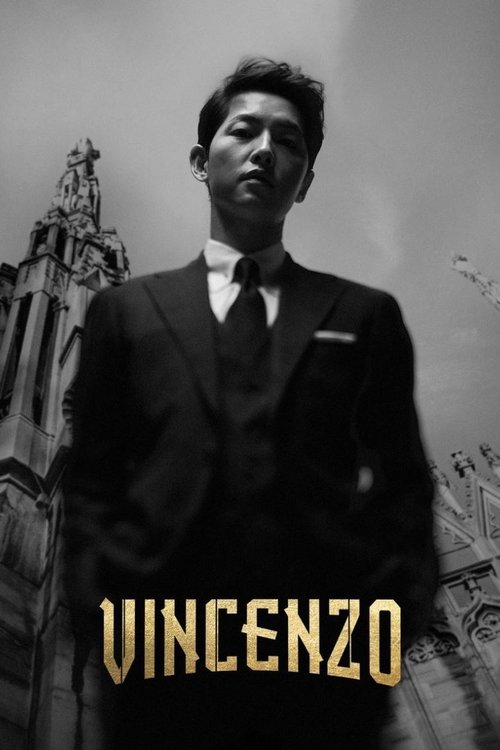
Vincenzo
A dark comedy's sharp suit meets a crime thriller's righteous fury, unfolding like a precisely tailored, blood-spattered opera of vengeance.
Vincenzo

Vincenzo

빈센조

"Only evil can punish evil."

20 February 2021 — 02 May 2021 South Korea 1 season 20 episode Ended ⭐ 8.5 (1,020)
Cast: Song Joong-ki, Jeon Yeo-been, Ok Taec-yeon, Kim Yeo-jin, Kwak Dong-yeon
Drama Action & Adventure Comedy
Justice Through Unconventional Means The Found Family The Corrupting Influence of Power and Greed Duality and Identity

Overview

"Vincenzo" follows the story of Vincenzo Cassano, a Korean-Italian mafia consigliere who returns to his homeland, South Korea, after being betrayed by his organization. His initial goal is to retrieve a massive amount of gold hidden in the basement of Geumga Plaza, a rundown commercial building. However, he soon finds himself entangled with the eccentric tenants of the plaza and their legal battle against the ruthless and corrupt Babel Group, a massive conglomerate that illegally seized the building.

Alongside the sharp and tenacious lawyer Hong Cha-young, whose father was a victim of Babel Group's cruelty, Vincenzo uses his unique and often brutal mafia tactics to fight for justice. What begins as a self-serving mission to recover his gold evolves into a larger war against an untouchable corporate evil. The series masterfully blends dark comedy, thrilling action sequences, and courtroom drama as Vincenzo and the Geumga Plaza residents form an unlikely family, taking on the powerful corporation in a high-stakes game of wits and retribution.

Core Meaning

The core meaning of "Vincenzo" revolves around the idea that evil must be fought with evil. It explores the failures and limitations of a corrupt legal system, suggesting that sometimes, unconventional and even ruthless methods are necessary to achieve true justice for the powerless. The series serves as a cathartic fantasy where a 'dark hero' steps in to punish villains who are beyond the reach of the law. Ultimately, it's a story about finding a new kind of family in an unexpected place and fighting for a cause greater than oneself, even if the methods are morally ambiguous.

Thematic DNA

Justice Through Unconventional Means 35%
The Found Family 30%
The Corrupting Influence of Power and Greed 25%
Duality and Identity 10%

Justice Through Unconventional Means

The central theme is the pursuit of justice when legal systems fail. Vincenzo Cassano, a mafia consigliere, consistently uses methods that are illegal and violent—blackmail, intimidation, and even murder—to punish the corrupt officials and executives of the Babel Group. The series argues that when adversaries operate without a moral compass and manipulate the law, fighting them conventionally is futile. This is contrasted with the initially idealistic approach of Hong Cha-young, who eventually embraces Vincenzo's methods to avenge her father and protect the innocent.

The Found Family

Vincenzo, an outsider who has always felt isolated, unexpectedly finds a sense of belonging with the quirky and loyal tenants of Geumga Plaza. Initially, he sees them as mere obstacles to his gold, but he gradually develops genuine affection and a fierce protectiveness over them. This 'plaza family' becomes his primary motivation, shifting his goals from personal greed to collective justice. Their unwavering support for him, despite his dark background, highlights the theme that family is defined by loyalty and love, not blood.

The Corrupting Influence of Power and Greed

The antagonists, particularly Jang Joon-woo (the real chairman of Babel Group) and Choi Myung-hee (a ruthless prosecutor-turned-corporate lawyer), serve as personifications of unchecked ambition and avarice. They believe their wealth and power place them above the law and morality, leading them to commit heinous acts without remorse. The series provides a scathing critique of corporate and legal corruption, showing how it victimizes ordinary people and erodes the fabric of society.

Duality and Identity

Many characters harbor secret identities. Vincenzo is a mafia lawyer posing as a small-time attorney. The main villain, Jang Joon-woo, masquerades as a cheerful, bumbling legal intern. The Geumga Plaza tenants themselves reveal hidden skills and pasts. This theme explores the contrast between outward appearances and inner realities, suggesting that people are more complex than they seem and that one's true nature will eventually be revealed under pressure.

Character Analysis

Vincenzo Cassano / Park Joo-hyung

Song Joong-ki

Archetype: Anti-hero
Key Trait: Pragmatic Ruthlessness

Motivation

Initially, his motivation is pure greed—securing the 1.5 tons of gold. However, after witnessing the murder of Hong Yoo-chan and the immense suffering caused by Babel Group, his motivation shifts. It becomes a personal vendetta and a mission to deliver justice to those the law cannot touch. His actions are fueled by a desire to protect his new family and punish evil in the only way he knows how.

Character Arc

Vincenzo begins as a cold, self-interested mafia consigliere whose sole purpose in Korea is to retrieve his hidden gold. He is pragmatic and ruthless, viewing the Geumga Plaza tenants as inconveniences. His arc is a gradual thawing of his detached demeanor as he becomes embroiled in their fight. Through his partnership with Hong Cha-young and his growing affection for the plaza residents, he rediscovers his capacity for empathy and justice, albeit delivered through his own violent code. He evolves from fighting for treasure to fighting for people, becoming a dark protector for his new-found family.

Hong Cha-young

Jeon Yeo-been

Archetype: The Ally / The Catalyst
Key Trait: Tenacious Resilience

Motivation

Her primary motivation is to avenge her father's death and dismantle the Babel Group. She is driven by a newfound sense of righteousness and a desire to continue her father's legacy of fighting for the underdog. Her partnership with Vincenzo is fueled by a shared goal and a growing personal connection.

Character Arc

Hong Cha-young starts as a cynical, success-driven lawyer for a corrupt law firm, often in direct opposition to her idealistic father. Her arc is triggered by her father's murder, which shatters her worldview. She transforms from a corporate shill into a passionate and fearless advocate for justice, founding the Jipuragi Law Firm. She embraces Vincenzo's unconventional methods, finding a balance between her legal knowledge and his mafia tactics. She becomes the moral compass and emotional anchor for Vincenzo, pushing him towards a more meaningful form of justice.

Jang Joon-woo / Jang Han-seok

Ok Taec-yeon

Archetype: The Shadow / The True Villain
Key Trait: Deceptive Psychopathy

Motivation

His motivation is absolute power, control, and the thrill of crushing his opponents. He has no moral compass and is driven by a god complex, believing he is entitled to do whatever he wants. His actions are fueled by ego, greed, and a sadistic desire to inflict pain.

Character Arc

Jang Joon-woo is introduced as a goofy and naive intern at the law firm where Hong Cha-young works, harboring a crush on her. His arc is a shocking reveal of his true identity as Jang Han-seok, the psychopathic and sadistic chairman of Babel Group. He does not evolve but rather unmasks himself, transitioning from a seemingly harmless character to the embodiment of absolute evil. His actions become increasingly unhinged and cruel as Vincenzo continuously thwarts his plans, revealing the true monster beneath the facade.

Choi Myung-hee

Kim Yeo-jin

Archetype: The Corruptor
Key Trait: Unapologetic Amorality

Motivation

Her motivations are power, success, and the thrill of winning at any cost. She enjoys manipulating the legal system and has a deep-seated contempt for weakness. She is driven by a desire to prove her superiority and maintain her position of influence within the corrupt power structure.

Character Arc

A former prosecutor, Choi Myung-hee is a ruthless and amoral lawyer who joins Wusang Law Firm to become Babel's top fixer. She has no developmental arc in the traditional sense; instead, she doubles down on her villainy. She is unapologetically evil and pragmatic, willing to bribe, threaten, and murder to achieve her goals. Her character serves as a foil to Vincenzo, representing corruption within the system, whereas Vincenzo is an outsider fighting it.

Jang Han-seo

Kwak Dong-yeon

Archetype: The Redeemed Sibling
Key Trait: Burgeoning Courage

Motivation

His initial motivation is survival—appeasing his terrifying brother. This evolves into a desperate desire for freedom and respect. He eventually becomes motivated by a genuine wish to atone for Babel's sins and to prove his own worth, inspired by Vincenzo's example.

Character Arc

Jang Han-seo starts as the puppet chairman of Babel, living in constant fear of his older brother, Jang Han-seok. He is portrayed as incompetent and cowardly. However, his arc is one of the most significant. Influenced by Vincenzo's strength and principles, he begins a slow and painful journey towards redemption. He attempts to stand up to his brother, seeking to become a true leader. He ultimately sacrifices himself to stop his brother, completing his transformation from a terrified puppet to a courageous man.

Symbols & Motifs

The Lighter

Meaning:

Vincenzo's gold lighter, engraved with "L'amico è come il sole," symbolizes his connection to his past as a consigliere, his Italian identity, and his method of delivering final judgment. It represents both his refined style and the fiery, destructive justice he dispenses.

Context:

It appears throughout the series, often when Vincenzo is contemplating a strategic move or before he exacts revenge. He frequently flicks it open and closed, a tic that signifies his calm before unleashing chaos. He uses it in the final episodes to execute his enemies, making it a literal instrument of his brand of justice.

Inzaghi (The Pigeon)

Meaning:

Initially a nuisance, the pigeon Vincenzo names Inzaghi becomes a symbol of unexpected alliance and loyalty. It represents the idea that help and friendship can come from the most unforeseen places and underscores the theme of the found family that extends even beyond humans.

Context:

Inzaghi consistently appears at Vincenzo's apartment window. While Vincenzo complains about the bird, he also cares for it. In a pivotal moment during Episode 14, when a killer attacks Vincenzo in his home, Inzaghi summons its flock to distract the assassin, saving Vincenzo's life and proving its loyalty.

Geumga Plaza

Meaning:

The building itself symbolizes community, resilience, and the hidden value of the seemingly insignificant. On the surface, it's a decrepit building, but it houses a treasure (the gold) and, more importantly, a tight-knit community of people with extraordinary hidden talents. It is the heart of the resistance against Babel.

Context:

The entire plot revolves around the plaza. Vincenzo's initial goal is the gold beneath it, but his fight becomes about protecting the building and its tenants from the Babel Group. The plaza is the battleground where most of the series' central conflicts unfold.

The Italian Suit

Meaning:

Vincenzo's impeccably tailored Italian suits symbolize his identity, his professionalism, and his methodical approach to his work. They serve as his armor, creating an image of sophistication and untouchable confidence that often intimidates his opponents before he even speaks.

Context:

Vincenzo is almost never seen without a bespoke suit, even in casual situations. His tailor is one of the Geumga Plaza tenants, reinforcing the connection between his past identity and his new community. The suits visually separate him from his more casually dressed adversaries and allies in Korea.

Memorable Quotes

오직 악마만이 악마를 벌할 수 있다. (Only a devil can punish another devil.)

— Vincenzo Cassano

Context:

This line is a recurring sentiment throughout the series, but it is powerfully stated as Vincenzo fully embraces his role as the dispenser of ruthless justice against Babel's executives, particularly in the latter half of the series.

Meaning:

This quote encapsulates the series' core philosophy. It's Vincenzo's justification for using his cruel, mafia-honed methods to fight the equally, if not more, evil Babel Group. He acknowledges his own nature as a 'devil' but frames it as a necessary evil to bring true judgment upon those who are shielded by a corrupt system.

후회는 세상에서 가장 지독한 지옥을 만드는 법이다. (Regret is the most painful hell one can create for oneself.)

— Vincenzo Cassano

Context:

He says this to Hong Cha-young, advising her on how to cope with the difficult choices they are making. It provides insight into his past and the mindset required to survive in the mafia world he comes from.

Meaning:

This quote reveals Vincenzo's personal philosophy of living without regret, which explains his decisive and often brutal actions. He believes in committing fully to a path, whether good or evil, because the torment of second-guessing and remorse is a fate worse than any punishment.

Episode Highlights

Episode 4: The Party

S1E4

This episode marks a major turning point. After the shocking murder of Hong Yoo-chan, Hong Cha-young and Vincenzo officially team up, with Cha-young taking over her father's firm. The episode culminates in a lavish party hosted by Babel Group, which Vincenzo crashes in spectacular fashion. He uses his knowledge of the Italian mafia to orchestrate a 'grape-harvesting' incident that humiliates the company's puppet chairman and sends a clear message that he is a formidable opponent.

Significance:

This is the first major joint operation for Vincenzo and Cha-young, cementing their partnership. It establishes the show's signature blend of high-stakes tension and dark comedy and showcases Vincenzo's strategic brilliance and flair for the dramatic.

Episode 8: The Reveal

S1E8

The episode features a tense courtroom battle where Vincenzo and Cha-young cleverly turn the tables on Babel Pharmaceuticals. However, the most significant moment is the shocking reveal at the end. The goofy legal intern Jang Joon-woo is revealed to the audience as Jang Han-seok, the true, psychopathic chairman of Babel Group, brutally murdering a prosecutor who was about to expose him.

Significance:

This twist completely re-frames the narrative, elevating the stakes and revealing the true nature of the enemy. It transforms a seemingly comedic side character into the primary antagonist and one of the most memorable K-drama villains.

Episode 14: Inzaghi's Revenge

S1E14

While dealing with the fallout of being framed, Vincenzo is attacked in his home by assassins. In a moment of dire need, he is saved by an unlikely ally: Inzaghi, the pigeon he had always shooed away. The bird summons its flock to attack and distract the killer, allowing Vincenzo to gain the upper hand. The episode also deepens the bond between Vincenzo and Cha-young.

Significance:

This episode is beloved by fans for its unique and comedic twist on a classic action trope. It solidifies the theme of finding allies in unexpected places and provides a moment of levity and heart amidst rising tension.

Episode 16: The Mother's Trial

S1E16

This is one of the most emotionally devastating episodes. Vincenzo's birth mother, Oh Gyeong-ja, whom he had been visiting in the hospital, is murdered on Jang Han-seok's orders. This personal attack pushes Vincenzo past his limits, unleashing his full mafia persona. The episode ends with him brutally torturing and killing those directly responsible, followed by him confronting Choi Myung-hee and Jang Han-seok, vowing to make them suffer.

Significance:

This episode marks the point of no return for Vincenzo. The loss of his mother strips away the last vestiges of his restraint, turning his fight from a strategic game into a deeply personal and brutal war of vengeance. It sets the stage for the series' violent and cathartic climax.

Episode 20: Finale

S1E20

In the final episode, Vincenzo delivers his ultimate judgment on the villains. He uses creatively brutal, mafia-style executions tailored to their sins: Choi Myung-hee is killed in a way that mirrors her favorite dance, and Jang Han-seok is subjected to a slow, agonizing death by the 'Spear of Atonement'. After cleaning the slate, Vincenzo escapes to Malta, but not before a heartfelt farewell with Hong Cha-young, promising a reunion.

Significance:

The finale delivers on the show's premise of 'evil fighting evil', providing a cathartic, albeit dark, conclusion where the villains receive their just desserts outside the bounds of the law. It solidifies Vincenzo's status as a true anti-hero and provides an emotionally satisfying, if bittersweet, ending for his relationship with Cha-young and the Geumga family.

Philosophical Questions

Is it justifiable to use evil methods to fight a greater evil?

This is the central question of the series. Vincenzo's moral code is clear: he is a villain, and he will use villainous tactics (torture, murder, blackmail) to destroy those who harm the innocent. The show consistently places him against antagonists so vile and protected by the law that conventional justice is impossible. By making the audience root for Vincenzo, the series forces a confrontation with the viewer's own moral boundaries. It explores whether the concept of 'justice' is absolute or if it is relative to the evil it seeks to eradicate.

Can a person truly escape their nature?

Vincenzo finds a family and fights for a noble cause, but he never sheds his identity as a mafia consigliere. In the finale, he explicitly states, "I am still a villain... I have no intention of becoming a hero." The series explores whether his core nature has changed or if he has simply found a better target for his inherent violence. It suggests that while one's environment and loyalties can change, one's fundamental nature may be immutable. He doesn't become good; he simply directs his 'evil' towards a 'just' cause.

Alternative Interpretations

One of the main alternative interpretations focuses on whether Vincenzo is a hero or simply a monster who happened to target worse monsters. While the series frames him as a 'necessary evil', some viewers and critics argue that his actions are unjustifiable regardless of his targets' villainy. This perspective suggests the show dangerously glorifies vigilantism and the idea that 'the ends justify the means', potentially sending a morally problematic message that violence is the ultimate solution to systemic corruption.

Another interpretation delves into the series as a political and social satire. Geumga Plaza and its tenants represent the common people, while Babel Group is a caricature of the chaebols (family-owned conglomerates) and corrupt authorities that wield immense power in South Korea. In this reading, Vincenzo is not just a character but an external force, a fantasy of what it would take to disrupt such an entrenched and corrupt system. The over-the-top comedy and violence can be seen as satirical tools used to critique a deeply flawed reality.

Cultural Impact

"Vincenzo" became a global phenomenon, significantly contributing to the Hallyu (Korean Wave). Its unique genre-blending of dark comedy, crime thriller, and social commentary resonated with international audiences, often ranking in the Top 10 on Netflix in numerous countries. The series revitalized the 'dark hero' trope in K-dramas, presenting a protagonist who is unapologetically villainous but fights for a just cause. This offered viewers a form of catharsis, particularly in a global climate of distrust towards legal and political institutions.

The show's stylish cinematography, high-end fashion (particularly Vincenzo's suits), and memorable lines permeated pop culture. It sparked discussions on the nature of justice and the ethics of vigilantism. Critically, it was praised for its clever writing, charismatic performances, and its ability to balance brutal violence with laugh-out-loud comedy. The series solidified the international stardom of its leads, especially Song Joong-ki and Jeon Yeo-been, and has left a lasting legacy as a prime example of a well-executed, multi-genre K-drama that appealed to a worldwide audience.

Audience Reception

Audience reception for "Vincenzo" was overwhelmingly positive, both domestically and internationally. Viewers praised its unique and successful blend of genres, with many highlighting the seamless transitions between dark comedy, thrilling action, and heartfelt drama. The chemistry between the leads, Song Joong-ki and Jeon Yeo-been, was a major point of praise, as was the performance of the entire ensemble cast, especially the Geumga Plaza tenants.

The character of Vincenzo Cassano was lauded as a refreshing and charismatic anti-hero. The main villain, Jang Han-seok, played by Ok Taec-yeon, was also frequently cited as one of the most compelling and terrifying villains in recent K-drama history. While the series was celebrated for its style, plot, and performances, some minor criticism was directed at the pacing in the middle episodes and the believability of certain plot points. However, the thrilling and cathartic finale was widely acclaimed, with most fans finding it a satisfying conclusion to the story.

Interesting Facts

  • The series was filmed partially in Italy before the COVID-19 pandemic, but many of the Italian scenes were completed using CGI due to travel restrictions.
  • The name of the pigeon, Inzaghi, is a reference to the famous Italian football player Filippo Inzaghi, known for being in the right place at the right time.
  • The role of Vincenzo was written with Song Joong-ki in mind by screenwriter Park Jae-bum, who was impressed with his performance in another drama, "The Innocent Man".
  • Actress Jeon Yeo-been, who played Hong Cha-young, performed many of her own stunts, particularly the comedic and action-oriented scenes.
  • The series was a massive commercial success, with its finale achieving the 6th highest viewership rating in tvN history at the time.
  • The corn salad that Vincenzo becomes obsessed with was not originally a major plot point but became a running gag due to its popularity with viewers.
  • The Geumga Plaza building is a real location in Seoul, but the interior and the temple on the roof were constructed sets.

Easter Eggs

In episode 7, the characters watch a zombie movie. The lead actors in that movie-within-a-movie are Song Joong-ki and Jeon Yeo-been themselves, in a nod to their other roles. Song Joong-ki previously starred in the fantasy series "Arthdal Chronicles" and Jeon Yeo-been in the movie "Night in Paradise".

This is a fun, meta-reference for fans, breaking the fourth wall in a subtle way and showcasing the actors in a different context within their own show.

Actors Jin Seon-kyu and Lee Hee-joon, who starred in the movie "The Man Standing Next" with Kwak Dong-yeon, make a cameo appearance as two airport robbers who try to mug Vincenzo upon his arrival in Korea in the first episode.

This cameo adds a layer of humor and industry insider recognition, rewarding viewers who are familiar with the actors' other works.

Ok Taec-yeon's character Jang Joon-woo is often seen eating SweeTARTS, a type of sweet and sour candy. This became a subtle character trait.

Fans have interpreted this as a symbolic representation of his dual nature: a sweet, harmless intern on the outside, but a sour, rotten person on the inside.

⚠️ Spoiler Analysis

Click to reveal detailed analysis with spoilers

Frequently Asked Questions

Explore More About This Movie

Dive deeper into specific aspects of the movie with our detailed analysis pages

Comments (0)

Leave a comment

No comments yet. Be the first to share your thoughts!