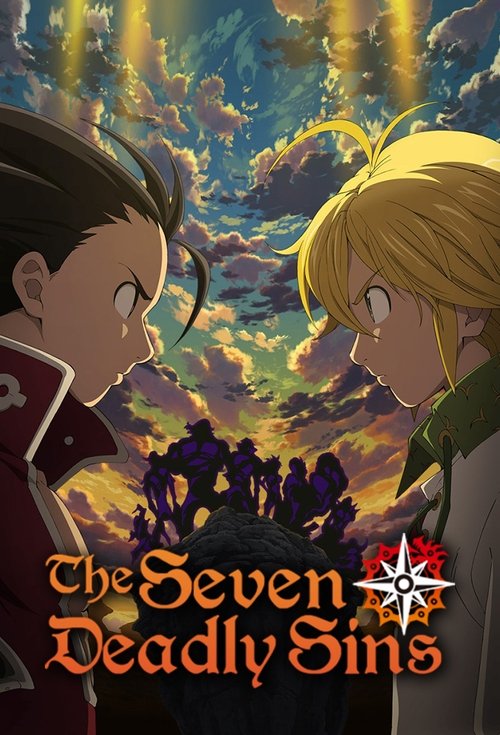
The Seven Deadly Sins
An epic shonen odyssey where disgraced legends battle ancient celestial curses, weaving a vibrant tapestry of forbidden love and thunderous steel across a myth-soaked landscape of eternal redemption and sacrifice.
The Seven Deadly Sins

The Seven Deadly Sins

七つの大罪

05 October 2014 — 23 June 2021 Japan 4 season 96 episode Ended ⭐ 8.4 (5,075)
Cast: Yuki Kaji, Sora Amamiya, Tatsuhisa Suzuki, Misaki Kuno, Aoi Yuuki
Animation Sci-Fi & Fantasy Action & Adventure
Redemption and Atonement Destiny vs. Free Will The Duality of Sin and Virtue Persistence of Love

Overview

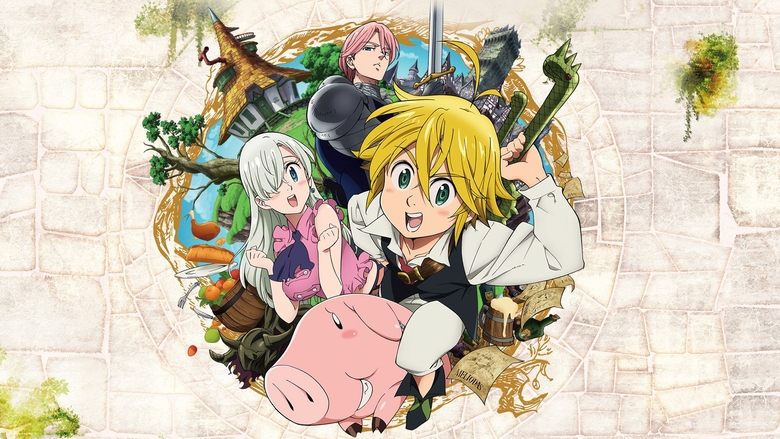
Set in the medieval land of Britannia, The Seven Deadly Sins follows Princess Elizabeth Liones as she seeks out a legendary group of knights who were framed for a coup ten years prior. These knights, each branded with a sin, are the kingdom's only hope against the corrupt Holy Knights who have seized power. The first season establishes the reunion of the group, led by the perpetually youthful and powerful Meliodas, as they liberate Liones and uncover a darker conspiracy lurking beneath the surface.

As the series progresses through its four seasons, the stakes escalate from political internal strife to a cosmic conflict involving the revival of the Demon Clan's elite warriors, the Ten Commandments. The narrative expands to explore the deep-seated histories of the Sins, revealing their connections to the ancient Holy War that occurred three thousand years ago. The story evolves into a race against time to break a tragic cycle of reincarnation and immortality that has bound Meliodas and Elizabeth for millennia.

The final seasons culminate in a clash against the primordial deities of the world—the Demon King and the Supreme Deity. The series balances high-octane battle sequences with intimate character studies, focusing on the bonds of friendship and the endurance of love against fate. It concludes by resolving the long-standing sins of the protagonists, allowing them to finally define their own futures beyond the shadows of their ancestral legacies.
Core Meaning

The core message of The Seven Deadly Sins is that humanity and virtue are not defined by labels or divine judgment, but by the choices made to protect others. The creators use the irony of naming their heroes after 'sins' and their villains after 'holy' titles to suggest that true morality is found in the weight of one's burdens and the willingness to atone. It explores the idea that even the most 'sinful' or 'monstrous' beings are capable of profound love and sacrifice, ultimately asserting that our past mistakes do not determine our worth; rather, it is our persistence in seeking redemption and the strength of our connections that forge our destiny.

Thematic DNA

Redemption and Atonement 35%
Destiny vs. Free Will 25%
The Duality of Sin and Virtue 20%
Persistence of Love 20%

Redemption and Atonement

Throughout the series, each of the Sins must confront the specific tragedy or mistake that earned them their title. Rather than running from their pasts, they use their 'sin' as a source of strength to prevent others from suffering similar fates. This theme develops from individual backstories into a collective effort to atone for the sins of their respective clans during the ancient Holy War.

Destiny vs. Free Will

The central conflict involving Meliodas and Elizabeth is a battle against a preordained cycle of death and rebirth imposed by the gods. The series emphasizes the struggle to break free from 'fate' and the expectations of one's lineage (Demon vs. Goddess) to choose a path based on personal conviction and love.

The Duality of Sin and Virtue

The show consistently subverts traditional moral archetypes. The 'Holy Knights' often act with cruelty and greed, while the 'Deadly Sins' exhibit loyalty, kindness, and self-sacrifice. This recurring theme challenges the audience to look beyond titles and social standing to judge characters by their actions.

Persistence of Love

Love is portrayed as a force capable of spanning millennia and overcoming death. Whether it is the romantic bond between Meliodas and Elizabeth, or the selfless devotion of Ban for Elaine, love acts as the primary motivator that fuels the characters' growth and gives them the power to challenge the divine.

Character Analysis

Meliodas

Yuki Kaji

Archetype: Anti-hero / Tragic Hero
Key Trait: Hidden Depth

Motivation

Initially motivated by a promise to protect Elizabeth, his goal evolves into a desperate mission to break their mutual curses, even if it means sacrificing his own humanity.

Character Arc

Starting as a seemingly carefree tavern owner, Meliodas is revealed to be the cursed son of the Demon King. His arc involves the slow stripping away of his cheerful facade to reveal a man burdened by 3,000 years of watching his beloved die. He eventually accepts his dark heritage not to rule, but to gain the power necessary to destroy the curse once and for all.

Elizabeth Liones

Sora Amamiya

Archetype: The Awakened Heroine
Key Trait: Compassion

Motivation

Driven by a deep sense of justice for her kingdom and a profound, subconscious love for Meliodas that transcends her loss of memory.

Character Arc

She begins as a naive, runaway princess seeking help. As the series progresses, she discovers her identity as the 107th reincarnation of the Goddess Elizabeth. Her development sees her transition from a protected individual to a powerful diplomat and healer who leads the allied forces in the final Holy War.

Ban

Tatsuhisa Suzuki

Archetype: The Lancer / Redeemed Thief
Key Trait: Selflessness

Motivation

His primary drive is the resurrection of Elaine, which eventually matures into a fierce loyalty to Meliodas and the Sins.

Character Arc

Ban starts as a reckless immortal seeking the resurrection of his lover, Elaine. His journey takes him through the depths of Purgatory, where he learns the true value of life and friendship, eventually sacrificing his immortality to save those he loves, proving he is the least 'greedy' member of the team.

Symbols & Motifs

The Ouroboros (Dragon Mark)

Meaning:

Symbolizes infinity and the endless cycle of Meliodas's life and the curse of reincarnation.

Context:

Found on Meliodas's left arm; it represents his status as the Dragon's Sin of Wrath and his 3,000-year struggle to reach an end to his journey.

Sacred Treasures

Meaning:

They symbolize the full potential of a character's spirit and their commitment to their role as a protector.

Context:

Each Sin possesses a unique weapon (like the spear Chastiefol or the hammer Gideon) that amplifies their magic, often requiring them to reach a specific level of emotional maturity or resolve to wield effectively.

The Boar Hat Tavern

Meaning:

A symbol of home, community, and the wandering nature of the outcasts.

Context:

A mobile tavern built on the back of a giant pig (Mama Hawk), serving as the base of operations for the Sins throughout their quest to reunite.

Memorable Quotes

Sate, sate, sate.

— Meliodas

Context:

Used throughout the series as a verbal tick when entering a room or observing a situation.

Meaning:

A catchphrase meaning 'Well, well, well.' It signifies his nonchalant attitude even in the face of immense danger.

I have no reason to feel hatred towards those who are beneath me. All I feel is pity.

— Escanor

Context:

Spoken during his legendary confrontation with Estarossa in Season 2.

Meaning:

Reflects the absolute peak of his pride and power, showing that he views himself as fundamentally superior to all other beings.

Who decided that?

— Escanor

Context:

Used frequently when opponents try to explain why he should be losing a battle.

Meaning:

A challenge to the laws of reality and fate. It asserts that his will is the only thing that defines his limitations.

Episode Highlights

The Seven Deadly Sins

S1E1

The premiere introduces the core dynamic of Meliodas and Elizabeth and establishes the series' signature blend of humor and high-fantasy action.

Significance:

Sets the entire quest in motion and introduces the mystery of the 'Sins' as heroes rather than villains.

Master of the Sun

S2E14

The introduction of Escanor, the final Sin, who reveals a power level that dwarfs even the Ten Commandments.

Significance:

A pivotal shift in the power dynamic of the series, giving the heroes a fighting chance against the demon invasion.

Meliodas vs. The Ten Commandments

S2E19

Meliodas takes on the elite demon force alone in a brutal, heartbreaking struggle that leads to his temporary death.

Significance:

The lowest point for the protagonists, revealing Meliodas's true origins and the terrifying stakes of the conflict.

The Cursed Lovers

S3E9

The full truth of Meliodas and Elizabeth's 3,000-year curse is finally revealed in detail.

Significance:

Reframes the entire series as a tragic love story and explains Meliodas's questionable behavior in earlier seasons.

What the Light Illuminates

S4E24

The final confrontation and the resolution of the main characters' arcs as they move toward a peaceful future.

Significance:

Provides closure for the series and sets the stage for the next generation of Britannia.

Philosophical Questions

Is atonement truly possible for a 'Deadly Sin'?

The series asks if a person is forever defined by their worst moment. It explores this by showing that the Sins' greatest acts of heroism are directly born from the lessons they learned during their deepest failures.

Does immortality drain life of its meaning?

Through Meliodas and Ban, the show examines the weariness of eternal life. It suggests that without the finality of death, relationships and emotions can become stagnant or agonizing, making the 'gift' of eternal life a true curse.

Alternative Interpretations

Some critics suggest the series can be read as a critique of religious dogma, where the 'Goddesses' and 'Holy Knights' represent the corruptive nature of institutionalized virtue, while the 'Sins' represent the messy but honest reality of human experience. Another interpretation viewed through the lens of psychological trauma sees the curses of Meliodas and Elizabeth as metaphors for the inability to move on from past loss, with the final breaking of the curse symbolizing the characters finally achieving emotional closure and 'moving forward' in time.

Cultural Impact

The Seven Deadly Sins was a cornerstone of Netflix's early strategy to acquire exclusive global streaming rights for high-profile anime, helping popularize the 'Netflix Original' anime branding. It stands as one of the best-selling manga series of the 2010s, with over 55 million copies in circulation. Culturally, it is noted for its unique interpretation of Arthurian myth through a shonen lens, blending Western folklore with Eastern storytelling tropes. While the first two seasons received widespread acclaim for their animation and pacing, the series' later years became a major point of discussion in the anime community regarding the impact of studio changes and production quality on a show's legacy. Despite these controversies, the franchise remains a heavy hitter, spawning multiple films and a successful sequel series, Four Knights of the Apocalypse.

Audience Reception

The audience reception of The Seven Deadly Sins is famously divided into two eras. The first two seasons (produced by A-1 Pictures) were met with high praise for their vibrant art, fluid combat, and engaging introduction to the world. However, the shift to Studio Deen for Season 3 (Wrath of the Gods) led to a significant backlash due to a perceived drop in animation quality and art consistency, particularly during the highly anticipated fight between Escanor and Meliodas. Despite these technical criticisms, the fan base remained loyal to the story and characters, with the final season seeing a slight recovery in sentiment as viewers sought closure for the 3,000-year-long epic. Overall, it is remembered as a high-tier shonen adventure with a tragic core that occasionally suffered from its own production hurdles.

Interesting Facts

  • Creator Nakaba Suzuki notably works without assistants, drawing and inking the manga mostly by himself.
  • Most of the characters are named after figures from Arthurian legend, such as King Arthur, Merlin, Meliodas, and Ban.
  • The geography of the land of Britannia is based on an inverted map of the United Kingdom and Ireland.
  • In the original pilot chapter, Meliodas was actually a skilled cook, a complete reversal of his infamously terrible cooking in the series.
  • Each Sin's tattoo represents a specific animal from various cultural mythologies associated with those sins.
  • The series transitioned animation studios from A-1 Pictures to Studio Deen for the final two seasons.

Easter Eggs

Fairy Tail Reference

The symbol of the kingdom of Danafor closely resembles the Phantom Lord guild mark from Hiro Mashima's Fairy Tail, a nod to the friendship between the two authors.

The Seven Sins' Ages

While they look like humans of various ages, most are thousands of years old (Meliodas, Merlin, King), mirroring the 'timeless' nature of the sins they represent.

⚠️ Spoiler Analysis

Click to reveal detailed analysis with spoilers

Frequently Asked Questions

Explore More About This Movie

Dive deeper into specific aspects of the movie with our detailed analysis pages

Comments (0)

Leave a comment

No comments yet. Be the first to share your thoughts!