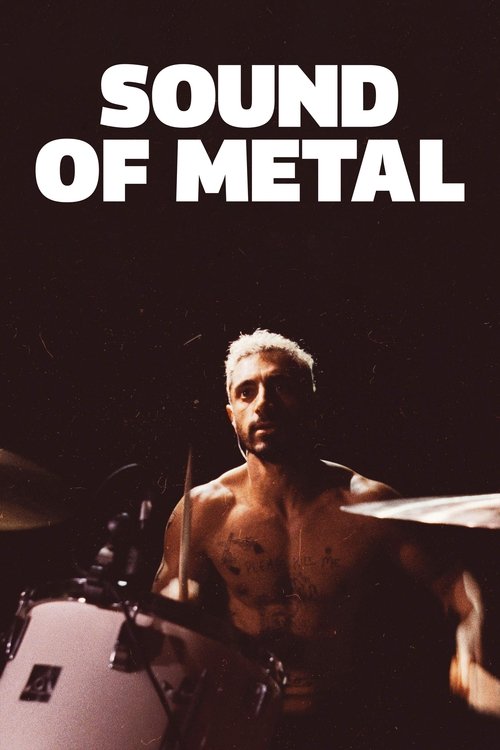
Sound of Metal
An immersive drama about a heavy metal drummer's descent into silence. A visceral journey from the chaos of noise to the serenity of stillness, exploring the painful beauty of accepting what is lost.
Sound of Metal

Sound of Metal

"Music was his world. Then silence revealed a new one."

20 November 2020 United States of America 121 min ⭐ 7.7 (2,752)
Director: Darius Marder
Cast: Riz Ahmed, Olivia Cooke, Paul Raci, Lauren Ridloff, Mathieu Amalric
Drama Music
Acceptance vs. "Fixing" Addiction and Control Stillness as Salvation Identity and Community
Box Office: $516,520

Overview

Ruben Stone is a recovering heroin addict and drummer for the metal duo Blackgammon, living a nomadic life in an RV with his girlfriend and bandmate, Lou. His world is shattered when he suffers sudden, severe hearing loss. Faced with the terrifying prospect of a silent future, Ruben frantically seeks a medical "cure" while struggling to maintain his sobriety.

At the urging of his sponsor, Ruben reluctantly joins a rural shelter for deaf recovering addicts run by Joe, a Vietnam veteran who lost his hearing in the war. Here, Ruben must learn to be deaf, cut off from the outside world and his music. While he begins to connect with the community and find moments of peace, he remains secretly fixated on expensive cochlear implant surgery, viewing his deafness as a temporary problem to be fixed rather than a new reality to be embraced.

The film culminates in a powerful confrontation between Ruben's desire to return to his old life and the undeniable permanence of his condition. After getting the implants and finding their artificial sound alienating, he visits Lou in Paris, only to realize their paths have diverged. In the end, he faces a profound choice between the noise of his past and the stillness of his present.


Core Meaning

The central message of Sound of Metal is that true peace is found not in fixing what is broken, but in accepting things as they are. The film deconstructs the traditional "overcoming disability" narrative, presenting deafness not as a tragedy to be cured, but as a culture and a state of being that offers its own form of grace.

Director Darius Marder uses Ruben's journey to explore the concept of stillness. The noise in Ruben's life isn't just the metal music; it's his constant restlessness and need for control. The film suggests that "God" or spiritual peace is found in the moments when we stop fighting our reality and simply sit with ourselves in silence.

Thematic DNA

Acceptance vs. "Fixing" 40%
Addiction and Control 30%
Stillness as Salvation 20%
Identity and Community 10%

Acceptance vs. "Fixing"

This is the film's central conflict. Ruben initially views his deafness as a medical problem with a financial solution (implants). Joe, conversely, teaches that deafness is not a handicap to be fixed. The film contrasts the medical model of disability with the cultural model, showing Ruben's painful journey from denial to radical acceptance.

Addiction and Control

Ruben's struggle isn't just with drugs; he is addicted to the chaos of his old life and the illusion of control. Joe explicitly points out that Ruben's frantic pursuit of the surgery creates the same behavior patterns as his heroin addiction—deceit, desperation, and an inability to sit still.

Stillness as Salvation

The film posits that inner peace ('The Kingdom of God') is found in stillness. Ruben's task to 'sit' and write is the hardest challenge he faces. The ending validates this theme when Ruben finally removes his processors to embrace the silence, finding the peace he couldn't find in sound.

Identity and Community

Ruben loses his identity as a musician and must find a new one. The film explores how identity is tied to community, contrasting the isolation of the hearing world with the communal, tactile, and expressive nature of the Deaf community.

Character Analysis

Ruben Stone

Riz Ahmed

Archetype: The Tragic Hero / The Seeker
Key Trait: Restless energy

Motivation

To cure his deafness so he can return to his music and save his relationship with Lou.

Character Arc

Starts as a frantic denier trying to claw back his past life. He goes through a 'dark night of the soul' in the deaf community, relapses into the 'fixing' mindset by getting surgery, and finally achieves a spiritual awakening by accepting silence.

Joe

Paul Raci

Archetype: The Mentor / The Sage
Key Trait: Radical acceptance

Motivation

To provide a sanctuary for deaf addicts where they can learn to treat their deafness as a valid way of being, not a defect.

Character Arc

Joe remains a steady, unmoving force. He welcomes Ruben, offers him a path to salvation, and firmly lets him go when Ruben chooses the path of 'fixing.' He serves as the moral compass of the film.

Lou

Olivia Cooke

Archetype: The Lover / The Mirror
Key Trait: Fragile strength

Motivation

Initially to survive with Ruben; later, to find her own peace and heal from her past trauma.

Character Arc

Begins as a codependent partner surviving on the road. After separating from Ruben, she reconnects with her father and discovers her own stability and identity, ultimately outgrowing the relationship.

Symbols & Motifs

The Cochlear Implants

Meaning:

They symbolize the false promise of a return to 'normalcy' and the rejection of one's present reality. They represent a technological attempt to bypass the spiritual work of acceptance.

Context:

The implants are presented as a miracle cure by doctors but result in a distorted, metallic, and alienating soundscape, reinforcing that the old world is gone forever.

The RV (Recreational Vehicle)

Meaning:

Represents Ruben's transient lifestyle, instability, and his 'bubble' of codependency with Lou. It's a cocoon that isolates them from the world.

Context:

Ruben selling the RV to pay for the surgery symbolizes him literally selling his home and stability for a chance to hear again, marking the point of no return.

Morning Pages / Writing

Meaning:

A tool for confrontation with the self. It symbolizes the discipline required to achieve mental stillness.

Context:

Joe assigns Ruben the task of sitting in an empty room and writing everything he feels. If he stops writing, he must sit still. This activity triggers Ruben's rage and eventually leads to his breakthrough.

The Church Bells

Meaning:

A contrast between the harsh, distorted noise of the hearing world and the serene beauty of silence.

Context:

In the final scene, the bells ring with an unbearable metallic screech through Ruben's implants. When he removes them, the bells are silenced (visually implied), and he finds peace.

Memorable Quotes

The world does keep moving, and it can be a damn cruel place. But for me, those moments of stillness, that place, that's the kingdom of God.

— Joe

Context:

Joe says this to Ruben during their final conversation, realizing Ruben hasn't found that stillness yet and is still chasing a cure.

Meaning:

This is the philosophical core of the film. Joe explains that peace isn't found in the external world, but in the internal ability to be still with oneself.

Everyone here shares in the belief that being deaf is not a handicap. Not something to fix.

— Joe

Context:

Joe explains the rules of the shelter to Ruben when he first arrives, setting the boundary that implants and 'fixing' talk are not welcome.

Meaning:

Establishes the fundamental ideology of the community and the central conflict for Ruben.

It's okay. It's okay.

— Ruben

Context:

The emotional farewell scene in the Paris apartment, where Ruben realizes they can no longer be the people they once were.

Meaning:

Signifies Ruben's final acceptance. He is telling Lou it's okay to let him go, but also telling himself it's okay to be deaf and alone.

You're acting like an addict.

— Joe

Context:

When Ruben asks Joe for money to buy back his RV after getting the surgery, Joe confronts him about his frantic behavior.

Meaning:

Highlights the film's parallel between chemical addiction and the addiction to 'fixing' one's life. Ruben's desperate selling of his possessions is framed as addict behavior.

Philosophical Questions

Is peace found in fixing our problems or accepting them?

The film argues that the human drive to 'fix' everything is often a source of suffering. True peace (the 'Kingdom of God') comes from radical acceptance of the present moment, however painful.

What constitutes a disability?

Through Joe's community, the film challenges the medical definition of disability. It suggests that disability is often a social construct and that a 'disabled' community can offer a richer, more connected human experience than the 'abled' world.

Who are we without our primary passion/function?

Ruben defines himself entirely as a drummer. When that is removed, he must face the existential void. The film explores the terrifying but necessary process of ego death and identity reconstruction.

Alternative Interpretations

The Suicide Theory: A minority of viewers interpret the ending, where Ruben sits in stillness, as a precursor to suicide, citing his loss of purpose and disconnection from both worlds. However, most critics and the director view it as a moment of spiritual survival and enlightenment.

The 'Addiction' Metaphor: The entire film can be read not just as a story about deafness, but as a metaphor for the addiction to the past. The 'noise' Ruben hears is the clutter of his ego and his refusal to let go. His deafness forces him to confront the silence he has been running from his whole life.

Cultural Impact

Sound of Metal is a landmark film for Deaf representation in cinema. It moved away from casting hearing actors in deaf roles (mostly), with Paul Raci's casting being particularly celebrated by the Deaf community. The film brought mainstream attention to the 'Deaf Gain' philosophy—the idea that deafness is a form of diversity rather than a deficit.

However, it also sparked debate within the community regarding its portrayal of cochlear implants. Some critics felt the film demonized implants and presented a binary choice (Deaf culture OR implants) that doesn't reflect the complex reality of many deaf people.

Technically, the film set a new standard for sound design, winning the Academy Award for Best Sound. Its use of subjective audio to put hearing audiences 'inside' the experience of deafness was revolutionary.

Audience Reception

Praises: Audiences and critics universally acclaimed Riz Ahmed's raw, transformative performance and Paul Raci's authentic, understated supporting role. The sound design was hailed as a masterpiece of immersion. The film was praised for avoiding the melodramatic tropes of 'inspirational' disability movies.

Criticisms: Some members of the Deaf community criticized the script's negative framing of cochlear implants and the fact that the lead role was played by a hearing actor (though Ahmed was praised for his dedication). Some viewers found the pacing of the middle section at the shelter to be slow.

Verdict: Widely considered one of the best films of 2020, a technical marvel with a profound emotional core.

Interesting Facts

  • Riz Ahmed wore custom-made auditory blockers inside his ear canals that emitted white noise, meaning he truly couldn't hear his own voice or the other actors during filming.
  • The film was shot in chronological order, which is rare. This allowed the actors to experience the emotional journey and character evolution in real-time.
  • Paul Raci, who plays Joe, is a CODA (Child of Deaf Adults) and a Vietnam veteran in real life. He is fluent in ASL and fronts a Black Sabbath tribute band that performs in ASL.
  • Director Darius Marder spent over a decade developing the project, which originally began as a Derek Cianfrance docu-fiction called 'Metalhead' where the band members would play themselves.
  • The sound design team used contact microphones placed inside skulls and helmets to record organic vibrations, mimicking the sensation of hearing sound through bone conduction and the body.
  • Most of the supporting cast in the shelter scenes were hired from the local Deaf community, not professional actors.
  • Riz Ahmed learned to play the drums from scratch for the film, training for months to perform the songs live on set.

Easter Eggs

Ruben's 'Please Kill Me' Tattoo

The tattoo on Ruben's chest references the famous oral history of punk book 'Please Kill Me.' It symbolizes his past self-destructive nature and commitment to the nihilistic punk ethos.

Band T-Shirt Storytelling

Ruben wears specific band shirts that mirror his journey. For example, he wears a 'Youth of Today' hoodie (a straight-edge band) when dealing with addiction, and an 'Einstürzende Neubauten' shirt (a band known for using scrap metal/noise) when contemplating the metallic sound of the implants.

The 'Blackgammon' Band Name

The fictional band name suggests a game of chance and strategy (Backgammon) but darker ('Black'), reflecting the high-stakes, gambling nature of their lifestyle.

⚠️ Spoiler Analysis

Click to reveal detailed analysis with spoilers

Frequently Asked Questions

Explore More About This Movie

Dive deeper into specific aspects of the movie with our detailed analysis pages

Comments (0)

Leave a comment

No comments yet. Be the first to share your thoughts!